
Starting a Service Business Checklist: The Complete Guide
A starting a service business checklist in five phases: offer, pricing, registration, bookings and first clients, with a worked budget and five chapters.

A starting a service business checklist covers five phases: define one service and who it is for, price it so every job makes a profit, make the business official, set up bookings and payments, and win your first ten clients. Work through it in order; most service businesses are ready for paid work in two to four weeks.
Key takeaways
- A service-based business sells time and skill, not stock, so it can start small and cheap. Your price has to cover your time, travel and tools.
- Pick one service for one kind of client first. You can add more once the first one sells.
- Register, separate your money and put your terms in writing before the first paid job, not after the first problem.
- Take a deposit, confirm in writing and invoice on the day. Those three habits protect cash flow from day one.
- Your first clients come from people you already know. Ask directly and make it easy to book.
Who this guide is for
- People turning a skill into a business: cleaners, photographers, consultants, coaches, stylists, tutors, technicians and event planners.
- Side hustlers going full time, in Lagos, Nairobi, London or anywhere else.
- Anyone who wants a checklist and a plan, not a business degree.
If you plan to sell physical products or open a shop, our broader guide on how to start a small business is the better place to begin.
The starting a service business checklist
This is the checklist the rest of the guide explains. Copy it, tick it off as you go, or download the printable version below.
Phase 1: Offer (week 1)
- Choose one service you can deliver well today.
- Name one type of client and the problem you solve for them.
- Write your value proposition in one sentence.
- Talk to five potential clients and ask what they pay today and what annoys them.
- Shortlist three business names and check they are free (see chapter 1).
Phase 2: Money (week 1 to 2)
- List your one-off start-up costs.
- List your monthly running costs.
- Work out your cost per job: time, travel, materials and helpers.
- Set a price per job or package that leaves a profit after every cost.
- Work out how many jobs a month you need to break even.
- Write a one-page business plan (see chapter 2).
Phase 3: Make it official (week 2 to 3)
- Choose a structure: sole trader or business name, or a limited company.
- Register with the official body in your country.
- Register for tax and note your filing dates (see chapter 3).
- Open a separate business bank account.
- Check licences, permits and insurance for your trade.
- Write your terms: deposits, cancellations, payment terms and what is not included.
Phase 4: System (week 3)
- Set up one place for client details, messages and notes.
- Create a booking page or enquiry form with your services and prices.
- Prepare a quote template and an invoice template with your payment details.
- Connect a way to take online payments and deposits.
- Write a client onboarding checklist for what happens after someone says yes.
- Plan a backup for power cuts, a sick day and a lost phone (see chapter 5).
Phase 5: First clients (week 3 to 4)
- Message 30 people you know with a clear offer and a booking link.
- Ask two or three trusted people for an introduction each.
- Set up your Google Business Profile if you serve a local area.
- Deliver the first jobs brilliantly and ask each happy client for a review.
- Follow up every enquiry within a day.
- Review after 30 days: what sold, what it cost, what changes.
Download the printable version
Download the starting a service business checklist (PDF, 10 pages). It has the five phases on one printable page, then a worksheet for each phase: your offer, your costs and your price (with the worked cleaning-business example), making it official, your system, and a tracker for your first 30 messages with a 30-day review. Free, no sign-up.
A worked example: the numbers behind a new service business
These figures are an illustration, not market rates. Use your own.
Kemi is starting a home cleaning service in Lekki, Lagos, with one part-time helper.
One-off start-up costs
| Item | Cost |
|---|---|
| Vacuum, mops, buckets and starter supplies | ₦350,000 |
| Uniforms and branded bags | ₦60,000 |
| Phone and data bundle, first month | ₦25,000 |
| Business registration | Check the current official fee |
| Total before registration | ₦435,000 |
Cost and profit per standard clean
| Amount | |
|---|---|
| Price to client | ₦35,000 |
| Cleaning supplies used | ₦3,000 |
| Transport | ₦4,000 |
| Helper’s pay | ₦10,000 |
| Profit per clean (contribution) | ₦18,000 |
Monthly fixed costs: data ₦15,000, marketing ₦40,000, equipment repairs fund ₦25,000 and insurance ₦15,000, so ₦95,000.
Break-even: ₦95,000 ÷ ₦18,000 = 5.3, so Kemi needs 6 cleans a month before the business pays her anything. At 20 cleans a month she earns 20 × ₦18,000 − ₦95,000 = ₦265,000 for her own time.
The same sums work for a handyman in Manchester: if fixed costs are £600 a month and each job leaves £45 after materials and travel, break-even is 14 jobs a month. Use our free hourly rate calculator to set a rate that covers your time.
Contents: the five chapters
| # | Chapter | What it covers |
|---|---|---|
| 1 | How to Name Your Business: A Small Business Name Generator Method, Rules and 100+ Ideas | Naming rules, availability checks and name ideas by style |
| 2 | Business Plan Checklist: How to Write a Simple Business Plan for a Service Business | A one-page plan and the checklist behind it |
| 3 | Small Business Tax Deductions Checklist: Records and Deadlines | Records, deductions and deadlines |
| 4 | Starting a Photography Business Checklist: How to Book Consistently | Packages, deposits and a calendar that stays full |
| 5 | Business Continuity Plan Checklist for Small Businesses | Keep working through power cuts, illness and lost data |
Chapters publish between 6 and 16 October 2026, and each link works from the day its chapter goes live. Setting up the business, consulting, cleaning and coaching are covered below, with links to the guides we already have on each.
Chapter 1: How to name your business
A good name for a service business does three jobs: it is easy to say on the phone, easy to spell into WhatsApp or a search bar, and it hints at what you do or who you serve. “Kemi’s Clean Homes” sells itself to a busy Lekki household; a clever made-up word needs a marketing budget to explain it.
The chapter walks through naming rules that save you trouble later. Avoid names that tie you to one street if you plan to grow across the city. Avoid spellings people will get wrong. Say it out loud ten times and ask five people to write it down after hearing it once.
Then it covers the checks to run before you print anything, because a name only works if you can use it:
- The official register. In Nigeria, search the Corporate Affairs Commission’s register for business names and companies. In the UK, check Companies House; in the US, your state’s business register.
- A domain name. Check whether the .com, .ng or .co.uk address is free.
- Social handles. Instagram, TikTok, Facebook and WhatsApp Business display names.
- Trademarks in your field, if the name will become valuable.
Never assume a name is free because a web search shows nothing. Registers are the source of truth, and names can be taken between your search and your application, so have two backups ready.
The chapter ends with name ideas grouped by style: descriptive (“Abuja Home Repairs”), founder-led (“Tunde Okafor Photography”), benefit-led (“Spotless in a Day”), and short brandable names. Treat them as starting points, not names you can register as they stand.
Full chapter: How to Name Your Business: A Small Business Name Generator Method, Rules and 100+ Ideas.
Chapter 2: How to write a simple business plan
A service business does not need a 40-page plan. It needs one page that answers six questions honestly, so you can make decisions and show a partner or bank you have thought it through:
- What do you sell? One service, described the way a client would describe it.
- Who buys it? One type of client, with a real example.
- How will they find you? Two channels you will actually use every week.
- What does it cost? One-off costs, monthly costs and cost per job.
- What will you charge? Your price and how many jobs you need to break even.
- What does success look like in 90 days? A number of clients and a monthly income.
The chapter includes a checklist for each section, and the worked example above shows the money section in practice. It also covers the mistakes that make plans useless: guessing prices without asking clients, leaving out your own pay, and planning for ten channels when you have time for two.
If you need a fuller document for a loan or a grant, our free business plan template gives you the sections lenders expect. Start with the one-page version anyway; the long plan is easier to write once the short one is clear.
Keep the plan where you will see it. Review it at the end of every month for the first six months, and change it when real clients tell you something your guesses did not.
Full chapter: Business Plan Checklist: How to Write a Simple Business Plan for a Service Business.
New business setup: registration, banking, tools and systems
This is the practical admin list: registration, banking, tools and systems. It is the part most people put off and then rush.
Registration. Decide between trading under your own name or a registered business name, and a limited company. A limited company separates your personal assets from the business but adds filing work. Rules differ by country. In the UK, GOV.UK says you must register for Self Assessment as a sole trader if you earn more than £1,000 in a tax year (checked on 1 October 2026). In the US, the SBA’s 10 steps to start your business covers structures and registration. In Nigeria, the Corporate Affairs Commission registers business names and companies, and our post on how to register a business in Nigeria walks through it step by step.
Banking. Open a separate business account as soon as you are registered, so business income and spending never mix with personal money. It makes tax, pricing and getting a loan far easier.
Tools and systems. A service business needs a small set of tools from day one: a client list, a booking page or enquiry form, quotes and invoices, a way to take payments, and a calendar. Then write down the terms that prevent most disputes: what is included, deposits, cancellations and when payment is due. Our guide to how much deposit to charge clients helps with the first one.
Insurance and licences. Some trades need a licence or certification; most benefit from public liability insurance once you work in clients’ homes or premises.
For registration step by step, the “make it official” chapter of our guide on how to start a small business goes into more detail.
Chapter 3: Small business tax checklist
Tax is where new service businesses most often get caught out, not because the rules are hard, but because records are missing when the deadline arrives.
A tax checklist has three parts:
- Records. Keep every invoice you send and every receipt for what you spend, in one place, from the first job. Note the date, client or supplier, amount and what it was for.
- Deductions. Learn which costs your country lets you deduct, such as equipment, transport to jobs, data, software and a share of home costs if you work from home. Keep proof for each.
- Deadlines. Write your registration date, filing dates and payment dates into your calendar on the day you register.
Tax rules change, and they differ between Nigeria, the UK, the US and everywhere else, so check your tax authority’s own pages rather than rates quoted on a blog. Know when to hire an accountant too: usually once you employ staff, register for a sales tax such as VAT, or form a limited company.
For the basics in plain language now, read our existing guide to small business taxes for beginners.
The habit that matters most is simple: send every invoice from one system and record every expense the week you pay it. At the end of the year, the numbers are already there, and you spend an afternoon on your return instead of a stressful week digging through bank alerts and WhatsApp receipts.
Full chapter: Small Business Tax Deductions Checklist: Records and Deadlines.
Starting a consulting business
Consulting is one of the cheapest service businesses to start and one of the hardest to grow, because you are selling expertise that clients cannot see before they buy.
Here is the starting a service business checklist applied to consulting:
- Niche. “Operations consultant” is too broad. “Helping Lagos logistics companies with 20 to 100 riders cut delivery delays” gets meetings.
- Packages. Turn hours into fixed-price packages: a diagnostic, a project and a monthly retainer. Fixed prices are easier to buy and protect you from endless scope.
- Pricing. Work back from the income you need and the days you can bill, then check the price against the value of the problem you solve.
- Proof. One detailed case study from past employment or a discounted pilot is worth more than a long CV.
- First clients. Your former colleagues, managers and suppliers are your first market.
Then put the paperwork that protects consultants in place: a proposal, a statement of work, and clear payment terms with a deposit before work starts. Our guide to writing a business proposal is a good companion.
A useful test before you launch: can you name ten people who could hire you, or introduce you to someone who could, in the next three months? If not, narrow the niche until you can.
Our guide on how to start a consulting business covers the topic in depth.
Starting a cleaning business
Cleaning businesses start fast and fill calendars quickly, but margins disappear if pricing, travel and staff time are not controlled from day one.
What to sort out first:
- Choosing a market. Homes, offices, short-let apartments or end-of-tenancy cleans. Each has different prices, hours and expectations.
- Licences and insurance. What to check in your area, and why insurance matters the first time something breaks in a client’s home.
- Pricing. By room, by hour or by package, with the cost-per-clean method from the worked example above.
- Scheduling. Grouping jobs by area to cut travel, which in Lagos traffic can decide whether a day makes money.
- Staff. When to hire your first cleaner, how to train to a checklist and how to check quality.
- Repeat clients. Weekly and fortnightly cleans are the heart of a stable cleaning business.
For the first month, a simple launch plan works: a starter offer for neighbours and friends, a booking page with fixed prices and a simple review request after every clean.
One pricing point matters more than the rest: quote end-of-tenancy and deep cleans separately from regular cleans. They take two or three times as long, and a flat “per visit” price that ignores this is the fastest way to work a full week and make nothing. The cost-per-clean table above works for both; only the hours and supplies change.
Our guide on how to start a cleaning business covers setup, pricing and scheduling in depth.
Chapter 4: How to start a photography business that books consistently
Most photographers are good at photography. The ones who earn a steady income are good at booking. This section is about the business side.
Start by choosing a focus: weddings and events, portraits, products for online sellers, or corporate headshots. Each has a different buying cycle. Weddings are booked months ahead with large deposits; product shoots are booked days ahead and repeat monthly.
Then build the system that keeps a calendar full:
- Packages with clear prices. Three options, with what is included and how many edited images.
- Deposits. A non-refundable deposit to hold the date, and the balance due before delivery.
- A booking page. Let clients choose a package and a date and pay the deposit in one go, instead of ten WhatsApp messages.
- Contracts. Usage rights, delivery times, cancellation and what happens if it rains.
- Repeat and referral work. Follow up after delivery, ask for reviews and offer anniversary or seasonal sessions.
Note your busy and quiet months in the first year, so you can plan promotions for the slow months before they arrive. Be strict with gear: buy what you use every week, rent the rest, and remember that a second camera body matters more than a fifth lens. Then keep a simple weekly routine for the business side: answer every enquiry within a day, send galleries on the promised date and post one piece of recent work.
Full chapter: Starting a Photography Business Checklist: How to Book Consistently.
Starting a coaching business
Coaching has almost no start-up cost, which is why the market is crowded. The coaches who build a business pick a clear outcome and sell it as a programme, not by the hour.
What to decide first:
- Offer. Who you help and what changes for them: “career coaching for mid-level bankers moving into tech” is easier to buy than “life coaching”.
- Format. One-to-one sessions, small groups or a mix, and how many sessions a programme needs.
- Pricing. Programme prices instead of hourly rates, with instalments where that helps clients commit.
- First clients. Free discovery calls with a clear next step, talks in communities your clients belong to, and referrals from your first five clients.
- Agreements. What coaching includes and excludes, confidentiality, rescheduling and refunds.
Then plan delivery: booking sessions without back-and-forth, keeping notes between sessions and following up so clients finish the programme. Clients who finish get results, and clients with results refer friends.
The discovery call deserves the most practice, because it is where most coaching sales are won or lost. A simple 20-minute structure works: ask where the client is now, where they want to be, what they have tried and what it costs them to stay stuck, then describe your programme and its price plainly and ask whether they want to start.
Our guide on how to start a coaching business covers the topic in depth.
Chapter 5: Business continuity plan checklist
A service business is often one person and one phone. If either stops working, so does the income. A business continuity plan is a short written answer to “what happens if…?”
Here is a checklist for the risks small service businesses actually face:
- Power and internet. Power cuts are part of daily life for many Nigerian businesses. Plan backup power for your phone and laptop, a second data line from a different network, and offline copies of the day’s bookings.
- Illness or emergencies. Who can cover jobs, or at least message clients, if you cannot work for a week?
- Lost or stolen phone. Client numbers, messages and photos should live in a cloud account, not only on the handset.
- Data loss. Back up invoices, contracts and client records automatically.
- Key supplier or staff member leaving. Write down how the work is done, so someone else can pick it up.
- Cash shocks. Keep at least one month of fixed costs in reserve, and know which clients you can call for advance bookings.
Turn each item into one action you can finish in under an hour, write the answers on a single page, and test the plan twice a year.
A quick example of why it matters: a photographer in Ibadan whose phone is stolen the week before a wedding can still reach the couple, the venue and her second shooter if her contacts, contract and timeline live in a cloud account. Without that, she spends the week rebuilding numbers from old WhatsApp groups instead of preparing for the job.
Full chapter: Business Continuity Plan Checklist for Small Businesses.
Mistakes that sink new service businesses
Most new service businesses that struggle in their first year make the same handful of mistakes. None of them needs money to fix, only a decision made early.
- Copying a competitor’s price. Their costs, travel and hours are not yours. Work out your own cost per job first, then compare.
- Working without a deposit. A client who has paid nothing can cancel the night before at no cost to them, and you lose the day. Take a deposit for any job that blocks out time.
- Agreeing terms on a phone call. If it is not written down, the client remembers it differently. Send a short written confirmation of what is included, the price and when payment is due.
- Mixing business and personal money. You cannot see whether the business makes a profit when its money sits in your personal account.
- Saying yes to every kind of job. A cleaner who also does laundry, errands and painting is hard to recommend. Be known for one thing first.
- Forgetting travel time. An hour in traffic each way can halve what a job really pays. Count it in the price, or group jobs by area.
Tools you’ll need
You can start a service business with a phone and a notebook, but the notebook stops working at about ten clients. These are the startbuddi modules that support each phase of the checklist. A free plan is available; see pricing for what each plan includes.
| Phase | What you need | startbuddi module |
|---|---|---|
| Offer | A page or form that describes your service | Publish (pages) and Forms |
| Money | Quotes, invoices, payment links and expense tracking | Money Manager |
| Make it official | Contracts and agreements with e-signatures | Documents |
| System | Client records, messages and a booking page with deposits | Customers and Bookings |
| First clients | Follow-ups and delivery checklists | Customers and Work |
Customers (CRM). One record per client with their details, messages and history. WhatsApp, email, Instagram and website chat land in one inbox.
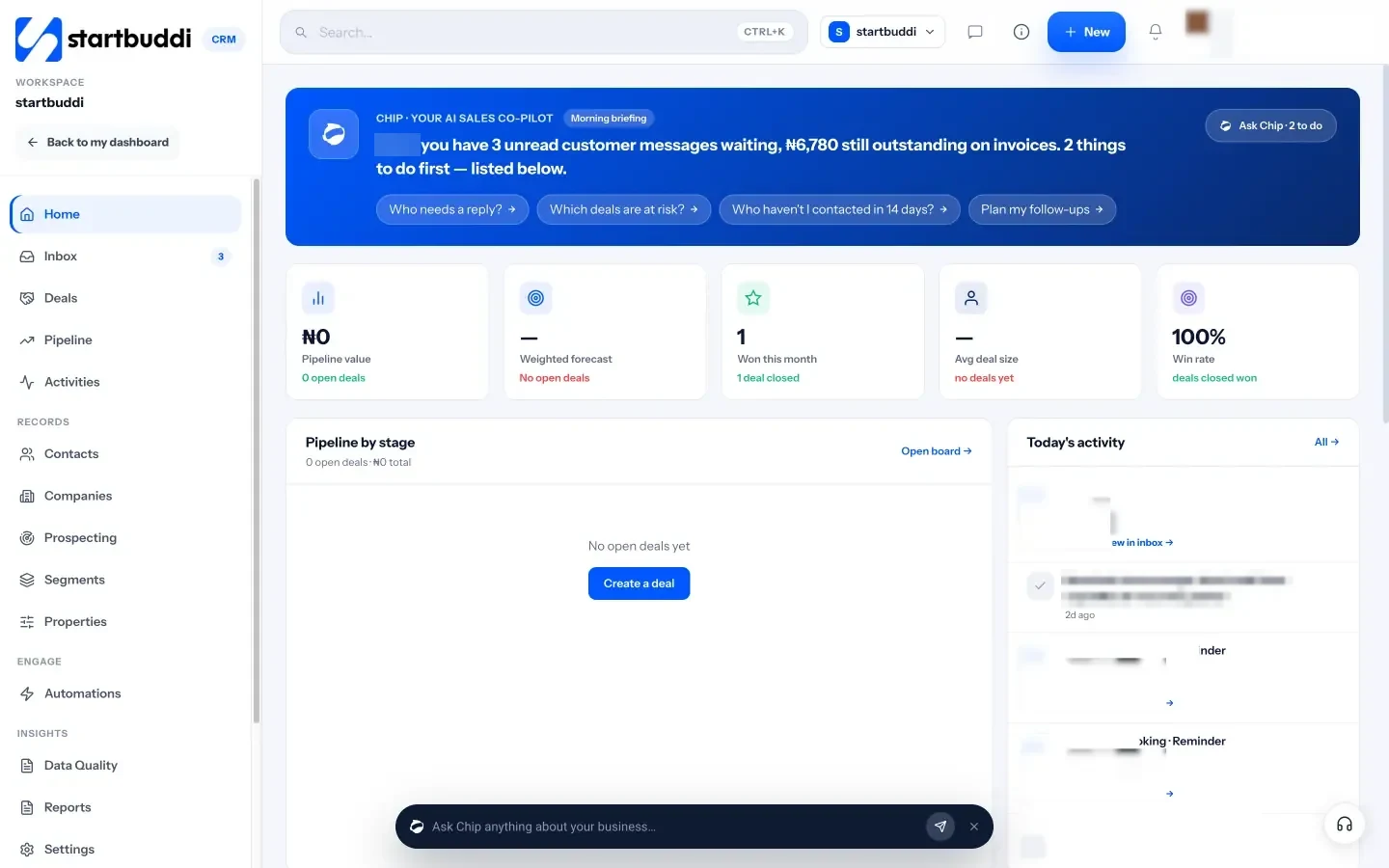
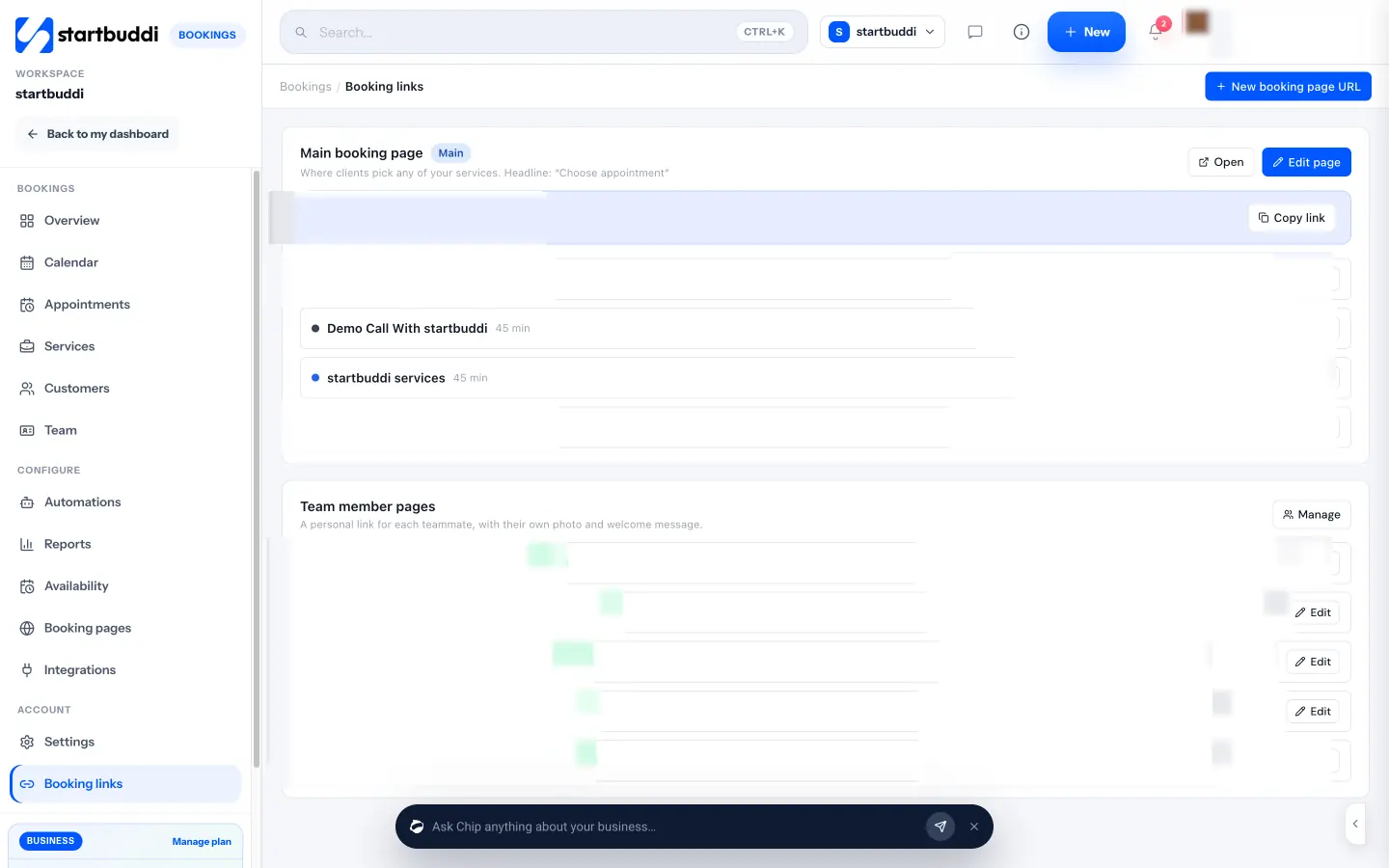
Bookings. A booking page with your services and prices, reminder emails, and the option to take a deposit through Paystack or Stripe when a client books.
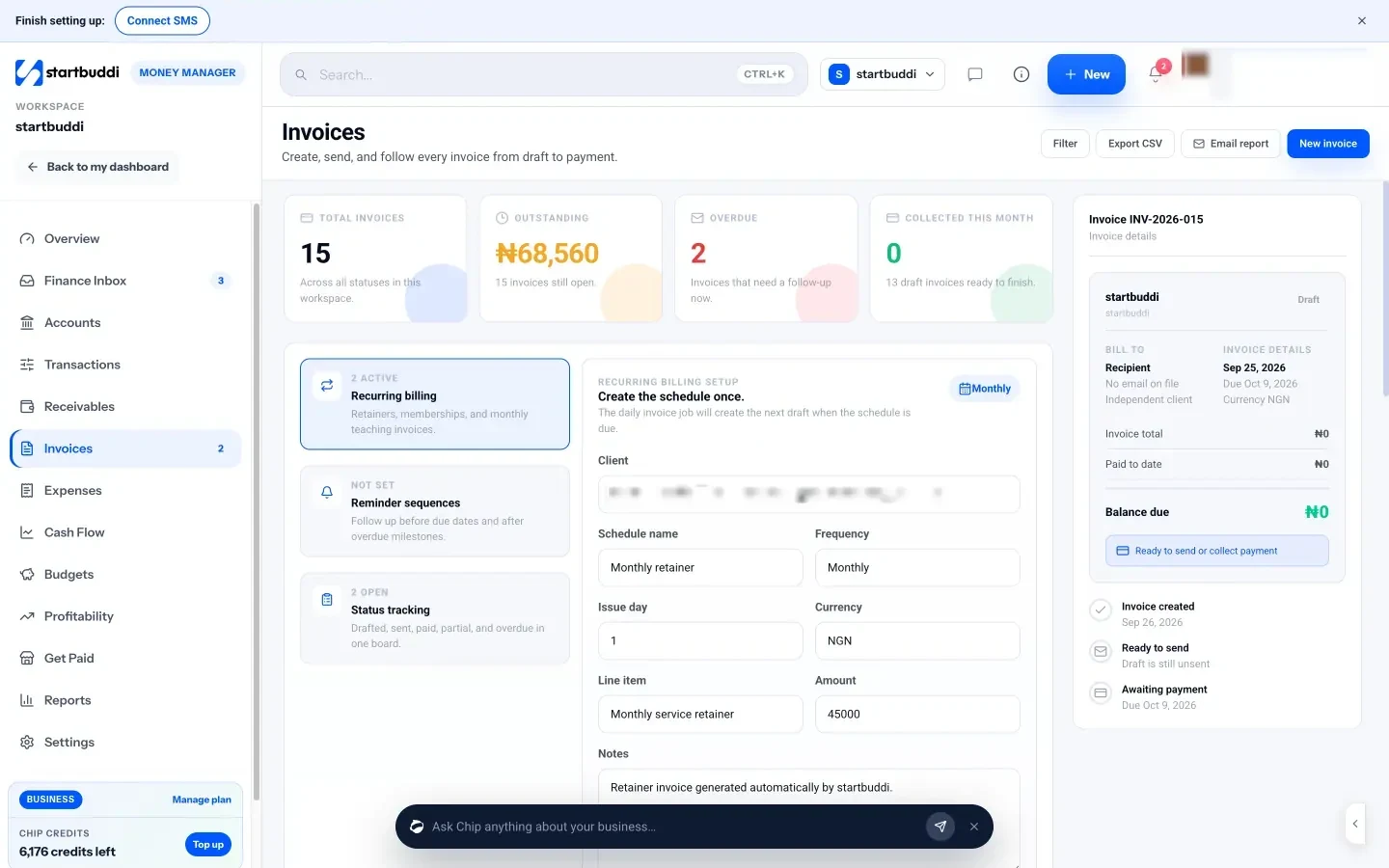
Money Manager. Estimates that turn into invoices, payment links and a view of what is paid and what is owed.
Work. Projects and tasks with subtasks, so your client onboarding checklist runs the same way every time. Our guide to onboarding a new client has a checklist to start from.
Chip, startbuddi’s AI assistant, sits on every screen to draft replies, follow-ups and documents, and on higher plans it can answer website chat and messages while you are on a job. Onboarding is guided: every page has built-in guides, and you can call a voice agent for a walkthrough of any feature.
Frequently asked questions
What do I need to start a service business?
You need a service people will pay for, a price that covers your costs and time, the right registration for your country, a separate bank account, simple written terms and a way to take bookings and payments. Most service businesses need very little equipment to start.
How much does it cost to start a service business?
It depends on the service. A consultant or coach can start with a laptop and a phone, while a cleaning or photography business needs equipment. List your one-off and monthly costs, add a buffer of at least one month of fixed costs, and cut anything you do not need for your first ten clients.
What is the first step in starting a service business?
Choose one service and one type of client, then talk to five potential clients before spending money. Their answers tell you what to offer, what to charge and how to describe it.
Do I need to register my service business before I start?
Rules vary by country. In the UK you must register for Self Assessment once self-employed income passes £1,000 in a tax year, and in Nigeria business names and companies are registered with the Corporate Affairs Commission. Registering early also makes banking and invoicing easier.
How do I price my services when I am starting out?
Work out your cost per job, including time, travel, materials and helpers, then add the profit you need. Check the result against what clients pay today. Our guide to pricing strategy for small business goes further.
How do I get my first clients for a service business?
Start with people who already know you: message 30 contacts with a clear offer and a booking link, and ask a few for introductions. Deliver well and ask for reviews. Our guide on how to get clients for a service business covers the next steps.
Start your service business with a system from day one
Work through the checklist above, then set up your client list, booking page and invoices in one place. Start startbuddi free and have your booking page ready before your first client asks.
Tiwalade Joanna Okedara-Kalu is the founder, CEO and CTO of startbuddi, the business system that brings clients, bookings, invoices, projects, marketing and the Chip AI assistant into one place. Tiwalade builds software around how service businesses really work day to day, and writes about client management, getting paid on time and why small businesses outgrow the tools they start with.
Founded startbuddi and leads its product and engineering