What are payment terms? Net 30 and other terms explained
Also called: Terms of payment, invoice terms, credit terms, net 30, net 15, due on receipt
Payment terms are the conditions you set for how and when a customer must pay, such as the due date (for example net 30, meaning within 30 days of the invoice), deposits, accepted payment methods, early-payment discounts and late fees.
Payment terms are the rules you set for how and when a customer pays you. They answer four questions: when is the money due, how much is due upfront, how can they pay, and what happens if they pay late. So what are payment terms in practice? They are the short lines on your quote and invoice, like “Net 30” or “50% deposit, balance due on completion”, that decide how quickly cash reaches your bank.
Terms are agreed before the work starts, usually in your quote or contract, then repeated on every invoice.
What are payment terms made of?
- Due date: how long the customer has to pay.
- Deposit or upfront payment: how much is paid before you start.
- Staged payments: for bigger projects, payments at agreed milestones.
- Payment methods: bank transfer, card, mobile money, payment link.
- Early-payment discount: an optional reward for paying fast.
- Late payment: interest or a late payment fee, if you charge one and the law allows it.
Common payment terms and what they mean
| Term | Meaning |
|---|---|
| Due on receipt | Pay as soon as the invoice arrives. |
| Net 7 / Net 14 | Pay within 7 or 14 days of the invoice date. |
| Net 30 | Pay within 30 days of the invoice date. Very common between businesses. |
| Net 60 / Net 90 | Pay within 60 or 90 days. Often requested by large companies. |
| 2/10 net 30 | Take 2% off if paid within 10 days; otherwise the full amount is due within 30 days. |
| EOM (end of month) | Pay by the end of the month the invoice is dated. |
| 50% upfront | Half before work starts, the rest on completion. |
| CIA / CWO | Cash in advance / cash with order: pay before anything is supplied. |
How to choose your payment terms
- Start short. Freelancers and small service businesses usually do better with 7 or 14 days than 30. The longer the term, the longer you finance your customer.
- Take deposits on bigger jobs. 30 to 50% upfront covers your costs and filters out customers who are not serious. Our guide on how much deposit to charge helps you pick a number.
- Match the customer. Individuals often pay on the day. Large companies may insist on net 30 or longer; price that in.
- Stage long projects. A three-month project billed only at the end is a three-month loan.
- Make paying easy. A pay button on the invoice removes excuses.
- Be the same for everyone. One standard set of terms for new customers is easier to explain and enforce. Make exceptions on purpose, for a reason you can name, and write them down.
Example wording
Put your terms in plain words on the quote and the invoice:
Payment terms: 50% deposit to book, balance due within 14 days of the invoice date. Pay by card using the link on this invoice or by bank transfer to the account shown. Please quote the invoice number as the reference.
See it in your own workspaceThis is built into startbuddi, connected to your clients, projects and invoices.Explore the workspace
For a business customer on longer terms:
Payment terms: net 30 from the invoice date. Please include PO number 4471 with your payment.
A worked example
Musa, a web developer in Kano, used to invoice ₦900,000 at the end of each project with “net 30”. Money often arrived 45 days after he finished. He switched to 40% upfront, 40% at the design sign-off and 20% within 7 days of launch. On the same project he now has ₦360,000 before he writes a line of code, and the last ₦180,000 is due a week after launch instead of a month.
Common mistakes
- No terms at all. “Please pay” with no date is treated as “whenever”.
- Terms only on the invoice. Agree them in the quote or contract first so the invoice is no surprise.
- Offering long terms by habit. Only give 30 days if the customer needs it.
- Not following up on the due date. Terms without reminders do little. See automated payment reminders.
Payment terms in startbuddi
In Money Manager, Settings has an Invoice defaults tab where you choose default due days of 7, 14, 21 or 30, along with your invoice prefix, tax rate and footer. Each invoice then shows its issue date and due date, and the notes and footer field holds your written terms and bank details. Customers can pay by card through Paystack or Stripe, or by the bank transfer details on the invoice.
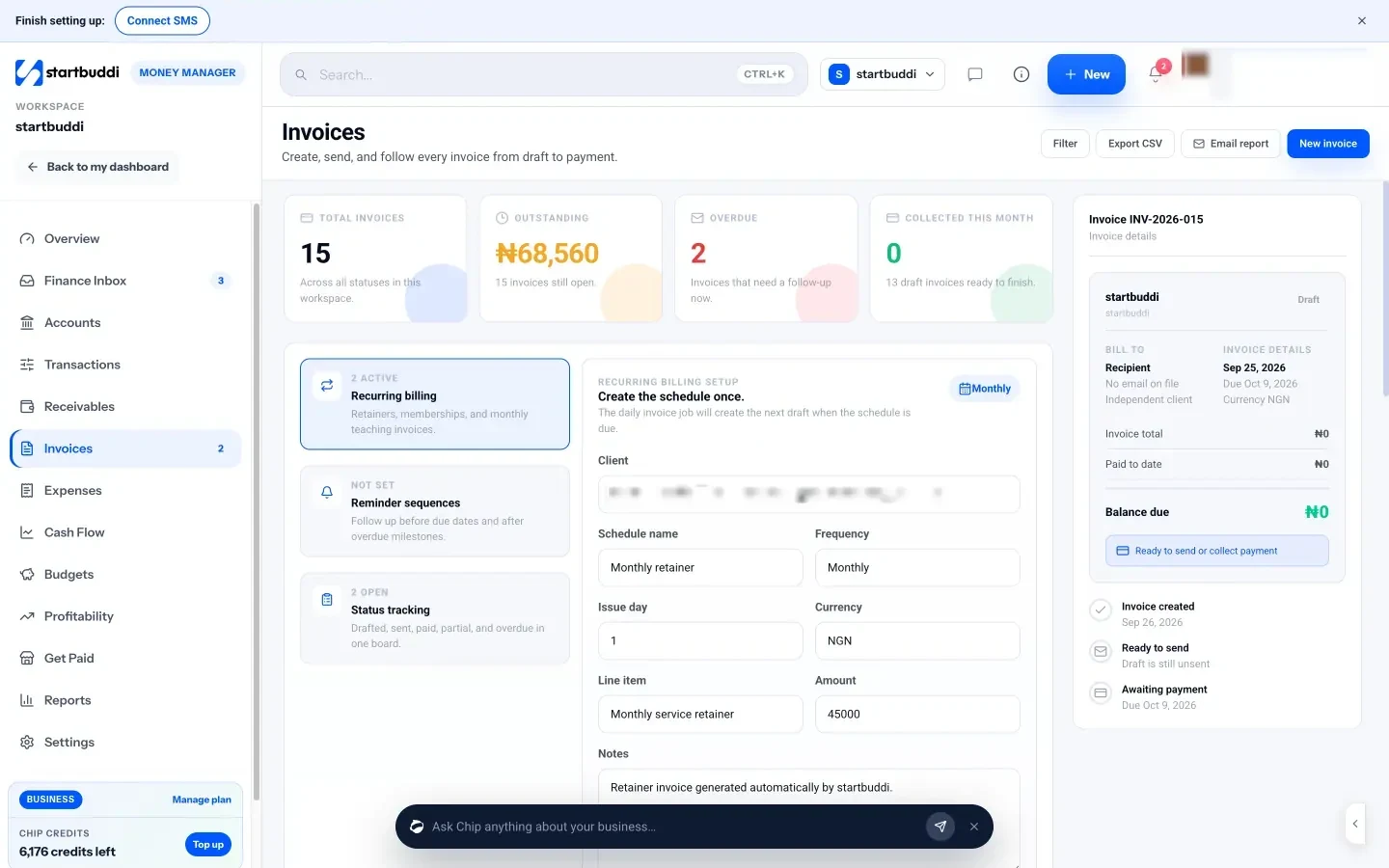
Estimates carry the same notes and terms field, so deposit terms are agreed before the work starts, and Get Paid can create a payment link for a deposit. Your next step: choose one standard set of terms for new customers, write it in two sentences, and add it to your invoice defaults today.
Related terms
FAQ
What does net 30 mean?
Net 30 means the full invoice amount is due within 30 days of the invoice date. Net 15 or net 60 work the same way with different numbers of days.
What are standard payment terms for a small business?
Many small service businesses use 7 or 14 days, often with a deposit for larger jobs. Net 30 is common between businesses. Choose the shortest terms your customers will accept.
What does 2/10 net 30 mean?
The customer can take a 2% discount if they pay within 10 days. Otherwise the full amount is due within 30 days.
Can I change payment terms for an existing client?
Yes, but tell them in advance and apply the new terms to new work, not invoices already sent. Put the change in writing.
Tiwalade Joanna Okedara-Kalu is the founder, CEO and CTO of startbuddi, the business system that brings clients, bookings, invoices, projects, marketing and the Chip AI assistant into one place. Tiwalade builds software around how service businesses really work day to day, and writes about client management, getting paid on time and why small businesses outgrow the tools they start with.
Founded startbuddi and leads its product and engineering