What is accounts receivable?
Also called: AR, receivables, trade receivables, debtors, money owed to you, outstanding invoices
Accounts receivable (AR) is the money your customers owe you for goods or services you have already delivered but have not been paid for yet, usually tracked as unpaid invoices.
Accounts receivable (AR) is the money your customers owe you for work you have already done or goods you have already delivered. Every unpaid invoice you have sent is part of your accounts receivable. So what is accounts receivable in plain words? It is your list of “who owes me, how much, and since when”.
In accounting, receivables count as an asset: money that belongs to you but has not reached your bank yet. The catch is that you cannot pay rent or wages with it until it arrives.
What is accounts receivable and why does it matter?
Most service businesses work on credit without calling it that. You finish the job, send an invoice with 14 or 30 days to pay, and wait. During that wait, you have effectively lent your customer the money.
- Cash flow. A business can be busy and profitable and still run short of cash because too much is sitting in receivables.
- Risk. The older an invoice gets, the less likely it is to be paid in full.
- Planning. Knowing what is due in the next 30 days tells you what you can afford to spend.
How accounts receivable works: an example
Chloe runs a small marketing agency in Manchester. On 1 March she has these unpaid invoices:
| Client | Invoice date | Amount | Status |
|---|---|---|---|
| Café group | 20 February | £2,400 | Due in 9 days |
| Law firm | 1 February | £3,000 | Due today |
| Gym chain | 10 January | £1,800 | 20 days overdue |
| Online shop | 1 December | £900 | 60 days overdue |
Her clients are on different terms, and her accounts receivable is £8,100. Only £2,400 is “healthy” (not yet due). The rest needs action today, and the £900 from December needs a firmer conversation. When each client pays, that invoice leaves receivables and the money moves into her bank balance.
Key parts of accounts receivable
Payment terms
How long customers have to pay, such as “due on receipt” or “net 30”. Clear payment terms on every invoice are the first step to getting paid on time.
The ageing report
An ageing report groups what you are owed by how late it is: current, 1 to 30 days overdue, 31 to 60, 61 to 90 and over 90. It shows at a glance where the risk sits.
Days to pay
The average number of days customers take to pay. A common version is days sales outstanding (DSO): receivables ÷ credit sales for the period × days in the period. If Chloe has £8,100 owed and invoiced £12,000 over the last 30 days, her DSO is about 20 days. Watch the trend: rising days to pay is an early warning.
Collections
The routine of reminding, following up and, where needed, escalating. See our entry on automated payment reminders.
Accounts receivable vs accounts payable
Receivables are money owed to you. Accounts payable is money you owe to suppliers. A healthy small business tries to collect receivables quickly and pay its own bills on time, but not early unless there is a discount.
How to reduce accounts receivable
- Invoice the same day the work is done. Late invoices get paid late.
- Take deposits on larger jobs, so less of the total is ever at risk.
- Make paying easy with a pay button, card and bank transfer options on the invoice.
- Send reminders before and after the due date, politely and on a schedule.
- Call early when an invoice is 7 to 14 days late. A friendly call often solves a problem that ten emails would not.
- Know when to stop work. Pausing new work for a client with old unpaid invoices protects you.
Our guide on how to get invoices paid faster goes into each step.
Common mistakes
- Tracking receivables in your head. You will forget someone, usually the biggest one.
- Waiting too long to chase. The longer an invoice sits, the harder it is to collect.
- Vague invoices. Missing due dates, purchase order numbers or bank details give customers a reason to delay.
- Counting receivables as cash. Plan spending on money received, not money owed.
Accounts receivable in startbuddi
Money Manager has a Receivables page, described in the app as “See who owes you, what is due soon, and what needs follow-up.” Stat cards show outstanding, overdue, due in 7 days, collected this month and average days to pay. Tabs split invoices into all, due soon, overdue, partially paid, paid and drafts, and each open invoice has a one-click Remind button. Chip suggests which invoice to chase first and can draft a personal reminder.
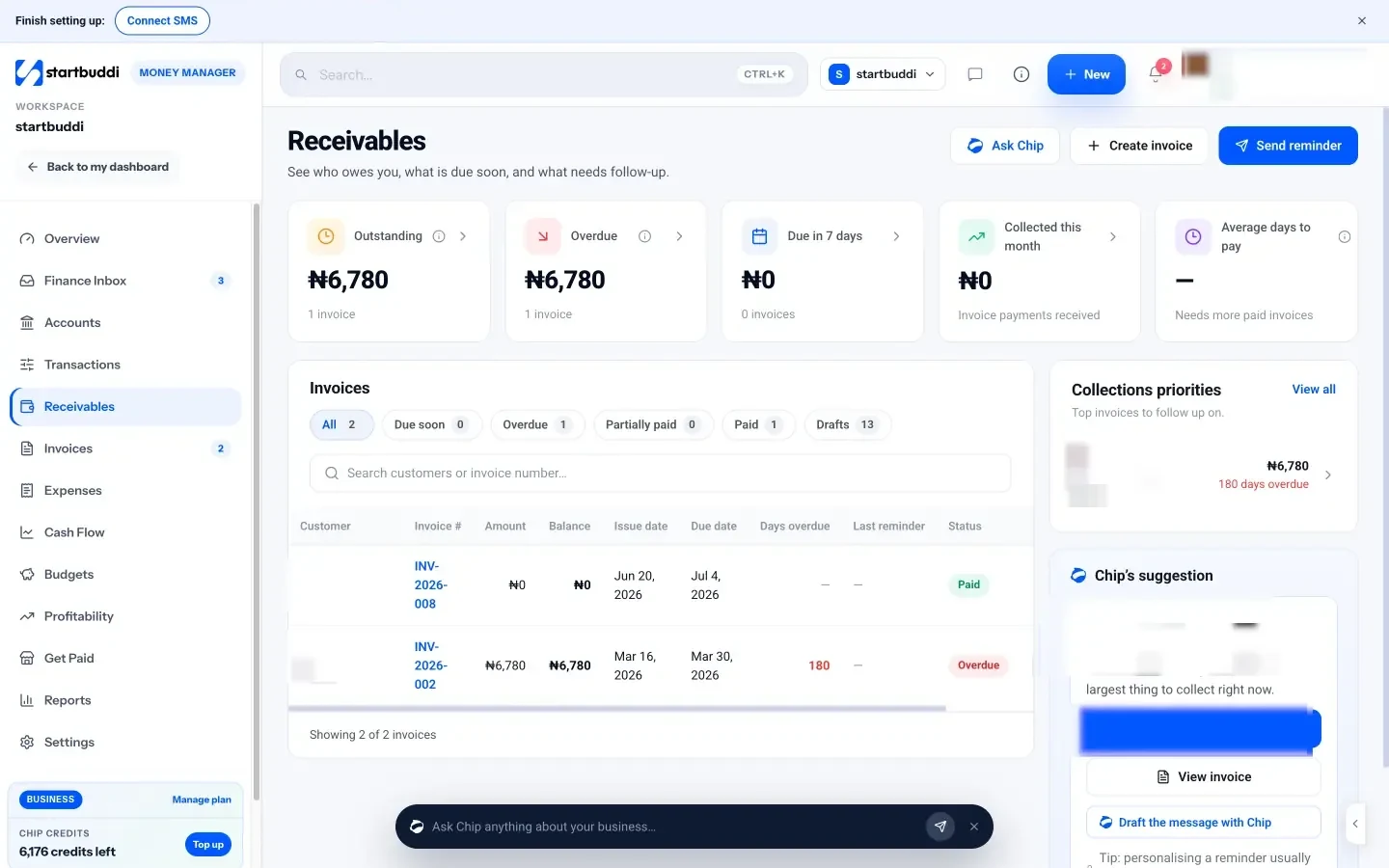
Invoices carry a pay button through Paystack or Stripe, plus bank transfer details, and when money arrives another way you record the payment against the invoice. The Reports page includes a receivables ageing view. Your next step: list every unpaid invoice with its due date, then send one friendly reminder today for anything past due. This help article shows how to send your first invoice in startbuddi.
Related terms
FAQ
Is accounts receivable an asset or a liability?
An asset. It is money owed to your business. Accounts payable, the money you owe others, is the liability.
What is a good number of days to get paid?
It depends on your terms and industry. Compare your average days to pay with the terms on your invoices: if you offer 14 days and customers take 40, you have a collections problem.
What is an accounts receivable ageing report?
A table that groups unpaid invoices by how late they are, such as current, 1 to 30 days, 31 to 60 days and over 90 days, so you can see which debts need attention first.
Do I need accounts receivable if I use cash accounting?
You still need to know who owes you money, even if your tax records only count income when it arrives. Tracking unpaid invoices is about cash flow as much as accounting.
Tiwalade Joanna Okedara-Kalu is the founder, CEO and CTO of startbuddi, the business system that brings clients, bookings, invoices, projects, marketing and the Chip AI assistant into one place. Tiwalade builds software around how service businesses really work day to day, and writes about client management, getting paid on time and why small businesses outgrow the tools they start with.
Founded startbuddi and leads its product and engineering