What is an invoice?
Also called: Bill, sales invoice, tax invoice, payment request
An invoice is a dated document a seller sends a buyer asking for payment. It lists what was sold, how much is owed, when it's due and how to pay, and it becomes part of both businesses' financial records.
What is an invoice? An invoice is a document you send a customer asking them to pay for something you’ve sold or a job you’ve done. It says what they bought, how much they owe, when payment is due and how to pay. Once sent, it’s also a record: it shows you made a sale and that money is owed to you.
In everyday speech people call it a bill. If you’ve ever sent a WhatsApp message saying “₦50,000 for the logo, please pay into this account”, you’ve sent an informal invoice. A proper one just puts those details in a clear, numbered format that both sides can file.
Why invoices matter for a small business
For a freelancer or small business, invoices do three jobs at once.
- They get you paid. A clear invoice with a due date and an easy way to pay removes excuses for delay.
- They keep your records straight. Every invoice is proof of income. Together they show what you’ve earned and who still owes you.
- They make you look established. Business clients often can’t pay without a proper invoice, because their own accounts team needs one.
Invoices also matter for tax. If you’re registered for VAT, your invoices usually need extra details. The UK government, for example, sets out what an invoice must include, and in Nigeria you can check current rules with the Nigeria Revenue Service. This is general information, not tax advice.
How an invoice works: a simple example
Kemi runs a small catering business. She caters a 60-guest birthday party.
- Before the event she sends an estimate, which the client accepts.
- After the event she sends invoice number INV-017: “Catering for 60 guests, 3-course menu, ₦540,000. Service staff, ₦60,000. Total ₦600,000. Due in 7 days.” It includes a pay-online link and her bank details.
- The client pays by card through the link. The invoice changes to paid, and Kemi has a clean record of the sale.
If the client doesn’t pay by the due date, the invoice becomes overdue, and Kemi sends a polite reminder that references the invoice number.
What goes on an invoice
Most invoices include:
- A unique invoice number, in sequence, so no two invoices share one
- The invoice date and, where relevant, the date the work was done
- Your details: business name, address and contact information
- Your customer’s details: name or company name and address
- Line items: a clear description of each product or service, with quantity and price
- Subtotal, tax and discount, if any, and the total due
- Payment terms: the due date, such as “due in 14 days”
- How to pay: a payment link, bank transfer details or both
Types of invoice
| Type | What it’s for |
|---|---|
| Standard invoice | A one-off bill for goods or services already delivered |
| Recurring invoice | The same bill sent on a schedule, such as a monthly retainer |
| Deposit or upfront invoice | Asks for part of the price before work starts |
| Final invoice | Bills the balance once the job is complete |
| Pro forma invoice | A preview of the bill before the sale is confirmed; not a demand for payment |
| Credit note | Reduces or cancels an invoice already sent, for example after a refund |
| VAT or tax invoice | An invoice with the extra tax details your authority requires |
Best practices for getting paid faster
- Send it straight away. The longer you wait after finishing the work, the longer you wait for the money.
- Make paying easy. A pay-online button alongside bank details gives customers a choice.
- Use short, clear terms. “Due in 7 days” works better than “net 30” for most small clients.
- Describe the work plainly. “Website design, 5 pages” beats “Services rendered”.
- Follow up politely and on time. A friendly note on the due date often does the trick. Our payment reminder generator can help with the wording.
- Keep every invoice in one place. You should be able to see what’s paid, due and overdue at a glance.
A common mistake is sending invoices as editable documents with no number. They’re easy to lose, easy to alter and hard to track. Use a proper numbered format every time, even for small jobs. If you need one today, try our free invoice generator.
Related terms
- Receipt: proof of payment issued after the invoice is paid. See invoice vs receipt.
- Estimate: a price given before the work, which can later become an invoice.
- Recurring invoicing: sending the same invoice on a schedule. See what recurring invoicing is.
- Payment link: a link that takes the customer straight to checkout, often added to an invoice.
Invoices in startbuddi
In startbuddi, Money Manager has an invoice builder where you pick an existing contact or type in a one-off recipient, add line items, and set tax, discount and currency. Totals calculate as you type. You can save a draft or create and send in one go, and the customer gets an email with a link to view and pay.
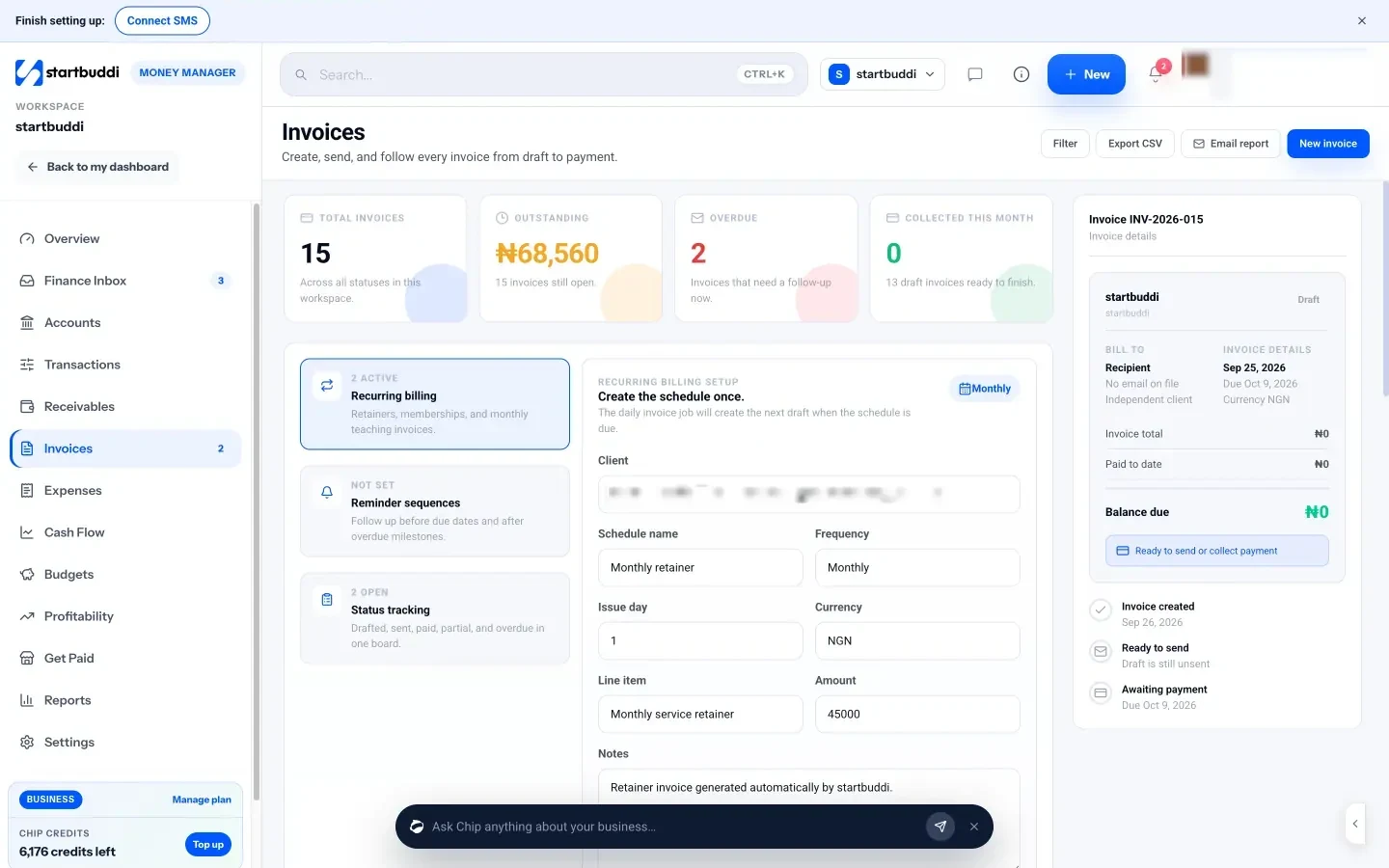
Customers can pay online through Paystack (cards, bank transfer, USSD, mobile money) or Stripe (cards), and your bank transfer details can sit on the invoice too. Each invoice moves through clear statuses, from draft and sent to viewed, partially paid, paid or overdue. You can download a PDF or record a payment that arrived another way.
Invoicing is included on every plan. Free covers five invoices a month, and Starter and above are unlimited. See more on the invoicing page.
Next step: open your last invoice and check it against the list above. If anything is missing, fix your template before you send the next one.
Related terms
FAQ
Is an invoice the same as a bill?
Yes, in everyday use. The seller calls it an invoice when sending it, and the buyer often calls it a bill when paying it.
When should I send an invoice?
As soon as the work is done or the goods are delivered, or at the agreed point for deposits and retainers. Sending promptly usually means being paid sooner.
Can I send an invoice without being a registered company?
Yes. Sole traders and freelancers send invoices all the time. Use your own name, and any business name you trade under, plus your contact details.
What if a customer doesn't pay by the due date?
Send a polite reminder that quotes the invoice number and amount. If it stays unpaid, follow up again and check your agreement for any late payment terms.
Tiwalade Joanna Okedara-Kalu is the founder, CEO and CTO of startbuddi, the business system that brings clients, bookings, invoices, projects, marketing and the Chip AI assistant into one place. Tiwalade builds software around how service businesses really work day to day, and writes about client management, getting paid on time and why small businesses outgrow the tools they start with.
Founded startbuddi and leads its product and engineering