What is recurring invoicing?
Also called: Recurring billing, repeat invoicing, scheduled invoicing, retainer invoicing
Recurring invoicing is sending an invoice to the same customer on a fixed schedule, such as monthly or quarterly, using a saved template for the amount, items and timing. It's how retainers, memberships and ongoing services are usually billed.
Recurring invoicing means sending the same invoice to the same customer on a fixed schedule, such as every month or every quarter. You set the customer, the amount and the timing once, and each new invoice follows that pattern instead of being written from scratch. It’s how most retainers, memberships, rentals and ongoing service contracts get billed.
If you’ve ever copied last month’s invoice, changed the date and number, and pressed send, you’ve done recurring invoicing by hand. The idea is simply to stop repeating that work, and to stop forgetting it.
Why recurring invoicing matters for a small business
Regular income is the steadiest income you can have. A retainer client who pays ₦150,000 every month is worth planning around, but only if the invoice actually goes out on time. When billing depends on you remembering, one busy week can push a payment back by a fortnight, and that gap lands straight on your cash flow.
- Predictable cash: bills go out on the same day each period, so payments arrive on a rhythm you can plan around.
- Less admin: you set the schedule once instead of rebuilding the same invoice twelve times a year.
- Fewer mistakes: the amount, description and customer details stay consistent, so there’s no wrong month in the description or old bank details at the bottom.
- A more professional feel: clients know what’s coming and when, which makes paying you easy.
It also helps you see your business clearly. When your repeat billing is set up properly, you can look at next month and know roughly what’s coming in before any new sales. Decisions like hiring help or buying equipment become much less of a guess.
How recurring invoicing works
Every recurring invoice schedule has the same building blocks: who you’re billing, what for, how much and how often. Here’s a simple example.
Adaeze runs a small social media agency in Lagos. A restaurant pays her a monthly retainer of ₦200,000 for content and scheduling. She sets up a schedule once: the restaurant as the customer, “Monthly social media retainer” as the line item, ₦200,000 as the amount, monthly as the frequency and the 1st as the issue day. Each month a new invoice is prepared with its own number and date. She checks it, sends it, and the restaurant pays through the link on the invoice.
If something changes for one month, such as an extra paid ad budget, she edits that single invoice before it goes out. If the change is permanent, she updates the schedule itself.
Recurring invoicing vs subscription billing
The two are close cousins and people often use the terms loosely. The practical difference is who does the charging.
| Recurring invoicing | Subscription billing | |
|---|---|---|
| How the customer pays | They get an invoice and pay it each time | Their card or account is charged automatically |
| Best for | Retainers, business clients, amounts that change | Memberships, fixed plans, consumer products |
| Control | You can review each invoice before it goes | Renewals run on their own until cancelled |
Many businesses use both: invoices for business clients who need a proper paper trail, and subscriptions for smaller fixed plans. Payment providers explain how automatic charging works on their side, for example Stripe Billing.
Key parts of a recurring invoice schedule
- Customer: who gets the invoice, ideally pulled from your contact list so the details stay current.
- Line items: what you’re billing for, written clearly enough that the client’s accounts team knows what it is.
- Amount and currency: fixed, or reviewed each period if usage varies.
- Frequency: weekly, monthly, quarterly or yearly.
- Issue day and payment terms: the date on the invoice and how long the client has to pay, for example 14 days.
- Start and end: when the arrangement begins, and whether it stops after a set number of invoices or runs until cancelled.
- Payment options: a pay-online link, bank transfer details, or both.
Best practices and common mistakes
- Agree the terms in writing first. A short agreement stating the amount, what’s included and the notice period prevents awkward conversations later. Our agency retainer agreement template is a good starting point.
- Bill in advance for services. Invoicing at the start of the month for that month’s work stops you working for weeks before you’re paid.
- Review before sending. A quick look catches scope changes, extra work or a client who asked to pause.
- Decide how you’ll chase. For example, a friendly note on the due date and a firmer one a week later.
- Keep prices current. If your rates rise in January, update the schedule, not just the next invoice.
- Remember to stop. When a contract ends, end the schedule, so a former client doesn’t get a bill they’ll dispute.
The biggest mistake is treating a recurring invoice as a guarantee of payment. It isn’t. It’s a request that arrives on time. You still need to watch which invoices are paid and follow up on the ones that aren’t.
Related terms
- Invoice: a document asking a customer to pay for goods or services. Recurring invoicing is invoicing on repeat. See what an invoice is.
- Retainer: an arrangement where a client pays a fixed fee each period for ongoing work or availability.
- Payment link: a link that takes the customer straight to checkout. Many invoices include one. See what a payment link is.
- Accounts receivable: the money customers owe you, including unpaid recurring invoices.
Recurring invoicing in startbuddi
In startbuddi, invoices live in Money Manager. On the Invoices page there’s a Recurring billing card where you create the schedule once: pick the client, name the schedule (for example “Monthly retainer”), choose monthly or quarterly, and set the issue day, currency, line item and amount. You can also generate the first draft for that client straight away.
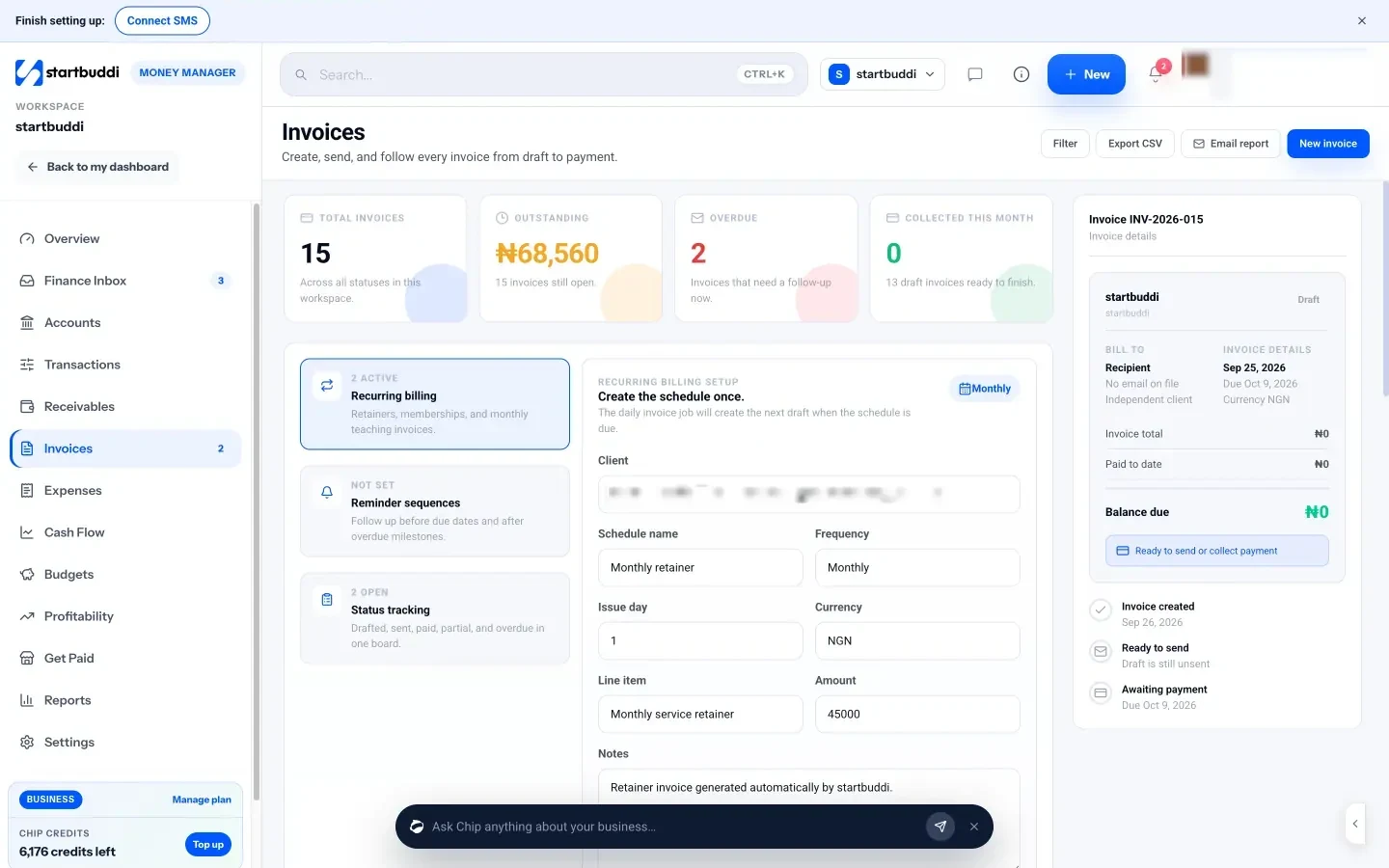
Each invoice can take payment online through Paystack or Stripe, and it can show your bank transfer details too. When a customer pays online, the invoice is marked paid and the payment appears in Transactions. The Receivables page shows who owes you, what’s due soon and what’s overdue, with a Remind button on each open invoice.
If you’d rather customers were charged automatically, Get Paid includes subscription plans that renew through your connected Paystack or Stripe account. Invoicing is on every plan: Free covers five invoices a month, and Starter and above are unlimited. See how it all fits together on the invoicing page.
Next step: list the clients you bill the same amount every period, then set up one schedule for the biggest of them. You can compare plans on the pricing page.
Related terms
FAQ
Is recurring invoicing the same as a subscription?
Not quite. With recurring invoicing the customer receives an invoice and pays it each time. With a subscription, their card or account is charged automatically until they cancel.
How often can recurring invoices be sent?
Any regular interval works: weekly, monthly, quarterly or yearly. Monthly is the most common for retainers and memberships. In startbuddi, recurring billing schedules are monthly or quarterly.
Can I change the amount on one recurring invoice?
Yes. Edit that single invoice before sending it for one-off changes, and update the schedule itself when the change is permanent.
Should I bill a retainer before or after the work?
Most service businesses bill retainers in advance, at the start of the period. It protects your cash flow and makes the arrangement clear to both sides.
Tiwalade Joanna Okedara-Kalu is the founder, CEO and CTO of startbuddi, the business system that brings clients, bookings, invoices, projects, marketing and the Chip AI assistant into one place. Tiwalade builds software around how service businesses really work day to day, and writes about client management, getting paid on time and why small businesses outgrow the tools they start with.
Founded startbuddi and leads its product and engineering