Invoice vs receipt: what is the difference?
Also called: Bill vs receipt, invoice vs proof of payment, payment request vs payment confirmation
An invoice is a request for payment sent before the customer pays. A receipt is proof of payment given after they've paid. Same sale, two moments: the invoice says "please pay", the receipt says "thank you, you've paid".
The difference between an invoice vs receipt comes down to timing. An invoice is sent before payment: it tells the customer what they owe, by when and how to pay. A receipt is issued after payment: it confirms that money changed hands. One asks for money, the other proves it arrived.
Both describe the same sale, so they look alike and people mix them up. Treating them as the same thing causes real problems, from customers paying twice to records that don’t add up at tax time.
Invoice vs receipt at a glance
| Invoice | Receipt | |
|---|---|---|
| Purpose | Requests payment | Confirms payment |
| When it’s issued | Before the customer pays | After the customer pays |
| Key details | Amount due, due date, how to pay | Amount paid, date paid, payment method |
| Status | Can be unpaid, part paid, overdue or paid | Always final: payment happened |
| Common in | Services, business clients, work done on credit | Shops, restaurants, online orders, paid invoices |
Why the difference matters for a small business
For a freelancer or small business, the two documents do different jobs in your records.
- Invoices track what you’re owed. Your unpaid invoices are your money in the pipeline. Without them you can’t see who still needs to pay.
- Receipts track what you’ve actually received. They’re the evidence behind your income figures, and the proof a customer needs if they claim the cost as a business expense.
- Together they stop disputes. When a client says “I already paid”, a numbered receipt linked to the invoice settles it in seconds.
Tax authorities expect you to keep business records that back up your income and costs. In the UK, for example, self-employed people must keep records for at least five years after the relevant tax return deadline. In Nigeria, check current record-keeping rules with the Nigeria Revenue Service (formerly FIRS). This is general information, not tax advice.
How it works in practice: one sale, two documents
Tunde is a freelance photographer. He shoots a product catalogue for a small skincare brand.
- After the shoot he sends an invoice: number INV-042, ₦180,000 for a half-day shoot and 30 edited photos, due in 14 days, with a pay-online link and his bank details.
- Nine days later the brand pays ₦180,000 by bank transfer.
- Tunde marks the invoice as paid and issues a receipt: receipt number, amount paid, date received, method (bank transfer) and a reference to INV-042.
If the brand had paid half up front, Tunde would issue a receipt for that part payment, and the invoice would show as part paid until the balance arrived.
What goes on each document
An invoice usually shows
- A unique invoice number and the invoice date
- Your business name and contact details, and the customer’s
- A clear description of the goods or services, with quantities and prices
- Tax such as VAT, if you’re registered, and the total due
- The due date and how to pay
The UK government lists what an invoice must include, and VAT-registered businesses have extra rules set out in HMRC’s VAT guide. Rules differ by country, so check with your local tax authority.
A receipt usually shows
- A receipt number and the date payment was received
- Who paid and who was paid
- The amount paid and the payment method
- What the payment was for, or the invoice number it settles
Common mistakes to avoid
- Sending an invoice marked “paid” instead of a receipt. It works in a pinch, but a separate receipt with its own number is clearer for both sides.
- Not linking receipts to invoices. Always reference the invoice number, especially for part payments.
- Reusing numbers. Invoice and receipt numbers should each run in their own unique sequence.
- Forgetting receipts for cash and transfers. Online payments often create a record automatically. Money that arrives by hand or by transfer needs recording too.
- Keeping them only in your email. Store both somewhere you can search by customer and date.
Related terms
- Invoice: the full story of what a bill is and what it should contain. See what an invoice is.
- Estimate or quote: comes before the invoice and says what the work will likely cost.
- Proof of payment: anything that shows money moved, such as a bank transfer slip. A receipt is the seller’s formal version.
- Expense tracking: the receipts you receive from suppliers are the backbone of your cost records. See what expense tracking is.
Invoices and receipts in startbuddi
In startbuddi’s Money Manager you create and send invoices, and customers can pay online through Paystack or Stripe. When an online payment comes in, the invoice is marked paid and the payment lands in Transactions, linked back to the invoice it settled.
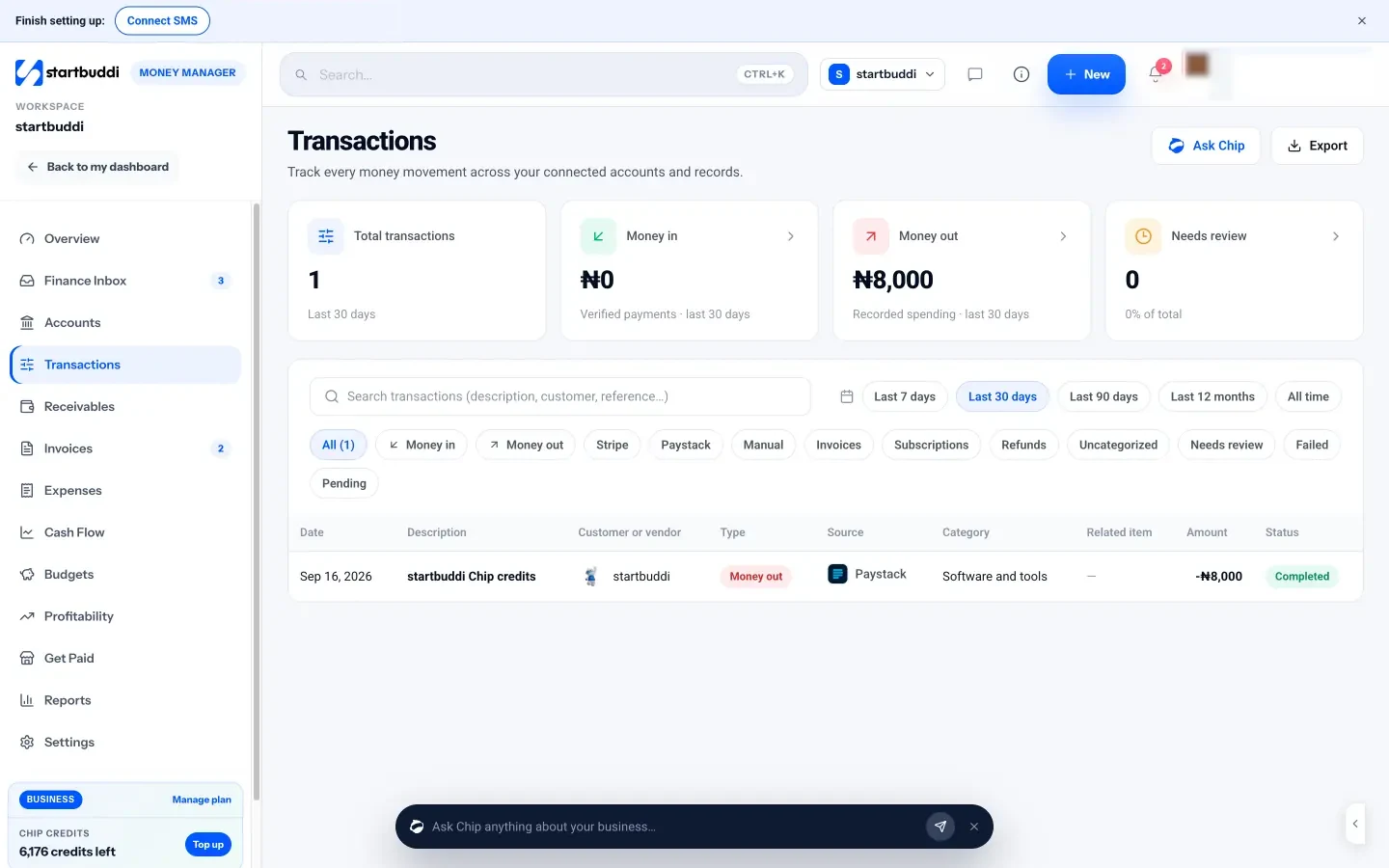
For money that arrives outside startbuddi, such as a bank transfer or cash, open the invoice and use Record payment. You enter the amount (part payments are allowed), the method and the date, and startbuddi records the payment with a numbered receipt, so the invoice shows as part paid or paid. Orders from your online store come with a receipt the customer can view or print.
For a longer walkthrough, read our blog post on the difference between an invoice and a receipt, or see how invoicing in startbuddi works.
Next step: pick your last three sales and check each has both an invoice and a receipt on file. If one is missing, that’s the gap to close first.
Related terms
FAQ
Can an invoice be used as a receipt?
A paid invoice shows what was owed, but it isn't formal proof of payment. Issue a separate receipt, or at least mark the invoice paid with the date and method.
Do I need to give a receipt if the customer paid by bank transfer?
It's good practice. The transfer slip proves the customer sent money, while your receipt confirms you received it and what it paid for.
Which comes first, an invoice or a receipt?
For work done on credit, the invoice comes first and the receipt follows payment. In shops, customers pay straight away, so they usually only get a receipt.
How long should I keep invoices and receipts?
It depends on your country. UK self-employed people must keep records for at least five years after the tax return deadline. Check your local tax authority's rules.
Tiwalade Joanna Okedara-Kalu is the founder, CEO and CTO of startbuddi, the business system that brings clients, bookings, invoices, projects, marketing and the Chip AI assistant into one place. Tiwalade builds software around how service businesses really work day to day, and writes about client management, getting paid on time and why small businesses outgrow the tools they start with.
Founded startbuddi and leads its product and engineering