What is expense tracking?
Also called: Expense management, spend tracking, cost tracking, business expense recording
Expense tracking is the habit of recording every business cost, with its amount, date, category and receipt, so you can see where money goes, control spending, claim allowable costs at tax time and know your real profit.
Expense tracking is recording every cost your business pays, as it happens, with the amount, date, what it was for and a copy of the receipt. Done regularly, it tells you exactly where your money goes, what your real profit is and which costs you can claim when you file taxes.
Most small business owners know roughly what they earn. Far fewer know what they spend, because costs are scattered across bank apps, cash, card payments and a pile of paper receipts. Tracking expenses pulls all of that into one list.
Why expense tracking matters for a small business
- You see your real profit. ₦2 million in sales means little if ₦1.7 million went on stock, data, fuel and software. Profit is income minus expenses, so you need both numbers.
- You spot leaks. Forgotten subscriptions, rising delivery costs and small daily spends add up. You can only cut what you can see.
- You pay the right amount of tax. In many countries, business costs reduce the profit you’re taxed on. In the UK, for example, HMRC explains which allowable expenses self-employed people can claim. Without records, you can’t claim them.
- You can plan. Knowing your regular monthly costs tells you how much you must earn just to break even.
Rules on what counts as a business expense differ by country, so check with your tax authority or an accountant. This is general information, not tax advice.
How expense tracking works
At its simplest, every expense gets one line in a record with a few details attached. Here’s an example.
Chidi runs a small printing shop. On Monday he buys paper and ink for ₦85,000, pays ₦12,000 for delivery, and renews his design software for $20. For each cost he records:
- Who he paid (the vendor)
- How much, and in what currency
- The date
- A category, such as “Office and supplies” or “Software and tools”
- How he paid: card, transfer or cash
- A photo of the receipt
At the end of the month, Chidi can see he spent most on supplies, that delivery costs have doubled since last quarter, and exactly what to hand his accountant.
Key parts of good expense tracking
Categories
Categories group similar costs so you can see patterns. Keep the list short and consistent, for example: software and tools, marketing, travel, office and supplies, contractors, taxes and fees, bank fees, and other.
Receipts
A receipt is your evidence that the cost was real and for the business. Snap a photo the moment you pay. Faded paper receipts at the bottom of a bag are the classic way records go missing. Our glossary entry on invoices vs receipts explains the difference between the two documents.
Recurring costs
Rent, software, phone plans and retainers you pay regularly should be recorded as recurring, so they show up in your forecasts without being re-entered each month.
Bills and reimbursements
Bills are costs you owe but haven’t paid yet, such as a supplier invoice due in 30 days. Reimbursements are costs a team member paid from their own pocket that the business will pay back. Both are expenses, just at a different stage.
Best practices and common mistakes
- Record as you go. A 30-second entry today beats an afternoon of guessing at month end.
- Separate business and personal spending. A dedicated business account makes tracking far easier.
- Link costs to jobs where you can. Tagging an expense to a project or client shows what each job really cost you.
- Review weekly. Ten minutes each Friday to categorise anything uncategorised keeps the list clean.
- Don’t track only big costs. Small repeat spends like data, transport and bank charges add up quickly.
- Keep records for as long as the law requires. UK self-employed people, for instance, must keep records for at least five years after the tax return deadline.
Need a simple format to start with? Our free expense report template covers the basics, and the profit margin calculator shows what your costs mean for each sale.
Related terms
- Money manager app: software that brings income, expenses and invoices together. See what a money manager app is.
- Cash flow: the timing of money coming in and going out. Good expense records make cash flow forecasts possible.
- Profit and loss: a report that subtracts expenses from income for a period.
- Accounts payable: bills you owe to suppliers but haven’t paid yet.
Expense tracking in startbuddi
In startbuddi, expenses live in Money Manager. Add expense opens a short form: vendor, amount, currency, category, date, how you paid, the receipt (image or PDF), and optionally the project or customer it relates to. If you’re not sure of the category, leave it as Uncategorized and it will wait for review.
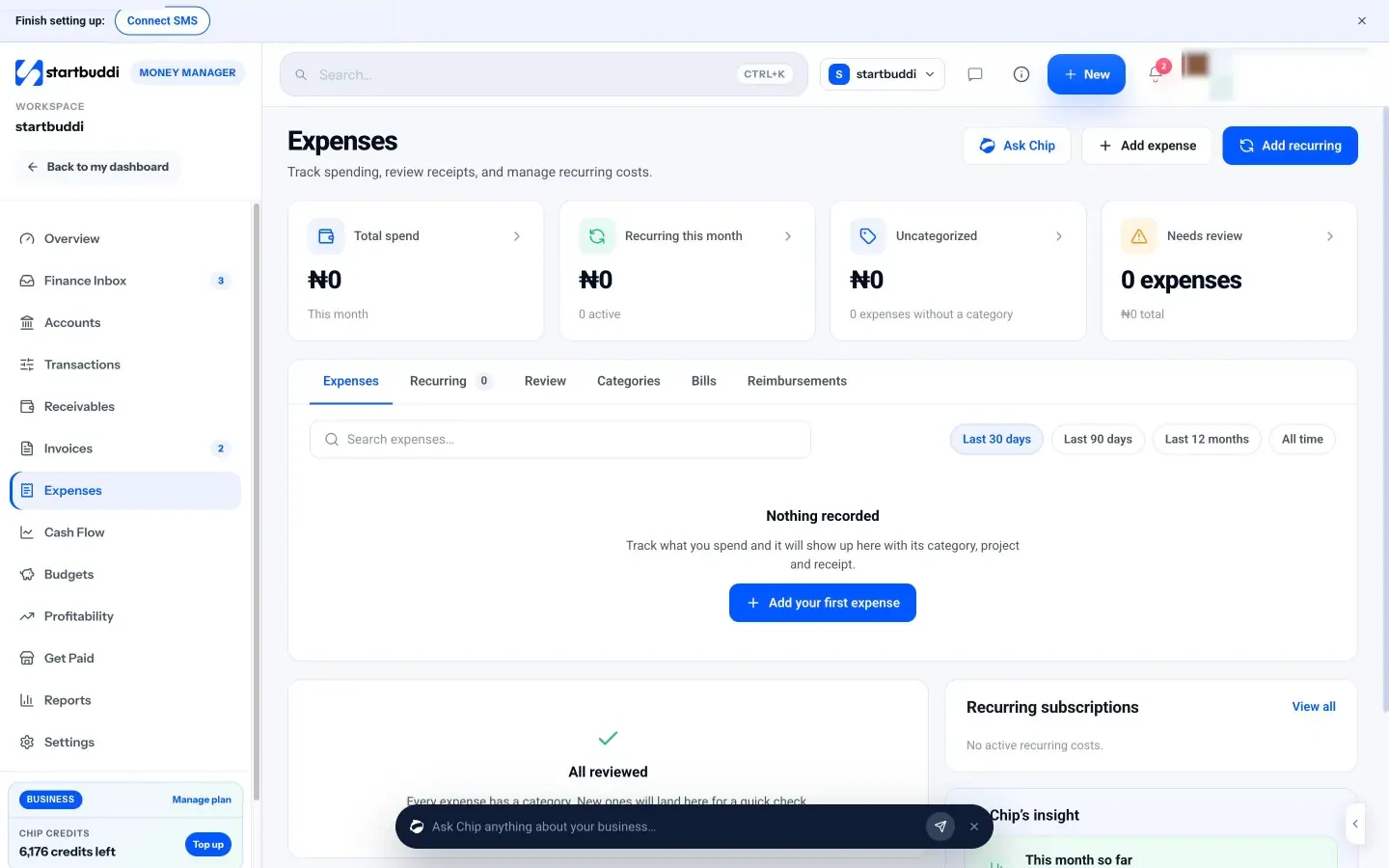
The Expenses page also has tabs for recurring costs (which you can pause or resume), a Review queue that suggests the category a vendor was last given, spend by category, bills you owe, and team reimbursements with an approval step. Every expense shows in Transactions as money out, and Chip can explain why spending is up or down this month. Expenses are entered by hand or from receipts; there’s no bank feed.
Expense tracking is included on every plan, including Free. Find out more on the expenses page.
Next step: find every business receipt from this week, record each one with a category, and set a 10-minute reminder for next Friday to do it again.
Related terms
FAQ
What counts as a business expense?
A cost you pay to run the business, such as supplies, software, travel, marketing or contractors. Personal costs don't count, and mixed costs usually need splitting. Check your local tax rules.
How often should I track expenses?
Record each one as it happens, then review weekly. Waiting until month end usually means lost receipts and guesswork.
Do I need to keep paper receipts?
A clear photo or scan is accepted in many countries, but rules vary. Check with your tax authority about digital records.
Is expense tracking the same as bookkeeping?
It's one part of bookkeeping. Bookkeeping also covers recording income, reconciling accounts and preparing reports.
Chinedu Kalu is the co-founder and chief operating officer of startbuddi, responsible for how the company runs day to day. Chinedu writes about the operational side of a small business: registering and running the company, money, hiring and the routines that keep a team on track.
Co-founded startbuddi and runs its operations