What is accounts payable?
Also called: AP, payables, trade payables, creditors, bills to pay, supplier invoices
Accounts payable (AP) is the money your business owes to suppliers, contractors and other vendors for goods or services you have already received but not yet paid for, usually tracked as unpaid bills.
Accounts payable (AP) is the money your business owes to the people and companies who supply it: the freelancer who delivered last week, the printer who sent an invoice, the software you pay for monthly on an invoice, the wholesaler who gave you 30 days to pay for stock. So what is accounts payable in one line? It is your list of bills you have received but not paid yet.
In accounting, payables are a liability: money you are committed to paying out. They are the mirror image of accounts receivable, which is money others owe you.
What is accounts payable and why does it matter?
Small businesses often think of payables only as “bills”. Managing them on purpose has real benefits:
- Cash flow control. Paying on the due date, not the day a bill arrives, keeps cash in your account longer.
- Supplier trust. Suppliers who are paid on time give better prices, priority and flexibility when you need it.
- No surprises. Knowing what goes out in the next 30 days stops you from spending money that is already committed.
- Fewer mistakes. A simple check before paying catches duplicate bills, wrong amounts and, sometimes, fraud.
How accounts payable works: an example
Ravi runs an events company in Pune. In one week he receives:
| Supplier | What for | Amount | Terms |
|---|---|---|---|
| Sound hire company | Speakers for a wedding | ₹45,000 | Due in 15 days |
| Florist | Stage flowers | ₹28,000 | Due in 7 days |
| Freelance photographer | Corporate event | ₹35,000 | Due on receipt |
His accounts payable rises by ₹108,000. He checks each bill against what was ordered and delivered, pays the photographer now, schedules the florist for day 7 and the sound company for day 15. As each is paid, it leaves payables. If he waited to pay all three until a client paid him, he would risk damaging relationships he needs for the next event.
The accounts payable process
- Order. For bigger purchases, agree the price in writing, ideally with a purchase order.
- Receive the bill. Record it as soon as it arrives, with the due date.
- Check it. Does it match what you ordered and what arrived? Is it a duplicate? Are the bank details the same as last time?
- Approve it. In a team, someone other than the person who ordered it should approve larger bills.
- Pay on the due date and record the payment.
- Keep the paperwork. Tax bodies expect you to keep records of business costs for a set number of years.
Payment terms and early-payment discounts
Suppliers set payment terms such as “net 30” (pay within 30 days). Some offer a discount for paying early, written as “2/10 net 30”: take 2% off if you pay within 10 days, otherwise pay the full amount by day 30. On a $5,000 bill that is $100 saved for paying 20 days early. Worked out over a year, that is roughly a 37% annual return on the cash, so it is often worth taking when you can afford to.
Accounts payable vs accounts receivable
| Accounts payable | Accounts receivable | |
|---|---|---|
| What it is | Money you owe suppliers | Money customers owe you |
| On the balance sheet | A liability | An asset |
| Goal | Pay accurately and on time | Collect quickly |
Common mistakes
- Paying bills the moment they arrive. Unless there is a discount, pay on the due date and keep the cash working.
- Paying late by accident. Late fees and lost goodwill cost more than a reminder system.
- No second check. Paying without comparing the bill to the order is how duplicates and inflated invoices slip through.
- Mixing bills and receipts. A bill is money you owe; a receipt proves you already paid. Our entry on invoices vs receipts explains the difference.
- Forgetting recurring costs. Rent and subscriptions are payables too, every month.
Accounts payable in startbuddi
In Money Manager, the Expenses section has a Bills tab for “money the workspace owes to vendors and people”. You record a bill with the payee, category, currency, amount, due date and notes, and it moves from draft through Needs approval to approved and due. You can mark a bill as disputed and record partial payments until it is fully paid. Stat cards show open bills, outstanding, overdue and paid.
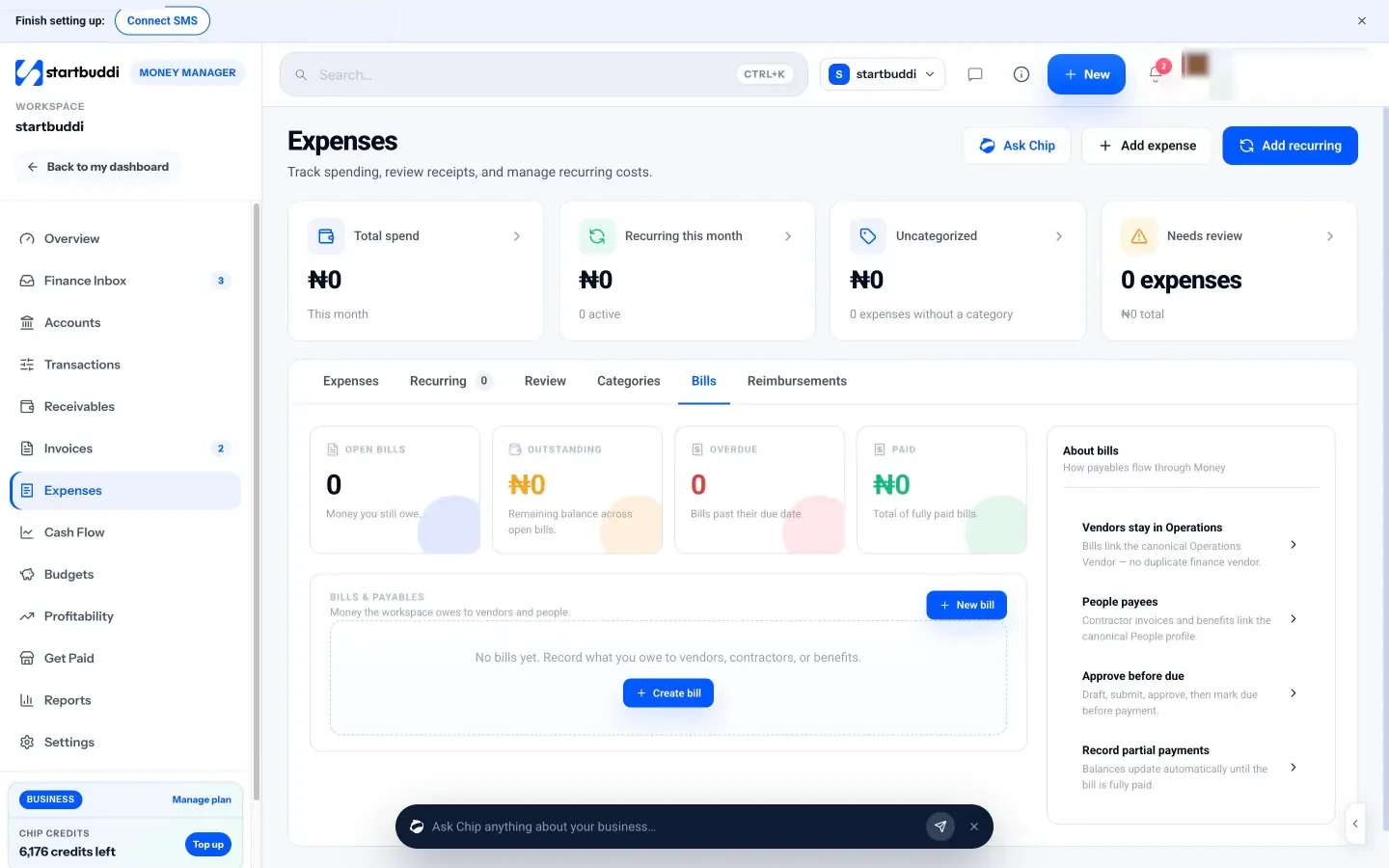
Recurring costs such as rent and software sit in their own tab and feed the cash forecast, and team out-of-pocket claims are handled in Reimbursements. The Reports page shows a payables ageing view next to receivables. Note that startbuddi does not pay suppliers for you or connect to your bank: you pay as usual and record the payment. Your next step: gather every unpaid bill you have and put the due dates in one list today.
Related terms
FAQ
Is accounts payable an expense?
Not exactly. A bill is recorded as an expense when you incur the cost, and as accounts payable until you pay it. Accounts payable is the liability that tracks what is still unpaid.
What is the difference between accounts payable and accounts receivable?
Accounts payable is money you owe suppliers. Accounts receivable is money customers owe you.
Should a small business pay bills early?
Usually pay on the due date to keep cash longer, unless the supplier offers an early-payment discount that is worth taking.
What does 2/10 net 30 mean?
You can take 2% off the bill if you pay within 10 days. Otherwise the full amount is due within 30 days.
Tiwalade Joanna Okedara-Kalu is the founder, CEO and CTO of startbuddi, the business system that brings clients, bookings, invoices, projects, marketing and the Chip AI assistant into one place. Tiwalade builds software around how service businesses really work day to day, and writes about client management, getting paid on time and why small businesses outgrow the tools they start with.
Founded startbuddi and leads its product and engineering