Deposits and upfront payments: how much to ask for and how
How much upfront payment to ask clients for, how to explain it, what to write about refunds, and the easiest ways to collect a deposit.



Photo: Vinicius "amnx" Amano / Unsplash
- Most service businesses ask for 25% to 50% upfront, closer to 50% for new clients and custom work, and 100% for small fixed jobs. Explain the deposit early, put the amount and refund terms in writing, and don't start until it has arrived.
If you are wondering how much to ask for before you start a job, here is the short answer. Most service businesses take an upfront payment of 25% to 50% of the total. Ask for closer to 50% from new clients, on custom work, or when you have to buy materials first. Ask for 100% upfront on small jobs and fixed bookings. On long projects, split the rest into milestone payments. Put the amount, the due date and the refund terms in writing before any work begins.
This guide explains how to choose the right amount for your situation, how to ask without scaring the client away, what to say about refunds, and how to actually collect the money.
Why ask for an upfront payment at all?
A deposit is not about distrust. It protects both sides and makes the whole project run better.
- It shows commitment. A client who has paid something is far more likely to reply to emails, send content on time and see the project through.
- It covers your early costs. Materials, stock, travel, subcontractors and software often have to be paid before you deliver anything.
- It protects your calendar. When you block out two weeks for one client, you turn other work away. A deposit makes that booking real.
- It smooths your cash flow. Money arrives at the start of the job instead of weeks after the end.
- It filters out time-wasters. Clients who refuse any upfront payment at all are often the same ones who pay late later.
Freelancers Union, the US freelancer advocacy group, recommends asking for a portion up front or in instalments so that you do not carry all the risk yourself. It notes that the upfront part can be anything from a fraction, such as 20%, up to the full project cost.
Deposit, retainer, milestones or full payment: which is which?
People use these words loosely. It helps to know the difference so your terms are clear.
| Type | What it is | Best for |
|---|---|---|
| Deposit | A part of the total, paid before work starts, then deducted from the final bill | One-off projects with a clear price |
| Full upfront payment | The whole price paid before you start or before the appointment | Small jobs, fixed packages, classes, bookings |
| Milestone payments | The price split into stages, each paid when a stage is reached | Longer projects with clear phases |
| Retainer | A regular fee, often monthly, paid in advance for ongoing work or availability | Ongoing support, social media, bookkeeping, advisory work |
You can mix them. A website project might have a 40% deposit, then two milestone payments, then a small monthly retainer for updates once it goes live.
How much upfront payment to ask for
There is no single legal or industry rule. The right figure depends on how much risk you carry before the client pays the rest. Use the table below as a starting point, then adjust.
| Situation | Suggested upfront payment | Why |
|---|---|---|
| Small job or fixed package (for example a logo refresh or one photo shoot) | 100% | The job is short and chasing a small balance costs more than it is worth |
| New client, custom project | 50% | No payment history yet, and the work is built only for them |
| Repeat client who pays on time | 25% to 30%, or none | You already know they are reliable |
| You must buy materials or stock first | The cost of materials plus 10% to 20% | You should never fund a client’s materials yourself |
| Events, venues and date-specific bookings | 30% to 50% to hold the date, the rest before the event | You turn away other bookings for that date |
| Projects longer than about 8 weeks | 25% to 40%, then milestones | Keeps money coming in while work continues |
Four questions that decide your number
- What will I spend before delivery? Add up materials, subcontractors, travel and tools. Your deposit should at least cover these.
- What happens if they cancel halfway? If you would lose other work or be left with custom items nobody else can use, ask for more.
- How well do I know this client? New and unknown clients carry more risk than long-standing ones.
- How long is the project? The longer the gap between starting and finishing, the more you should split payments up.
A worked example
Say you are quoting ₦600,000 to build a website for a new client over six weeks. You pay ₦60,000 upfront for a theme, plugins and stock photos, and you are turning down another project to fit it in. A fair structure might be:
- 40% deposit (₦240,000) to book the start date and cover early costs.
- 30% (₦180,000) when the client approves the design.
- 30% (₦180,000) before the site goes live.
Notice the last payment comes before launch, not after. Once the work is live, the client has far less reason to pay quickly. Our free deposit calculator works out these splits for any total.
How to ask for a deposit without scaring the client
Clients rarely object to a deposit that is explained up front. They object to surprises. Three habits help:
- Mention it early. Say it on the first call (“I work with a 50% deposit to book your dates”) so it is expected by the time the quote arrives.
- Put it in the quote. Write the deposit amount, what it covers and when it is due on your estimate or proposal. You can start from our free quote and estimate template.
- Explain the benefit to them. The deposit reserves their slot, lets you order materials and means the project starts on time.
Deposit request email template
Subject: Next step for [project]: deposit to book your start date
Hi [Name],
Great to hear you’d like to go ahead with [project]. To book your start date of [date], I take a [50%] deposit of [₦300,000]. This covers [materials and the first phase of work] and is deducted from your final bill.
You can pay by card or transfer here: [payment link]. As soon as it arrives I’ll confirm your slot and send over the project plan.
The remaining [₦300,000] is due [on delivery / in two stages], as set out in the attached quote.
Thanks, [Your name]
Put this into practiceEverything in this article works inside startbuddi, free to start.Start free
If the client pushes back
Some clients will ask to skip the deposit. You have options between “yes” and “no”:
- Offer a smaller deposit with more milestones.
- Offer a small discount for paying in full upfront. Freelancers Union suggests discounts of 3% to 15% as one way to encourage early payment.
- Start with a small paid first phase, such as a discovery session, before committing to the full project.
If a client still refuses to pay anything before you begin on custom work, treat that as useful information about how the rest of the project might go.
Refundable or non-refundable? What to write in your terms
A deposit only protects you if everyone knows what happens to it when plans change. Write it down in your quote, proposal or contract. A simple clause might say:
“A deposit of [50%] is due before work begins and reserves your start date. If you cancel more than [14] days before the start date, we refund the deposit minus any costs already spent on materials. If you cancel within [14] days of the start date, the deposit is non-refundable. The deposit is deducted from your final invoice.”
Keep it fair. A deposit should cover real costs and lost time, not act as a penalty. Also be aware that consumer law can override your terms when you sell to individuals rather than businesses. For example, in the UK customers who buy at a distance, such as online or by phone, can usually cancel within 14 days, and there are special rules when a service starts inside that period. This is general information, not legal advice, so check the consumer rules in your country, and consider having a lawyer look over your standard terms. Our freelance agreement template is a good place to start.
How to collect the upfront payment
Make paying the deposit as easy as agreeing to it. The main options are:
- A payment link. Quick to create and easy to send in WhatsApp or email. The client pays by card or transfer in a minute. See what a payment link is and how to create one in Nigeria.
- A deposit invoice. Better when the client’s finance team needs a formal document. Invoice the deposit now, then send a second invoice for the balance.
- Bank transfer. Common and cheap, but you have to check your account and match the payment yourself. Always ask for a reference such as the invoice number.
Whichever you choose, do not start work until the money has actually arrived, not just been promised. Then send a quick confirmation so the client knows their slot is secured. If you need help with the wording for the balance later, see how to ask a client for payment politely.
Upfront payment examples by type of business
The same principles play out differently depending on what you sell. Here is how four common businesses might set their terms.
Photographers and videographers
A wedding or event date can only be sold once, so many photographers take a booking fee of around a third to hold the date, with the balance due a week or two before the event. For short portrait sessions, full payment at booking is simpler for everyone.
Caterers, decorators and event planners
Food, flowers and hired equipment are bought days before the event and cannot be returned. A typical structure is a deposit to confirm the booking, a second payment once the final numbers are agreed, and the balance before the event day, so you are never cooking on credit.
Trades and installers
For a solar installer, plumber or electrician, parts can be the biggest cost of the job. Ask for at least the cost of materials upfront, then the labour on completion. For larger installations, add a stage payment when the equipment is delivered to site.
Consultants and coaches
Advice-based work has few materials, so the risk is mostly your time. Coaches often sell packages paid in full before the first session, while consultants use a deposit for project work or a monthly retainer paid at the start of each month.
Whatever your field, the test is the same: if the client walked away tomorrow, would the money you already hold cover what you have spent and the work you turned down?
Common deposit mistakes
- Starting before the deposit clears. “It’s on its way” is not a payment.
- Leaving the biggest payment until after delivery. Schedule the final payment before launch or handover where you can.
- No written refund terms. Arguments about cancelled projects almost always come down to what was, or was not, agreed.
- Forgetting to deduct the deposit. Your final invoice must show the deposit already paid, or the client will think you are overcharging.
- Different rules for every client. A standard policy is easier to explain and feels fairer.
How startbuddi helps you take upfront payments
In startbuddi, the quote, the agreement and the deposit sit in one place, so you do not retype details between tools.
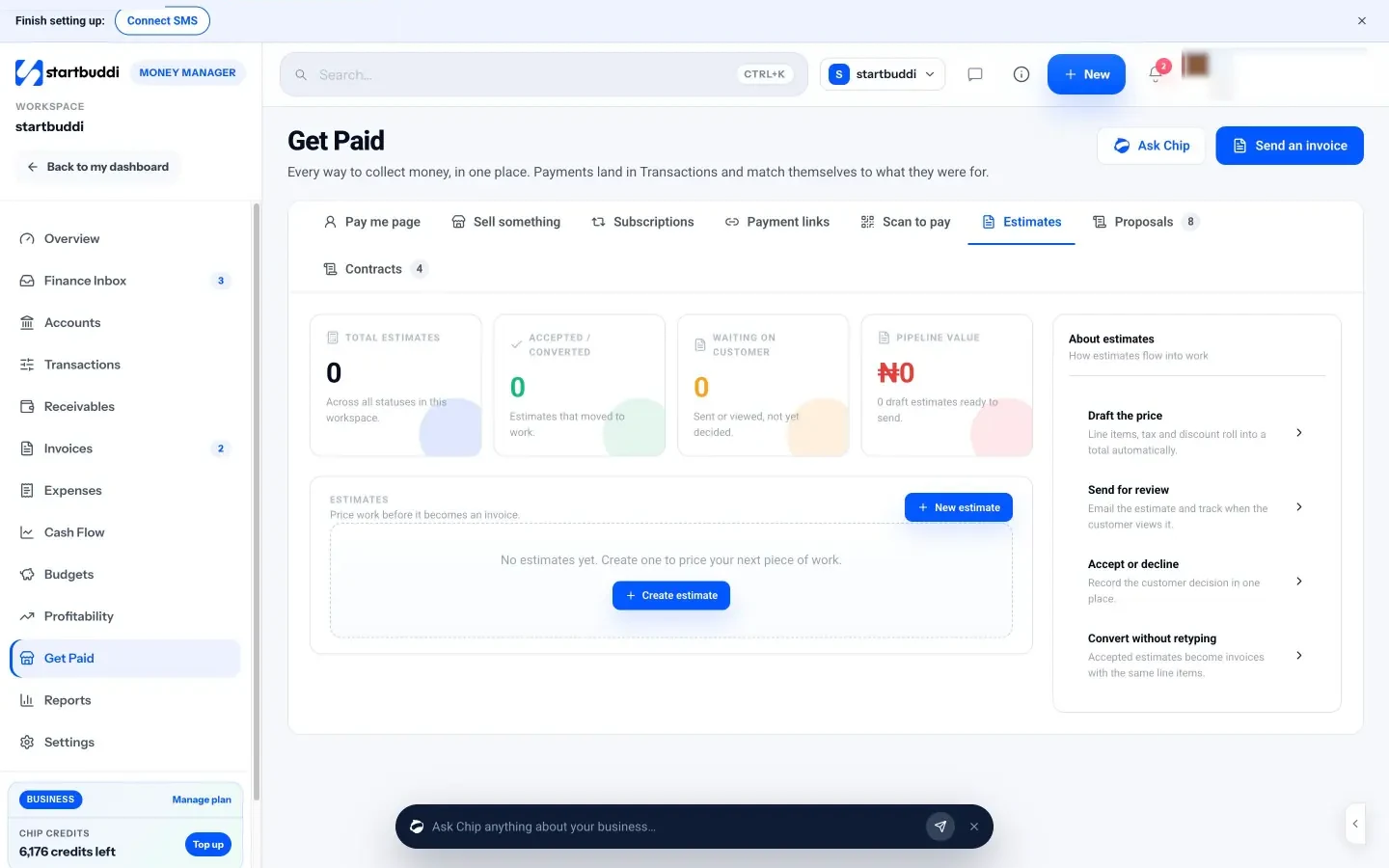
- Estimates with your deposit terms. In Estimates, proposals and contracts, you add line items, tax and notes such as “Valid for 30 days. 50% deposit to begin.” When the client agrees by replying to your email, you mark the estimate accepted and convert it into an invoice with the same line items.
- Contracts with e-signatures. Start from a template such as the Freelance Contract or Brand Design Contract, edit the wording, add your deposit clause, and send it for signature. You can see which contracts are drafts, awaiting signature or signed.
- Payment links for deposits. Get Paid lets you create a payment link with a title and amount, then copy it into WhatsApp or send it by email. Clients pay through Paystack or Stripe, and the money goes to your own account.
- Partial payments on invoices. If a client pays a deposit by bank transfer against an invoice, you can record it on that invoice. The invoice then shows Partially paid, with the balance still due.
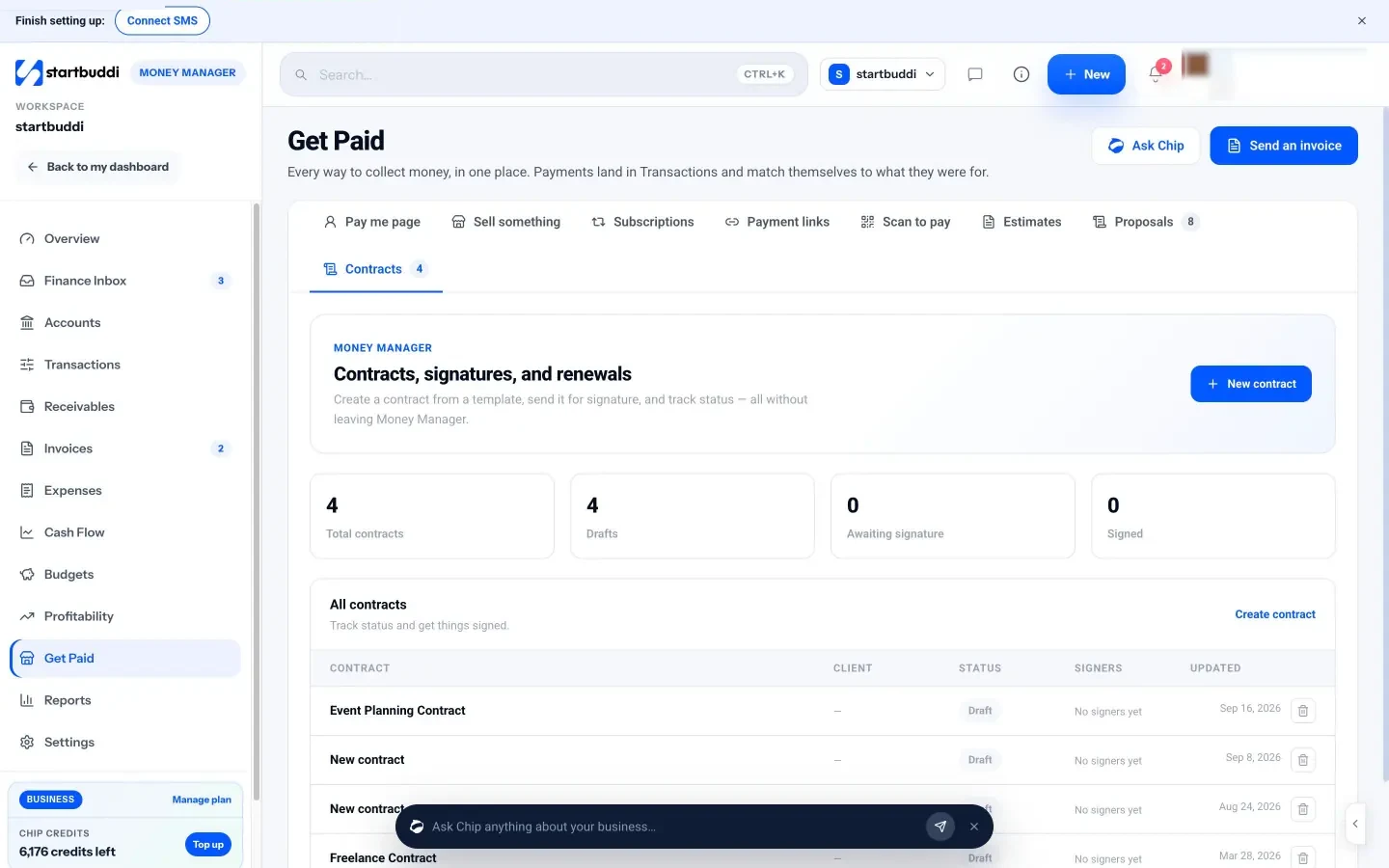
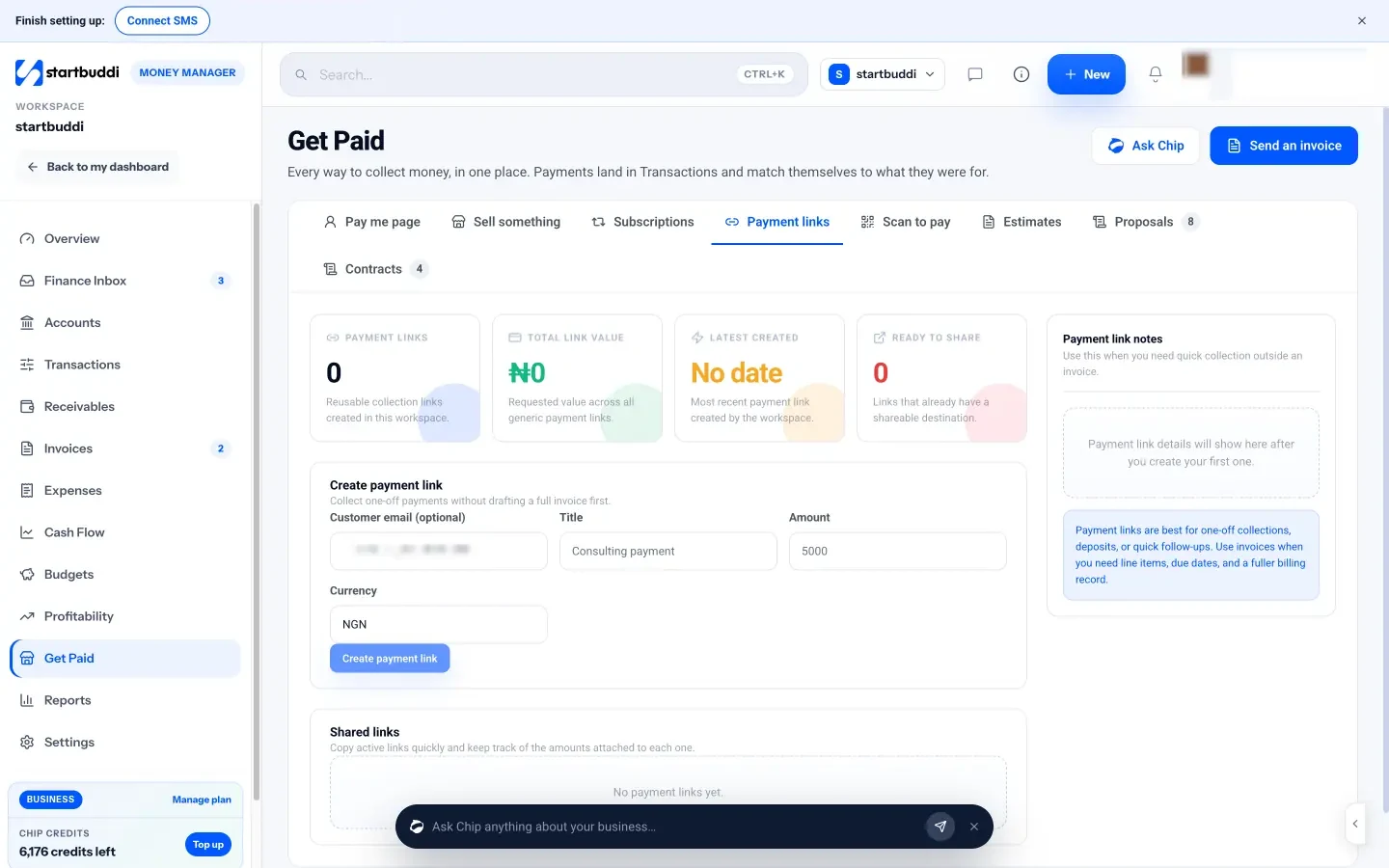
Estimates, contracts and payment links are available on every plan, including Free. Taking card payments needs a connected Paystack or Stripe account.
Your next step
Write your standard deposit policy today: the percentage, when it is due, and what happens if a client cancels. Add it to your quote template and mention it on your next sales call. When you want quotes, contracts and deposit links in one place, see how invoicing works in startbuddi or compare plans on our pricing page.
Sources
- Freelancers Union: 7 tips for getting paid upfront
- GOV.UK: Online and distance selling for businesses
- Freelancers Union: Contract Creator
Frequently asked questions
Is a 50% deposit too much?
Not for new clients or custom work. It is common, especially when you have to buy materials or turn away other work to fit the project in.
Should the deposit be refundable?
That is your choice, but write it down. Many businesses refund part of the deposit if the client cancels early and keep it if they cancel close to the start date.
Do I need to deduct the deposit from the final invoice?
Yes. Show the deposit already paid and the balance due, so the client can see they are not paying twice.
Can I ask a repeat client for a deposit?
You can. Many businesses lower or drop the deposit for reliable clients, but keep it for large projects or when you need to buy materials.
Tiwalade Joanna Okedara-Kalu is the founder, CEO and CTO of startbuddi, the business system that brings clients, bookings, invoices, projects, marketing and the Chip AI assistant into one place. Tiwalade builds software around how service businesses really work day to day, and writes about client management, getting paid on time and why small businesses outgrow the tools they start with.
Founded startbuddi and leads its product and engineering