
Business Continuity Plan Checklist for Small Businesses
A business continuity plan checklist for small businesses: power, phones, data, illness, suppliers and cash, with a one-page template and a worked example.

A business continuity plan checklist lists what keeps your business earning when something goes wrong: backup power and data, a second way to reach clients, someone who can cover your work, copies of key documents and a cash reserve. For a small service business it fits on one page, takes an afternoon to write and should be tested twice a year.
Key takeaways
- Start with the work that brings in money, not with the disasters. List your critical activities, then ask what could stop each one.
- For each critical activity, decide how long you could stop before clients or cash suffer, and write one workaround.
- Most small-business disruptions are ordinary: a power cut, a stolen phone, a sick owner, a supplier who disappears. Plan for those first.
- Client details, contracts and invoices should live in the cloud and be exported to a second place on a schedule.
- A plan nobody has tested is a guess. Run a short “what if” drill every six months.
What is a business continuity plan, and does a small business need one?
A business continuity plan is a short written answer to one question: if this goes wrong tomorrow, how do we keep serving clients and getting paid? Large companies write long documents against the ISO 22301 standard. A cleaner, a two-person agency or a solo consultant needs something much smaller, but needs it just as much, because there is no spare department to absorb the hit.
The US government’s Ready.gov describes business continuity planning as a process to manage a business disruption, built in six stages: prepare, define objectives, identify and rank risks, develop strategies, assign teams and test (checked on 1 October 2026). This chapter turns those stages into a checklist a one-to-ten-person service business can finish in an afternoon.
In the starting a service business checklist, this is the last item in the “system” phase. It is easier to write before you are busy than after your first emergency.
How to write a business continuity plan in six steps
1. List your critical activities
Write down the five to eight things that, if they stopped, would cost you clients or money within a week. For most service businesses the list looks like this:
- answering new enquiries;
- confirming and delivering booked jobs;
- invoicing and taking payment;
- reaching existing clients;
- paying staff and key suppliers;
- keeping client records, contracts and files.
2. Decide how long each one can stop
For each activity, write the longest gap you could live with. Answering enquiries might tolerate four hours. Invoicing might tolerate three days. Delivering a booked wedding shoot tolerates zero. Large companies call this the maximum tolerable downtime; you only need a number next to each line.
3. Identify the risks that could stop them
Go through the common causes of small-business disruption (the checklist below covers them) and mark the ones that apply to you. A home-based bookkeeper in Abuja worries about power and internet; a catering business in Lagos also worries about flooding on delivery routes and a gas supplier running out.
4. Write one workaround per risk
A workaround is a specific action, not a hope. “Use backup power” is a hope. “Inverter covers the router and laptop for six hours; if it runs out, work from the co-working space on Admiralty Way, which has generator power” is a workaround.
5. Name who does what
For each workaround, write a name. In a one-person business, the second name is the person who steps in if you can’t: a partner, a trusted freelancer or a family member who can at least message clients. Give them the access they would need now, not in the middle of the crisis.
6. Test it and review it
Pick one scenario every six months and walk through it: “my phone has just been stolen” or “I’m in hospital for a week”. Time how long it takes to reach every client booked for that week. Fix whatever slowed you down, and update the plan.
The business continuity plan checklist
Copy this list into a document or task list and tick each item off once it is done, not once it is planned.
Power and internet
- Backup power for the devices you work on: an inverter, a power bank for each phone, or both.
- A second data line from a different network, so one network outage doesn’t stop you.
- A known place to work if both fail: a co-working space, a client’s office or a café with generator power.
- Today’s bookings and client numbers available offline, or printed the night before when power is unreliable.
Phone and devices
- Client contacts saved to a cloud account, not only on the handset.
- WhatsApp chat backup switched on, and a note of which account it backs up to.
- Screen lock and remote wipe set up on every work phone and laptop.
- A spare handset or a cheap backup phone that can take your SIM.
- Two-step verification on email and your main business accounts, with backup codes stored somewhere safe and offline.
Data and accounts
- Client records, contracts, invoices and files kept in cloud tools rather than on one device.
- A regular export of your client list and invoices to a second place, such as a separate cloud drive or an external drive kept unplugged.
- A list of every account the business depends on (email, bank, payment provider, booking page, website, social), with who owns the login.
- A test restore: open the backup and check it actually contains what you need.
People
- A named person who can cover jobs or message clients if you are ill or away.
- Written steps for your core service, so someone else can deliver it. A standard operating procedure does this job.
- Shared access for at least one other person to the client list and the inbox, with their own login.
- Emergency contacts for every staff member.
Suppliers and tools
- A second supplier for anything you can’t work without (cleaning chemicals, printing, parts, fuel).
- A note of what happens if a key app or platform goes down for a day, and how you would take bookings and payments manually.
- Contracts and supplier terms stored where you can find them without your laptop.
Money
- A cash reserve of at least one month of fixed costs, in a separate account.
- A second way to take payment: if your card or payment gateway is down, a bank transfer with your account details ready to send.
- A list of who owes you money right now (your accounts receivable), so you can chase it if cash gets tight.
- Business insurance checked for what it actually covers (equipment, premises, liability, business interruption).
Clients and communication
- A short message template for “we have to reschedule”, ready to send to every affected client.
- An out-of-hours or away message on your main channels.
- A rule for refunds and rebooking when you cancel, written in your terms before you need it.
Data breaches
- Know what to do if client data is lost or stolen. In Nigeria, the Data Protection Commission’s implementation directive under the Nigeria Data Protection Act says controllers must notify the Commission of personal data breaches within 72 hours of becoming aware (checked on 1 October 2026). In the UK, the ICO says reportable breaches must be reported as soon as possible and, where feasible, within 72 hours (checked on 1 October 2026).
- A note of who would make that report and where the client list is, so you can tell affected people quickly.
A one-page business continuity plan template
Copy this into a document, fill in each line and keep a printed copy somewhere you can reach without a working phone.
BUSINESS CONTINUITY PLAN: [Business name]
Owner: [Name]          Deputy: [Name, phone]          Last tested: [Date]

1. CRITICAL ACTIVITIES
Activity                  | Max downtime | Who covers it
Answering enquiries       |              |
Delivering booked jobs    |              |
Invoicing and payments    |              |
Paying staff and suppliers|              |

2. RISKS AND WORKAROUNDS
Risk                      | Workaround                       | Owner
Power cut                 |                                  |
Internet down             |                                  |
Phone lost or stolen      |                                  |
Owner ill for a week      |                                  |
Key supplier unavailable  |                                  |
Laptop or data lost       |                                  |
Payment provider down     |                                  |

3. WHERE THINGS ARE
Client list (and backup)  :
Contracts and documents   :
Invoices and payments     :
Account logins list       :

4. KEY CONTACTS
Deputy / cover            :
Main suppliers            :
Bank and payment provider :
Insurer                   :

5. MESSAGE TO CLIENTS IF WE MUST RESCHEDULE
"Hi [name], something has come up on our side and we can't make [date].
We're sorry. Can we move you to [option 1] or [option 2]? Your deposit
stays with your booking."

6. CASH
Monthly fixed costs: ______   Reserve held: ______   Months covered: ______
If you already keep written processes, store this plan next to them. Our free SOP template and the guide to writing standard operating procedures help with the “someone else can deliver it” part.
Worked example: a cleaning business in Lagos
These figures are illustrative, not market rates.
Ngozi runs a home and short-let cleaning business in Lekki with three cleaners. She books about 60 cleans a month at an average of ₦35,000, so roughly ₦2,100,000 a month comes in. Her fixed costs (two salaried cleaners, transport float, data, marketing and a small office) come to ₦780,000 a month.
She writes her plan in one afternoon:
| Critical activity | Max downtime | Main risk | Workaround | Owner |
|---|---|---|---|---|
| Answering enquiries | 4 hours | Phone stolen or dead | WhatsApp backed up to the cloud; deputy has a login to the shared inbox; spare phone in the office | Ngozi, then Ada (supervisor) |
| Delivering booked cleans | Same day | Cleaner sick | One part-time cleaner on call at an agreed day rate; supervisor can cover | Ada |
| Supplies | 2 days | Supplier out of stock | Second supplier in Ajah, prices agreed in advance | Ngozi |
| Invoicing and payment | 3 days | Laptop lost | Invoices and payment links in a cloud tool, usable from any phone | Ngozi |
| Paying staff | 0 days late | Cash gap | One-month reserve in a separate account | Ngozi |
The cash line needs a sum. One month of fixed costs is ₦780,000. If the business lost a week of work (about a quarter of the month’s cleans), revenue would fall by roughly ₦525,000 (₦2,100,000 × 0.25), while fixed costs would stay the same. A ₦780,000 reserve covers that week and leaves ₦255,000 spare. Ngozi decides to build the reserve by moving ₦130,000 a month into a separate account, which reaches ₦780,000 in six months.
Her first drill is “my phone is stolen on a Monday morning”. She times herself: with the spare phone, the cloud contacts and the deputy’s inbox access, every client booked that week is messaged in 40 minutes. Before the plan, the same exercise would have meant rebuilding numbers from memory and old WhatsApp groups.
A one-person accountant in Manchester would write the same table with different risks: a broadband outage, a laptop failure during self-assessment season, and illness in January. The structure doesn’t change.
How to test your plan without a real emergency
Testing can be as simple as a 30-minute conversation. Ready.gov’s continuity material recommends exercises to validate a plan; for a small business, a “tabletop” walk-through is enough.
- Pick one scenario. “The power is off for three days” or “the owner is in hospital from tomorrow.”
- Walk through the next 48 hours. Who messages clients? Where is the client list? How do payments come in?
- Note every “we’d have to find out”. Each one is a gap in the plan.
- Fix the gaps that week. Most take under an hour: share a login, print a contact list, buy a power bank.
- Write the test date on the plan. Put the next one in your calendar for six months’ time.
Once a year, also test your backups properly. The UK National Cyber Security Centre’s small organisations guide to backing up data says to back up the data your business needs to operate, keep external backup devices disconnected when not in use, and check that you know how to restore your backup and that it contains your important data (checked on 1 October 2026).
Mistakes to avoid
- Planning only for disasters you see on the news. Fire and floods matter, but a stolen phone or a sick owner is far more likely in any given year.
- Keeping the plan only on the device that might fail. Store it in the cloud and on paper.
- Backing up without restoring. A backup you have never opened may be empty or out of date.
- One person holding every login. If only you can get into the bank, the booking page and the inbox, the business stops when you do.
- No cash reserve. Most workarounds cost money: a day rate for cover, a taxi to a generator-powered office, a replacement laptop.
- Writing it once and forgetting it. New staff, new tools and new clients change the plan. Review it every six months.
How to do this in startbuddi
startbuddi won’t keep your lights on, but it removes several single points of failure by keeping clients, documents, tasks and payments in the cloud rather than on one phone.
- Keep the client list in Customers and export it on a schedule. Contacts created by your forms, bookings and website chat live in Customers. From the Contacts list, export to CSV or Excel (“Download now” or “Email it to me”) and keep that file in a second place.
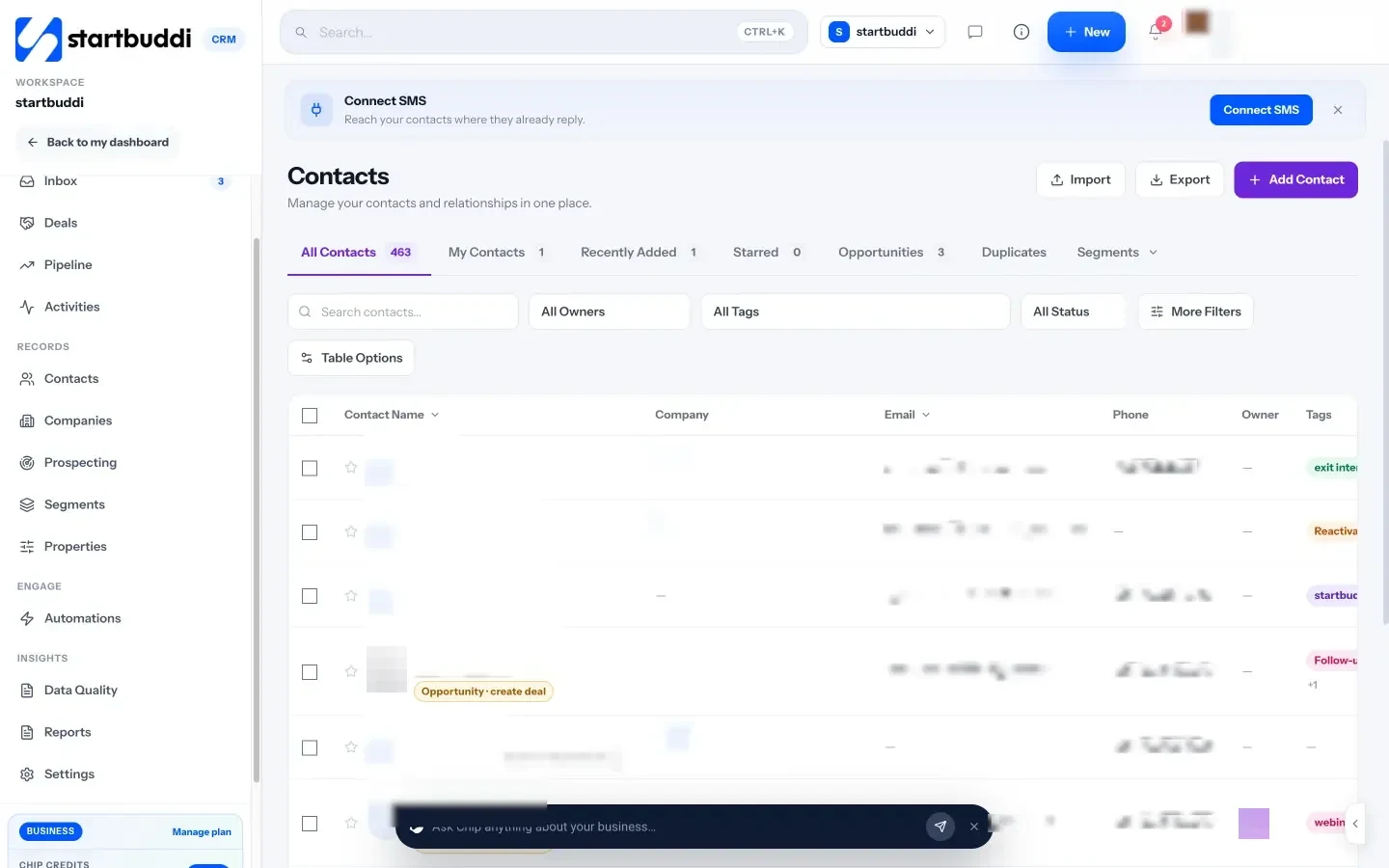
- Give your deputy their own login. In Settings, Team & Staff, invite the person who covers for you with a role that fits what they need to do, so they can see the client list and reply in the shared Inbox without borrowing your phone.
- Turn the checklist into a repeating task. In Work, open My work, click Add task, name it “Business continuity check” and add each checklist item as a subtask. Set Repeats to Monthly for the backup export and create a separate task for the six-monthly drill.
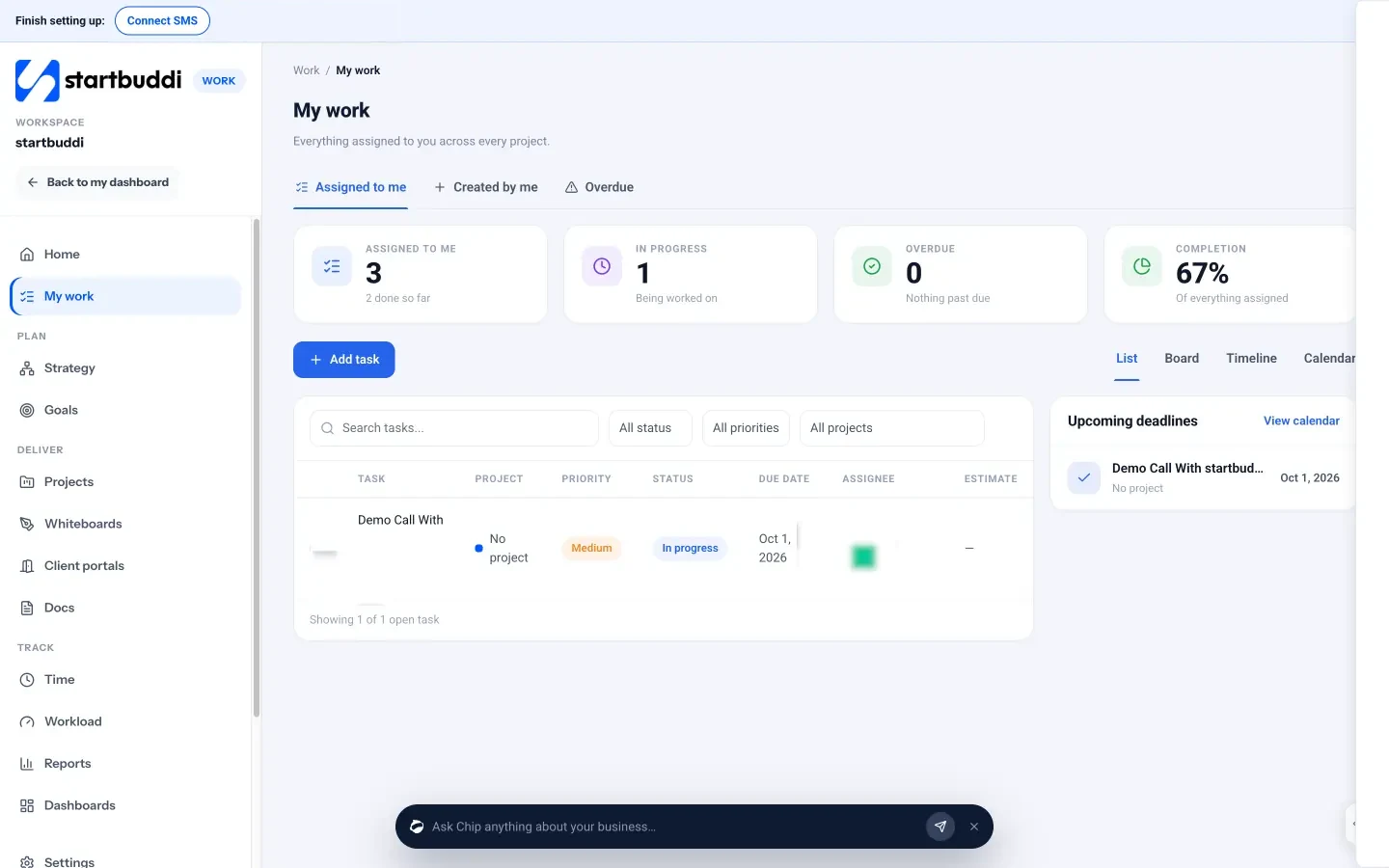
- Take payment from any device. In Money Manager, Get Paid, create a payment link or send an invoice from your phone if your laptop is gone. Clients pay by card, bank transfer, USSD or mobile money through Paystack, or by card through Stripe.
- Keep messages answered when you can’t. On the Growth plan and above, Chip can reply to customer messages “when no one on the team replies” or “outside business hours”, and steps back once you or a teammate replies.
- Store contracts and terms in Documents, so your cancellation and refund rules are reachable from any device when you need to reschedule clients.
A free plan is available; see pricing for what each plan includes.
Continue the guide
- Back to the guide: Starting a Service Business Checklist: The Complete Guide
- Previous chapter: How to start a photography business that books consistently
- This is the final chapter. Starting the guide again? Chapter 1 is how to name your business.
FAQs
What should a business continuity plan checklist include?
It should include your critical activities, how long each can stop, the risks that could stop them, one workaround per risk with a named owner, where your data and documents are, key contacts, a client message for rescheduling and your cash reserve. For a small business this fits on one page.
What are the five main parts of a business continuity plan?
A simple way to remember it is: critical activities, risks, workarounds, people and testing. You list what earns money, what could stop it, how you would keep going, who does what, and when you last checked the plan worked. Larger organisations add a formal business impact analysis and recovery time objectives.
How often should a small business test its continuity plan?
Twice a year is a sensible minimum, plus after any big change such as a new staff member, a new key tool or a move. A test can be a 30-minute walk-through of one scenario. Restore a backup at least once a year to check it actually works.
What is the difference between a business continuity plan and a disaster recovery plan?
A business continuity plan covers how the whole business keeps serving clients during a disruption: people, suppliers, cash and communication. A disaster recovery plan is narrower and covers restoring IT systems and data. Small businesses can keep both on the same page.
How much cash reserve should a small business keep?
Aim for at least one month of fixed costs to start, then build towards three months. Work it out from your own figures: add up rent, salaries, subscriptions and other costs you pay even when no work comes in. Keep it in a separate account so it doesn’t get spent by accident.
Is there a business continuity plan template for small businesses?
Yes. The one-page template on this page covers critical activities, risks and workarounds, where things are, key contacts, a client message and cash. Copy it into a document, fill it in and keep a printed copy somewhere you can reach without your phone.
Make your business harder to knock over
Write the one-page plan this week, then move your client list, documents and invoices somewhere that doesn’t depend on a single phone. Start startbuddi free and set up your monthly continuity check as a repeating task today.
Tiwalade Joanna Okedara-Kalu is the founder, CEO and CTO of startbuddi, the business system that brings clients, bookings, invoices, projects, marketing and the Chip AI assistant into one place. Tiwalade builds software around how service businesses really work day to day, and writes about client management, getting paid on time and why small businesses outgrow the tools they start with.
Founded startbuddi and leads its product and engineering