What is a standard operating procedure (SOP)?
Also called: SOP, process document, work instruction, operating procedure, playbook
A standard operating procedure (SOP) is a written, step-by-step description of how a routine task is done, so that anyone who follows it gets the same result every time.
A standard operating procedure (SOP) is a written, step-by-step description of how a routine task is done in your business, so that anyone who follows it gets the same result every time. It says what the task is, who does it, when, what they need and the exact steps in order. Think of it as a recipe for work you repeat: sending an invoice, onboarding a client, closing the shop at night or publishing a blog post.
You will also see it called an SOP, a process document, a work instruction or a playbook. In a small business the names overlap. What matters is that the knowledge lives on a page, not only in one person’s head.
Why a standard operating procedure matters for a small business
When you are the only person doing the work, the process lives in your memory. That works until you get ill, take a holiday, hire someone or simply forget a step you only do once a quarter. SOPs fix that.
- Consistent quality. Every customer gets the same service, whoever serves them.
- Faster training. A new hire can learn from the document instead of shadowing you for a week.
- Easier delegation. You can hand a task over with confidence because the steps are written down.
- Fewer mistakes. Checklists catch the steps people skip when they are busy.
- A business that can run without you. If you ever want to sell, step back or grow, written processes are part of what makes the business worth something.
How an SOP works: an example
Kwame runs a small bookkeeping practice in Accra with two assistants. Month-end reports kept going out late because each assistant did them slightly differently. He wrote a one-page SOP called “Monthly client report”:
- Purpose: send every retainer client a clear monthly summary by the 5th.
- Owner: the assistant assigned to the client. Kwame reviews.
- When: first working day of the month.
- What you need: the client’s bank statements, last month’s report and the report template.
- Steps: download statements, check every transaction is categorised, fill in the template, flag anything unusual in yellow, send to Kwame for review, then email the client with the standard cover note.
- Done when: the client has the report and it is saved in their folder.
Within two months, every report went out on time, and when one assistant left, the replacement was producing reports in her second week.
Key parts of a standard operating procedure
| Part | What to write |
|---|---|
| Title | A plain name people will search for, such as “Refund a customer”. |
| Purpose | One sentence on why the task exists and what “good” looks like. |
| Owner | The role responsible, not only a person’s name, so it survives staff changes. |
| Trigger and timing | What starts the task and how often it happens. |
| Tools and inputs | The logins, files, templates or materials needed. |
| Steps | Numbered actions, one per line, starting with a verb. |
| Checks | How to confirm it was done right. |
| Version and date | When it was last reviewed and who changed it. |
A ready-made layout helps. Our free SOP template gives you these sections to fill in.
Types of SOP
- Step-by-step list. The most common format, good for simple, linear tasks.
- Checklist. Tick boxes for tasks where order matters less than completeness, such as opening or closing a shop.
- Flowchart. Useful when the process branches: “if the customer paid by card, do this; if by bank transfer, do that”.
- Screen recording or photo guide. A short video or annotated screenshots for software tasks. Pair it with written steps so it is searchable.
Best practices and common mistakes
- Start with the tasks that hurt. Pick the jobs that go wrong most often or that only one person knows how to do.
- Keep it short. If an SOP runs to ten pages, nobody will read it. Split it into smaller procedures.
- Test it on someone else. Ask a colleague to follow it without help. Wherever they get stuck, the document needs work.
- Do not write it and forget it. Tools and prices change. Review each SOP at least once a year, or whenever the process changes.
- Do not hide it. An SOP saved in someone’s personal drive is almost as lost as one never written. Keep them in one shared place.
- Do not confuse a policy with a procedure. A policy says what the rule is (“refunds within 14 days”); an SOP says how to carry it out.
For tasks you hand to others regularly, pair the SOP with a clear owner and due date so it actually happens. Our guide to writing an employee handbook covers where policies and procedures sit together.
Related terms
A workflow automation takes an SOP a step further by letting software do some of the steps for you. A task management system is where the recurring tasks an SOP describes get assigned and tracked. An employee handbook collects your policies, and often links to the SOPs that put them into practice.
SOPs in startbuddi
You can write SOPs in Documents, which has SOP as its own document type, so you can filter the library to see every procedure in one list. The editor supports headings, numbered lists, to-do lists and tables, keeps a version every time you save, and lets you link a document to a project or task. Chip can help from inside the editor, for example to rewrite a draft more clearly or list what is missing.
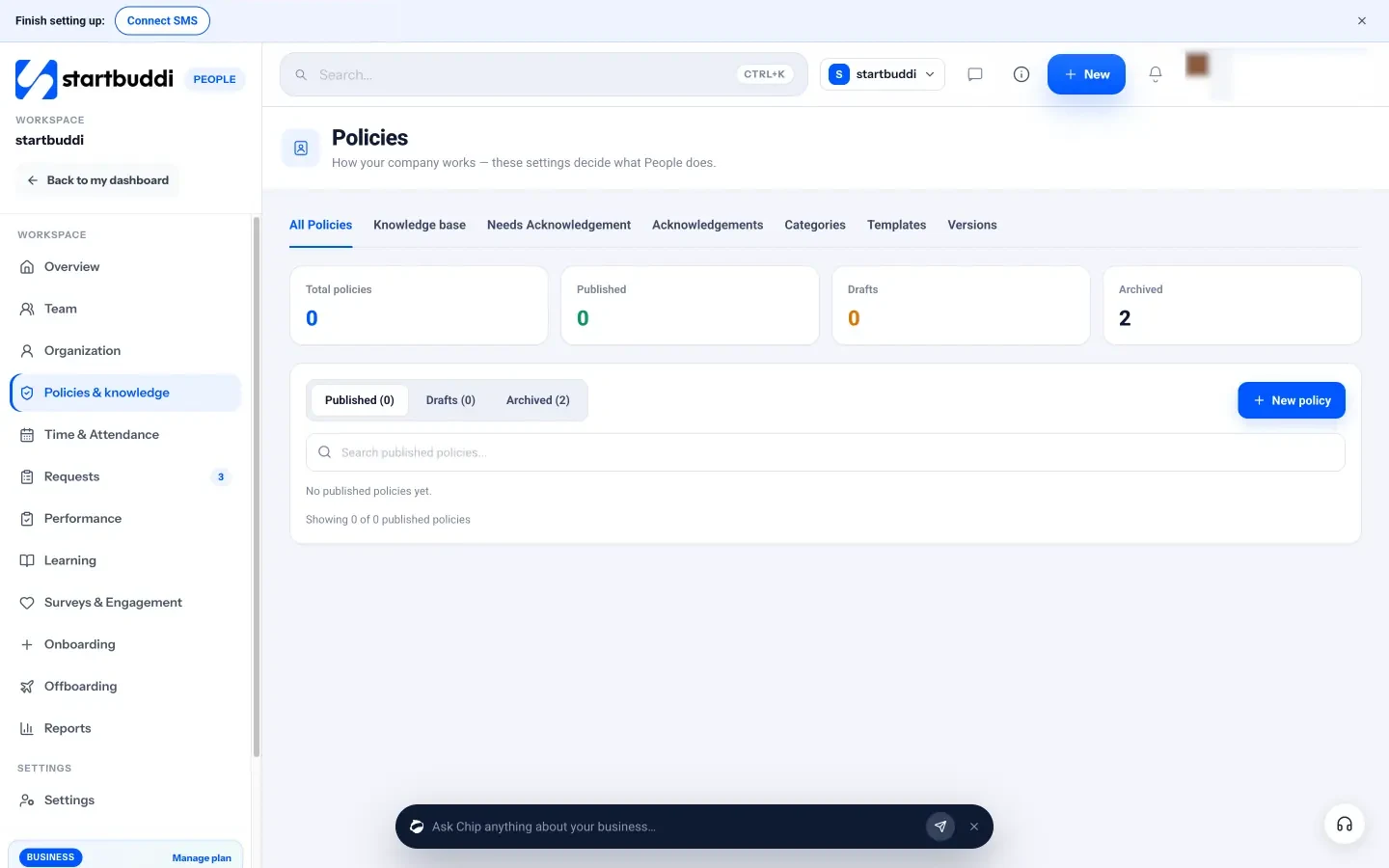
If you want people to confirm they have read a procedure, write it as a page in the Policies & knowledge area of People and use Make this a policy to ask for sign-off. Every change is kept as a version, and a changed policy asks everyone to acknowledge it again.
For procedures that repeat, create a task in Work with a daily, weekly or monthly repeat and link the SOP document to it, so the steps are one click away when the task comes due. Your next step: pick the one task only you know how to do, and write its SOP this week.
Related terms
FAQ
What does SOP stand for?
SOP stands for standard operating procedure: a written set of steps for doing a routine task the same way every time.
How long should an SOP be?
As short as possible while still being complete. Most small-business SOPs fit on one or two pages. If it grows longer, split it into several procedures.
What is the difference between a policy and an SOP?
A policy states a rule or decision, such as your refund window. An SOP explains the steps to carry that rule out.
How often should I update my SOPs?
Review each one at least once a year and whenever the tools, prices or people involved change.
Tiwalade Joanna Okedara-Kalu is the founder, CEO and CTO of startbuddi, the business system that brings clients, bookings, invoices, projects, marketing and the Chip AI assistant into one place. Tiwalade builds software around how service businesses really work day to day, and writes about client management, getting paid on time and why small businesses outgrow the tools they start with.
Founded startbuddi and leads its product and engineering