How to write an employee handbook for a small team
What to put in an employee handbook, how to write it in plain language in a weekend, sample wording, and how to keep it up to date as your team grows.


- A small-team employee handbook should be 10 to 20 pages of plain answers to the questions people actually ask. Decide your rules, start from a template, write in your own voice, have the risky sections checked, collect read confirmations and review it on a schedule.
An employee handbook is a short, written guide to how your business works: what you expect from people, what they can expect from you, and the rules for things like pay, leave, conduct and complaints. For a small team, the best employee handbook is not a 60-page legal document. It’s 10 to 20 pages of plain answers to the questions people keep asking, written in your own voice and updated whenever a rule changes.
This guide shows you what to put in it, how to write it in a weekend, and how to keep it alive once the team grows.
Why a small team needs an employee handbook
When it’s you and one other person, the rules live in your head. By the time you have four or five people, that stops working. Different people get different answers, new hires ask the same questions, and a disagreement about leave or lateness turns into a debate about what was “agreed”.
A handbook fixes that in three ways:
- Consistency. Everyone gets the same answer, whether they ask you, their manager or read it themselves.
- Speed. New hires learn how things work in an hour instead of a month. It pairs well with a proper employee onboarding plan.
- Protection. Written rules for discipline, complaints and data handling show you acted fairly if a dispute ever gets serious.
In the UK, for example, the Acas Code of Practice on disciplinary and grievance procedures says rules and procedures should be written down, specific and clear. An employment tribunal can adjust an award by up to 25% if either side unreasonably fails to follow the Code. Other countries have their own rules, but the principle travels well: write it down before you need it.
This is general information, not legal advice. Check what applies to you with your labour ministry, an employment lawyer or an official body such as Acas in the UK.
Employee handbook vs contract vs policy
These three documents get mixed up. Here’s how they fit together.
| Document | What it is | Example |
|---|---|---|
| Employment contract or written terms | The individual agreement with one person. Legally binding. | Salary, job title, start date, notice period |
| Policy | One rule on one topic, applied to everyone (or a group). | Leave policy, expenses policy, remote work policy |
| Employee handbook | The collection of your policies plus the context: who you are, how you work, where to get help. | Everything a new hire needs to read in week one |
Some things must be in writing for each person. In Nigeria, section 7 of the Labour Act requires a written statement of key terms (pay, hours, holidays, sick pay, notice) within three months of the start date. In the UK, a written statement of employment particulars is due on day one. A handbook doesn’t replace those. It supports them and can hold the detail, such as how to request leave or claim expenses.
A useful rule: put things that are personal (pay, role) in the contract, and things that apply to everyone (how leave works) in the handbook. Then say in the contract that the handbook’s policies apply and may be updated.
What to include in an employee handbook
Use this as your table of contents. You don’t need every section on day one. Start with the ones marked “must have” and add the rest as you grow.
Must have
- Welcome and how we work. Who you serve, what you care about, how decisions are made. Half a page.
- Working hours and attendance. Core hours, where people work, how to report lateness or absence.
- Pay and expenses. Pay day, how to claim expenses, what needs approval first.
- Leave. Annual leave, sick leave, public holidays, parental leave, how to request time off and who approves it. See our guide to writing a leave policy for a small business.
- Conduct. How you expect people to treat customers and each other, and what counts as serious misconduct.
- Disciplinary and grievance procedures. What happens if there’s a problem, and how an employee raises a complaint.
- Data and confidentiality. How to handle customer and staff information, passwords and devices.
Good to have
- Remote work. Equipment, working hours across time zones, reachable times.
- Performance and reviews. How often reviews happen and what they cover.
- Learning. Training budget, required courses, how to ask for help.
- Health and safety. Especially for trades, cleaning, logistics or anyone on customer sites.
- Anti-harassment and equal treatment. What’s not acceptable and how to report it safely.
- Leaving the company. Notice, handover, returning equipment, final pay.
- Benefits and celebrations. Health cover, bonuses, birthdays, team events.
A note on data protection
If you hold staff records, you hold personal data. In Nigeria that brings you under the Nigeria Data Protection Act 2023, overseen by the Nigeria Data Protection Commission, and other countries have similar laws. Your handbook should explain what staff data you collect, why, who can see it and how long you keep it, as well as how staff must treat customer data.
How to write an employee handbook in seven steps
1. List the questions people already ask
Scroll back through your team chat and WhatsApp. Every “can I…”, “how do I…” and “what’s the rule for…” is a handbook section. This list keeps you focused on what’s useful, not what looks impressive.
2. Decide your actual rules
Many small businesses have never decided. How many leave days? Does unused leave carry over? Who approves expenses over a certain amount? Decide these first, with your manager or co-founder if you have one. Check them against the legal minimums in your country.
3. Start from a template, then make it yours
A template saves hours. Our free employee handbook template gives you the structure. Then rewrite every section in your own words. A handbook that sounds like a law firm won’t get read.
4. Write in plain language
Short sentences. “You” and “we”. Examples instead of abstractions. Compare these two versions of the same rule:
Before: “Employees are required to provide notification of absence due to illness at the earliest reasonable opportunity prior to the commencement of their scheduled working hours.”
After: “If you’re sick, message your manager before 9am. If you’re off for more than two days, we’ll ask for a doctor’s note.”
5. Get a professional to check the risky bits
You can write most of it yourself. Ask an employment lawyer or HR adviser to review discipline, grievance, termination, data protection and anything involving pay. That’s usually a few hours of their time, not a full drafting job.
6. Share it and ask people to confirm they’ve read it
A handbook no one reads protects no one. Ask each person to confirm they’ve read it, and keep a record with the date and the version. When you change a policy, ask again.
7. Review it on a schedule
Put a review date in the calendar every six or twelve months, and also whenever the law changes, you hire in a new country or a rule causes confusion. Note what changed and when.
Sample wording you can adapt
Here are short examples in a friendly, direct tone. Adapt the numbers to your own rules and local law.
- Working hours: “Our core hours are 10am to 4pm, Monday to Friday. Outside those, plan your day as you like, as long as your work gets done and customers get answers within one working day.”
- Expenses: “Keep the receipt. Claim within 30 days. Ask your manager before spending more than ₦50,000 on anything.”
- Customer data: “Customer phone numbers and emails stay in our systems. Don’t copy them to personal phones or spreadsheets.”
- Raising a concern: “If something’s wrong, tell your manager. If it’s about your manager, tell the founder. We’ll reply within five working days and keep it confidential.”
A starter outline for a five-person business
If you want a shape to aim for, here’s a realistic first version for a small service business. It fits in about 15 pages and takes a focused weekend to draft.
| Section | Length | What it answers |
|---|---|---|
| Welcome and how we work | 1 page | Why we exist, who our customers are, how we make decisions |
| Your first weeks | 1 page | What happens in onboarding, who your buddy is, when reviews happen |
| Hours, location and attendance | 1 to 2 pages | When and where we work, what to do if you’re late or unwell |
| Leave and public holidays | 2 pages | How many days, how to request them, who approves |
| Pay, expenses and equipment | 2 pages | Pay day, claiming expenses, looking after company devices |
| Customers and data | 2 pages | How we talk to customers, where their data lives, what not to share |
| Conduct, discipline and grievances | 3 pages | What we expect, what happens if things go wrong, how to raise a concern |
| Leaving us | 1 page | Notice, handover, returning equipment |
| Where to get help | Half a page | Who to ask about what, and how quickly they’ll reply |
Write the welcome section last. Once you’ve written the rules, it’s much easier to explain the values behind them in a few honest sentences.
Common employee handbook mistakes
- Copying a big company’s handbook. It will mention departments, benefits and processes you don’t have, and people will ignore the rest.
- Promising what you can’t deliver. If you write it, people will hold you to it. Don’t include a benefit you might withdraw next quarter.
- Writing it once and forgetting it. An out-of-date handbook is worse than none, because it gives the wrong answer with confidence.
- No version history. If a rule changes, you need to know which version applied to a request made six months ago.
- Keeping it in a PDF no one can find. Put it somewhere searchable that everyone can reach from their phone.
- Rules that don’t match reality. If the handbook says managers approve leave but the founder actually does, fix one of them.
How startbuddi helps you build and run your handbook
In startbuddi, your handbook lives in Policies & knowledge inside the People module. The idea is simple: write your company handbook once, and the rules actually run your leave, approvals and onboarding, while you can see who has read them.
Structured policies, not just text. There are 15 built-in policy categories, including Employment, Working hours, Attendance, Leave, Remote work, Expenses, Performance, Onboarding and Offboarding, plus a Custom category for anything else. The New policy wizard walks you through the policy type, a few questions, rules and approvals, and who it applies to (everyone, team members, contractors or specific departments). Publishing a Leave, Working hours or Attendance policy changes how requests and approvals behave in the app.
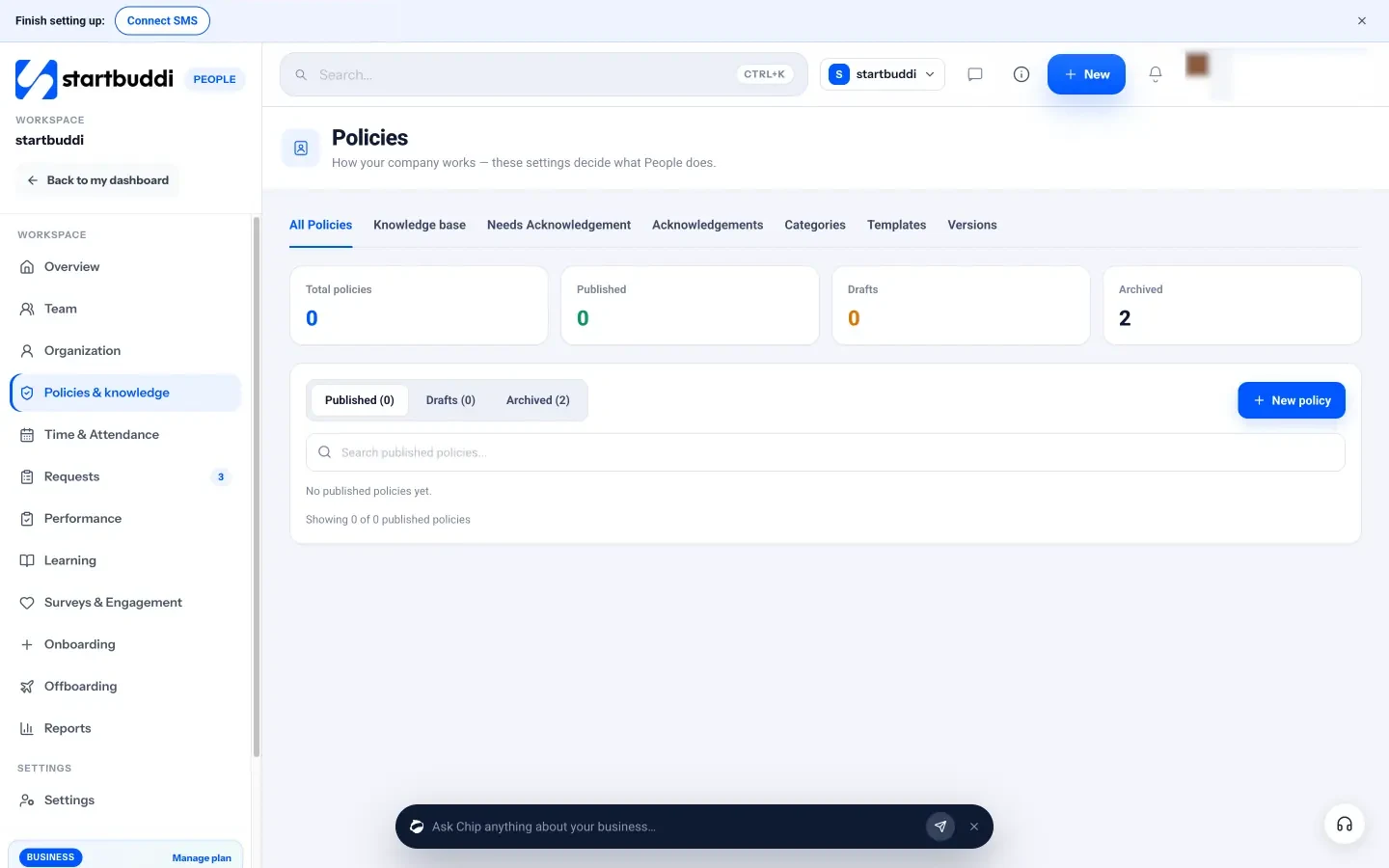
Templates to start from. Policy templates give you a structured starting point that you then edit for your own business.
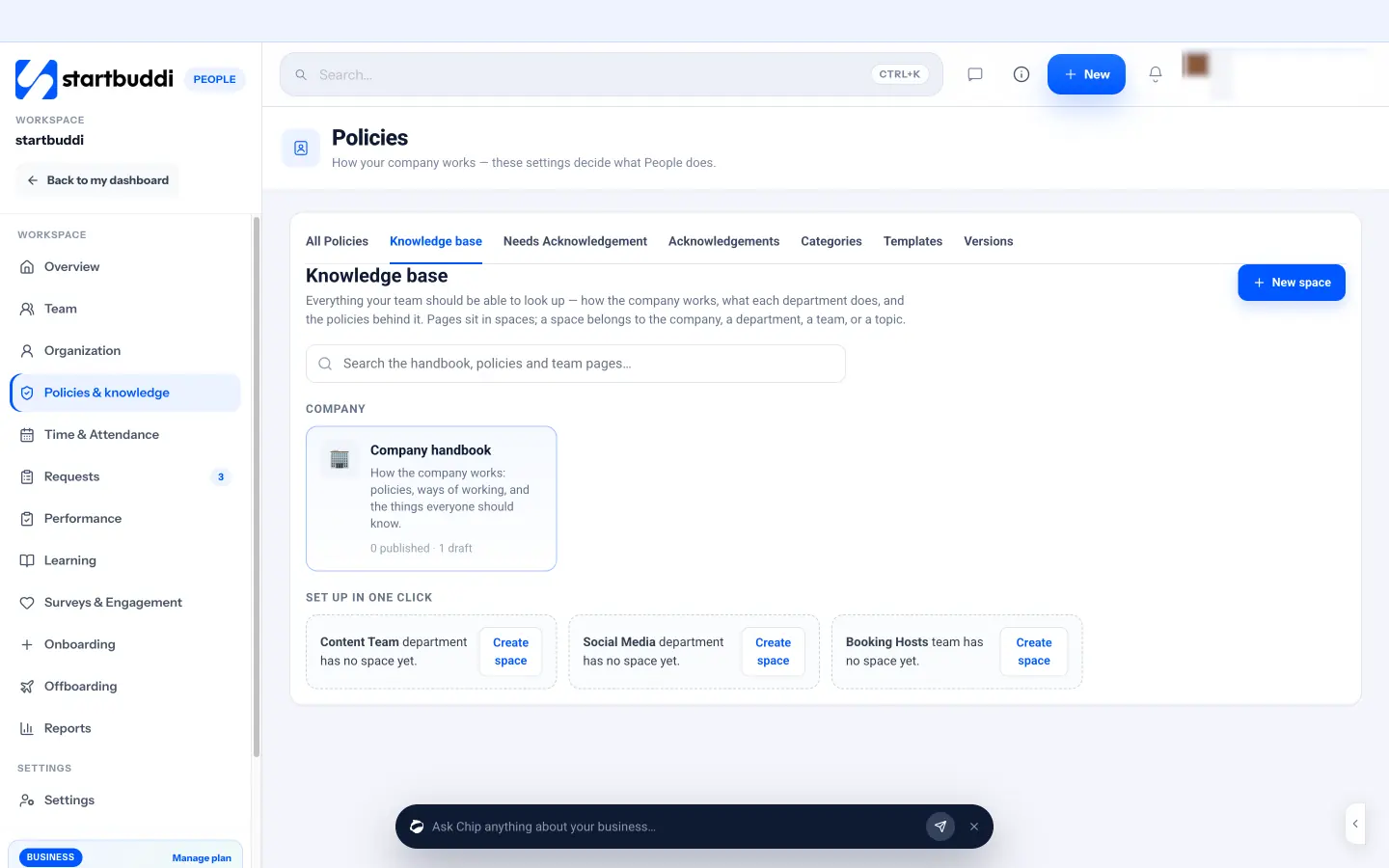
A searchable knowledge base. Pages sit in spaces that belong to the company, a department, a team or a topic, and startbuddi creates a handbook space for your company. You can set who sees each space and search across the handbook, policies and team pages. Any page can become a policy, with or without sign-off.
Acknowledgements and versions. Employees see when a policy needs their acknowledgement and confirm with one click. The Acknowledgements view shows who has signed, who is overdue, and a Remind button for anyone outstanding. When you change a policy, everyone is asked to sign again, and every change stays traceable: older requests keep the rule version that applied at the time.
Chip HR answers from your own handbook. In the New policy wizard, describe how your company handles something and Chip suggests answers to the questions. Once the handbook is published, Chip HR answers staff questions such as “What is the rule for sick leave?” from your published policies and names the page it used. If nothing covers the question, it says so plainly instead of guessing. It also reminds you who still needs to acknowledge a policy.
People and Policies are available on every plan. Asking teammates to read and sign your handbook means they need a seat in your account, which starts on the Starter plan (2 seats included, 5 on Growth). Every paid plan has a 30-day trial. See pricing.
Your next step
This week, list the ten questions your team asks most often and answer each one in two or three plain sentences. That’s the first draft of your handbook. Then download the free employee handbook template to fill the gaps, or publish it straight into startbuddi Policies & knowledge so people can find it, read it and sign it in one place.
Sources
- Acas: Code of Practice on disciplinary and grievance procedures
- Nigeria Labour Act, section 7: written particulars of terms of employment
- GOV.UK: Written statement of employment particulars
- Nigeria Data Protection Commission (Nigeria Data Protection Act 2023)
Frequently asked questions
How long should an employee handbook be?
For a small team, 10 to 20 pages is plenty. Cover the must-have sections first and add more only when a real question comes up.
Is an employee handbook legally required?
Usually not as a single document, but many countries require certain terms in writing for each employee, and written procedures help if a dispute arises. Check with your local labour authority.
Can I change my handbook later?
Yes. Keep a version history, tell people what changed and ask them to confirm they've read the new version. Changes to contract terms may need the employee's agreement.
Should contractors get the handbook?
Give contractors the parts that apply to them, such as data handling and conduct with customers, but keep employment policies like leave for employees.
Chinedu Kalu is the co-founder and chief operating officer of startbuddi, responsible for how the company runs day to day. Chinedu writes about the operational side of a small business: registering and running the company, money, hiring and the routines that keep a team on track.
Co-founded startbuddi and runs its operations