
How to start a cleaning business: setup, pricing, scheduling and your first team
A four-part guide to starting a cleaning business: choose your market, price and quote jobs, win clients and schedule cleans, then hire and train a team that keeps standards high.


This guide explains how to start a cleaning business, from deciding what kind of cleaning you will do, to pricing your first quote, scheduling recurring cleans without double-booking, and hiring and training the people who will carry your name into clients’ homes and offices. It is written for people starting small, often as a solo cleaner or with one or two helpers, in any country: a house cleaner in Manchester, an office cleaning start-up in Lagos, an Airbnb turnover service in Cape Town, an end-of-tenancy specialist in Toronto.
The short version: choose one market to start (homes, offices or a specialist service), register and insure the business properly, price every job from your real costs, win your first clients locally and ask every happy client for a referral, put regular clients on a fixed schedule, and write down exactly what a clean includes so every cleaner does it the same way.
Each chapter starts with the business thinking, with worked numbers, templates and mistakes to avoid, then shows how to run that part in startbuddi, and where another kind of tool fits better. By the end you will have a clear service list, a pricing method, a scheduling routine and a plan for your first hires.
Plan your cleaning business: market, costs and legal setup
Cleaning is one of the most accessible businesses to start. You do not need a degree, the equipment costs are modest, and demand does not disappear in a downturn: homes and offices always need cleaning. That accessibility is also the challenge. Anyone can start, so the businesses that last are the ones that choose a clear market, price properly, and turn up reliably. This chapter covers choosing what kind of cleaning to offer, working out your start-up costs, and setting the business up legally.
Is a cleaning business a good idea?
Demand is steady and broad. In the US alone, the Bureau of Labor Statistics counts about 2.4 million janitors and building cleaners, with around 321,800 job openings a year projected on average over the decade to 2035 (BLS, janitors and building cleaners). That is one category in one country, but it gives a sense of how much cleaning work exists and how much of it turns over every year.
The same source reports a median wage of $17.71 an hour for janitors and building cleaners in May 2025. That matters for you as an owner in two ways: it is a guide to what you may need to pay staff in the US, and it reminds you that profit in cleaning comes from pricing, efficiency and keeping clients, not from the hourly rate alone.
Choose your market
"Cleaning" covers very different businesses. Choose one to start with; you can add others later.
| Market | Who pays | Typical work | What to know |
|---|---|---|---|
| Residential (regular) | Households | Weekly or fortnightly home cleans | Easy to start; recurring income; trust and consistency matter most |
| Residential (one-off) | Households, landlords, letting agents | Deep cleans, end of tenancy, move-in and move-out | Higher price per job, but you must keep finding new clients |
| Short-let turnovers | Airbnb hosts, property managers | Cleaning and resetting between guests | Tight time windows, laundry, restocking, same-day demands |
| Commercial | Offices, shops, clinics, schools | Evening or early-morning contract cleaning | Larger contracts, written tenders, staff and supervision needed |
| Specialist | Homes and businesses | Carpets, windows, post-construction, kitchens, sanitisation | Special equipment and training; less competition |
Most people start with regular residential cleaning because it needs little equipment and builds recurring income quickly. Commercial work pays in bigger contracts but usually needs a team, insurance that clients will check, and the ability to clean out of hours reliably.
Residential or commercial: a closer look
The two main paths feel very different day to day, so it is worth picturing a normal week in each before you choose.
Residential cleaning happens in daytime hours, in people's homes, usually with the client out at work. You deal with many clients, each paying a modest amount, and relationships are personal: clients notice who comes, whether the same cleaner returns, and small details like how the towels are folded. Income builds steadily as you add regular clients, and losing one client is not a disaster. Marketing is constant but local.
Commercial cleaning happens early in the morning or in the evening, in offices, shops, clinics or schools. You deal with fewer clients, each paying more, often on a contract. Buyers care about reliability, insurance, supervision and value, and may compare several written quotes. Losing one client can remove a large share of your income, so you need several contracts before you are safe. Work is steadier week to week, but winning it takes longer.
A common path is to start residential, build a reputation and a small team, then add a few small commercial contracts (a dental practice, a small office) that fit around the residential schedule.
Know your local competition
Before you set prices or print flyers, spend an afternoon researching who already cleans in your area. Search for cleaning services in your town, read their reviews (especially the bad ones), look at their service lists and, where they publish them, their prices. Ask friends and neighbours who they use and what annoys them.
You are looking for a gap. Common ones: nobody reliable does end-of-tenancy cleans near the university; the big firms will not take small offices; local cleaners do not use eco-friendly products; nobody offers online booking; reviews keep complaining about cleaners changing every week. A gap gives you something specific to say in your marketing.
What it costs to start
A residential cleaning business can start with very little. A worked example for a solo cleaner, using illustrative prices you should check locally:
| Item | USD example | NGN example |
|---|---|---|
| Vacuum cleaner (commercial-grade, bagged) | $250 | ₦180,000 |
| Mop, buckets, caddies, brushes, microfibre cloths | $120 | ₦60,000 |
| First stock of cleaning products | $100 | ₦50,000 |
| Gloves, aprons, basic protective equipment | $40 | ₦20,000 |
| Registration and any local licence | $50 to $300 | varies |
| Insurance (first year, often paid monthly) | $500 to $1,500 | varies |
| Simple branding: uniform tops, business cards, flyers | $150 | ₦80,000 |
| Booking, invoicing and client tools | $0 to $50 a month | varies |
The biggest costs usually come later: transport (a car or van, fuel, or fares between jobs), wages when you hire, and more equipment as you add services. If you do not drive, choose a small area you can cover by public transport or on foot, and price in travel time.
An equipment checklist for day one
- A reliable vacuum with the right attachments for stairs, upholstery and edges.
- Mop and bucket (a flat mop with washable pads saves time and water).
- Colour-coded microfibre cloths: one colour for bathrooms, another for kitchens, another for general surfaces, so germs are not carried between rooms.
- Caddy to carry products from room to room.
- Scrubbing brushes, a toilet brush set per client or a disinfection routine, a squeegee, extendable duster.
- A small set of products: all-purpose cleaner, bathroom cleaner, glass cleaner, degreaser, floor cleaner, disinfectant. Fewer products, used well, beats a van full of bottles.
- Gloves, aprons and eye protection.
- Bin bags, spare vacuum bags and filters.
A one-page plan with a break-even number
You do not need a long business plan, but you do need to know how many cleans a month keep the lights on. Write one page covering: your market and area, your services and prices, your costs, and your break-even point.
Worked example: a solo cleaner in Nairobi has fixed monthly costs of KSh 18,000 (insurance, phone, transport pass, software, product restock) and wants to take home KSh 60,000 a month. That is KSh 78,000 needed. If a regular clean is priced at KSh 2,400 and products and travel for each clean cost about KSh 300, each clean contributes KSh 2,100. Break-even is 78,000 ÷ 2,100, so about 37 cleans a month, or roughly 9 a week. That tells you how many regular clients to aim for before giving up other income. Our free business plan template has space for these numbers.
Stand out with a clear position
Small cleaning businesses win by being specific. Some positions that work: "the same cleaner every time", "eco-friendly products only", "specialists in end-of-tenancy cleans that get deposits back", "Airbnb turnovers with laundry and restocking included", "offices cleaned after 7pm, no disruption". Pick one that fits a gap you found, use it in your name, profile and flyers, and make sure your operations actually deliver it.
Paying for the start
Most cleaning businesses are funded from savings, and the low start-up cost is one of the attractions. Keep it lean: buy the equipment you need for your first service, not every service you might offer, and add kit as the work pays for it. If you need a van, consider starting with a smaller area you can cover by public transport or a car you already have, and buy a vehicle once regular income can cover the payments. If you do borrow, borrow for equipment that earns money, and work out how many cleans a month the repayments equal before you sign. Many owners keep another job part-time for the first few months while the regular client list builds, then move to full-time cleaning once bookings cover their break-even number.
Set up the business legally
This is general information, not legal or tax advice. Rules vary by country, state and city, so check with the official bodies where you operate.
The basics are similar in most places:
- Register the business. Many cleaners start as sole traders or sole proprietors, and form a company later. In the UK, GOV.UK explains how to set up as a sole trader. In Nigeria, business names are registered with the Corporate Affairs Commission. In Canada, see starting a business on canada.ca.
- Check licences and permits. Some cities and states require a general business licence for cleaning services. In the US, the SBA's guide to licences and permits explains that requirements vary by activity and location.
- Get insurance. Public or general liability insurance covers damage to a client's property or injury to someone. Many commercial clients will ask for proof before signing. When you hire, employers' liability or workers' compensation insurance may be legally required. Some cleaning businesses also take out a bond or cover for theft by employees, which reassures clients who give you keys. The SBA's business insurance guide suggests comparing agents and reviewing cover every year.
- Open a business bank account and keep every receipt from day one.
- Understand tax. Register with your tax authority and set aside a share of every payment. An accountant can tell you how much, and whether sales tax or VAT applies at your turnover.
Decide your service list
A clear service list makes quoting, booking and training easier. For a residential start-up, four services are plenty:
- Regular clean (weekly or fortnightly): kitchen, bathrooms, dusting, floors, bins, beds made.
- Deep clean: everything in a regular clean, plus inside cupboards, skirting boards, limescale, behind appliances, windows inside.
- End of tenancy: a deep clean to a letting agent's checklist, with oven and fridge included.
- Add-ons: oven, fridge, inside windows, laundry, ironing, balcony.
Write a checklist for each service before you take your first booking. It becomes your quote, your promise to the client and your training material. Chapter 4 covers checklists in detail.
Name, brand and trust signals
Pick a name that says what you do and where, is easy to spell, and is free to register. Then build trust signals, because clients are letting a stranger into their home: a simple, consistent logo; uniforms or branded tops; clear photos of real work (with permission); your insurance stated plainly; and reviews. For home cleaning, trust sells more than price.
Mistakes to avoid at the start
- Offering everything to everyone. Start with one market and three or four services.
- Skipping insurance to save money.
- Buying cheap equipment. A domestic vacuum used eight hours a day will not last.
- Covering too big an area. Travel time between jobs is unpaid time.
- No written service checklist. Without one, every argument about what "a clean" includes is yours to lose.
How to set up your services in startbuddi
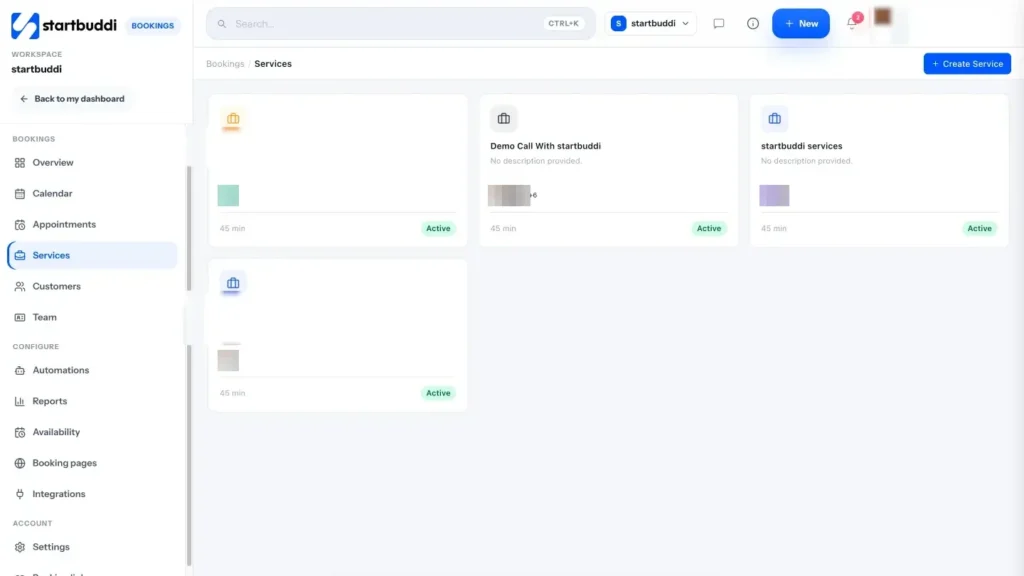
In startbuddi, your service list becomes bookable services under Bookings, then Services. Click Create Service and give each one a name, a description (paste in the summary of your checklist), a duration and a colour, then assign it to yourself or a teammate. In the full editor you can set a price and currency (including USD, GBP, EUR, NGN, KES, ZAR and GHS), and add booking questions such as number of bedrooms and bathrooms, pets, parking and access instructions. Answers can be saved to the client's contact record.
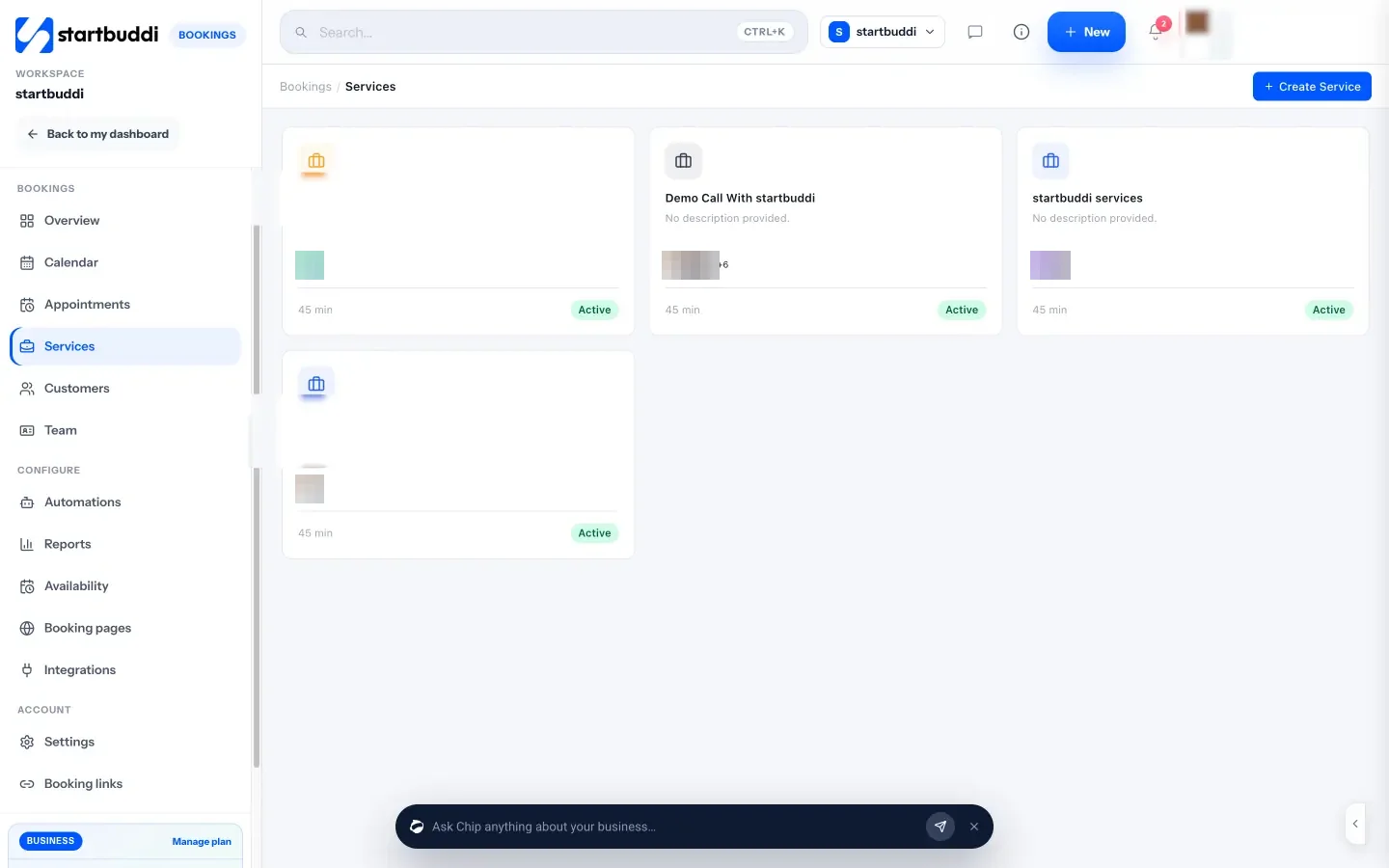
Be aware of one limit: service durations in Bookings go up to two hours. That suits quote visits, short regular cleans and add-ons. For longer jobs, such as a five-hour deep clean or an office contract, many cleaners take the booking for a quote visit online, then schedule the job itself as a task in Work (chapter 3 covers this). If you also want a simple web presence, startbuddi's business pages in Publish let you put your services and booking link on a page of your own. For the full picture of running a home service business, see our guide on how to run a home service business.
Price and quote cleaning jobs so every job makes money
Pricing is where most new cleaning businesses go wrong. They look at what competitors charge, knock a bit off to win work, and discover months later that after travel, products, insurance and their own unpaid hours, they are earning less than minimum wage. This chapter shows you how to build a price from your real costs, the main pricing methods for cleaning, worked quotes for homes and offices, how to write a quote clients say yes to, and how deposits and cancellation fees protect your income.
Know your cost per hour
Every cleaning price should start from what an hour of cleaning actually costs you. Four parts:
- Labour: what you pay the cleaner per hour, or what you want to pay yourself, plus any employer taxes and holiday pay.
- Supplies: products, cloths, bags, and wear on equipment, per hour of cleaning.
- Overheads: insurance, phone, software, marketing, accountant, spread across your working hours.
- Travel: time and cost between jobs, which is usually unpaid unless you price it in.
Then add profit on top. Profit is not a luxury: it pays for replacing equipment, covering quiet weeks and growing the business.
The same calculation in other places, with illustrative numbers:
| Where | Cost per hour | With 25% margin |
|---|---|---|
| UK | £17.50 | about £23.50 an hour |
| Nigeria (Lagos) | ₦3,000 | about ₦4,000 an hour |
| Kenya (Nairobi) | KSh 450 | about KSh 600 an hour |
| South Africa (Johannesburg) | R95 | about R127 an hour |
These are examples, not market rates. Work out your own costs, then compare your result with local prices. If your cost-based rate is far above the market, look for savings (a smaller area, better equipment, fewer wasted trips) or a better-paying market; if it is far below, you are probably underpricing.
Choose a pricing method
| Method | How it works | Best for | Watch out for |
|---|---|---|---|
| Hourly | Client pays for time on site | New clients, unclear jobs, add-ons | Clients worry about slow cleaners; you earn less as you get faster |
| Flat rate per job | One price per clean, based on size | Regular home cleans, end of tenancy | You need a good estimate of time |
| Per room or per bedroom | Set prices by number of bedrooms and bathrooms | Residential; quick online quotes | Homes of the same size vary a lot in condition |
| Per square foot or square metre | Price per area cleaned | Commercial contracts, post-construction | Needs accurate measurements and a site visit |
| Monthly contract | Fixed monthly fee for a set schedule | Offices, shops, regular homes | Scope must be written down clearly |
Most residential businesses end up with flat rates by home size for regular cleans, and hourly or flat rates for deep cleans and add-ons. Clients prefer knowing the price upfront. You prefer being paid for efficiency.
Worked quote: a regular home clean
A three-bedroom, two-bathroom house, fortnightly. From experience (or a timed first clean), it takes one cleaner 3 hours. At $39 an hour, that is $117. You might set your published price for this size of home at $120 per fortnightly clean, and $150 for a one-off clean of the same home, because first cleans take longer and one-off clients cost more to win.
Build a simple price list from the same logic:
| Home size | Estimated time | Regular clean | One-off or first clean |
|---|---|---|---|
| 1 bed, 1 bath | 2 hours | $80 | $100 |
| 2 bed, 1 bath | 2.5 hours | $100 | $125 |
| 3 bed, 2 bath | 3 hours | $120 | $150 |
| 4 bed, 3 bath | 4 hours | $160 | $200 |
Our free price list template gives you a layout for publishing yours.
Worked quote: a small office
A 2,000 square foot office, cleaned three evenings a week. A site visit shows: a kitchen, two toilets, open-plan desks and one meeting room. You estimate 1.5 hours per visit for one cleaner, so 4.5 hours a week, or about 19.5 hours a month (4.33 weeks). At $39 an hour, that is about $760 a month. Add supplies the client expects you to provide (hand soap, toilet paper, bin liners) at cost plus a margin, or agree the client supplies them. Quote $780 a month on a 12-month contract with a 30-day notice period.
Price your add-ons
Add-ons raise the value of each visit with little extra travel. Price them from the time they take, with a small premium for the unpleasant ones.
| Add-on | Typical extra time | Example price at $39 an hour |
|---|---|---|
| Inside oven | 1 to 1.5 hours | $50 |
| Inside fridge | 30 minutes | $20 |
| Inside windows (per room) | 15 minutes | $10 |
| Change bed linen (per bed) | 10 minutes | $8 |
| Laundry, one load washed and folded | 20 minutes of active time | $15 |
| Inside kitchen cupboards | 45 minutes | $30 |
Recurring discounts and minimums
Regular clients are worth more to you than one-off clients: no marketing cost, predictable income, faster cleans once the home is under control. It is fair to charge them less per clean, and it encourages people to commit. A common structure is a one-off price, a slightly lower fortnightly price, and a lower weekly price, with monthly cleans priced close to one-off because homes get dirtier between visits.
Set a minimum charge per visit, such as two hours. Very short jobs cost almost as much in travel and setup as longer ones, and a minimum keeps your day efficient.
Worked quote: a short-let turnover
A one-bedroom apartment in Cape Town rented on a short-let platform. Each turnover includes a full clean, changing bed linen and towels, restocking toiletries and taking out rubbish, and must be finished between 11am check-out and 3pm check-in. It takes 1.5 hours on site. Your cost per hour is R95, so labour and overheads are about R143. Laundry of linen at a local service costs R80 per turnover. Restocking items are charged at cost. With a margin, you might quote R320 per turnover plus restock items, and a higher price for same-day bookings with less than 24 hours' notice. The host's reviews depend on your work, so reliability matters more than a low price.
Commercial quotes: what buyers look for
Commercial buyers compare quotes carefully. Beyond the price, a winning quote shows:
- A clear specification: which areas, which tasks, how often (daily, weekly, monthly).
- Staffing: who will clean, how they are trained and supervised, and cover for absences.
- Insurance and any certificates, with copies available.
- How quality is checked and how complaints are handled, with response times.
- Security: how keys and alarm codes are handled.
- References from similar clients.
Take time over the first few commercial quotes. A well-written one can be reused, with changes, for every tender that follows.
What to put in a cleaning quote
- Your business name, contact details and insurance statement.
- The client's name and property address.
- The service and a short checklist of what is included, and what is not.
- Frequency, day and time window.
- Price per clean or per month, and whether tax is included.
- Payment terms: when you invoice, how to pay, any deposit.
- Your cancellation and lockout policy.
- How long the quote is valid.
Our free quote and estimate template covers these points.
Tax on your prices
If you are registered for VAT, GST or sales tax, say clearly on every quote whether prices include it. Household clients compare the final amount, so many residential cleaners show tax-inclusive prices; business clients usually expect prices before tax. Your accountant or tax authority can tell you whether and when you need to register.
Deposits, cancellations and lockouts
Last-minute cancellations and lockouts (you arrive and cannot get in) cost you a paid slot you cannot refill. A clear policy, agreed in writing before the first clean, protects you without upsetting good clients. A common approach:
- A deposit for one-off and deep cleans, taken at booking.
- Free cancellation with 48 hours' notice.
- A fee, often 50% of the clean, for cancellations with less notice or lockouts.
- Regular clients get one free late change a year as goodwill.
Our free cancellation policy template helps you write one, and our post on reducing no-show appointments covers the wording.
How clients will pay you
Make paying easy and predictable. For regular home clients, the simplest arrangements are an invoice after each clean with a pay link, a monthly invoice for all cleans that month, or a subscription that charges automatically. For one-off cleans, take a deposit when they book and the balance on the day. For commercial contracts, invoice monthly in advance or in arrears as agreed in the contract, with clear payment terms. Avoid collecting cash at the door where you can: it is hard to track, awkward for cleaners and risky to carry.
Talking about price
New owners often apologise for their prices. Don't. State the price, explain what is included, and stop. If someone says it is too expensive, ask what they are comparing it with. Often it is a single cleaner working informally without insurance, and you can explain the difference calmly: "We're insured, every clean follows a checklist, and if your usual cleaner is away we send a trained replacement." If budget really is the issue, offer less frequent cleans or a shorter list of rooms rather than cutting your rate.
When a job takes longer than quoted
It happens, especially on first cleans and deep cleans. Agree in your terms what happens: for example, "If the job needs more than 30 minutes beyond the estimate, we'll check with you before continuing." Then call or message the client from site, explain what is taking longer and why, and give them the choice. Adjust the price for future regular cleans if the home consistently takes longer than your estimate.
Raising prices
Costs rise every year: wages, products, fuel, insurance. Review prices once a year and raise them in small steps rather than waiting until you are losing money. Give regular clients at least a month's notice, explain briefly, and keep the message short and friendly.
Pricing mistakes to avoid
- Copying competitors' prices without knowing their costs.
- Forgetting travel time. Four jobs a day with 30 minutes between each is two unpaid hours.
- Quoting without seeing the property for deep cleans and offices. Ask for photos or visit.
- Discounting the first clean, which is usually the hardest.
- No written scope, which invites "while you're here, could you...".
How to quote and get paid in startbuddi
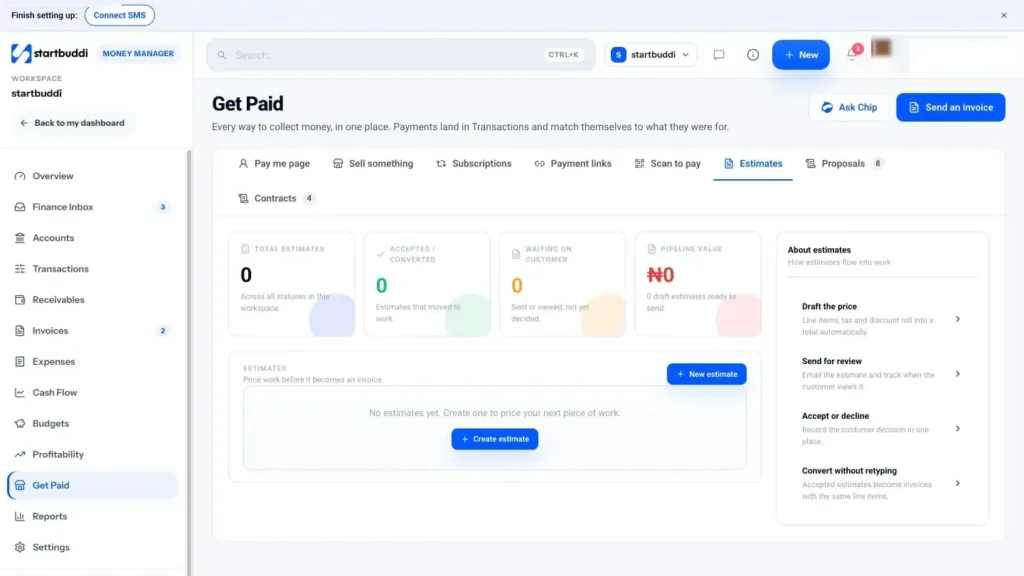
In startbuddi, quotes live in Money Manager, under Get Paid, then Estimates. Click New estimate, pick an existing client or type in a one-off recipient (and tick "also save as a contact"), add line items for the service and any add-ons, set tax and discount, and add your terms in the notes, for example "Valid for 30 days. 50% deposit for deep cleans." Send it by email. When the client replies to accept, click Mark accepted, then Convert to invoice, and the invoice is created with the same line items.
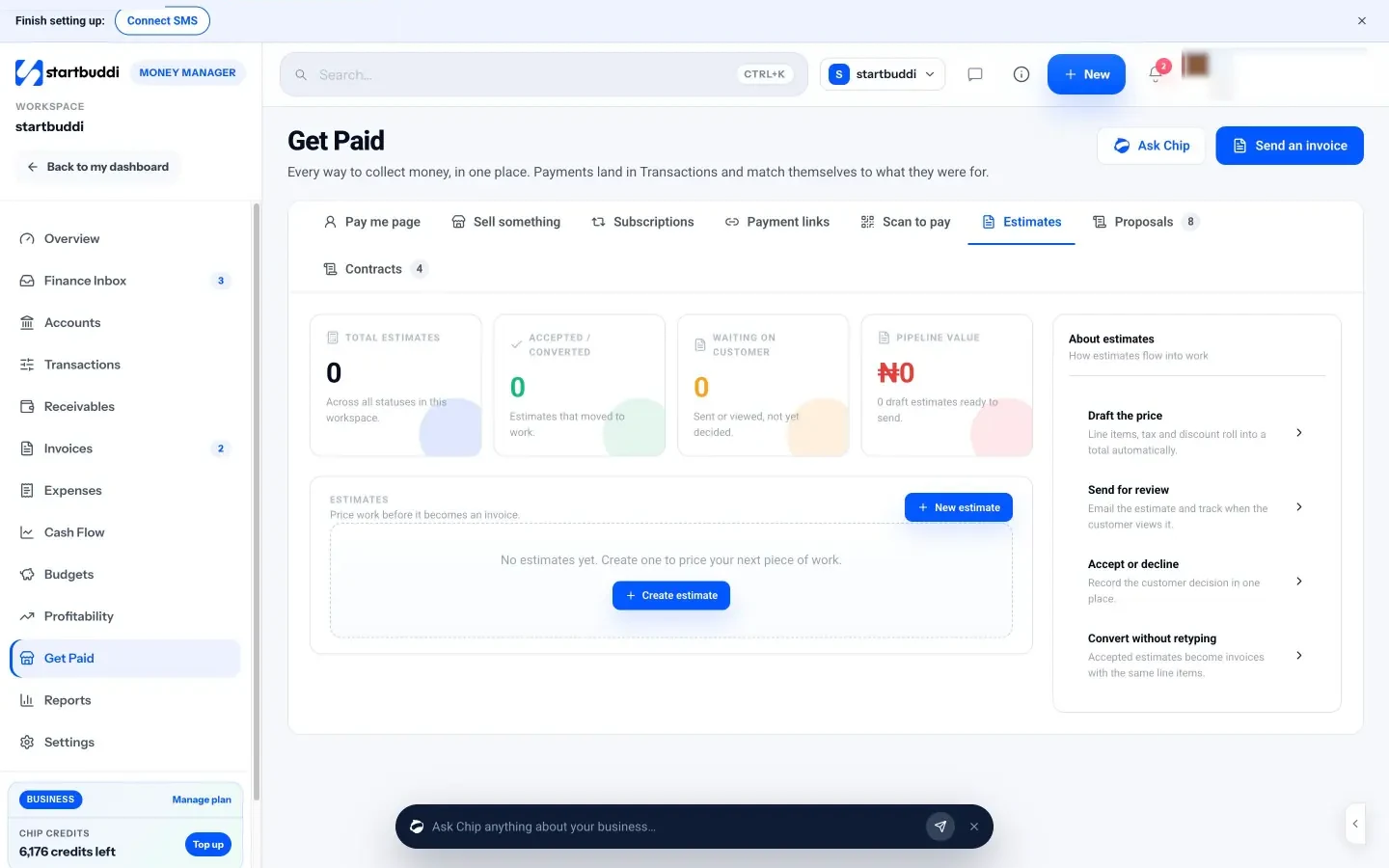
For bookable services, you can set a price in Bookings and turn on Require payment to book, choosing the full amount or a deposit. The client pays through Paystack or Stripe checkout when they book, and the slot is held while they pay. For quick one-off collections, such as a lockout fee, a payment link in Get Paid lets you request an amount without drafting a full invoice.
For regular clients who want to pay automatically, the Subscriptions tab in Get Paid lets you create a plan, such as "Fortnightly clean, 3-bed", with a monthly or annual amount, and send the client a subscribe link. Renewals are handled by your payment provider, Paystack or Stripe, which needs to be connected and verified first. Invoices themselves can carry a Pay button for card payment and your bank details for transfers, and you can record payments that arrive outside startbuddi, such as a bank transfer, so your list of who has paid stays accurate. The Receivables view shows who owes you, what is due soon and what is overdue, which makes your weekly money check a two-minute job. Our guide on how to send an invoice and get paid on time covers the follow-up routine.
Remember that startbuddi is not accounting software, so keep your accountant or bookkeeping tool for tax returns. Money Manager gives you invoices, payments received and expenses in one place, which makes that handover much easier.
Win clients and schedule cleans without double-booking
Two problems take over a cleaning business once it gets going: finding enough of the right clients, and fitting all their cleans into a week without gaps, clashes or cleaners sent to the wrong address. This chapter covers the marketing that works for local cleaning businesses, how to build a schedule around recurring clients, what to look for in cleaning business scheduling software, and where startbuddi fits and where a dedicated field-service tool would suit you better.
Where cleaning clients come from
Cleaning is local and trust-based, so the marketing that works is local and trust-based too.
- Google Business Profile. When people search "cleaner near me", the map listings appear first. A complete profile with your services, area, hours, photos and reviews is the single most useful free marketing tool for a cleaning business. Our post on local SEO for small business covers how to set it up and get found.
- Reviews. Ask every happy client for a review, the same day as a clean they have praised. Make it easy with a direct link.
- Referrals. Offer existing clients a thank-you (a discount on their next clean) for every new regular client they send you.
- Neighbourhood density. Once you clean one house on a street, flyer the neighbours: "We clean on your street every Tuesday." It fills your schedule with short travel times.
- Local groups. Community WhatsApp and Facebook groups, residents' associations, school parent groups.
- Partners. Letting agents, estate agents, property managers, short-let hosts and builders all need cleaners regularly.
- Commercial outreach. For offices, visit or call local businesses, ask who handles cleaning, and offer a free walk-through and quote.
Turn enquiries into bookings
Speed wins. People looking for a cleaner often contact several at once and book whoever replies first with a clear answer. Reply within an hour during working hours, with three things: a price or price range, the next available slot, and how to book. A template:
Hi Sarah, thanks for getting in touch. For a 3-bed, 2-bath home, a first deep clean is $150 and regular fortnightly cleans are $120. Our next free slot on your street is Tuesday at 9am. You can book it here: [booking link]. Any questions, just reply.
For bigger or unusual jobs, offer a short quote visit or ask for photos, and book it on the spot.
A plan for your first ten clients
- Clients 1 to 3: people who know you. Tell friends, family, neighbours and former colleagues you have started, and ask who they know who needs a cleaner. Charge your full price; a small launch thank-you such as a free add-on is fine.
- Clients 4 to 6: their neighbours and friends. Ask your first clients for reviews and referrals. Flyer the streets around them.
- Clients 7 to 10: local search and groups. With a few reviews, your Google Business Profile starts to work. Post in community groups with a clear offer and your booking link.
Along the way, contact two or three letting agents or property managers with a short introduction and your end-of-tenancy checklist. One good agent can send you several jobs a month.
The first visit with a new client
The first clean decides whether a one-off client becomes a regular. Plan it carefully:
- Walk through the home with the client, if they are there, or ask for notes in advance: priorities, areas to avoid, delicate surfaces, pets, where products and the vacuum should be left.
- Confirm access: keys, codes, parking, alarm, and what to do if nobody is home.
- Allow extra time. First cleans usually take longer, which is why they are priced higher.
- Leave a short note afterwards: what you did, anything you noticed (a dripping tap, a broken tile), and when you will be back.
- Follow up the next day to ask how it went and offer a regular slot.
Build your schedule around recurring clients
Recurring cleans are the backbone of a residential cleaning business: predictable income, less marketing, and cleaners who get to know each home. Schedule them first, then fit one-off jobs around them.
- Give each regular client a fixed slot: "every other Tuesday, 9am to 12pm". Clients like the certainty, and it makes planning easy.
- Group by area and day. Monday is the north side, Tuesday the east, and so on. It cuts travel time sharply.
- Keep the same cleaner for each regular client where you can. It is one of the main things clients value.
- Leave buffers. Build 15 to 30 minutes between jobs for travel, overruns and a quick break.
- Hold one flexible slot a day for one-off cleans, re-cleans and emergencies.
A sample weekly schedule
| Day | Morning | Afternoon |
|---|---|---|
| Monday | North: 2 regular cleans | North: 1 regular clean, 1 flexible slot |
| Tuesday | East: 2 regular cleans | East: deep clean (one-off) |
| Wednesday | Centre: 2 regular cleans | Quote visits and admin |
| Thursday | South: 2 regular cleans | South: 1 regular clean, 1 flexible slot |
| Friday | End-of-tenancy clean | End-of-tenancy clean (continued) |
A weekly scheduling routine
Scheduling is not a one-off task. A short routine keeps the week under control:
- Thursday: check next week's calendar. Confirm every regular client is in, spot gaps, and move one-off jobs into them.
- Friday: send cleaners their schedule for next week, with addresses, access notes and any client changes.
- Each afternoon: check tomorrow's jobs for last-minute changes, and make sure reminders have gone out.
- Monthly: look for clients who could move to a day when you are already nearby, and for gaps you could fill with a flyer drop on the right streets.
Messages and WhatsApp, done professionally
Many cleaning clients prefer to message. That is fine, but keep it professional so nothing gets lost. Use a business number rather than your personal one. Set expectations for reply times. Keep all changes to bookings in writing, and copy them into your schedule the moment you agree them. Never share one client's address or access details in a group chat with other clients or unrelated contacts. If several people handle messages, use a shared inbox so everyone can see the history. In startbuddi, the customer inbox brings email, SMS and WhatsApp conversations into one place, linked to each client's record; WhatsApp and SMS need the Starter plan or above.
Commercial cleaning scheduling
Commercial cleaning follows a different rhythm: work happens before or after business hours, on fixed days, often with a key or alarm code. Scheduling rules that help:
- Agree the exact days, start time and latest finish time in the contract.
- Assign a regular cleaner and a named backup for every site.
- Keep access details (keys, codes, who to call) in one secure place, not in cleaners' phones.
- Use a site checklist, with daily, weekly and monthly tasks, so periodic jobs like cleaning inside fridges or high dusting are not forgotten.
- Schedule a monthly quality walk-through with the client contact.
Plan for holidays, sickness and cover
Recurring clients expect their clean to happen even when their usual cleaner is away. Plan cover before you need it:
- Keep each regular client's notes (access, priorities, preferences) written down, so a stand-in cleaner can do the job properly.
- Introduce a backup cleaner to your biggest clients early, so a substitute is not a stranger.
- Ask cleaners to book holidays well ahead, and block them in the calendar straight away.
- When cover is not possible, tell the client early and offer an alternative day, rather than letting them discover a missed clean.
- Block your own business closures, such as public holidays, in advance so clients cannot book them.
Reduce no-shows, lockouts and last-minute changes
For home cleaning, the main risks are the client forgetting, not leaving access, or cancelling late. A reminder a day before, with the time window and access instructions, prevents most of them. Pair it with your cancellation policy from chapter 2.
Choosing cleaning business scheduling software
A paper diary or a spreadsheet works for your first few clients. Once you have regular clients and more than one cleaner, most businesses move to software. There are two broad types, and it helps to know which one you need.
| Type | What it does | Suits |
|---|---|---|
| Booking and scheduling software | Online booking, availability, reminders, staff calendars, deposits | Residential and small commercial cleaners who want clients to book and pay online |
| Field service management software | Dispatch, route planning, GPS tracking of staff, job costing, mobile job sheets | Larger teams with many vehicles and jobs spread across a region |
Questions to ask when choosing commercial or home cleaning services scheduling software:
- Can clients book and pay a deposit online, and reschedule themselves?
- Does it handle recurring cleans (weekly, fortnightly, monthly)?
- Can you see every cleaner's day on one calendar and assign jobs to specific people?
- Does it send reminders to clients, and by which channels?
- Does it link bookings to client records and invoices, so you do not retype details?
- Does it sync with your own calendar, and which way (one-way or two-way)?
- Do you need route planning or GPS tracking of cleaners? If so, you need field service software.
- What does it cost per user as your team grows?
Our booking software buyer's list compares options for service businesses.
Whatever you choose, try it with your real schedule for two weeks before moving every client across, and keep your existing diary running in parallel until you trust it.
Scheduling mistakes to avoid
- Back-to-back jobs with no travel time.
- Accepting any slot a client asks for, scattering your week across the city.
- Changing cleaners constantly for regular clients.
- Keeping the schedule in one person's head. When they are sick, nobody knows where anyone is going.
- No reminders, so lockouts eat into your income.
How to schedule in startbuddi, and where it stops
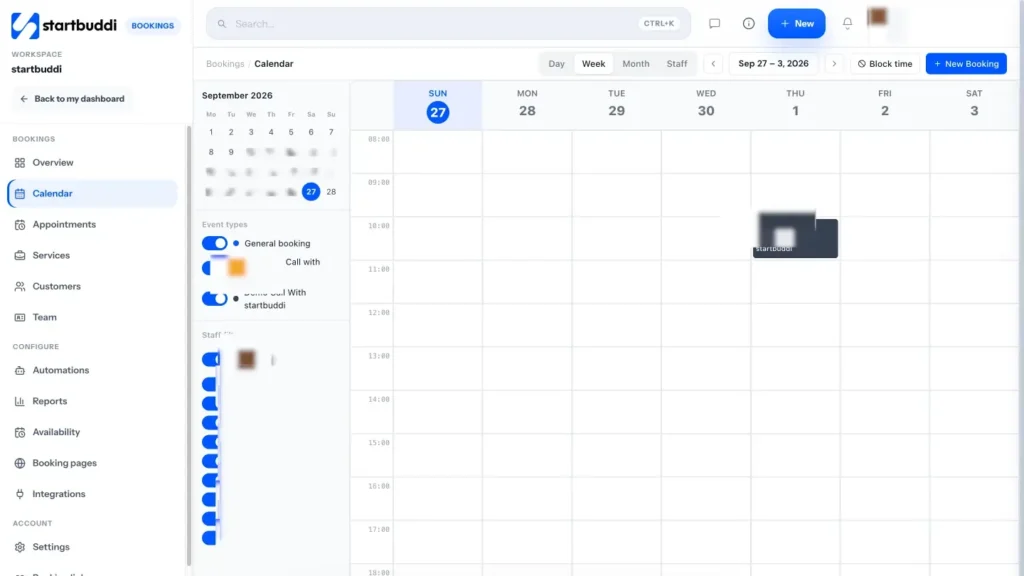
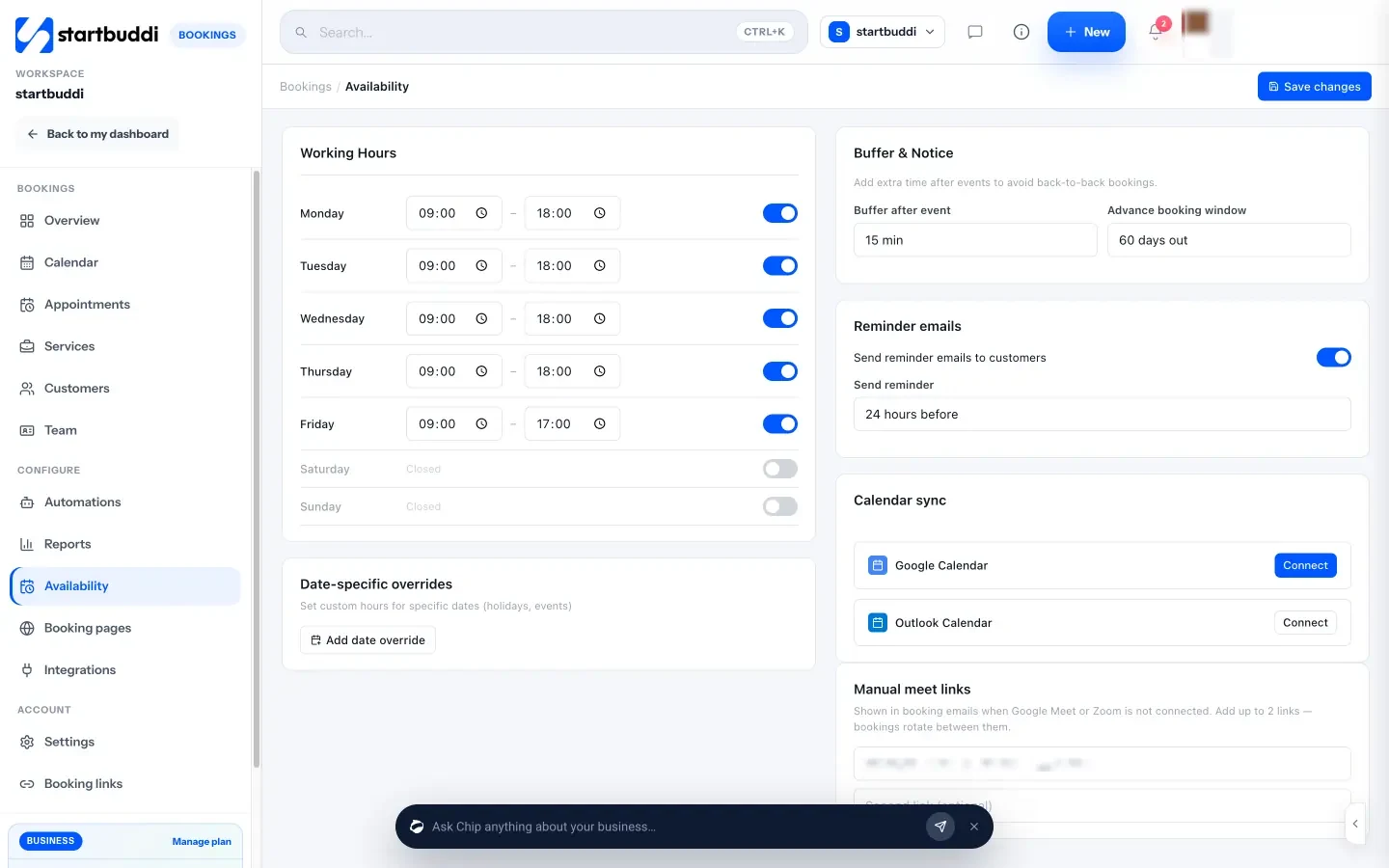
In startbuddi, Bookings handles the client-facing side. Share one booking link (by WhatsApp, email, your website, or a QR code on flyers), and clients choose a service, pick a time from your live availability and enter their details. Under Availability you set working hours per weekday, a buffer after each booking (up to 60 minutes, useful for travel), how far ahead people can book, and when the automatic reminder goes out, such as 24 hours before.
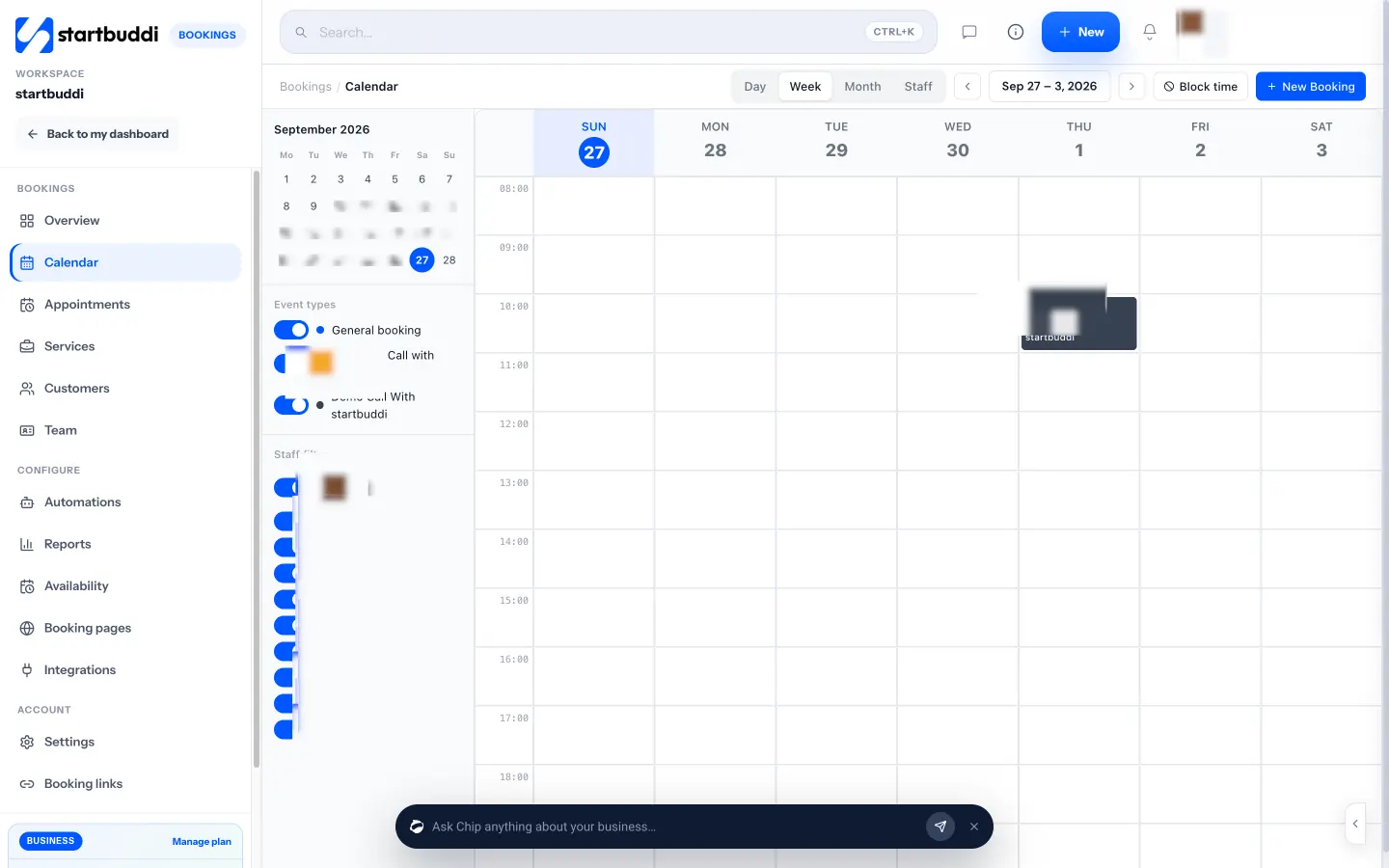
The Calendar shows day, week, month and staff views, with Block time for lunch, training or holidays. With a team, add cleaners under Team, let each set their hours, and assign services to specific people or share bookings in rotation. When a job is done, mark it complete or no-show, and send the no-show follow-up email from your templates. Bookings also create or update the client in Customers, and you can generate an invoice from a booking.
Know the limits so you choose the right tools. Booking reminders can go by email, WhatsApp or SMS: switch the channels on in Bookings settings. WhatsApp needs a connected WhatsApp number, and SMS needs an SMS connection and a plan that includes SMS. Each booking gets one automatic reminder; add extra messages with a booking automation. Calendar sync pushes bookings to Google Calendar (and Outlook where set up) but does not read your busy times back. Service durations go up to two hours. And startbuddi is not field-service dispatch software: there is no route planning or GPS tracking of cleaners.
Chip can help with the setup. In chat, Chip can create a booking service from a plain description, such as "Regular clean, 2 hours, $100, weekdays 8am to 5pm", including the price, buffer and weekly hours, and it shows you a preview to confirm before anything is saved. For each service you can also ask Chip to suggest booking questions (for example number of bathrooms, pets, parking), which arrive as drafts for you to keep or delete.
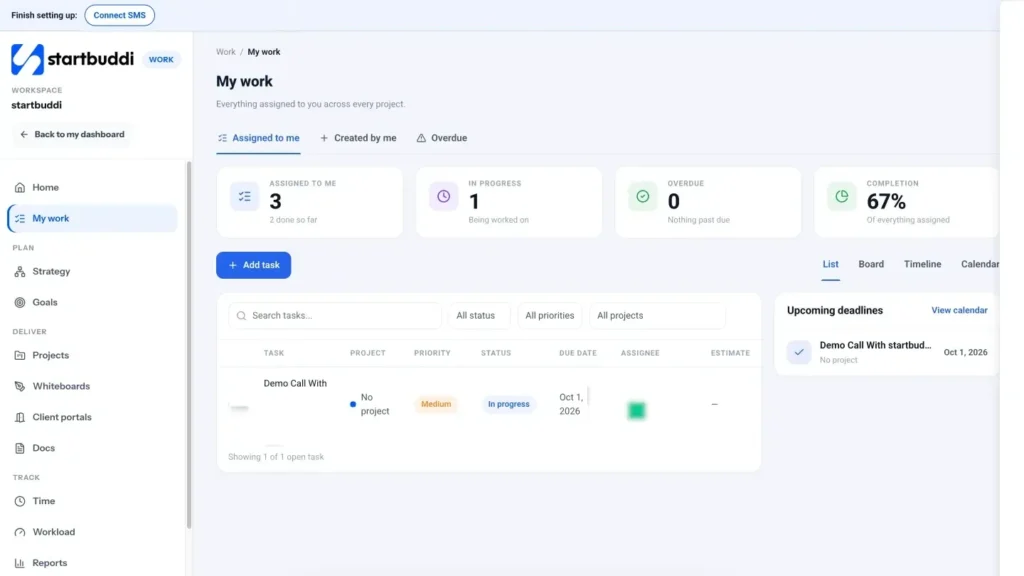
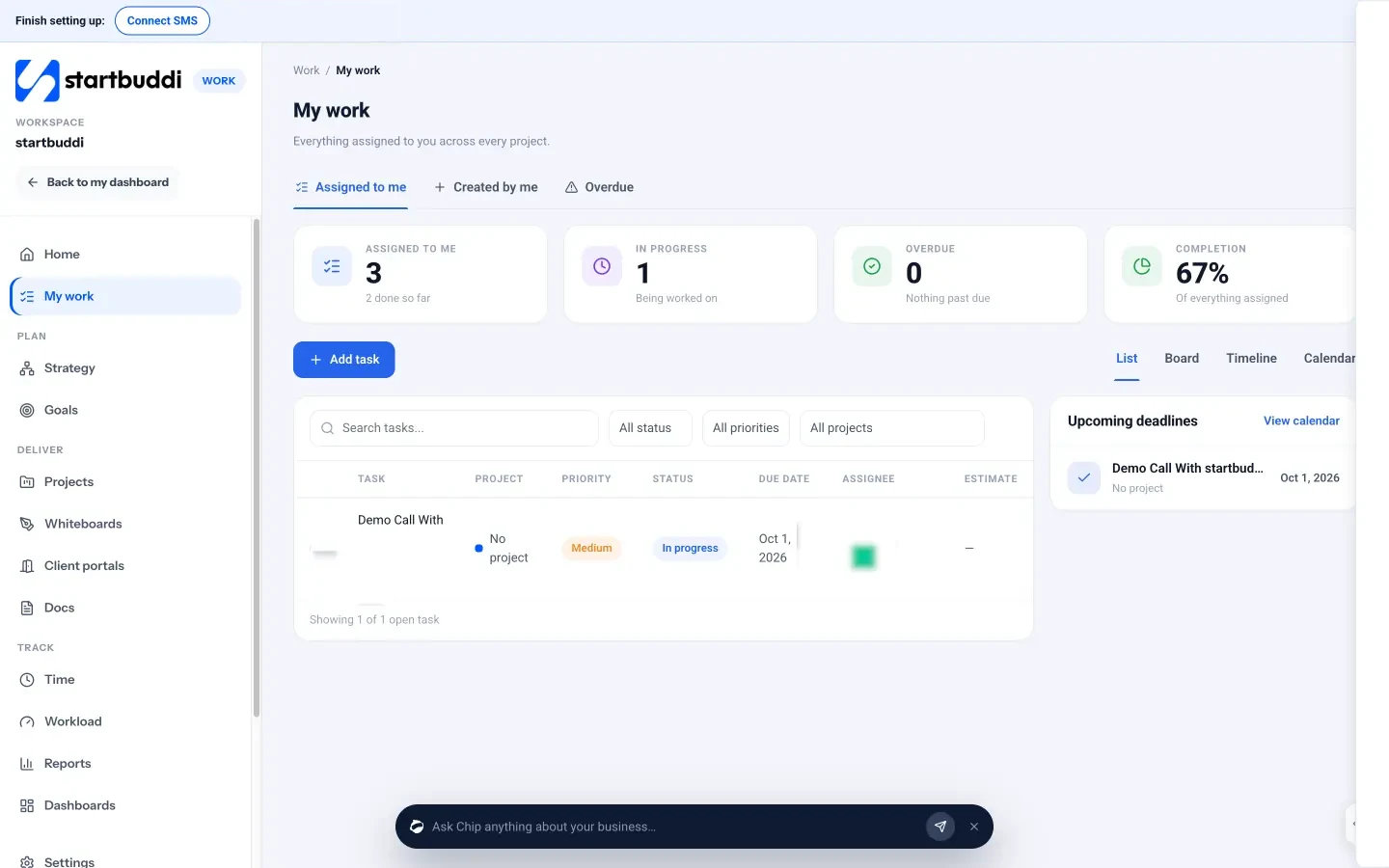
For long jobs and commercial contracts, use Work. Create a project per commercial client, add a task for each visit or checklist area, assign it to a cleaner, set a due date and use Repeats (daily, weekly or monthly) for recurring work. Everyone sees their jobs in My work, in a list or on a calendar. See booking software for cleaning companies for how the pieces fit.
Hire, train and run a cleaning team that keeps standards high
Most cleaning businesses hit a ceiling when the owner is fully booked. Growing beyond that means trusting other people to clean to your standard in clients' homes and offices, often without you there. That is the hardest and most important step. This chapter covers employees versus contractors, hiring for reliability, training with checklists, chemical safety, quality checks, handling complaints, keeping keys and access secure, and running the money side as the team grows.
Employees or contractors?
This is general information, not legal or tax advice. Employment status rules differ by country and are enforced seriously, so check with your tax authority or an employment adviser.
Many cleaning businesses are tempted to treat cleaners as self-employed contractors to avoid payroll costs. Whether that is lawful depends on the real working relationship, not the label in a contract. In the US, the IRS explains that, under common-law rules, a worker is generally an employee if you can control what will be done and how it will be done, and it looks at behavioural control, financial control and the relationship of the parties (IRS, independent contractor or employee?). In the UK, GOV.UK explains how employment status is decided and what rights each status has. Other countries have similar tests.
If you set cleaners' hours, tell them how to clean, provide their equipment and products, and they wear your uniform, they may well be employees in law. Getting it wrong can mean back taxes, penalties and claims. Take advice before you decide.
Hire for reliability and trust
You can teach someone to clean a bathroom to your standard in a week. You cannot easily teach reliability, honesty or care. Hire for those first.
- Ask about attendance and reliability directly, and check references with previous employers or clients.
- Run a paid trial clean. Two to three hours, with you or a senior cleaner, in a real home or office. Watch how they work, how they handle products, whether they notice detail, and how they speak to the client.
- Check identity and right to work in line with local law, and background checks where clients expect them and the law allows.
- Be clear about pay, hours, travel and expectations from the first conversation.
- Put the offer in writing. Include pay, hours, place of work, start date and any trial period.
Plan their first week before they start; the first-week plan later in this chapter gives you a structure.
Train with checklists
Checklists are the heart of a consistent cleaning business. They set the standard, train new cleaners, show clients what they are paying for, and settle arguments. Write one per service, organised room by room, in the order the work is done.
Regular clean: kitchen
1. Clear and wipe worktops, including under small appliances.
2. Clean the outside of appliances: fridge, oven, microwave, dishwasher.
3. Clean the hob.
4. Clean and polish the sink and taps.
5. Wipe cupboard fronts and handles.
6. Empty bins, clean the lids, fit new liners.
7. Vacuum, then mop the floor, working towards the door.
8. Take an after photo.
Train new cleaners with the four-step method: explain, show, let them try, review. Pair them with a senior cleaner for their first few jobs, then spot-check. Our guide on how to train employees covers training plans, job aids and checking that training worked, with cleaning examples throughout.
Chemical and personal safety
Cleaning products can be hazardous. The UK's Health and Safety Executive notes that some ingredients can cause skin allergies and asthma, and some products are corrosive and can burn skin and eyes, and that employers must assess the risks, control exposure and give staff information, instruction and training (HSE, COSHH and cleaning). In the US, OSHA's Hazard Communication standard requires employers to inform and train workers about hazardous chemicals they use at work, including labels and safety data sheets. Check the equivalent rules where you operate.
Practical basics for any cleaning team:
- Keep a list of every product you use, with its safety data sheet.
- Label every refilled bottle.
- Never mix products, especially bleach with anything else.
- Provide gloves and eye protection, and make sure people use them.
- Ventilate while cleaning bathrooms and ovens.
- Train on safe lifting, ladders and slippery floors.
- Have a plan for lone working: cleaners check in and out of each job.
Check quality without micromanaging
Standards slip slowly unless someone checks. A light quality routine:
- After photos of key areas (kitchen, bathrooms) on every job.
- Spot checks: a supervisor visits a few jobs each week, unannounced, and scores them against the checklist.
- Client feedback: a short message after the first three cleans, then every few months: "How did we do? Anything we missed?"
- Monthly review of complaints, re-cleans and compliments, by cleaner and by service.
Share good results as well as problems. Cleaners who hear when clients are happy take pride in keeping it that way.
Handle complaints well
Complaints will happen. Handled well, they often increase loyalty. A simple routine: thank the client for telling you, apologise for the problem, ask for a photo if possible, offer to re-clean the area within 24 to 48 hours at no charge, and follow up afterwards. Then fix the cause: a checklist gap, a training need or an unrealistic time slot.
Pay and keep good cleaners
Turnover is one of the biggest hidden costs in cleaning. Every time a cleaner leaves, you recruit and train again, and regular clients lose the person they trusted. Things that help people stay:
- Fair, reliable pay, always on time, with travel time between jobs paid or clearly accounted for.
- Predictable schedules, with changes kept to a minimum and shared early.
- Good equipment. Nobody enjoys fighting a broken vacuum all day.
- Recognition. Pass on client compliments by name, the same day.
- A path to grow: senior cleaner, trainer, team leader.
- Being listened to. Ask cleaners what slows them down; they often know the fix.
Add team leads as you grow
Once you have more than five or six cleaners, you cannot personally check every job. A team lead or supervisor, usually your most reliable senior cleaner, can train new starters, do spot checks, cover absences, handle small complaints on the spot and hold keys for a group of clients. Give them a clear list of responsibilities, a small pay increase that reflects the extra work, and time in their week to do it. It frees you to focus on sales, pricing and the bigger clients.
Know which clients make you money
Not all clients are equally profitable. Once a quarter, look at each regular client's price against the actual time spent, travel and any re-cleans. Worked example: two clients each pay $120 a clean. Client A takes 3 hours with 10 minutes' travel from the previous job. Client B takes 3.5 hours, sits 40 minutes away from everyone else, and has needed two re-cleans this quarter. Client B may be costing you money. Options: raise their price, move them to a day when you are nearby, or politely refer them elsewhere.
A first-week plan for a new cleaner
- Day 1: welcome, paperwork, uniform and equipment. Safety training: products, labels, mixing rules, gloves, lifting. Walk through the checklists.
- Days 2 and 3: paired cleans with a senior cleaner, the new starter working alongside and taking over more rooms each job.
- Day 4: the new starter leads, the senior watches and gives feedback using the checklist.
- Day 5: first solo clean on a straightforward regular client, with a spot check that afternoon and a short end-of-week chat.
- Weeks 2 to 4: solo regular cleans, weekly spot checks, deep-clean training in week 3.
Keys, codes and client security
Clients trust you with access to their homes and premises. Protect it:
- Label keys with a code, never with the client's address.
- Store keys in a locked box, and log who takes which key and when it comes back.
- Keep alarm codes and access notes in a secure system, not in group chats.
- Collect keys back immediately when a cleaner leaves your business.
When a cleaner leaves
People move on, and how you handle it protects your clients. On their last day, collect every key, fob and access card against your key log, and change any alarm codes or door codes they knew. Remove their access to your booking, messaging and scheduling tools. Reassign their regular clients to another cleaner, and tell those clients personally who will be coming next, ideally with an introduction visit. Return any deposit or equipment agreements, settle final pay with your payroll provider, and ask them, kindly, what would have made them stay. In startbuddi, the Offboarding checklist in People covers the handover, equipment returns and access removal in order, and nothing is removed until you complete it.
Run the money side as you grow
Invoice promptly: regular clients weekly or monthly, one-off jobs on completion or upfront. Offer easy payment options, record every payment, and chase late payers calmly and quickly. Track three numbers monthly: revenue, labour cost as a share of revenue, and client churn (how many regulars you lost). Rising labour cost or churn is an early warning.
Where to grow next
Once your regular residential work is steady and profitable, growth usually comes from one of four directions: more regular clients in the same area (the cheapest growth, because travel time stays low), a new area with its own team lead, a specialist service such as carpets or post-construction cleaning that raises the value of each visit, or small commercial contracts that fill early mornings and evenings. Add one at a time, check the numbers after three months, and keep standards consistent before adding the next.
Mistakes to avoid when building a team
- Hiring in a rush because you are overbooked.
- Treating everyone as a contractor without checking the law.
- No written checklists, so every cleaner does it differently.
- Skipping safety training.
- Only hearing about problems from clients.
How to run the team in startbuddi
For jobs, Work gives every cleaner one list. Create a task per job or per site visit with the address and access notes in the description, assign it, set the due date and add subtasks for the room-by-room checklist. Use Repeats for regular cleans. Each cleaner opens My work to see everything assigned to them across every project, what is overdue and what is due next, as a list or on a calendar.
For people, use People. Onboarding templates turn your first-week plan into a checklist with owners and due dates. Learning lets you add training resources (a video of your kitchen clean, a link to a safety guide) and assign them to each new cleaner. Your checklists and safety rules can live in the knowledge base, and rules people must confirm, such as chemical safety, can be published as a policy that needs sign-off. Requests handle leave and other asks, with approvals going to the right person. On the Free plan only the owner seat is available; teammates need seats on a paid plan (Starter includes 2, Growth 5 and Scale 15). See People and pricing.
Two more features help as the team grows. Time & Attendance in People shows who is working, remote or away today, with optional clock-in and clock-out and corrections that go to a manager for approval, which suits cleaners who start and finish at different sites. Workload in Work shows how much work is assigned to each person week by week, so you can spot a cleaner who is overbooked and reassign a job before they burn out. Chip HR can answer your team's everyday questions, such as how much leave they have left or what the rule is on product mixing, from the handbook you publish, and it names the page it used.
Some honest limits. Payroll is not part of startbuddi: it does not calculate pay and tax, so use a payroll provider or accountant for that. It is not GPS dispatch software, so there is no live tracking of where cleaners are. And there is no photo-upload job sheet for cleaners on site, so agree how after photos are shared, for example in the task comments or your team chat.
A good next step: write your four service checklists this week, set up your services and availability in Bookings, and share your booking link with ten people who might need a cleaner. See the startbuddi for cleaning businesses page for more.
Tiwalade Joanna Okedara-Kalu is the founder, CEO and CTO of startbuddi, the business system that brings clients, bookings, invoices, projects, marketing and the Chip AI assistant into one place. Tiwalade builds software around how service businesses really work day to day, and writes about client management, getting paid on time and why small businesses outgrow the tools they start with.
Founded startbuddi and leads its product and engineering