
How to train employees: a simple employee training plan for small teams
A four-part guide to training your team: find the skills that matter, build an employee training plan, teach so it sticks, and check it is working.

This guide shows you how to train employees in a small business, from working out what people actually need to learn, to checking months later that the training changed how the work gets done. It is written for owners and managers who have never had a training department and never will: a café with six staff, a cleaning company with a dozen cleaners, a five-person agency, a shop that has just hired its first two people.
The short answer: decide what “good” looks like for each role, teach one thing at a time by showing and then letting the person try, write the key steps down so nobody depends on memory, and check back after a week and a month. Everything else in this guide is detail on those four moves.
Each chapter starts with the business thinking, with examples, templates and mistakes to avoid, and ends with how to do it in startbuddi. By the end you will have a skills list for each role, a written 90-day employee training plan, a way of teaching that sticks, and a simple routine for measuring whether it worked.
Why training matters, and how to work out what to teach
Most small businesses do not decide not to train people. They just never get round to it. A new hire starts on a busy Monday, shadows whoever is free, picks up habits (good and bad) from that person, and three months later the owner wonders why jobs are done five different ways. Training is the fix, but only if you teach the right things. This chapter is about deciding what those things are before you spend a single hour teaching.
What employee training actually is
Employee training is any planned effort to help someone do their job better: a first-week induction, a demonstration of how to use the booking system, a safety briefing, a shadowing day with a senior colleague, a short online course, or a written checklist they follow until the task is second nature. The key word is planned. Picking things up by accident is learning, but it is not training, and it produces uneven results.
For a small team, training usually falls into five groups:
- Induction: how the business works, who does what, where things live, what the rules are. Every new person needs it once.
- Job skills: the specific tasks of the role, such as making a flat white, quoting a job, cleaning a bathroom to your standard, or setting up a client's social media calendar.
- Safety and compliance: handling chemicals, lifting, food hygiene, data protection, anything the law or your insurer expects.
- Customer and people skills: answering the phone, handling a complaint, giving and taking feedback.
- Growth skills: what someone needs to take on more responsibility, such as supervising a shift or running a client account.
Training and onboarding: what is the difference?
The two overlap, and people often use the words interchangeably. Onboarding is everything that turns a new hire into a settled member of the team: paperwork, equipment, accounts, introductions, the handbook, the first conversations with their manager. Training is the part that builds skills, and it carries on long after onboarding ends. A new starter's first month usually contains both. A three-year employee learning to supervise a shift is only doing training.
It helps to keep them separate in your head because they have different owners and timings. Onboarding is a checklist with a finish line. Training is a habit that never really finishes. If you only think about training when someone new starts, the rest of your team stops growing.
Why it is worth the time
Owners of small businesses are short on time, so training has to earn its place. Three reasons it usually does.
Mistakes are expensive. Think about the cost of one error in your business. A cleaner who uses the wrong product on a marble worktop can cause damage worth hundreds of dollars. A junior who sends the wrong invoice amount costs you a day of awkward emails. A barista who does not know the recipe wastes milk and coffee on every remake. If a two-hour training session prevents even one of those a month, it has paid for itself.
People stay longer when they grow. LinkedIn's research with learning professionals found that providing learning opportunities was the number one strategy organisations were using to keep staff, and that companies with strong learning cultures reported higher retention and more internal moves (LinkedIn Workplace Learning Report 2024). Replacing someone means advertising, interviewing and starting again, so keeping a good person is almost always cheaper.
You get your own time back. In a business where only the owner knows how things are done, every question comes to the owner. Training, and especially written procedures, is how you stop being the bottleneck.
How to think about it: the 70-20-10 idea
A useful rule of thumb comes from research by the Center for Creative Leadership, which found that the executives it studied described their key development experiences as roughly 70 per cent on-the-job challenges, 20 per cent other people, and 10 per cent formal coursework (Center for Creative Leadership, the 70-20-10 rule). CCL itself treats this as a guideline, not a formula, and it was about leaders rather than every role, but the lesson travels well to a small business.
Most of what your staff learn will come from doing the work. Some will come from colleagues and from you. Only a small slice will come from courses or videos. So a good employee training plan in a small business is mostly about organising the doing: giving people the right tasks in the right order, pairing them with the right person, and writing down the standard. The course or video is the smallest part.
Start with the role, not the course
The most common mistake is starting with training content ("let's find a customer service course") rather than the job. Flip it round. For each role, answer one question: what does someone in this job need to be able to do, on their own, to our standard?
Write the answer as a list of tasks that begin with a verb. For a home cleaner, that might be:
- Check the job sheet and confirm access instructions before arriving.
- Greet the client and confirm any special requests.
- Clean a kitchen to our checklist in under 45 minutes.
- Clean a bathroom to our checklist in under 30 minutes.
- Choose the right product for each surface, and never mix chemicals.
- Take before-and-after photos and report any damage.
- Lock up and return keys the way the client asked.
For a junior in a marketing agency, the list might include scheduling posts for a client, writing a first draft of a caption in the client's tone, pulling a monthly report, and replying to a client email within the day. For a shop assistant: opening and closing the till, taking card and mobile payments, handling a return, restocking, and answering the three questions customers ask most.
Keep each list to 8 to 15 tasks. If it is longer, you are describing two jobs or listing steps rather than tasks.
Build a simple skills matrix
Once you have the task list, turn it into a skills matrix: tasks down the side, people across the top, and a simple score in each box. You do not need software for the first version; a table on paper works.
| Task | Amina | Ben | Chidi |
|---|---|---|---|
| Clean a kitchen to checklist | 3 | 2 | 1 |
| Choose the right product for each surface | 3 | 1 | 1 |
| Report damage with photos | 2 | 2 | 0 |
| Handle a client complaint on site | 2 | 1 | 0 |
Use a four-point scale: 0 = has not learned it yet, 1 = can do it with help, 2 = can do it alone, 3 = can teach it to others. The gaps jump out: Chidi is new and needs almost everything, Ben needs the product training, and Amina is your natural trainer for kitchens and products.
The matrix also shows your risk. If only one person scores 3 on a task that matters, you have a single point of failure. Cross-training a second person is a cheap insurance policy for holidays, sickness and resignations.
Other ways to spot training needs
The skills matrix covers the basics. These sources tell you where to look next:
- Complaints and redos. What do customers complain about? Which jobs get redone? Each repeat problem is usually a training gap, a missing procedure, or both.
- Questions you keep answering. If three people have asked you how to issue a refund this month, write it down and teach it once.
- Performance conversations. Reviews and one-to-ones surface what people feel unsure about. Ask directly: "What part of the job do you feel least confident about?"
- Changes coming up. A new service, a new tool, a new client type or a new law all need training before they arrive, not after the first mistake.
- Ambitions. Ask each person what they want to be doing in a year. Training that helps them get there is training they will take seriously.
When training is not the answer
Before you plan any training, check that a lack of skill is really the problem. Plenty of performance issues look like training gaps but are something else, and no amount of teaching will fix them.
- The process is broken. If the checklist is missing a step, or two people have been told different things, fix the process first, then train on the fixed version.
- The tools are wrong. A slow laptop, a vacuum that keeps cutting out or a booking system nobody can find things in will slow down a well-trained person too.
- The time is unrealistic. If a deep clean is booked for two hours but takes four, the cleaner will cut corners however well trained they are.
- The expectations were never said. Sometimes people simply do not know what "good" looks like because nobody told them. That is a five-minute conversation, not a course.
- Motivation or fit. If someone can do the task well when you are watching and does not when you are not, that is a performance conversation, not a training need.
A quick test: "If their life depended on it, could they do this task correctly today?" If the answer is yes, training will not help much. If the answer is no, it will.
Ask your team before you plan
Your staff often know where the gaps are better than you do. Before you write any plan, spend fifteen minutes with each person, or send three short questions:
- Which part of your job would you like to be better at?
- What did you have to work out on your own that we should have taught you?
- What do new people usually get wrong in their first month?
The third question is especially useful. Experienced staff remember what tripped them up and see what trips up others, and their answers often point straight at the most useful training you can run.
Decide what to train first
You will find more gaps than you have time to fix. Rank them with two questions: how often does this task happen, and how bad is it when it goes wrong? Tasks that are frequent and high-risk come first (for a cleaner, chemical safety; for a café, food hygiene and the till). Frequent but low-risk tasks come next, because small improvements add up. Rare, low-risk tasks can wait or live in a written guide people look up when needed.
Common mistakes at this stage
- Buying a course before defining the job. Generic courses rarely match how your business does things.
- Training everyone on everything. People switch off when half the content is irrelevant to them.
- Relying on shadowing alone. Shadowing copies whatever the colleague does, including their shortcuts. Pair it with a written standard.
- Leaving out the "why". People follow rules they understand. Explain why a step matters, not only what it is.
- Forgetting existing staff. Training is not only for new hires. Long-serving people drift from the standard too.
How to do this in startbuddi
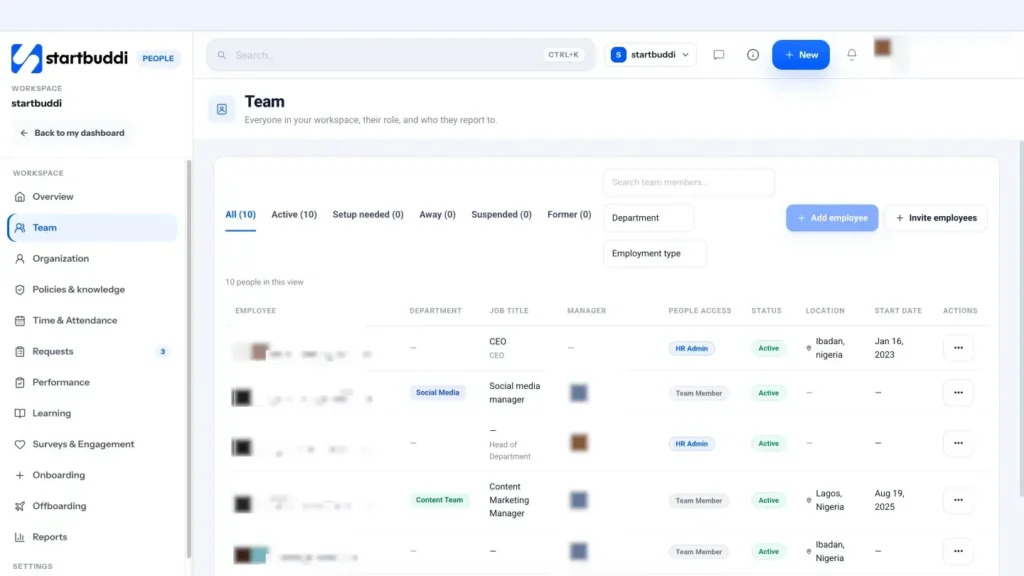
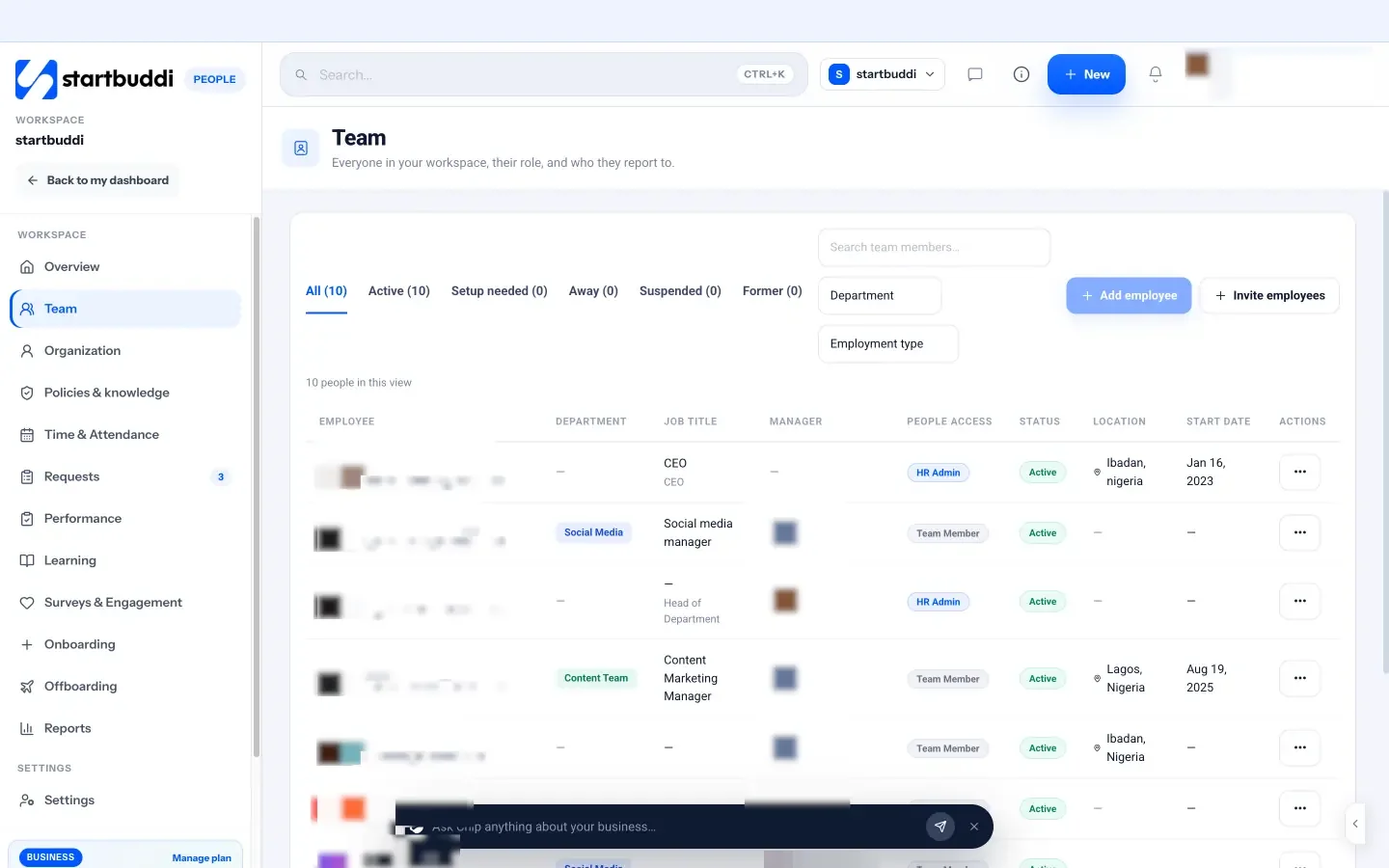
The groundwork for training is knowing who does what. In startbuddi, open People, then Team. Each person has a profile with their job title, department, manager, employment type and start date, and a Learning tab that shows what has been assigned to them and what they have finished. Filling in job titles and departments first pays off later, because you can assign training to a whole department rather than person by person.
Under Organization you can set up departments and teams, and startbuddi draws the org chart from each person's manager. That structure is what training assignments, survey audiences and knowledge-base spaces hang off, so it is worth ten minutes before you build your first plan. If you are still hiring your first people, our guide on how to build a team covers hiring, onboarding and leave for your first employees.
There is no built-in skills matrix screen in startbuddi, so keep your first matrix as a simple table in Documents or on paper. What startbuddi does well is the next step: turning the gaps you found into assigned training that you can track, which is the subject of the next chapter.
A note on plans: every workspace can open People, but on the Free plan only the owner seat is available. To invite teammates so they can see their own training, you need a paid plan with seats; Starter includes 2, Growth 5 and Scale 15. See pricing for the details.
Build an employee training plan (with a 90-day template)
- Before day one
- Days 1 to 30: the essentials
- Days 31 to 60: independence
- Days 61 to 90: ownership
- A café in Nairobi hiring two baristas
- A five-person agency in Manchester hiring a junior
- A cleaning company in Lagos taking on three cleaners
You know what each role needs. Now you need a plan: who learns what, in what order, from whom, by when, and how you will know they have got it. An employee training plan sounds formal, but for a small business it can fit on one page. This chapter gives you the structure, a ready-to-copy 90-day template, three worked examples from different kinds of business, and a simple way to budget it.
What goes into an employee training plan
A useful plan answers six questions for each skill:
| Question | What to write | Example |
|---|---|---|
| What? | The task, written as an outcome | Clean a bathroom to our checklist in under 30 minutes |
| Why? | One line on why it matters | Bathrooms are what clients notice first and complain about most |
| How? | The method: demo, shadowing, video, written guide, course | Demo by Amina, then two supervised cleans, then the checklist |
| Who? | The person teaching and the person learning | Amina teaches, Chidi learns |
| When? | A target date | By the end of week 2 |
| Proof? | How you will check they can do it | Amina signs off after two cleans that pass the checklist |
The last column is the one most plans leave out, and it is the most important. "Did the training" is not the same as "can do the job". Decide up front what proof looks like.
The 90-day employee training plan template
Most roles can be structured in three phases. Adapt the timings to the job: a shop assistant may be fully trained in three weeks, a new account manager may take the full three months.
Before day one
- Send a welcome note with start time, what to wear, who to ask for and what to bring.
- Prepare equipment, logins and a copy of the key procedures.
- Choose a buddy: a colleague who is not their manager and who will answer the small questions.
Days 1 to 30: the essentials
- Induction: how the business works, the team, the tools, the rules, the handbook.
- Safety and compliance training that must happen before they work alone.
- The three to five most frequent tasks of the job, taught one at a time.
- End-of-week check-ins in weeks 1 and 2, then a 30-day conversation.
Days 31 to 60: independence
- The rest of the core task list, with the person working alone on the tasks already signed off.
- Customer-facing skills: complaints, difficult questions, upselling where relevant.
- A 60-day conversation: what is going well, where they feel unsure.
Days 61 to 90: ownership
- The less frequent tasks, often through written guides rather than live demos.
- One stretch goal: a small improvement they own, such as rewriting a checklist or training the next new starter on one task.
- A 90-day review that also covers what training they want next.
If you want a ready structure for those first weeks, our post on how to onboard a new employee has a full onboarding plan for in-person and remote hires, and it pairs well with this chapter.
Choose the right method for each skill
The "How?" column in your plan matters. Different skills suit different methods, and using the wrong one wastes time. Here is a quick guide.
| Method | Best for | Watch out for |
|---|---|---|
| Demonstration and practice | Physical and hands-on tasks: cleaning, cooking, repairs, using equipment | Needs a trainer's time for every learner |
| Shadowing | Seeing how a whole job flows, client calls, site visits | Copies the colleague's habits, good and bad |
| Written guide or checklist | Tasks with many steps, rare tasks, anything that must be done the same way every time | Nobody reads a 20-page manual; keep it short |
| Short video | Software, anything done on a screen, tasks you want to teach many people | Goes out of date when the tool changes |
| External course | Certificates, specialist skills nobody in the team has, general skills like writing | Rarely matches your way of doing things |
| Coaching and feedback | People skills, judgement, supervising others | Slow, and only as good as the coach |
Most skills use a mix. A good pattern for a hands-on task is: short written guide, demonstration, supervised practice, then the guide stays behind as a reminder. For a software task: a two-minute screen recording, then a practice run on real work with someone checking.
Plans for existing staff and cross-training
The 90-day template is built for new starters, but the same structure works for people already in the team. For an existing employee, the plan is usually shorter and more focused: two or three skills for the next quarter, chosen with them, each with a method, a teacher, a date and a proof.
Cross-training deserves its own line in the plan. List every task only one person can do well, and pick a second person to learn it over the next quarter. In a café, that might be the weekly stock order. In an agency, the monthly client reporting. In a cleaning company, the key-holding and access process for your biggest commercial client. When the one person who knows is off sick, you will be glad you did.
Three worked examples
A café in Nairobi hiring two baristas
Week 1 covers food hygiene, the till and opening and closing. Week 2 covers the six drinks that make up most orders, taught by the head barista with a recipe card for each. Week 3 adds the rest of the menu and the milk alternatives. Proof for each drink is simple: the head barista tastes three in a row and they match the standard. Month 2 adds handling complaints and training on the stock count. The only outside cost is a food hygiene certificate course, which many local authorities or training providers offer.
A five-person agency in Manchester hiring a junior
Month 1 is tools and process: the project board, the client portal, the brand files, how briefs are written, how time is logged. The junior shadows two client calls and drafts captions that a senior edits. Month 2 they schedule one client's social calendar alone, with a senior checking before anything goes live. Month 3 they run that client's monthly report. Proof is the output: two months of posts published with fewer and fewer edits.
A cleaning company in Lagos taking on three cleaners
Day 1 is safety: which products are used for what, the gloves and ventilation rules, and what never to mix. Days 2 to 5 are paired cleans with a senior cleaner using a room-by-room checklist. Week 2 they clean alone on regular clients, with the supervisor doing spot checks. Proof is a checklist score on three unannounced spot checks. Month 2 covers deep cleans and end-of-tenancy work, which have their own checklists.
A one-page plan you can copy
Here is the café example written out as a single page. Swap the tasks for your own role and keep the same shape.
Training plan: barista (new starter), start date 6 October
Trainer: Wanjiru (head barista). Buddy: Otieno. Manager: Grace.
Week 1. Induction and handbook (Grace). Food hygiene rules and cleaning schedule (Wanjiru). Till, card and mobile payments (Otieno). Proof: runs the till alone for one hour at a quiet time without errors.
Week 2. Espresso, flat white, cappuccino, latte, americano, tea (Wanjiru, one drink per session with a recipe card). Proof: three of each drink in a row that match the standard.
Week 3. Rest of the menu and milk alternatives (Wanjiru). Opening routine (Otieno). Proof: opens with Otieno watching, nothing missed.
Month 2. Handling complaints (Grace, with role play). Stock count (Wanjiru). Proof: one real stock count matches Wanjiru's.
Month 3. Closing routine alone. One improvement of their choice. 90-day review with Grace.
Check-ins: end of weeks 1 and 2, day 30, day 60, day 90.
Notice that every line has a teacher and a proof, and that no week has more than a few new things in it. That is the whole trick.
How much to budget for training
For most small businesses, the biggest training cost is not courses; it is time. Budget it honestly so it does not get squeezed out on busy weeks.
Here is a worked example for a new cleaner paid $16 an hour, trained by a senior paid $20 an hour:
| Item | Hours | Cost |
|---|---|---|
| New hire's time in induction and safety training | 6 | $96 |
| Four paired cleans (new hire) | 12 | $192 |
| Four paired cleans (senior's extra time) | 12 | $240 |
| Three spot checks by the supervisor | 3 | $60 |
| Supplies used in practice | n/a | $30 |
| Total | $618 |
Some of the paired cleans are billable to clients, so the true cost is lower. Compare it with the cost of one lost regular client or one damaged surface and the case usually makes itself. The same maths works in any currency: in naira, rand or rupees, list the hours, multiply by the rates, and add any course fees.
Where to find training material without a big budget
- Your own best person. Film them doing the task on a phone, with them talking through each step. It is often better than any generic video.
- Suppliers. Equipment makers, software companies and product suppliers usually publish free guides and videos, and some will train your staff for free.
- Official bodies. Health and safety regulators, tax authorities and trade bodies publish free guidance written for small businesses.
- Free and low-cost online courses for general skills such as spreadsheets, writing or customer service.
- Industry associations, which often run affordable short courses and certificates.
Questions to ask before paying for an outside course
Sometimes an outside course is the right answer, especially for certificates. Before you pay, ask the provider:
- What exactly will my employee be able to do at the end that they cannot do now?
- How much of the time is practice rather than listening?
- Is there a certificate, and is it recognised by regulators, insurers or clients in our industry?
- Can we see the course outline and a sample lesson?
- What support is there after the course if they get stuck?
After the course, ask the employee to spend ten minutes showing the rest of the team the most useful thing they learned. It spreads the value and checks they took something away.
Mistakes to avoid when planning
- Cramming it all into week one. People remember very little of a day-long information dump. Spread it out.
- No named teacher. "The team will show them" means nobody will. Name one person per skill.
- No time protected. Put training sessions in the diary like client appointments.
- A plan nobody sees. Share it with the new person on day one so they know what is coming and can ask for what is missing.
How to build the plan in startbuddi
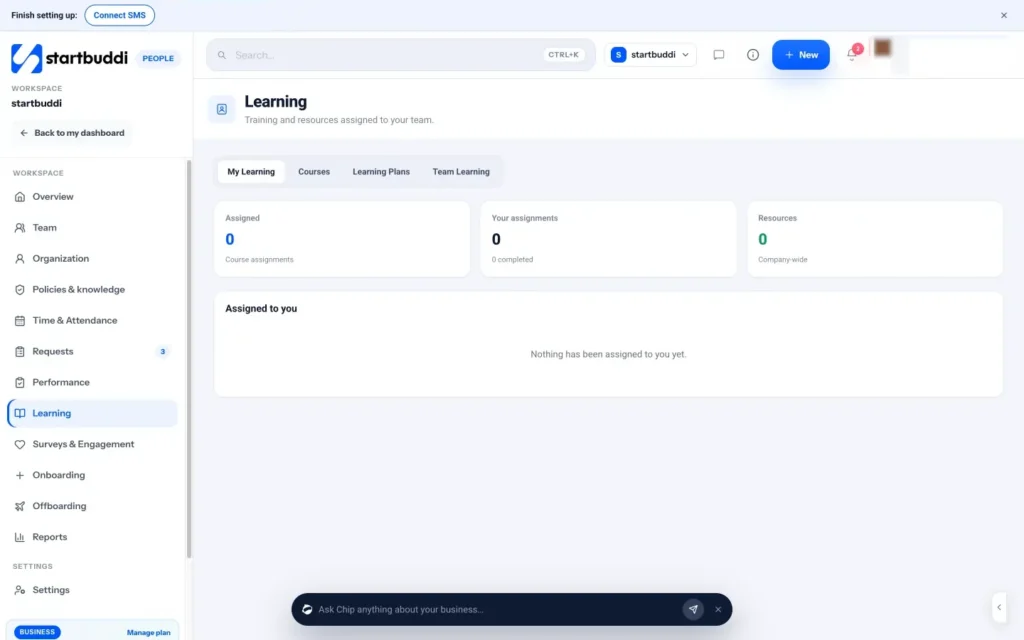
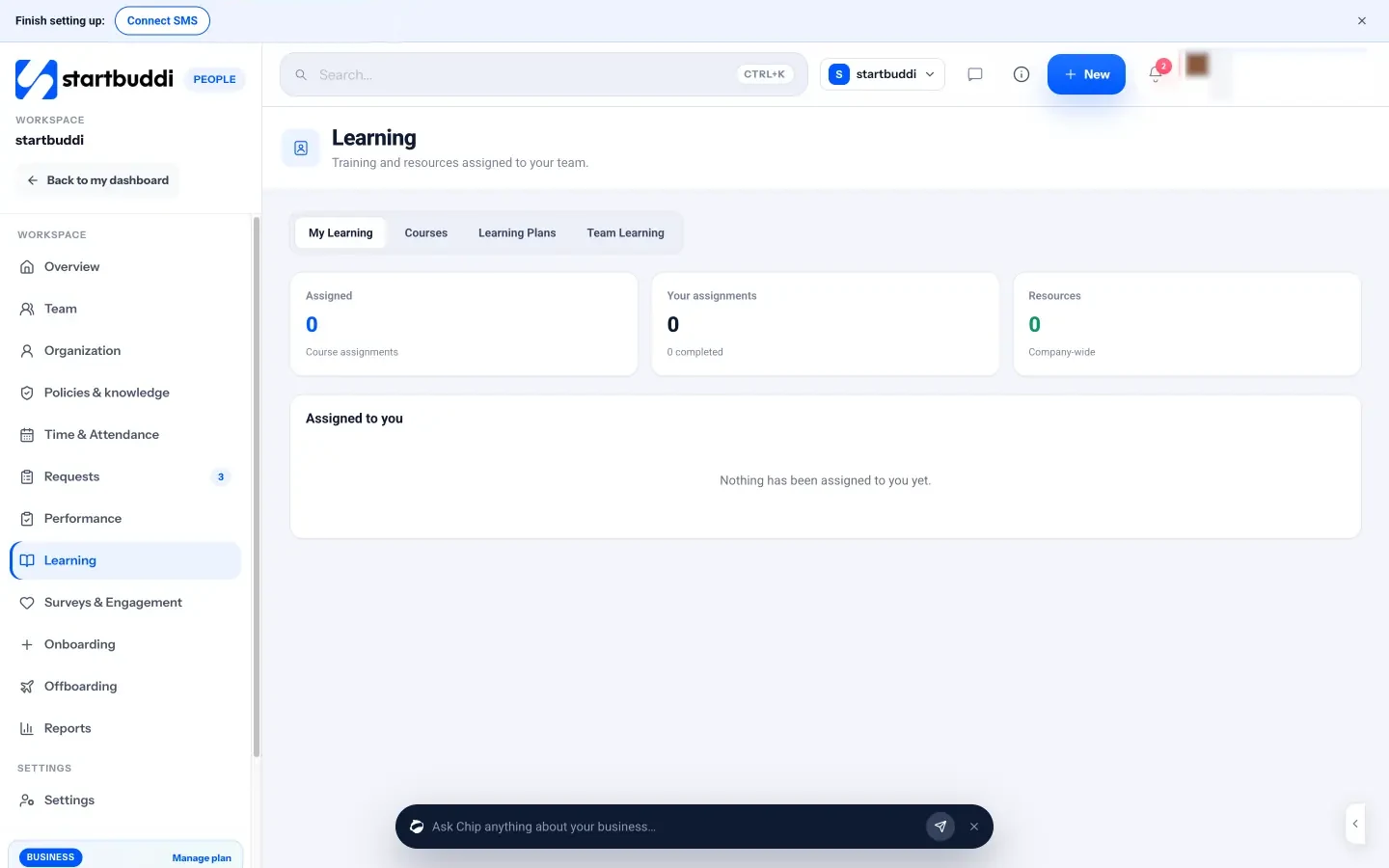
In startbuddi, training lives under People, then Learning. Start by adding your learning resources. Each resource has a title, a type (Video, Document, Link, Workshop, Webinar or Course), a link and a description. Point the link at wherever the material lives: a video you recorded, a supplier's guide, a course on another site, or a page in your own knowledge base.
Next, group resources into a learning plan. The app describes a plan as a set of resources assigned together, such as a role's essentials, a compliance refresher or a first-month curriculum. Build one plan per role ("Cleaner: first month", "Barista essentials") and assign it to a person, a team or a department. Managers only see their own team.
For new hires, tick Assign during onboarding on the resources every starter needs, and they will be assigned automatically. In Onboarding, templates let you build a checklist of steps grouped by timing (Day 1, Week 1 and so on), with owners such as the new hire, their manager, HR or IT. That is where the non-learning parts of your 90-day plan live: laptop ready, paired cleans booked, 30-day check-in scheduled.
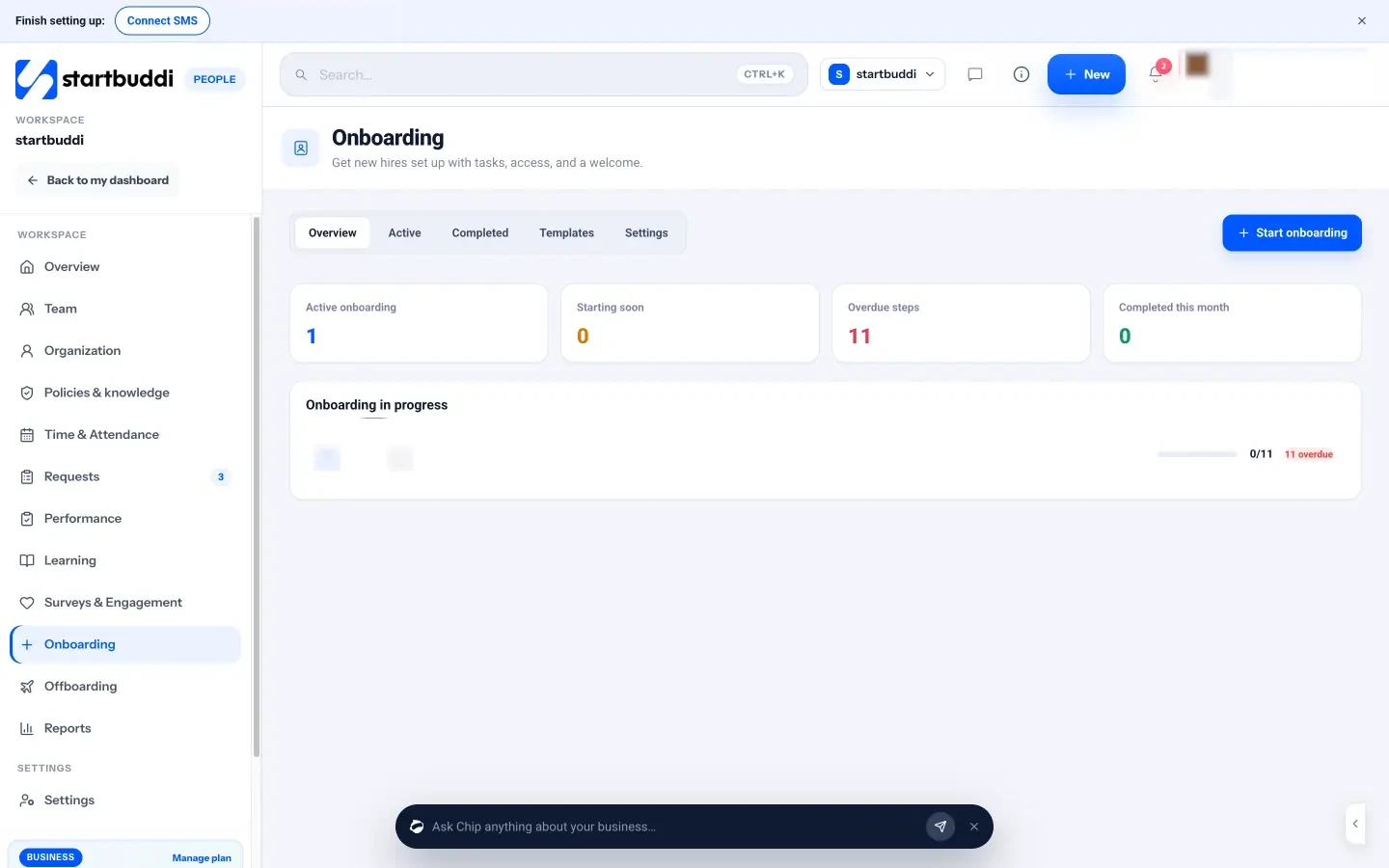
If you would rather start from a conversation, Chip HR can draft a 30/60/90 plan for a named new hire and save it as a draft in Documents, which you can then edit into the one-page plan above. It can also suggest an onboarding checklist for a role, such as "new designer", and either start a real onboarding or build a reusable project from it. As always with Chip, you see a preview and confirm before anything is created.
Be clear about what startbuddi is and is not here. Learning is a resource library with assignment and completion tracking. It does not host video courses, run quizzes or issue certificates, so keep hosting material wherever it already lives and use startbuddi to assign it and see who has finished. Read more on the Learning page and the onboarding and offboarding page.
How to teach so training sticks
You have a plan. Now comes the part most people get wrong: the teaching itself. A lot of workplace training is someone talking for an hour while the new person nods. They leave feeling informed and remember a fraction of it a week later. This chapter covers how people actually learn skills at work, a simple four-step method for teaching any task, how to write job aids that do the remembering for them, how to train remote staff, and the safety training you may be legally required to provide.
Why people forget training
In the 1880s, the psychologist Hermann Ebbinghaus measured how quickly he forgot lists he had learned, and plotted what became known as the forgetting curve: memory drops steeply in the first hours and days, then levels off. A 2015 study repeated his experiment and found results similar to his original data (Murre and Dros, PLOS ONE). Learning nonsense syllables is not the same as learning a job, but the practical lesson holds: if people hear something once and never use it, most of it will be gone.
Three things fight the forgetting curve at work:
- Practice straight away. Doing the task within minutes of being shown it.
- Spacing. Coming back to the skill after a day, a week and a month, rather than covering it once.
- Something to look it up in. A checklist or guide, so the person does not need to remember every step.
The four-step method for teaching any task
This method is old and plain, and it works for making coffee, quoting a job, using a till or cleaning a shower.
- Explain. Say what the task is, why it matters and what good looks like. Show a finished example. Keep it to a few minutes.
- Show. Do the task yourself at normal speed, then again slowly, talking through each step and the reason for it.
- Let them try. The learner does it while you watch. Let small mistakes happen if they are safe; stepping in too early stops them learning.
- Review. Ask what went well and what they would change. Add your own points, starting with what they did right. Agree when they will do it again.
Repeat steps 3 and 4 until the person meets the standard without help. Then sign it off in your plan.
Ask questions instead of testing memory
At the end of a session, "any questions?" nearly always gets a "no". Better questions check understanding without feeling like an exam:
- "Talk me through what you would do if the client isn't home when you arrive."
- "Which product would you use on this surface, and why?"
- "What is the one step you think you're most likely to forget?"
- "If a customer asked you about our refund policy right now, what would you say?"
Give feedback that helps people improve
The review step is where most learning happens, and it is easy to get wrong. Vague praise ("good job") teaches nothing, and a list of everything that was wrong overwhelms people. A simple pattern works better:
- Something specific they did well. "You worked top to bottom, so nothing dripped onto the clean floor."
- One thing to change next time. "The taps still had water marks. Finish them with the dry microfibre cloth."
- Why it matters. "Clients see taps and mirrors first; that's where they judge the whole clean."
- When they'll try again. "Let's do the next bathroom together at the Okafor house on Thursday."
One change at a time is enough. If there are five things to fix, pick the most important and save the rest for the next round.
Teach in small pieces
Short, focused lessons are easier to fit around a working day and easier to remember. Some people call this microlearning. In practice it means breaking a skill into chunks of five to fifteen minutes: one card, one short video or one demonstration, followed by practice. A new shop assistant might learn card payments on Monday, refunds on Tuesday and gift cards on Wednesday, rather than "the till" in one afternoon.
Small pieces also make spacing easy. On Friday, ask the new starter to do a refund while you watch, even though they learned it on Tuesday. That second go a few days later does more for memory than an extra hour on day one.
Adjust for different people
Not everyone learns at the same pace or in the same way. A few adjustments help:
- Experienced hires can skip the basics. Ask them to show you how they do a task, then teach only the differences in your business.
- People working in a second language benefit from photos, demonstrations and short written steps in plain words. Where you can, offer key safety material in the languages your team speaks.
- Nervous learners do better with a private first attempt, away from customers and colleagues.
- Fast learners get bored. Once they meet the standard, give them the next skill or ask them to help write the job aid.
Write job aids so nobody depends on memory
A job aid is anything that helps someone do a task correctly at the moment they are doing it: a checklist, a laminated card, a one-page guide, a short screen recording. For a small business, job aids are the most valuable training material you will make, because they keep working after the trainer has gone home.
Good job aids share a few traits:
- One task per page. "How to close the till", not "Shop procedures".
- Steps start with a verb and are in the order they happen.
- Warnings sit next to the step they apply to, not in a paragraph at the end.
- Photos of what good looks like, where it helps.
- A date and an owner, so people know it is current and who to ask.
Here is an example for a cleaning team:
Bathroom clean: standard visit (target 30 minutes)
1. Open a window or turn on the extractor fan.
2. Spray toilet, sink and shower with the blue bathroom cleaner. Never mix it with bleach.
3. Dust from top to bottom: light fittings, mirror frame, shelves.
4. Scrub and rinse the shower, then the sink, then the toilet, in that order.
5. Polish mirrors and taps with the microfibre cloth.
6. Wipe the floor last, working towards the door.
7. Take an after photo and note anything broken on the job sheet.
Owner: Amina. Last checked: March 2026.
When you have a few of these, you have the start of a set of standard operating procedures. Our free SOP template gives you a layout to copy for longer procedures.
Use role play for customer situations
You cannot wait for a real angry customer to teach someone how to handle one. Role play feels awkward for the first two minutes and then becomes one of the most useful training tools you have. Keep it short and specific:
- Pick one situation: a client says the clean was not good enough, a customer wants a refund without a receipt, a prospect says your price is too high.
- Write the three or four points a good answer covers. For a complaint: listen without interrupting, apologise for how they feel, confirm what went wrong, and offer a specific fix with a time.
- You play the customer; they play themselves. Run it for two or three minutes.
- Review using the feedback pattern above, then swap roles so they hear it from the other side.
Two or three rounds on the same situation is enough. Then write the key points on a card or a knowledge-base page so they can look it up after a difficult call.
Use a buddy, not just a boss
New people ask their manager the big questions and hold back the small ones because they do not want to look silly. A buddy fills that gap: a colleague who is not their manager and whose job for the first month includes answering "where do we keep the spare mop heads?" without a sigh. Pick someone who does the job well and explains things patiently, and give them a little time back in their week to do it.
Training remote and hybrid staff
Remote training follows the same four steps, with a few adjustments:
- Record the "show" step. A short screen recording of you doing the task, with your voice explaining, can be rewatched as often as needed.
- Do the "try" step live on a video call with screen sharing, so you can watch and help.
- Write everything down. Remote staff cannot glance over at a colleague, so the written guide matters even more.
- Schedule short daily check-ins for the first two weeks. Ten minutes is plenty.
- Give them a person to message with a promise of a quick reply during their first weeks.
Safety and compliance training: what the law may expect
This is general information, not legal advice. Rules differ by country, industry and the size of your business, so check with the official body where you operate.
In many countries, some training is not optional. In the UK, the Health and Safety Executive explains that employers must provide the information, instruction and training employees need to work safely, that health and safety training should take place during working hours and be free for employees, and that new starters and people whose work or equipment changes need training too (HSE, decide what training you need). In the US, OSHA's guidance says training should be given in the languages and at a literacy level all workers can understand, and updated when equipment, processes or assignments change in ways that increase hazards (OSHA, education and training). In Canada, the Canadian Centre for Occupational Health and Safety publishes guidance for employers, and most other countries have a labour or safety authority that does the same.
Practical points that apply almost everywhere: do safety training before people work alone, keep a simple record of who was trained on what and when, and repeat it when something changes.
Common teaching mistakes
- Talking too long. If you have been explaining for more than ten minutes without the learner doing anything, stop and let them try.
- Doing it for them. Taking the mop, the mouse or the pen back to "show them quickly" teaches them to wait for you.
- Criticising in front of customers or colleagues. Correct small things privately and calmly.
- Teaching your shortcuts first. Teach the standard way. Shortcuts come once someone understands why the steps exist.
How to do this in startbuddi
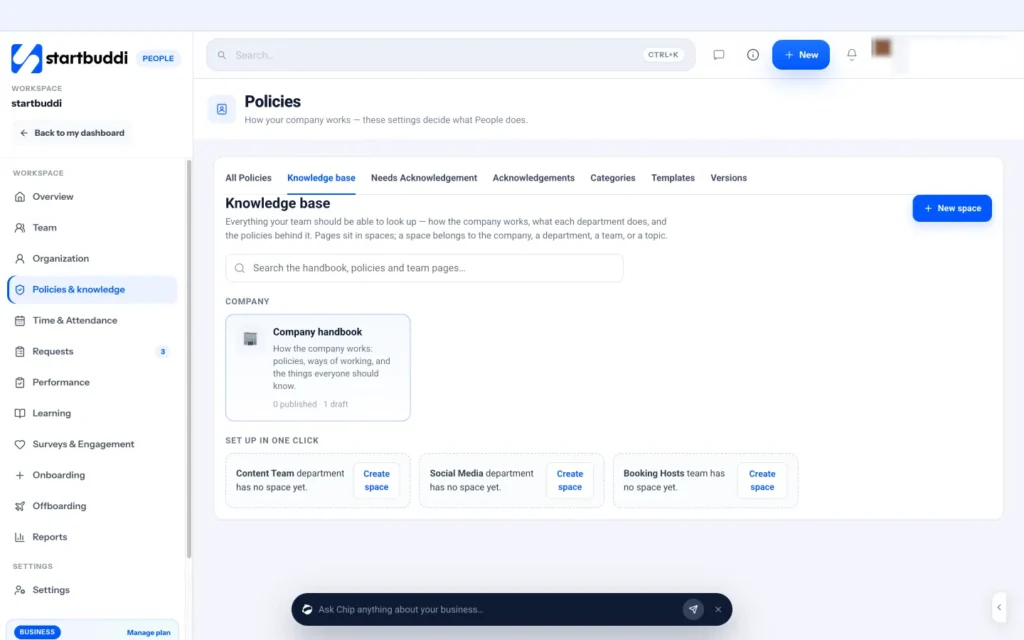
Your job aids and procedures need a home that everyone can search. In startbuddi that is the knowledge base, under People, then Policies & knowledge, then Knowledge base. Pages sit in spaces, and a space can belong to the company, a department, a team or a topic. A company handbook space is created for you, and you can set up a space for each department in one click. Pages have a rich-text editor with headings, lists and tables, drafts, and version history.
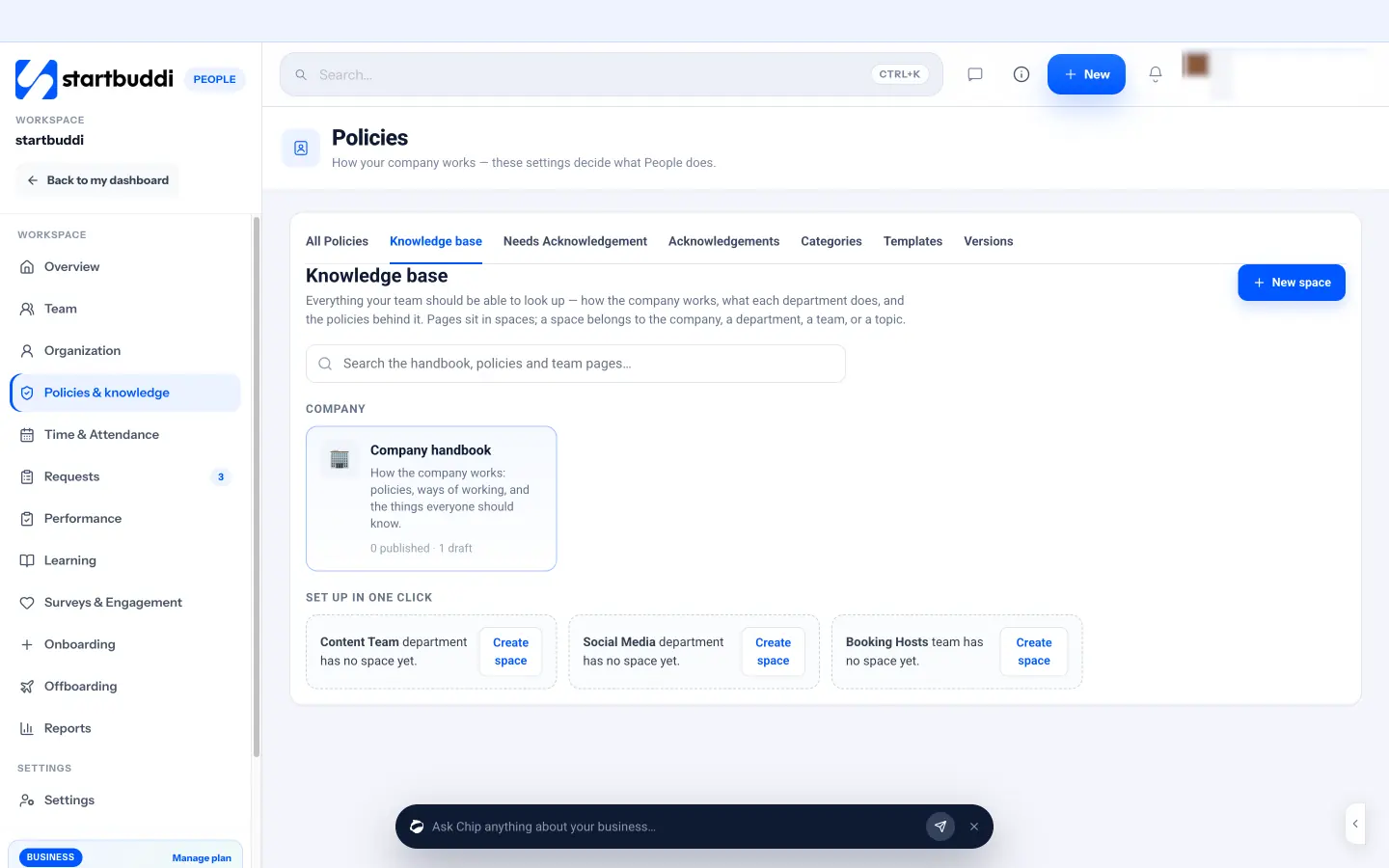
Write one page per task, following the job-aid rules above, and link to that page from the matching learning resource so people can find it from their training list too. For rules that people must read and confirm, such as your chemical-safety rules or your data-protection rules, use Make this a policy and choose a policy that needs sign-off. Employees then see a banner asking them to acknowledge it, and you can see who has and has not, with a Remind button for anyone outstanding. If a policy changes, everyone is asked to sign again.
A tip for the first few pages: start with the questions new people ask most. The knowledge base itself suggests writing down "the thing people keep asking about", and a page can be a how-to, a checklist, a decision or a policy. Five short pages that answer real questions are worth more than a long manual nobody opens. Add labels such as "cleaning", "till" or "clients" so pages are easy to find from the search box.
Chip HR, the HR side of Chip, answers "how do I..." questions from your published handbook and names the page it used. If nothing covers the question, it says so rather than guessing. That makes it a useful buddy for the small questions at 7am when nobody else is around. For writing the handbook itself, see our post on how to write an employee handbook, and the handbook, policies and knowledge base page for what the feature does.
Measure what changed, and keep training going
Most small businesses stop at delivery. The session happened, the box is ticked, everyone moves on. But the point of training was never the session; it was better work. This chapter shows you how to check whether training worked without drowning in paperwork, how to keep simple training records, how to link training to reviews and pay, and how to build a routine that keeps your team learning after the first 90 days.
Four levels of checking whether training worked
The best-known way to evaluate training is the Kirkpatrick Model, first set out by Donald Kirkpatrick in the 1950s. It has four levels: reaction (did people find it relevant and engaging?), learning (did they gain the knowledge and skills?), behaviour (do they apply it on the job?) and results (did the outcomes you wanted happen?) (Kirkpatrick Partners, the Kirkpatrick Model). Large companies build whole evaluation programmes around it. A small business can use it as four quick questions.
| Level | The question | A small-business way to check |
|---|---|---|
| 1. Reaction | Did they find it useful? | Ask two questions at the end: "What was most useful?" and "What was confusing?" |
| 2. Learning | Can they do it now? | Watch them do the task once, unaided, against the checklist. |
| 3. Behaviour | Are they doing it on the job? | Spot-check a week and a month later, without warning. |
| 4. Results | Did the business outcome improve? | Compare the number you cared about before and after: complaints, redos, time per job, reviews. |
Levels 3 and 4 are where the value is, and they are the ones most often skipped. Put the one-week and one-month spot checks in the diary when you run the training, or they will not happen.
Pick one number per training topic
For level 4, choose a single number that the training should move, and write it down before you start. Some examples:
- Cleaning: complaints per 100 cleans, or the share of spot checks that pass first time.
- Café: drinks remade per week, or average queue time at the lunchtime peak.
- Agency: rounds of edits per piece of work before the client approves it.
- Shop: refunds processed wrongly, or average basket size after upsell training.
- Sales: share of quotes that turn into paid work.
Worked example: a cleaning company in Johannesburg gets 6 complaints per 100 cleans in March. It runs bathroom training in April with a new checklist. In May and June complaints fall to 3 per 100. Other things may have changed too, so do not treat it as proof, but it is a strong sign the training was worth it, and a clear story to share with the team.
Work out the return on training
You do not need a finance team to estimate whether training paid off. Put the cost next to the saving, using rough but honest numbers.
Worked example: an agency in Toronto spends 10 hours of a senior's time (at $45 an hour) and 15 hours of a junior's time (at $25 an hour) on training the junior to write first drafts in each client's tone. That is $450 plus $375, so $825 in time. Before training, each piece of work needed three rounds of edits from the senior, around 45 minutes per piece. After training, it needs one round, around 15 minutes. At 40 pieces a month, the senior saves 20 hours a month, worth $900. The training pays for itself in the first month and keeps paying after that.
Not every saving is that clear. Fewer complaints, better reviews and staff staying longer are harder to put a figure on, but they are real. Write them down alongside the numbers you can measure.
Plan refreshers
Some training needs repeating. A simple schedule stops it slipping:
| Type of training | Suggested refresh |
|---|---|
| Safety and chemical handling | Every year, and whenever products, equipment or the work changes |
| Food hygiene, first aid and similar certificates | As the certificate or local rules require |
| Data protection and handling customer information | Every year |
| Core job skills | Spot checks each quarter; retrain only where checks show drift |
| Rarely used tasks | A quick practice run once or twice a year, plus a written guide |
When someone is not improving
Occasionally a person goes through the training and still cannot do the task. Before you conclude it is them, check the training: was the standard clear, did they get enough practice, was the teacher patient, did they have the right tools? Try a different method or a different teacher. If they still struggle after a fair second attempt, have an honest, private conversation about whether the role suits them. That is kinder than letting frustration build on both sides.
Keep simple training records
You need a record of who was trained on what and when. It helps you spot gaps, plan refreshers, answer an insurer or inspector, and show a new manager where everyone stands. At minimum, keep:
- The person's name and role.
- The training topic or resource.
- The date it was completed, and who signed it off.
- For safety and compliance topics, when it needs repeating.
Update your skills matrix at the same time. Watching the scores move from 0 and 1 to 2 and 3 over a quarter is one of the most satisfying views a small-business owner can have.
Connect training to reviews and growth
Training works best when it is part of how you manage people, not a separate project. In every review or one-to-one, cover three training questions:
- What have you learned since we last spoke, and how are you using it?
- Where do you feel least confident right now?
- What do you want to learn next, and why?
The answers feed straight back into your plan. And when someone has clearly grown (they now train others, run a client, supervise a shift), recognise it. That might be a title, more responsibility, a pay rise or public thanks. People keep learning when learning leads somewhere.
Build a training routine that lasts
After the first 90 days, training easily drifts. A light routine keeps it alive without taking over your week:
- Weekly: a ten-minute "one thing" slot in the team meeting. One person shows one tip, one mistake to avoid, or one new procedure.
- Monthly: review your training ideas note and pick the next topic. Do the one-month spot checks for last month's training.
- Quarterly: update the skills matrix, refresh safety topics that are due, and check whether your chosen numbers moved.
- Yearly: ask each person what they want to learn in the coming year, and set aside the time and money for it.
Show people where training leads
In a small business there is no ladder of job titles, which can make people feel there is nowhere to go. You can still show a path. Write down two or three levels for each main role and the skills that move someone between them. For a cleaning company, that might be cleaner, senior cleaner (trains new starters, handles deep cleans, can be sent alone to new clients) and team leader (runs a crew, does spot checks, handles client complaints). For an agency: junior, executive (owns a client's day-to-day work), account lead (owns the relationship and the report).
Link each level to specific items on your skills matrix. Then training stops being something that happens to people and becomes something they can use to move up. It also makes pay conversations fairer, because everyone can see what the next level asks for.
Celebrate progress
Learning a new skill at work can be uncomfortable, especially for people who have not studied in years. Notice and name progress: a quick message when someone passes their first spot check, a mention in the team meeting when someone trains a colleague for the first time, a small treat when the whole team finishes the annual safety refresher. It costs little and makes the next round of training easier to start.
Train the trainers
As you grow, you cannot teach everything yourself. The people who score 3 on your skills matrix are your trainers. Give them the four-step method from chapter 3, ask them to write or update the job aid for their task, and let them run the next session while you watch and give feedback. It is a development step for them and frees up your time.
A quarterly training review in 30 minutes
Once a quarter, block half an hour and work through these questions, ideally with your managers or senior staff:
- What training did we run this quarter, and who completed it?
- Did the spot checks show people doing the task to standard a month later?
- Did the number we picked for each topic move?
- Which gaps on the skills matrix are still open, and which tasks still depend on one person?
- What new services, tools, clients or rules are coming next quarter that people need to learn first?
- Which safety or compliance topics are due for a refresher?
- What did people say about the training, and what should we change?
Write the answers down in one short page. Over a year, those four pages tell the story of how your team got better, and they make next year's training budget an easy conversation.
Mistakes to avoid
- Measuring attendance, not ability. "Everyone attended" says nothing about whether they can do the work.
- No follow-up. Without spot checks, old habits come back within weeks.
- Training as punishment. If training only happens after mistakes, people learn to hide mistakes.
- Forgetting refreshers. Safety and compliance topics need repeating, and so do skills that are used rarely.
- Ignoring feedback. If people say a session was confusing, fix it before the next person goes through it.
How to measure and keep it going in startbuddi
In People, then Learning, the Team Learning view lists each employee with their department, how many resources were assigned, how many they have completed, and their completion rate. That covers your basic training record. Each person's profile also has a Learning tab. You can ask Chip HR "Who has unfinished training?" and it will tell you, and employees can ask "What training do I have open?". If someone wants a course that is not in your library, they can raise a learning or training request under Requests, which goes to the right approver based on your policies.
For levels 1 and 3, use Surveys & Engagement. There is a built-in New joiner check-in template for asking new hires how their first weeks went, and you can start from scratch to ask a few questions after a training block. Surveys can be anonymous, which tends to get more honest answers about what was confusing. Our guide to the employee engagement survey covers how to write good questions.
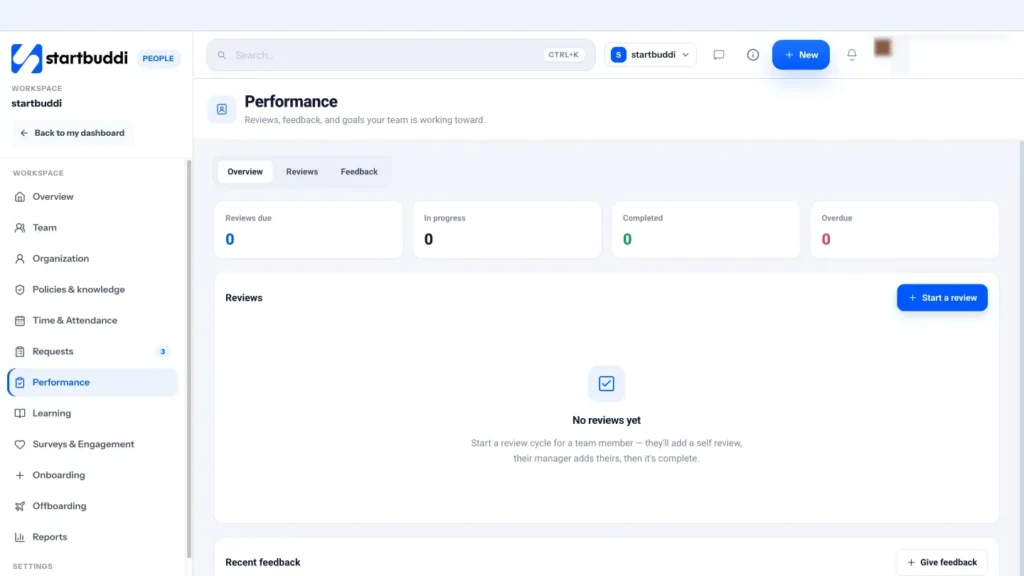
To connect training to growth, use Performance. Start a review for a team member, they add a self review, their manager adds theirs with a rating from 1 to 5, and you can send ongoing feedback at any time. Chip HR can draft a balanced review summary from the person's reviews, feedback, goals and training, and a person always decides the rating. Our free performance review template has questions you can adapt, including the three training questions above.
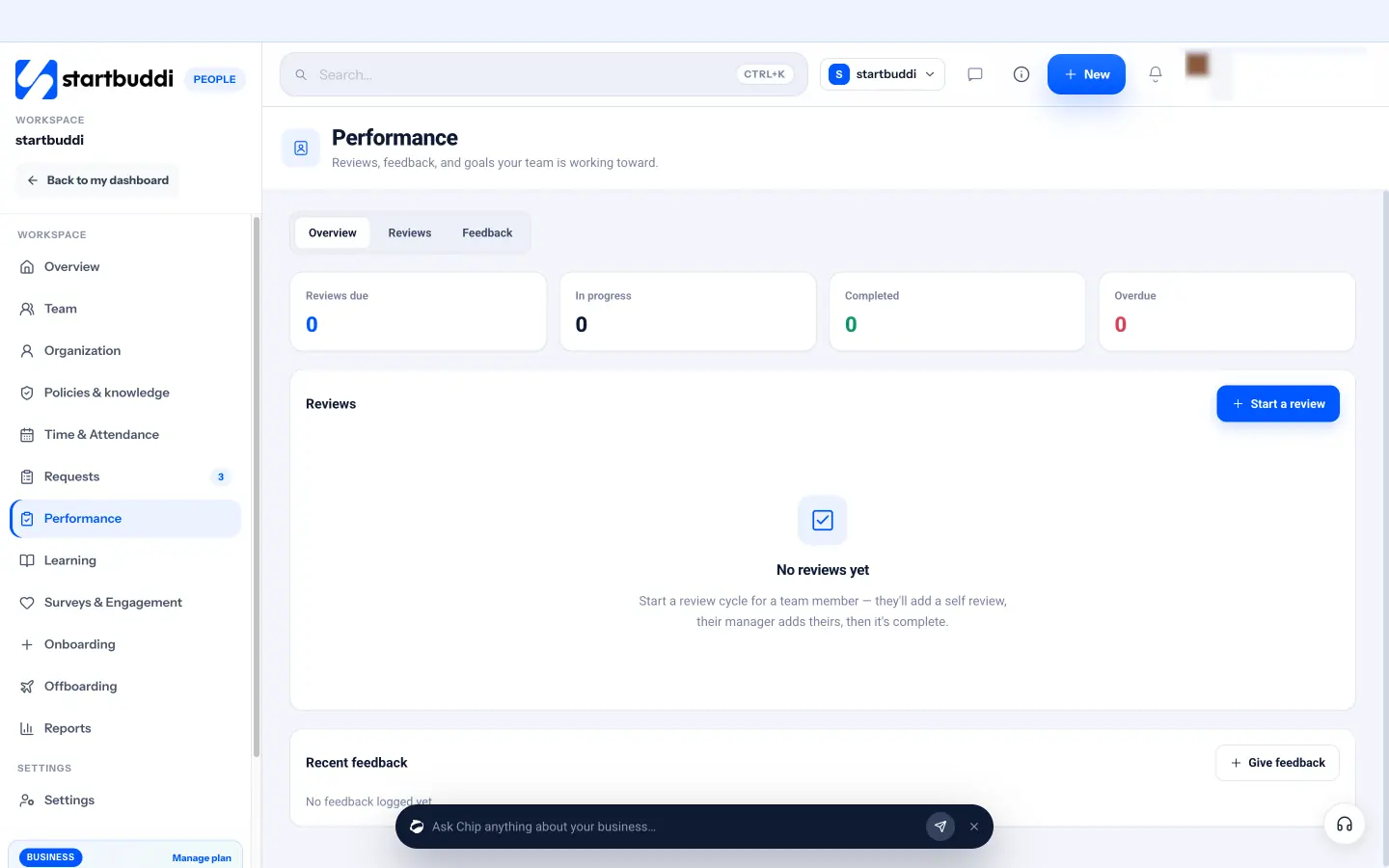
A few Chip HR prompts that help with the routine above: "Who has unfinished training?" before your monthly review, "Which employees have incomplete onboarding?" to catch new starters whose first-weeks steps have slipped, and "Help me prepare a probation check-in for Chidi" before a 90-day conversation. Chip previews anything it wants to create or change and asks you to confirm first.
One honest limit: People reports in startbuddi cover headcount, joiners and leavers, leave, attendance and policy sign-off, but there is no export or custom report builder yet, so if you want to chart training against complaints over time, pull the numbers into a spreadsheet each quarter.
A good next step: pick one role, write its task list, and build your first learning plan this week. See how it works on the People page, or compare plans on pricing.
Chinedu Kalu is the co-founder and chief operating officer of startbuddi, responsible for how the company runs day to day. Chinedu writes about the operational side of a small business: registering and running the company, money, hiring and the routines that keep a team on track.
Co-founded startbuddi and runs its operations