No-show appointments cost you time, money, and energy every single week. If you want to know how to reduce no show appointments, reminders alone will not solve it. …
- Why Do Clients Miss Appointments in the First Place?
- How Can Automated Reminders Help You Reduce No Show Appointments?
- What Scheduling Changes Actually Cut Down on No-Shows?
- How Do You Write a No-Show Policy That Clients Actually Respect?
- How Should You Follow Up After a Missed Appointment Without Pushing Clients Away?
No-show appointments cost you time, money, and energy every single week. If you want to know how to reduce no show appointments, reminders alone will not solve it.
The real fix is better communication, smarter scheduling, and staying human even when clients let you down. By the end of this article, you will have a clear system to cut your no-show rate and keep every client relationship fully intact.
Why Do Clients Miss Appointments in the First Place?
Most clients do not skip on purpose. The real reasons are forgetfulness, sudden schedule clashes, transport problems, appointment anxiety, or plain confusion about the time and location.
That tells you something important. Most no-shows are a communication gap, not a character flaw. Once you see it that way, you stop reacting with frustration and start building systems that genuinely help clients show up. Every strategy in this guide is built on that single insight.
How Can Automated Reminders Help You Reduce No Show Appointments?
Forgetfulness drives the majority of missed bookings. Reminders fix that. The goal is not to bombard clients but to check in at the right moments in a way that feels warm, not robotic.
A three-step sequence works well across most service industries:
- Seven days before: a friendly confirmation with the key appointment details
- 48 hours before: a clear reminder with a simple option to confirm or reschedule
- Day of: a short, warm heads-up letting them know you are ready
SMS is your strongest channel. Text messages are read faster and more consistently than any other outreach method, which is why they work so well for appointment reminders. Email works well for clients who prefer more detail or need pre-appointment instructions. Whichever channel you use, write like a real person. A warm, specific message will always outperform a cold automated blast.
Tools like startbuddi help service businesses automate these reminder sequences without losing the personal feel, so every client hears from you at exactly the right time.
What Scheduling Changes Actually Cut Down on No-Shows?
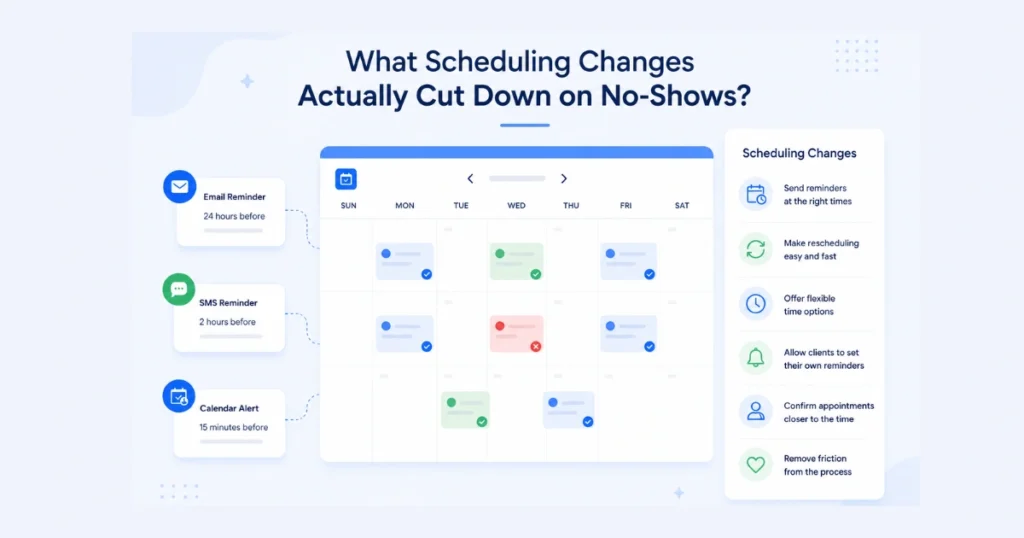
Your scheduling setup affects attendance more than most people realize. Three changes make the biggest difference.
Reduce the gap between booking and appointment. The longer a client waits between booking and their session, the more likely life gets in the way. Same-day and next-day slots see fewer no-shows. Where possible, tighten that window.
Let clients book themselves. When clients choose their own slot, they are far more invested in showing up. Giving people the option to self-schedule online removes friction and puts the decision in their hands.
Set up a waitlist. When someone cancels, your system notifies the next person in line automatically. Your slot fills without extra work on your end.
Each of these changes helps reduce no show appointments through convenience rather than enforcement. Where your service allows it, offering a virtual option also removes the travel barrier entirely.
How Do You Write a No-Show Policy That Clients Actually Respect?
Most businesses write their no-show policy like a legal warning. Clients skim it, forget it, and feel blindsided when it is enforced. That erodes trust before you have had a chance to build it.
Write your policy early and frame it around mutual respect. Something like: “We hold this time just for you. If your plans change, a 24-hour heads-up lets us offer your slot to someone who needs it.” That wording lands very differently from a fee warning.
If you charge a cancellation fee, add it to the booking confirmation, reminder messages, and any intake forms. Clients who agree upfront almost always honor it. For new clients or high-value sessions, a small deposit creates commitment without feeling adversarial.
Always leave room for genuine emergencies. One rigid enforcement with a loyal client can cost you far more than the empty slot.
How Should You Follow Up After a Missed Appointment Without Pushing Clients Away?
What you do after a no-show shapes whether that client ever comes back. Most businesses either say nothing or lead straight with the policy. Both responses usually cost them the client.
This is where startbuddi helps. You can set up same-day follow-up messages that send automatically, so your response is always consistent and never written in the heat of the moment.
Lead with care, not frustration. A message like, “Hi [Name], we noticed you missed today. We hope everything is okay. Whenever you are ready, we would love to help you reschedule,” does three things at once. It shows the client matters more than the booking. It keeps the relationship open. And it gives a clear, pressure-free next step.
Clients who miss often feel guilty about it. A kind message turns that guilt into gratitude and increases the chance they return. Save the policy reminder for repeat situations. The first follow-up should always feel human.
For habitual no-shows, a phone call beats a text every time. A real conversation builds accountability that automated messages simply cannot match.
How Can You Use Technology to Reduce No Show Appointments at Scale?
Consistency is what brings your no-show rate down. Technology makes that possible even when your team is stretched.
A solid scheduling platform gives you automated multi-channel reminders, two-way SMS, confirmation tracking, waitlist management, and appointment history in one place. CRM integration lets you personalize outreach based on each client’s behavior. Past no-show clients may need an extra reminder. Reliable regulars often need just one.
As you grow, predictive tools help you spot high-risk bookings early by flagging patterns like long lead times or repeat cancellation history, so you can act before the no-show happens.
Businesses that effectively reduce no show appointments are not usually the ones with the toughest policies. They are the ones with the most consistent communication and the smoothest client experience.
Frequently Asked Questions
Run this from one workspace
Clients, projects, money and marketing — connected, not scattered across five apps.
See how it worksWhat is a reasonable no-show rate for a service business?
Most service businesses aim to keep their no-show rate below 10%. Anything consistently higher points to a gap in reminders, scheduling, or client communication.
How far in advance should I send appointment reminders?
Three touchpoints work best: one week before, 48 hours before, and on the day. This keeps the booking top of mind without feeling intrusive.
Should I charge a fee for missed appointments?
Only if you tell clients upfront before they book. A surprise fee damages trust. A small deposit at booking is often more effective and far less confrontational.
How do I handle a client who keeps missing appointments?
Call them rather than text. Ask if anything makes attendance difficult and work toward a solution. If the pattern continues, it may be time to reassess the arrangement.
Conclusion
Getting this right comes down to knowing your clients. Most missed bookings are preventable with the right reminders, smarter scheduling, honest policies, and follow-ups that feel human rather than transactional.
The businesses that get this right protect both their revenue and their relationships. Done well, those two things reinforce each other.
If you are looking for a simple starting point, startbuddi is built for service businesses that want to reduce no-shows and grow client trust without the complexity. You can get started for less than $10 and see results quickly.
Put this into practice
Everything in this guide is built into startbuddi — free to start.
Start freeWritten by
Chinonye Umezinne
SEO Copywriter| Email growth Specialist| I help businesses increase revenue with strategic SEO content & high-converting email funnels.
Keep reading
Related playbooks
Stop reading. Start doing.
Free to start. No card needed. Your full workspace is ready in five minutes.