SMS marketing guide: how to set up SMS marketing for your business
How to set up SMS marketing from scratch: consent rules in the US, UK and Nigeria, sender IDs, choosing a provider, message length, timing and measuring results.


Chinonye wrote this while on the startbuddi team. The product has changed since, so the team updated it on .
- Build a list of customers who agreed to hear from you, register a sender your customers recognise, choose a provider that delivers in their countries, and keep each message within 160 characters. Follow local consent rules (including Nigeria's DND), honour every STOP reply, send in daytime and measure delivery, clicks, opt-outs and sales.
To set up SMS marketing for your business, you need four things: a list of customers who agreed to hear from you, a sender your customers recognise (a business name where the country allows it, or a registered number where it doesn’t), an SMS provider that delivers reliably in your customers’ countries, and short messages that follow local consent rules. Get those right and SMS remains one of the fastest ways to reach customers, because it works on every phone, with or without data.
This SMS marketing guide walks through each step in order: when SMS is worth it, the rules in a few major markets (with a closer look at Nigeria’s Do-Not-Disturb system), choosing a provider, writing messages that fit in one text, when to send, and how to measure what works.
Is SMS marketing still worth it?
For many businesses, yes, but for specific jobs. SMS is strongest when a message is short, time-sensitive and needs to land even without data: appointment reminders, delivery updates, “we’re open this Sunday”, a weekend sale, a payment link. It reaches customers who don’t use WhatsApp or email much, and it doesn’t depend on someone opening an app.
It’s weaker for long stories, images or back-and-forth conversation. For those, WhatsApp or email usually does better. Our comparison of WhatsApp vs SMS marketing covers the trade-offs, and how to run a sale across email, WhatsApp and SMS shows how the channels work together in one campaign.
A simple test: if the message fits in one sentence and is useful today, SMS is a good fit.
The rules for SMS marketing
This is general information, not legal advice. Check the current rules with the regulator where your customers are, and with your provider, before your first campaign. The principles are similar almost everywhere: get clear permission before you send marketing texts, say who you are, make stopping easy and act on it quickly, and never buy lists.
United States and Canada
In the US, the FCC says businesses sending marketing texts by automated means must get the consumer’s prior express written consent, and people can opt out at any time in any reasonable way. You also can’t send from a business name there: alphanumeric sender IDs aren’t supported in the US or Canada, so businesses send from a registered 10-digit long code, a toll-free number or a short code. Your provider handles the registration.
United Kingdom and Europe
In the UK, the ICO’s guidance on electronic marketing covers texts as well as email: you generally need consent, with a limited “soft opt-in” for existing customers. EU countries apply similar rules alongside the GDPR.
Nigeria: Do-Not-Disturb, routes and sender IDs
Nigeria has one of the more detailed systems, so it’s worth covering closely.
DND and short code 2442. The NCC runs a Do-Not-Disturb service on the short code 2442. A subscriber who texts STOP to 2442 activates full DND and should stop receiving unsolicited promotional messages. There is also partial DND, where people choose categories they still want, such as banking, real estate or education. Your customers can check their status by texting STATUS to 2442.
What this means for you: promotional messages sent on the ordinary route won’t reach numbers on DND, even if that person once bought from you. Messages that are genuinely transactional (an OTP, a delivery or appointment confirmation) can go on a separate route, but you must not use that route for promotions.
Promotional vs transactional routes. Nigerian SMS providers usually offer two routes. Termii’s messaging API documentation is a clear example:
- Generic (non-DND) route: meant strictly for promotional messages. It won’t deliver to DND numbers, and on MTN it doesn’t deliver between 8pm and 8am WAT.
- DND (transactional) route: delivers to all numbers regardless of DND, and is meant for transactional or critical messages only. Your sender ID must be approved for it.
Plan campaigns for daytime, and keep promotions off the transactional route. Misusing it can get your sender ID blocked.
Registered sender IDs. An alphanumeric sender ID is the name that appears instead of a phone number, such as “AdaBakery”. Providers in Nigeria register sender IDs with the networks before you can use them, which can take several working days. Termii’s documentation says a sender ID should be 3 to 11 characters. Pick something customers will recognise, ideally your trading name, and avoid generic words like “Promo” or “Info”.
Consent. The Nigeria Data Protection Commission oversees the Nigeria Data Protection Act 2023. In plain terms, collect phone numbers for a clear purpose, tell people you’ll send them marketing messages, keep a record of how and when they agreed, and make stopping easy. Never buy lists. Apart from the legal risk, strangers are the people most likely to complain or activate DND.
Kenya, South Africa, India and most other markets have their own data protection laws and sender registration rules, so ask your provider what applies before you send.
Step-by-step guide: how to set up SMS marketing
Step 1: build a consented list
Start with the customers you already have. Good places to collect numbers with permission:
- At checkout or on your receipt: “Want a text when we have offers? Reply YES.”
- On your booking or order form, with an unticked box for marketing texts.
- At events and in-store, with a short sign-up form or QR code.
- From your website, with a simple form. Our guide to building a lead capture form covers the wording.
Save every number in international format (+44 7700 …, +1 415 …, +234 803 …) and keep one list. If your customers currently live in WhatsApp chats and notebooks, turn them into a proper customer database first.
Step 2: choose a provider
You’ll send through an SMS provider (also called an aggregator or gateway) with agreements with the mobile networks in your customers’ countries. International platforms such as Twilio and Brevo cover many countries; in Africa, businesses also commonly use Termii and Africa’s Talking. When you compare them, check:
- Price per SMS segment in each country you send to, and the currency you pay in.
- How long sender ID registration takes, and whether they register it for you.
- Delivery reports, so you know which messages actually arrived.
- How opt-out replies (STOP) are handled.
- Whether they plug into the tools you already use for customers and bookings.
If you’re comparing SMS tools more widely, our list of SMS marketing software is a good next read.
Step 3: register your sender
Submit your preferred sender ID or number registration through your provider, with whatever business details and documents they ask for. While you wait, draft your first messages, agree who will answer replies, and set up the landing page or booking link your messages will point to.
Step 4: segment before you send
Even a list of 300 customers has groups: people who bought last month, people who haven’t bought in six months, people in different cities, people who book vs people who buy products. Sending the right offer to a smaller group almost always beats blasting everyone. The same segmentation you would use for email works for SMS.
Step 5: send a small test first
Send your first campaign to yourself and two or three colleagues on different mobile networks. Check the sender name, the line breaks, the link and the character count, then send to the real list.
How to write SMS messages that fit and get read
Mind the character limit
A standard SMS holds 160 characters. Longer messages split into segments of 153 characters each, and each segment is usually billed as a separate SMS, as Twilio’s guide to SMS length explains. There’s a trap: if you use any character outside the basic GSM set, such as an emoji or some currency symbols, the whole message switches to Unicode and the limit drops to 70 characters. Some currency signs, such as the naira sign, are outside the basic set too: writing “N5,000” or “NGN 5,000” keeps a message in one segment. Test in your provider’s preview before you send.
A simple structure
- Who it’s from (your sender ID does most of this).
- The value, in the first few words.
- The deadline or reason to act now.
- One action: a link, a number to call or a word to reply.
- How to stop, for promotional messages.
Examples you can adapt
Hi Chioma, 20% off all braids this Sat & Sun at Ada Beauty, Yaba. Book: adabeauty.com/book Reply STOP to opt out
Hi Tom, your MOT at Park Lane Garage is tomorrow at 9:30am. Need to move it? Reply R and we’ll call you.
Your order #2231 is on its way and should arrive today before 6pm. Questions? Call 0803 000 0000
Last chance: free delivery on orders over N20,000 ends midnight. Shop: adastore.ng Reply STOP to opt out
Notice what’s missing: no capital letters shouting, no “Dear Esteemed Customer”, no three different offers.
When to send SMS campaigns
- Daytime only for promotions. Stay between about 9am and 7pm in the customer’s time zone. In Nigeria this also keeps you inside MTN’s 8am to 8pm window for the promotional route, so nothing gets held back.
- Match the moment. A lunch offer at 11am, a salary-week sale near month end, a weekend event on Thursday or Friday.
- Don’t overdo it. For most businesses, two to four promotional texts a month is plenty. Every extra message is a chance for someone to opt out.
- Avoid sensitive times. Be thoughtful around public holidays and religious observances; a pushy sales text at the wrong moment costs goodwill.
Measuring SMS marketing results
Track four numbers for each campaign:
| Metric | What it tells you |
|---|---|
| Delivery rate | How many messages actually arrived. Low rates point to opted-out or bad numbers, or route problems. |
| Clicks or replies | Whether the message was interesting enough to act on. |
| Opt-outs | Whether you’re sending too often or to the wrong people. |
| Sales or bookings | Whether it made money. Use a campaign-specific link, code or phone line to tell. |
Compare each campaign with the last. If delivery drops, clean your list. If opt-outs spike, send less often or target more tightly. For automated texts that go out on triggers (after a booking or purchase), see automated SMS campaigns.
Common SMS marketing mistakes to avoid
- Texting everyone you’ve ever met. Old numbers from a phone book or a bought list bring complaints and opt-outs, and they drag your delivery rate down.
- No way to stop. Promotional texts should say how to opt out, and you must act on it quickly. A customer who can’t stop your messages will stop trusting your brand.
- Vague sender names. If customers don’t recognise the sender ID, they won’t read the message. Use the name on your shopfront or Instagram.
- Links that don’t work on a basic phone. Keep the landing page light and mobile friendly, and test it on a slow connection.
- Forgetting the follow-through. If you promise “reply YES to book”, make sure someone is watching the replies and answers the same day.
How startbuddi helps with SMS marketing
startbuddi includes SMS marketing as part of the Marketing module, next to email and WhatsApp, using the same contact list as the rest of your business.
Sending
You can send through startbuddi’s built-in SMS with nothing to set up, or connect your own Termii, Africa’s Talking, Twilio or Brevo account and use your own sender ID. The SMS settings include a readiness checklist (SMS can send, sender ID set, test message sent, opt-outs handled) and a button to send a test message.
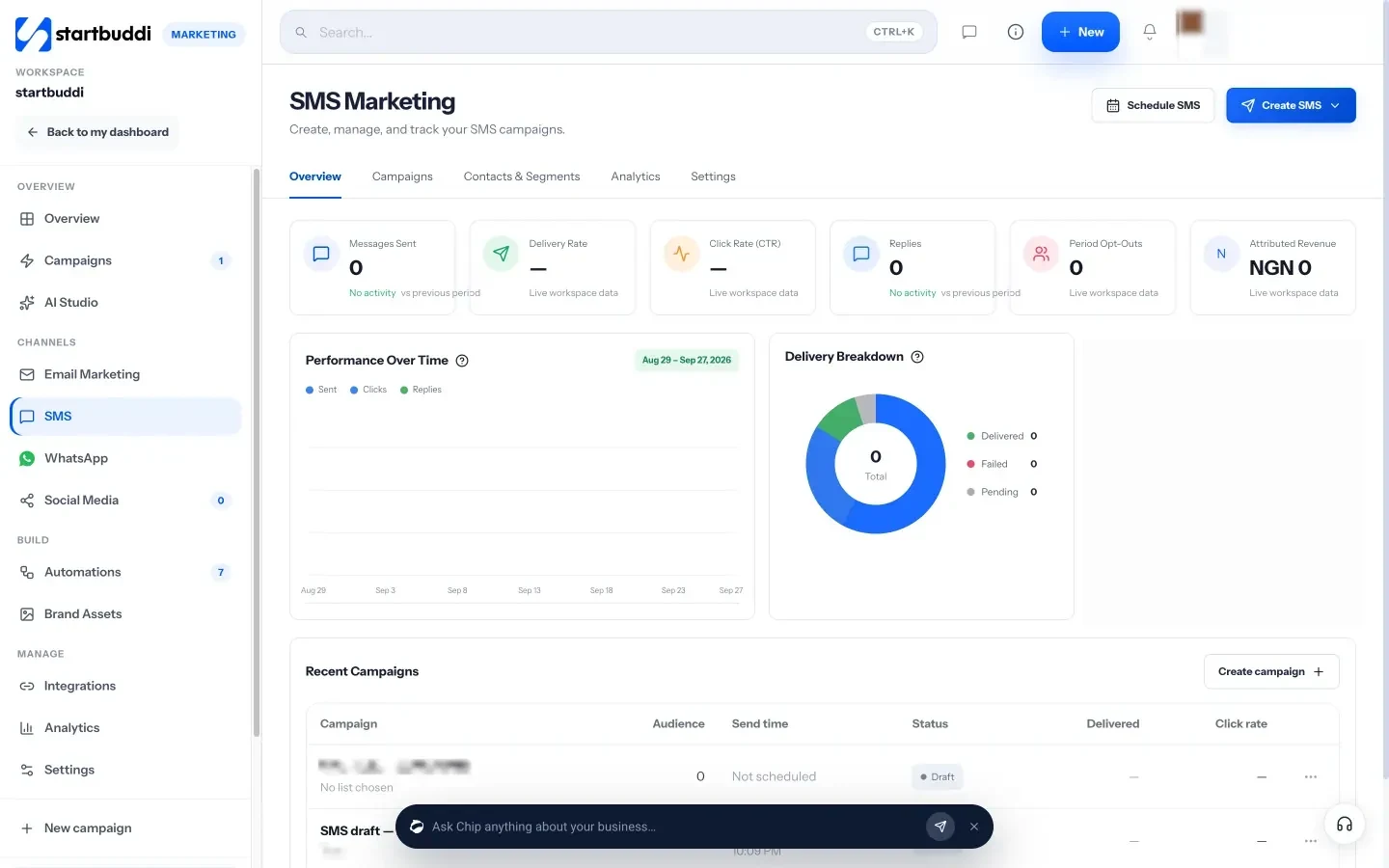
To create a campaign, you name it, choose an audience or list, check the sender ID and write the message. Merge tags such as first name and city personalise it, and a live phone preview shows a character count and how many SMS segments the message will use. You can send now, schedule a date and time, or save a draft.
Opt-outs and replies
When someone replies STOP, UNSUBSCRIBE, CANCEL, END or QUIT, they come off your SMS list and every campaign skips them. This works automatically for the built-in SMS, Twilio and Africa’s Talking; for Termii and Brevo, startbuddi doesn’t read replies yet, so handle opt-outs on the provider side too. Replies are counted in your analytics and appear in the customer inbox.
Your list and segments
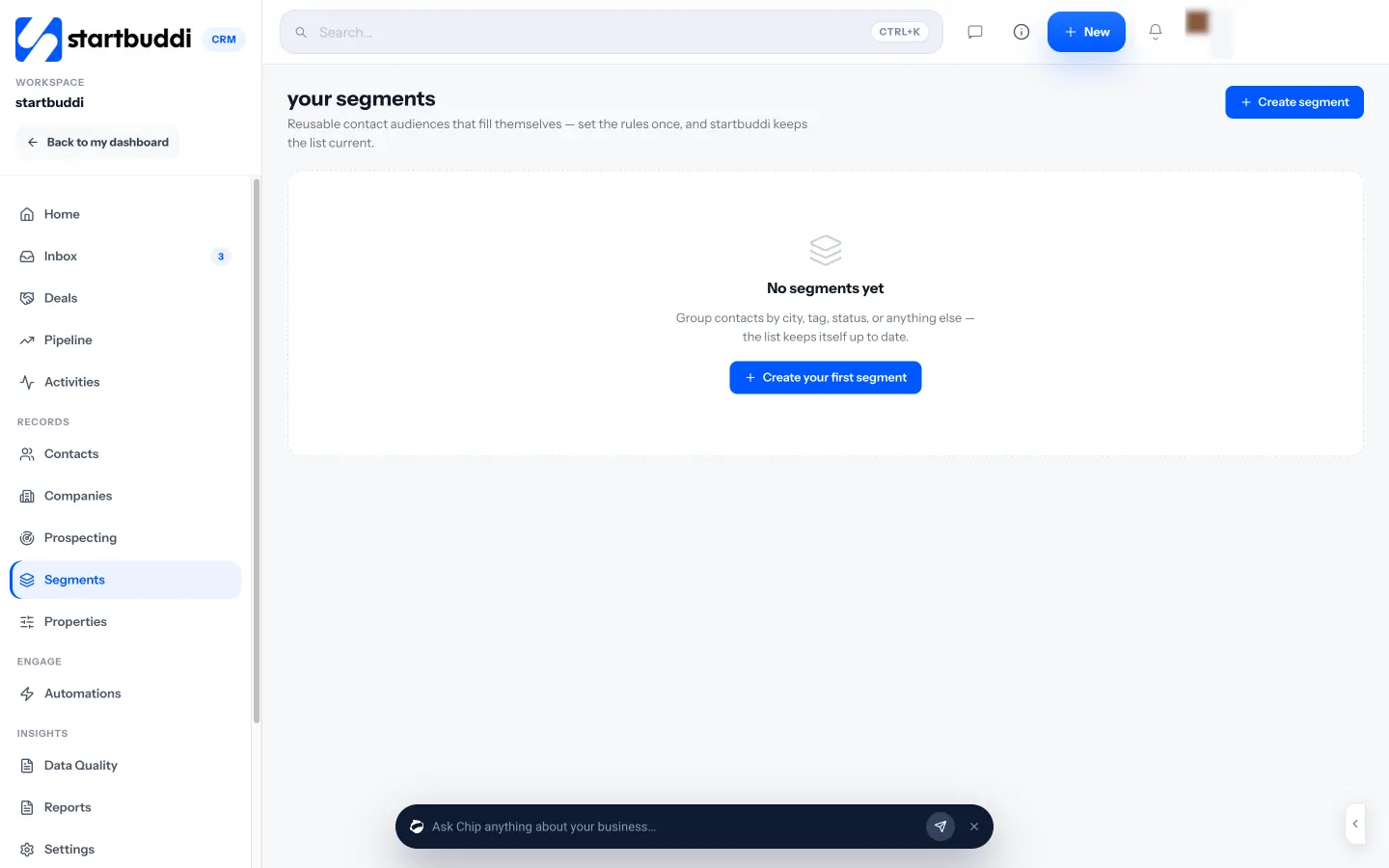
SMS uses the same contacts as the rest of startbuddi, with an opt-in filter. You can add numbers one by one or import a CSV, and build segments that keep themselves up to date by city, tag or status.
What to know before you start
The Marketing module, including SMS, needs the Starter plan or above; it isn’t available on Free. Each plan includes a monthly SMS allowance (50 on Starter, 200 on Growth and 500 on Scale), and messages sent through your own provider account are paid to that provider. If you connect your own provider, sender registration and routing (including Nigeria’s DND routes) are handled by that provider, so check both with them before your first campaign. The help article on sending an SMS campaign shows each screen.
Your next step
Pick your sender ID today and ask your provider how long registration takes. While it’s being approved, write three messages you’ll actually need in the next month (a reminder, an offer and an update) and check each fits in 160 characters. If you’d like SMS, email and WhatsApp to share one contact list, see SMS marketing in startbuddi (or bulk SMS in Nigeria) or compare the plans; Starter comes with a 30-day trial.
Sources
- FCC fact sheet: TCPA consent for robocalls and robotexts (January 2024)
- Twilio: long codes, short codes and toll-free numbers for US and Canada messaging
- NCC Consumer Portal: Do-Not-Disturb (DND) service in Nigeria
- NCC Consumer Portal: Rules on unsolicited calls and SMS
- Termii Developers: Messaging API (routes, time restrictions, sender ID length)
- Nigeria Data Protection Commission
- Twilio: How long can an SMS be?
- ICO: Electronic mail marketing
Frequently asked questions
Can I send SMS from my business name in the US?
No. Alphanumeric sender IDs are not supported in the US or Canada, so businesses send from a registered 10-digit number, a toll-free number or a short code set up through their provider.
Why are my promotional SMS not delivering in Nigeria?
The most common reasons are DND (the number has opted out via 2442), sending outside daytime hours on MTN's promotional route, an unregistered sender ID, or badly formatted numbers.
How long does sender ID registration take in Nigeria?
It depends on your provider and the networks, and usually takes several working days. Ask your provider for their current timeline and required documents.
Can I send promotions on the DND route?
No. The DND or transactional route is for OTPs, confirmations and other critical messages. Using it for promotions can get your sender ID blocked.
How many characters can one SMS have?
160 characters with standard characters. Emojis and some symbols switch the message to Unicode, which allows only 70 characters per SMS.
How often should I send marketing SMS?
Two to four promotional texts a month suits most small businesses. Watch your opt-out rate and send less if it rises.
SEO Copywriter| Email growth Specialist| I help businesses increase revenue with strategic SEO content & high-converting email funnels.