
How to start a small business: a step-by-step guide from idea to first customers
A four-part guide to starting a small business: test your idea, plan the money, make it official and launch with a simple set of tools.


This guide explains how to start a small business, step by step, from testing an idea to taking your first payment. It is written for people starting on their own or with one or two partners: a freelancer going full time, a baker turning weekend orders into a shop, a consultant leaving a job, a founder building a service before an app. You do not need a business degree, investors or a big budget.
The short answer: prove that people will pay before you spend much, work out your numbers on one page, make the business official in the way your country requires, then set up a small, connected set of tools and launch to people you already know. The four chapters follow that order. Each one starts with the business thinking, with examples, templates and mistakes to avoid, and ends with how to do it in startbuddi. By the end you will have a tested offer, a one-page money plan, a starting a business checklist for your country and a working launch system.
Step 1: find an idea people will pay for
- Choose an idea that fits you
- Pick a customer before you pick a product
- Three tests you can run this month
- A worked example
- Build a waitlist or quote page
- Add a form that collects the right details
- Follow up with the people who said yes
Most new businesses do not fail because the owner filed the wrong form. They fail because not enough people wanted to pay for what was on offer, at a price that covered the costs. That is why the first step in starting a small business is not choosing a name or designing a logo. It is finding out, cheaply and quickly, whether real people will hand over real money for what you plan to sell.
This chapter shows you how to choose an idea that suits you, describe it in one sentence, and test it in two or three weeks for less than the cost of a business card order. Then it shows how to run that test in startbuddi with a simple page and a form.
How to start a small business the low-risk way
There are two ways to start. The first is to build everything, then look for customers: rent the space, buy the stock, print the menus, make the website, and hope. The second is to find customers first, then build only what they need. The second way feels slower in week one and is much faster by month six, because you spend money only on things you know people want.
Think of your first weeks as a series of small bets. Each bet costs a little time or money and answers one question. Will people click? Will they leave their email? Will they book a call? Will they pay a deposit? Every "yes" earns you the right to spend a bit more. Every "no" saves you from a larger loss later.
Choose an idea that fits you
The best small business ideas sit where three circles overlap: something you can do well, something people already spend money on, and something you can deliver with the time and cash you have. You do not need an original idea. A cleaner in a busy suburb, a bookkeeper for hair salons, or a caterer who specialises in office lunches are all ordinary ideas that work because there is steady demand.
Write down three to five ideas and score each one from 1 to 5 on these questions:
- Skill: can you do this well today, or within a month of practice?
- Demand: do people already pay someone for this? Can you name three competitors?
- Reach: do you know, or can you easily reach, the people who buy it?
- Start-up cost: can you start for less than one or two months of your savings?
- Enjoyment: would you still do this on a bad Tuesday in month eight?
An idea that scores 18 or more out of 25 is worth testing. If two ideas score the same, choose the one with the lowest start-up cost. Competitors are a good sign, not a bad one: they prove the market exists. Your job is to find a group of customers they serve poorly.
Pick a customer before you pick a product
New owners often describe their customer as "everyone". Everyone is not a customer; it is a budget problem, because you cannot afford to reach everyone. Choose a narrow first group you can describe in one line, such as "busy parents in north London who want healthy dinners delivered twice a week" or "small restaurants in Lekki that need a menu page and WhatsApp ordering". You can widen it later. A narrow group is cheaper to reach, easier to talk to and quicker to say yes.
Once you have a group, list where they already spend time: WhatsApp groups, Facebook groups, a local market, LinkedIn, a trade association, school gates. That list becomes your first marketing plan. Our guide on how to market a small business goes much deeper on this.
Write your offer in one sentence
Before you test anything, you need something clear to test. Use this template:
I help [specific customer] get [result they want] by [what you do], for [price or price range].
Examples:
- "I help small restaurants in Nairobi take more orders by building a menu page with WhatsApp ordering, for KSh 15,000 set-up."
- "I help first-time landlords in Manchester keep tenants happy with monthly cleaning and inspection visits, from £60 a visit."
- "I help busy professionals in Toronto eat better with five cooked lunches delivered every Monday, for CA$75 a week."
If you cannot fill in the sentence, you are not ready to test yet. The price matters most. People will tell you an idea is "great" all day; a price turns politeness into a decision.
Test demand before you spend
A demand test is any small action that shows whether people want what you offer. The stronger the action, the better the evidence. Here they are from weakest to strongest:
| Signal | What it proves | How strong |
|---|---|---|
| Likes and comments on a post | People noticed | Weak |
| Replies to a question ("would you use this?") | People are curious | Weak |
| Email or phone number on a waitlist | People want to hear more | Medium |
| A booked call or visit | People will give you time | Strong |
| A deposit or pre-order | People will give you money | Strongest |
Aim for the bottom two rows as quickly as you can. Ten people who paid a deposit tell you more than a thousand likes.
Three tests you can run this month
1. The waitlist page. Build one simple page that explains your offer, shows the price or a starting price, and asks people to join a waitlist or request a quote. Share it with your target group for two weeks. Count visits and signups. If 100 visitors lead to fewer than two signups, your message or your audience is off. If 100 visitors give you ten or more, you have something.
2. The ten conversations. Talk to ten people who match your customer. Do not pitch. Ask how they solve the problem today, what it costs them, what annoys them about it, and what they would change. Write down their exact words. You will reuse them on your page and in your posts, and they will convert better than anything you invent.
Five questions that work well in these conversations:
- "Tell me about the last time you dealt with this problem. What happened?"
- "How do you handle it today, and what does that cost you in money or time?"
- "What is the most annoying part?"
- "Have you tried anything else? Why did you stop?"
- "If someone fixed this for you, what would it be worth?"
Questions about the past give you facts. Questions about the future ("would you buy this?") give you polite guesses, so keep those to the end.
3. The paid pilot. Offer your service to three to five early customers at a small discount in exchange for honest feedback and a testimonial if they are happy. Take a deposit. This tests the whole business: finding customers, delivering, getting paid and hearing what they think.
A worked example
Here is an illustration. Amara wants to start a meal-prep business in Lagos. She scores three ideas and picks weekly office lunches for small teams. Her sentence: "I help small offices in Victoria Island feed their teams well with five healthy lunches a week, from ₦12,500 per person per week."
She builds a waitlist page, shares it in two WhatsApp groups for local business owners and messages 30 office managers she knows. In two weeks the page gets 180 visits and 14 signups (about 8 per cent). She calls all 14. Six want a trial week, and four offices, each with a team of five, pay a 50 per cent deposit on the first week (4 × 5 × ₦12,500 = ₦250,000, half of which is ₦125,000). She has that money in deposits before she has bought a single extra pot, and four real customers to learn from.
If the numbers had been 180 visits and one signup, she would have changed the offer (perhaps a lower price, or a different customer such as gyms) and tested again. Either way, she learned in two weeks and spent almost nothing.
Common mistakes when testing an idea
- Asking friends and family only. They love you and will say yes. Test with strangers who match your customer.
- Hiding the price. Without a price, signups tell you little. Show at least "from" pricing.
- Testing for too long. Two to three weeks is enough to see a signal. Waiting months to be sure usually means you are avoiding a decision.
- Spending on branding first. A logo and a colour scheme can come later. Clear words on a plain page beat a beautiful page that says nothing.
- Ignoring a "no". A weak result is useful information. Change one thing (customer, promise or price) and run the test again.
- Not writing things down. Keep a simple log of every test: what you tried, how many people saw it, how many acted. You will need these numbers when you set your prices and plan your marketing.
What to have at the end of this step
Before moving on, you should have:
- One chosen idea, scored against the others.
- A one-line description of your first customer group.
- Your offer sentence with a price.
- Results from at least one demand test, written down.
- A list of people who signed up or paid, with their contact details and permission to contact them.
That last item is the start of your customer list, and it is more valuable than any logo. Keep it somewhere safer than a notebook or a WhatsApp chat.
How to test your idea in startbuddi
As a business system for people starting out, startbuddi puts contacts, pages, forms, bookings, invoices, marketing and projects in one account, with Chip, the AI assistant, built in. For a demand test you need three parts of it: a page, a form and your contact list. All three are on the Free plan.
Build a waitlist or quote page
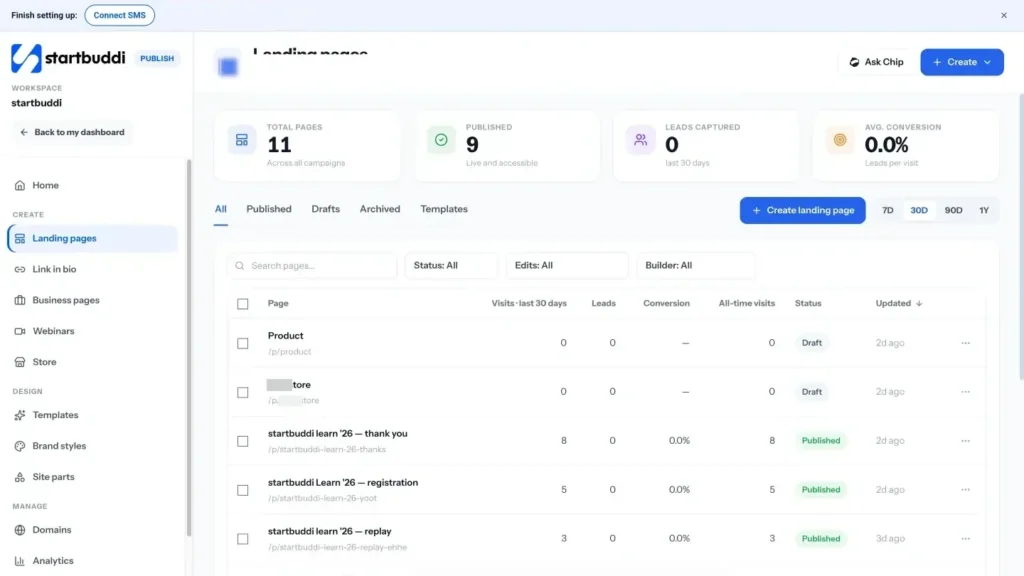
Open Publish and create a landing page. You can start from a template, start blank, or choose Build with Chip and describe the page in a sentence. When you create a page, you can pick what it is for, including "Collect leads" and "Build a waitlist". Chip writes the words in your brand, but it never makes up prices, reviews or numbers: those stay as placeholders for you to fill in, which is exactly what you want for an honest test. Building a page with Chip uses Chip credits, and the price is shown before anything is spent; templates and blank pages do not use credits.
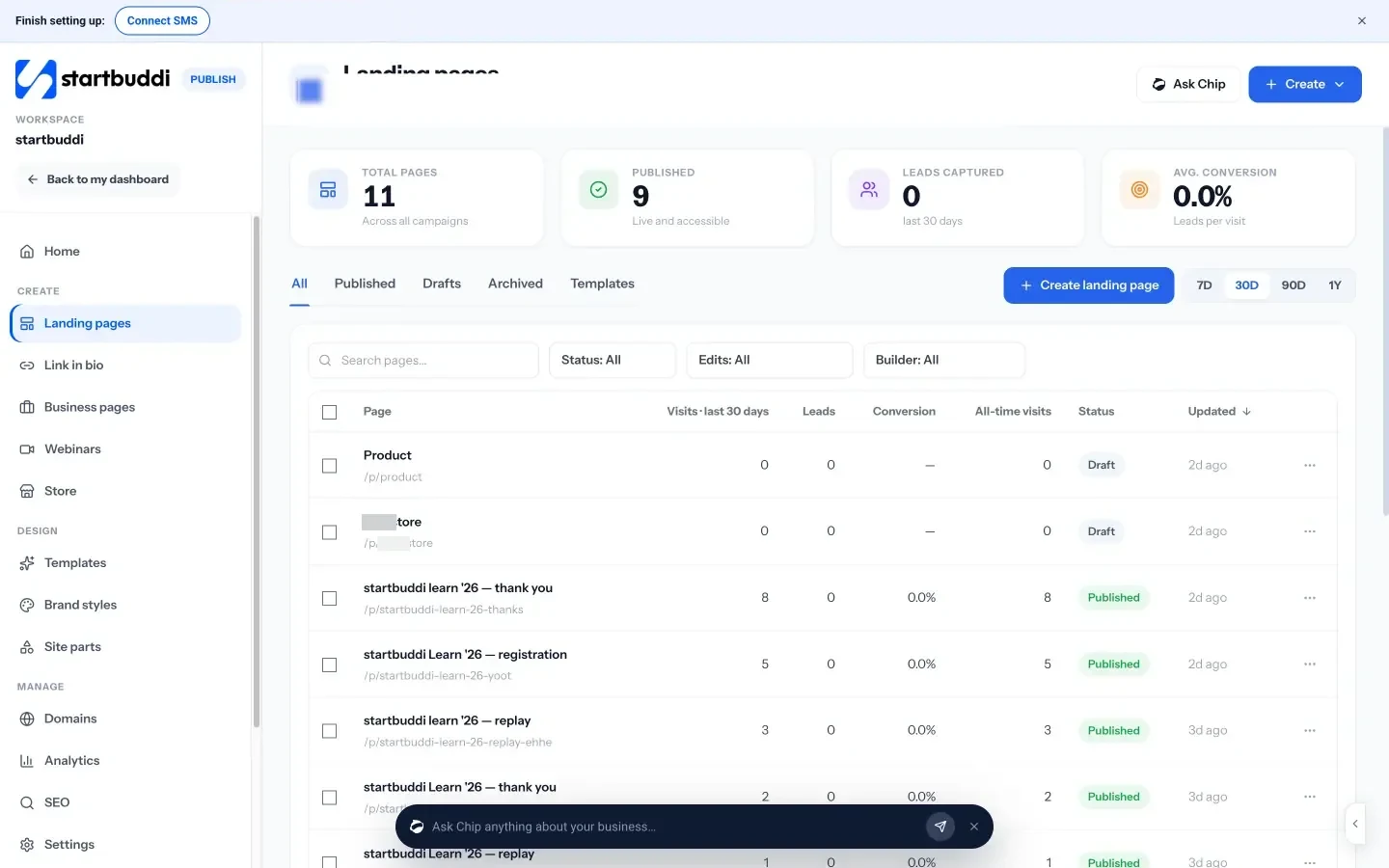
Every landing page has an Overview with visits, leads and conversion, so you can read your demand test without a spreadsheet. The page lives at your startbuddi web address straight away; you can connect your own domain later from Publish.
Add a form that collects the right details
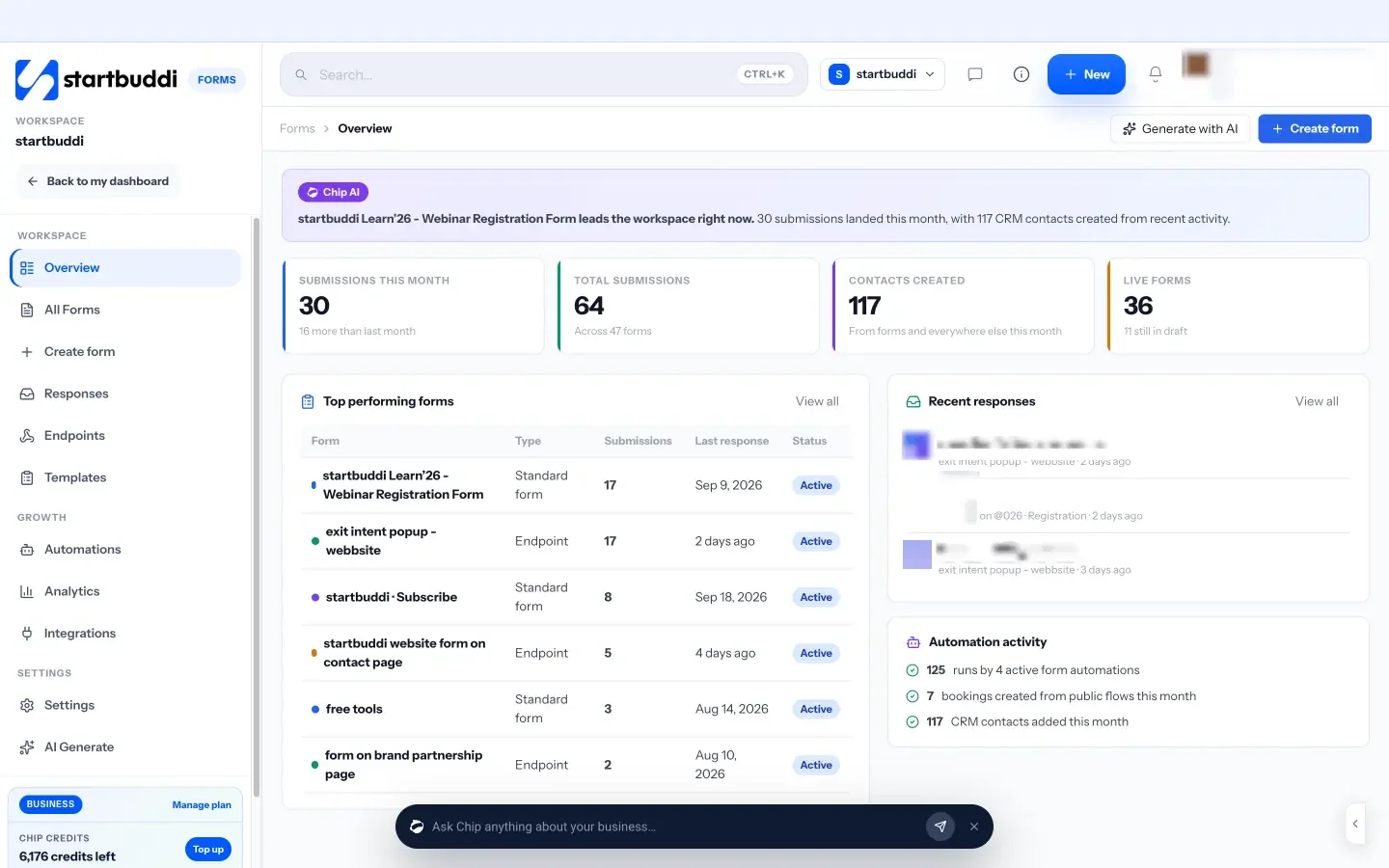
Keep the form short: name, email or phone, and one question that tells you how serious they are, such as "When would you like to start?" or "How many people are in your team?". In Forms you can build one from a template, from scratch, or let Chip draft the fields from a description. Every response is saved in Forms, and you can choose to add or update the person as a contact automatically, so your waitlist becomes a real list rather than a pile of messages. The Free plan includes one form, which is enough for a test.
Follow up with the people who said yes
Open Customers to see everyone who signed up. From each contact you can see where they came from and add notes from your conversations. When you are ready to take a deposit, you can send an invoice or a payment link from Money Manager, which you will set up in chapter 4. For more on turning a list of names into a proper system, read our guide on how to organise your customers.
Once you have a signal that people will pay, you are ready for the numbers. Chapter 2 shows you how to work out your start-up costs, set a price that makes a profit and write your plan on a single page.
Step 2: plan the money (costs, pricing and break-even)
- Pricing a service by the hour or day
- Pricing a product or package
- Common pricing mistakes
- An example one-page plan
- Budgets: turn your plan into numbers you can watch
- Expenses: record costs as they happen
- Cash flow: see what your balance could look like
Once you know people will pay, the next question is whether the business can pay you. Plenty of busy businesses lose money on every sale without noticing, because the owner never added up what each job really costs. This chapter gives you four simple sums: start-up costs, monthly running costs, price and break-even. Then it shows you how to put them on one page and track them in startbuddi.
You do not need to be good at maths. You need a calculator, an honest list of costs and about two hours.
Work out your start-up costs
Start-up costs are the one-off amounts you pay before or just after you open. List everything, even small items, because small items add up. Group them so nothing is missed:
| Group | Examples |
|---|---|
| Registration and legal | Business name or company registration, licences, a lawyer to check a contract |
| Equipment | Laptop, tools, kitchen equipment, a cleaning kit, a phone |
| Stock and materials | Ingredients, packaging, products to resell, first batch of supplies |
| Premises | Deposit on a space, fit-out, signage (often zero if you start from home) |
| Marketing to launch | A first print run, a small advertising test, photos |
| Software and tools | Your business system, a domain name, accounting software |
| Cash buffer | Money set aside to cover slow early months |
The last row is the one most people skip. A new business rarely earns its full potential in month one. Customers need time to find you, and clients who pay by invoice may take 30 days or more. A buffer that covers three months of running costs gives you room to learn without panicking.
Here is a small example. A mobile hairdresser in Johannesburg lists a styling kit and chair (R6,500), a starter stock of products (R3,000), business registration and a simple website (R1,500) and a three-month buffer of running costs (R9,000). The total is R20,000. Without the buffer it looks like R11,000, which is the number most people put in their plan, and the reason many of them run out of cash in month two. If the full number is more than you have, look for things to borrow, buy second-hand or delay, rather than cutting the buffer.
Work out your monthly running costs
Running costs are what it takes to keep the doors open each month. Split them into two types:
- Fixed costs stay the same whether you have one customer or fifty: rent, phone, software, insurance, loan repayments, and any salary you pay yourself.
- Variable costs rise with every sale: ingredients, materials, delivery, payment processing fees, a helper paid by the job.
Knowing which is which matters, because it tells you how much each sale really contributes. If a lunch sells for $12 and the food and packaging cost $5, each sale contributes $7 towards your fixed costs and, eventually, your profit. That $7 is called the contribution.
Set a price that makes a profit
Many new owners set their price by looking at competitors and going a little lower. That is a quick way to be busy and broke. Start from your costs, then check against the market, then decide where you sit.
Pricing a service by the hour or day
If you sell your time, work backwards from what you need to earn:
- Decide what you need to take home in a year, say $48,000.
- Add your yearly business costs, say $6,000 for software, equipment and insurance.
- Work out your billable hours. If you work 46 weeks a year and can bill 25 hours a week (the rest goes on admin, sales and learning), that is 1,150 hours.
- Divide: ($48,000 + $6,000) ÷ 1,150 = about $47 an hour.
That is your floor, before tax. If competitors charge $60 to $90, you can price at $65 and still sit in the market. If they charge $30, you either need a cheaper way to deliver, a different customer who values more, or a different business. Our hourly rate calculator runs these sums for you.
Pricing a product or package
For a product, start with the variable cost of one unit, then add a margin that covers your fixed costs and profit. A common way to check is gross margin: (price minus variable cost) ÷ price. A cake that costs £8 in ingredients and packaging and sells for £28 has a gross margin of (28 − 8) ÷ 28 = 71 per cent. Food, handmade goods and services often need healthy margins because volumes are small. Try a few prices on paper before you settle on one.
Common pricing mistakes
- Forgetting payment fees. Card and online payment providers charge a fee on each payment, usually a percentage plus a small fixed amount. Check your provider's published rates and include them in your variable cost.
- Pricing for the first job only. The first job often takes longer than expected. Price for how long it really takes, not how long you hope it takes.
- Giving open-ended discounts. If you offer launch pricing, put an end date on it and say so in writing, so moving to your full price later is not a surprise.
- Never raising prices. Costs rise every year. Review your prices at least once a year, and give existing customers a month's notice when they change.
- Hiding extras. Travel, rush jobs and extra rounds of changes should have their own prices. Write them down once and reuse them on every quote. A written price list is a quick way to do this.
Find your break-even point
Your break-even point is the number of sales you need each month to cover all your fixed costs. The formula is simple:
Break-even sales = monthly fixed costs ÷ contribution per sale
Here is how it looks for three different businesses.
| Business | Fixed costs a month | Price | Variable cost | Contribution | Break-even |
|---|---|---|---|---|---|
| Office lunches (US) | $2,100 | $12 | $5 | $7 | 300 lunches (about 15 a working day) |
| Home cleaning (UK) | £1,400 | £60 a visit | £18 | £42 | 34 visits (about 8 a week) |
| Small design studio (Nigeria) | ₦900,000 | ₦250,000 a project | ₦40,000 | ₦210,000 | 5 projects |
Remember that fixed costs should include a basic wage for you. A business that only breaks even because the owner works for free has not really broken even.
Break-even turns a vague goal ("get more customers") into a clear one ("sell 15 lunches a day by the end of month three"). It also tells you quickly if the plan is unrealistic. If you need 60 cleaning visits a week on your own, the price or the costs need to change.
Where the money comes from
Most small businesses start with the owner's savings, a side income, or early customer money such as deposits and pre-orders. Customer money is the best kind: it costs nothing and proves demand. Other options include loans from family, small business loans from a bank, microfinance, grants and government schemes. Each country has its own programmes. For example, the US Small Business Administration lists loan programmes, the British Business Bank runs start-up loans in the UK, and many African countries have state-backed funds for small enterprises. Borrow only for things that will clearly earn the money back, such as equipment that lets you take more orders, and never to cover a price that does not make a profit.
Write it on one page
A business plan does not need to be 40 pages. Unless you are asking a bank or investor for money, one page is enough, and one page you actually read is worth more than a long document in a drawer. Use these headings:
- What we sell: your offer sentence from chapter 1.
- Who buys it: your first customer group, and where you will find them.
- Why us: one or two reasons someone would pick you over the alternatives.
- Price and costs: price, variable cost per sale, fixed costs a month.
- Break-even: sales needed each month, and by when you expect to reach them.
- Start-up budget: total one-off costs and where the money comes from.
- First 90 days: three goals with numbers, such as "20 paying customers" or "₦1.5 million in sales".
- Biggest risks: the two things most likely to go wrong, and what you will do if they do.
Our free business plan template follows a similar structure if you want a starting point. Review the page once a month and update the numbers with what really happened.
An example one-page plan
Here is how the plan might look for a home cleaning business in Manchester, using the numbers from the break-even table above.
- What we sell: regular home cleaning for first-time landlords and busy renters, from £60 a visit.
- Who buys it: landlords with one to three flats in south Manchester; found through two letting agents, a local Facebook group and a leaflet drop in three streets.
- Why us: the same cleaner every time, photos after every visit, and bookings and payment online.
- Price and costs: £60 a visit; £18 variable cost (products, travel, card fees); £1,400 fixed costs a month including a basic wage.
- Break-even: 34 visits a month, expected by the end of month two.
- Start-up budget: £1,200 (equipment, insurance, leaflets, software, a small buffer), paid from savings.
- First 90 days: 12 regular customers, 45 visits in month three, five reviews on Google.
- Biggest risks: letting agents do not refer (plan B: door-to-door leaflets in two more areas); illness (plan B: a trained backup cleaner paid by the job).
It fits on one screen, and every line can be checked against real results at the end of each month. That is the point.
Money habits to set up from day one
- Keep business and personal money apart. Open a separate account as soon as you can (chapter 3 covers this). Mixing them makes tax time painful and hides whether the business works.
- Record every expense when it happens. Take a photo of the receipt and log it the same day. Waiting until the end of the year means lost receipts and missed tax deductions.
- Invoice promptly. Send the bill the day the work is done. Our guide on how to send your first invoice walks through it.
- Look at cash every week. Profit on paper is not the same as money in the bank. Our post on tracking cash flow explains the difference and a simple weekly check.
- Set aside money for tax. Move a fixed percentage of every payment into a separate pot. Ask an accountant or your tax authority what percentage fits your situation.
How to plan and track your money in startbuddi
Money Manager is the part of startbuddi where you send bills, take payments and see where money went. For a new business, three areas matter most at the start.
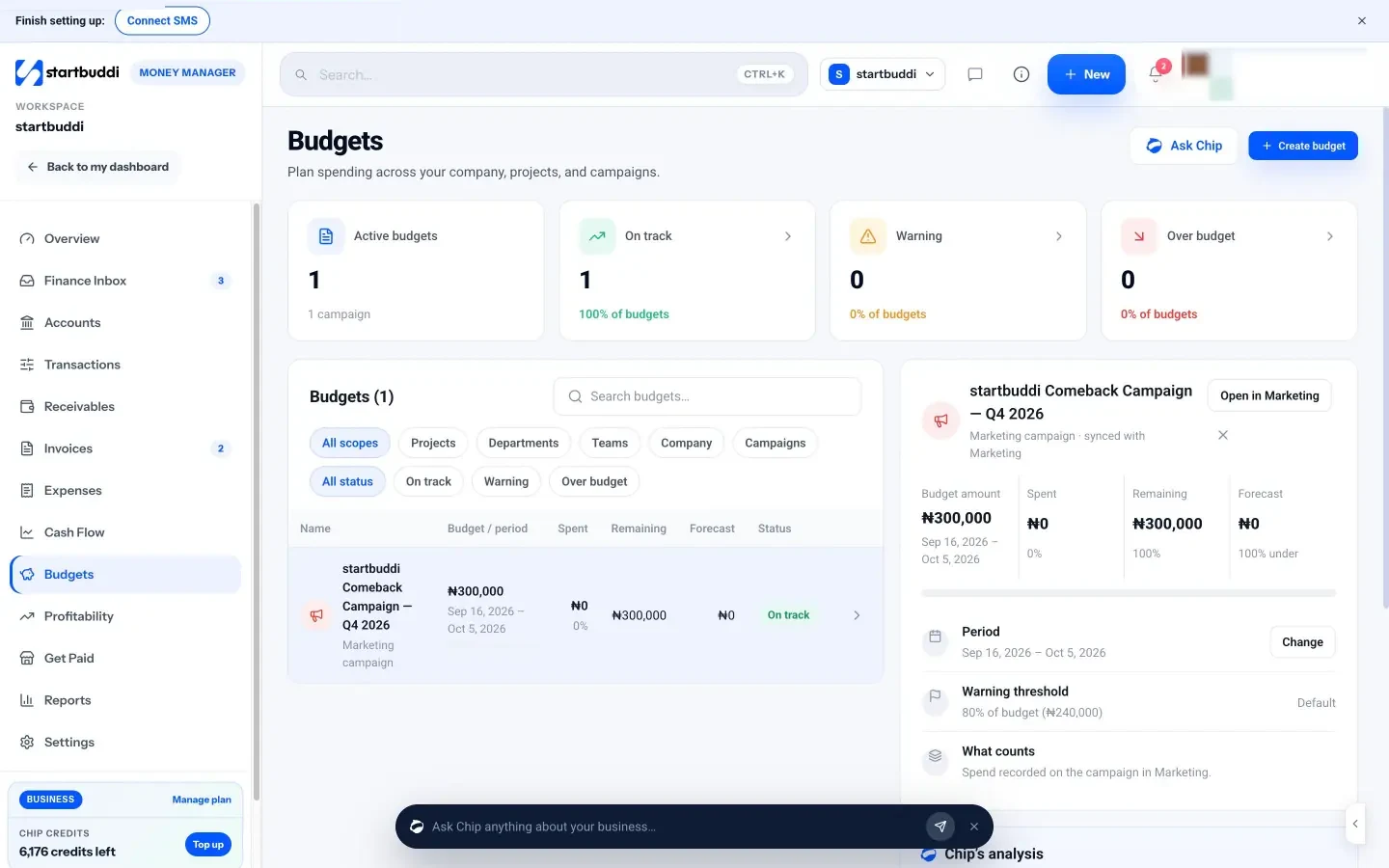
Budgets: turn your plan into numbers you can watch
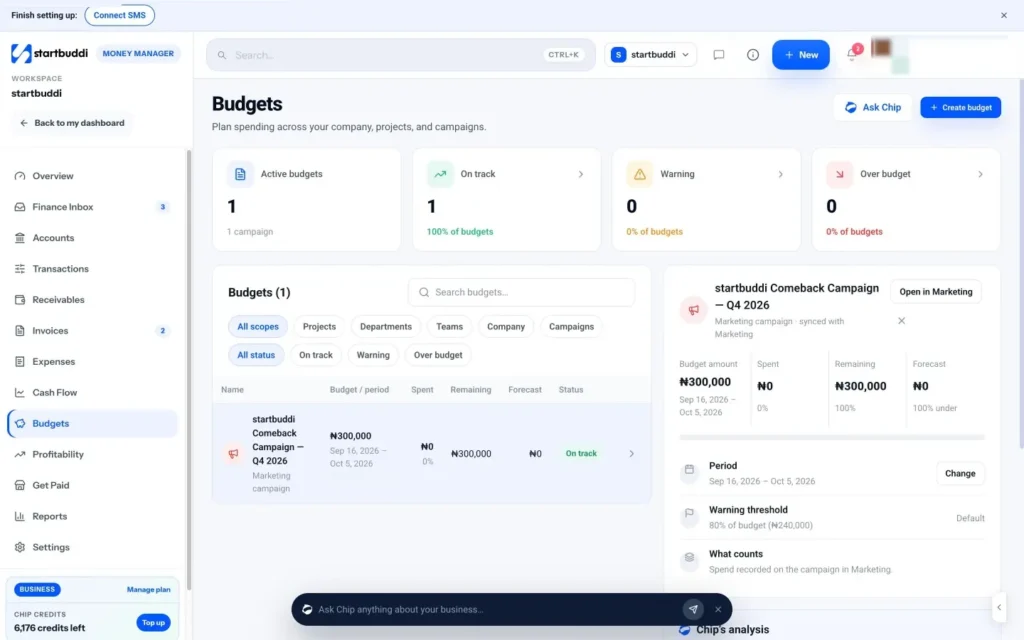
In Money Manager, Budgets lets you plan spending across the company, projects and campaigns. Put your monthly running costs and your launch budget in, then check them against what you actually spend. It is a simple way to notice early when marketing or supplies are running ahead of plan.
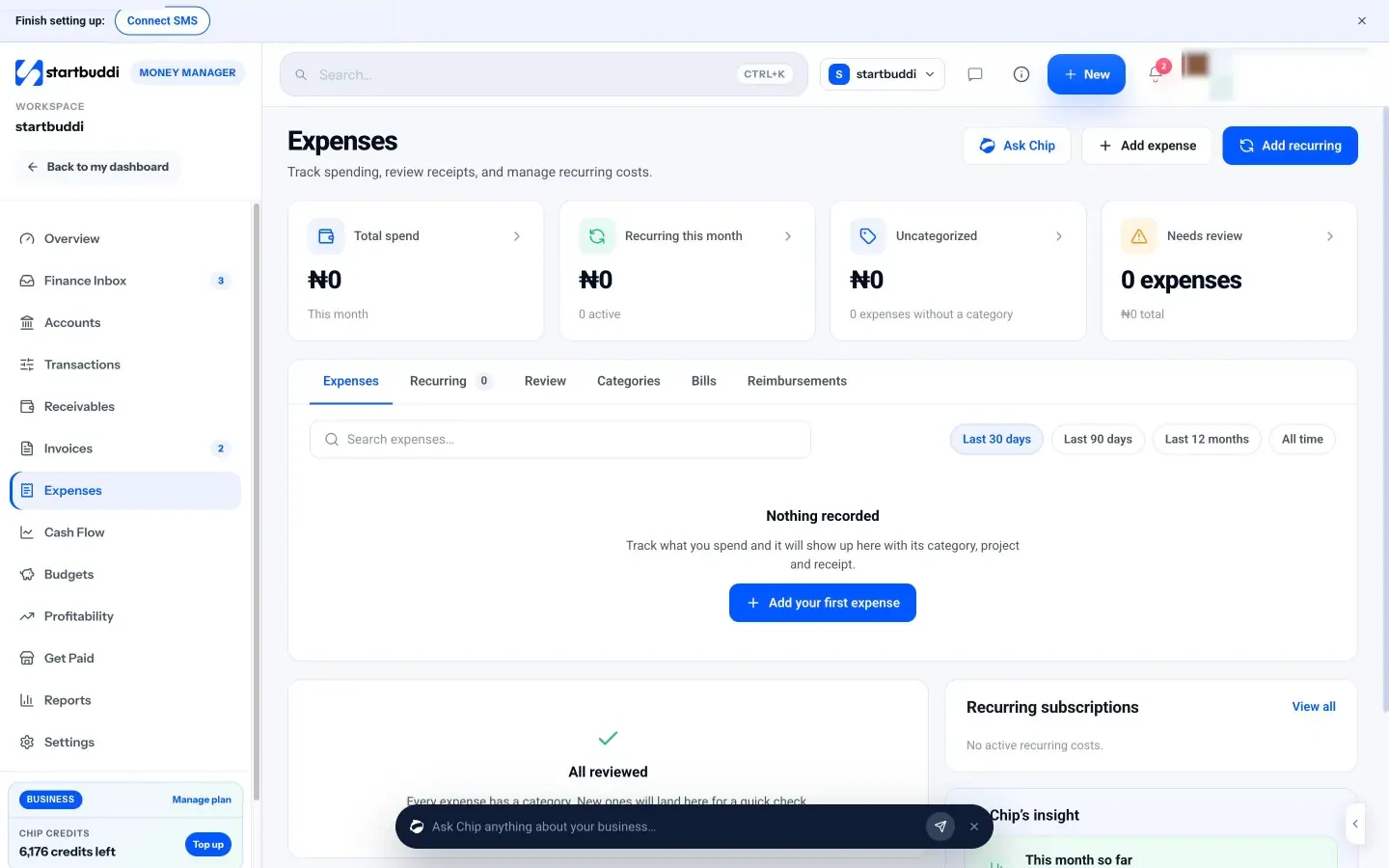
Expenses: record costs as they happen
Use Expenses to log what you spend, keep receipts with each cost and track recurring costs such as software and rent. Recording expenses in the same place you invoice means the Overview can show money in against money out, and Profitability can show which customers and projects bring in the most value.
Cash flow: see what your balance could look like
The Money Manager Overview shows money in, money out and what is still owed to you, with an estimated balance for the next 30 days. Cash Flow goes further and shows how money is moving over time. Checking it once a week takes a few minutes and is the habit that keeps many small businesses alive through a slow month. You can read more about these screens on the cash flow, budgets and profitability page.
Money Manager is available on every plan, including Free, which allows up to 5 invoices. Starter removes the invoice limit (see pricing).
With a tested offer and a plan that adds up, you are ready to make the business official. Chapter 3 covers business structures, registration, tax numbers, bank accounts and the paperwork that protects you.
Step 3: make it official (your starting a business checklist)
- If you are starting with a partner
- A realistic two-week timeline
- Contracts and agreements with e-signatures
- Keep everything linked to the right client
Making a business official sounds daunting, but for most small businesses it is a short list of tasks: choose a structure, register the name or company, sort out tax, open a bank account, check whether you need a licence, and put a few basic protections in place. This chapter explains each one in plain words, points you to the official bodies in several countries, and gives you a starting a business checklist you can tick off in a week or two.
This is general information, not legal or tax advice. Rules differ by country, state and industry, and they change. Check the official sources linked below or speak to an accountant or lawyer for your situation.
Choose a business structure
Your structure decides who is legally responsible for the business, how you pay tax and how much paperwork you do each year. Names vary between countries, but most small businesses choose one of three types.
| Structure | What it means | Good for | Watch out for |
|---|---|---|---|
| Sole trader or sole proprietor | You and the business are the same legal person | Freelancers and one-person services testing the water | You are personally liable for business debts |
| Partnership | Two or more people share ownership and responsibility | Two friends starting a trade or service together | Each partner can be liable for the others' decisions; a written agreement is essential |
| Limited company or LLC | The business is a separate legal person that you own | Businesses with more risk, staff, bigger contracts or plans to raise money | More filing, separate accounts and sometimes higher running costs |
Many people start as a sole trader because it is quick and cheap, then form a company once income grows or the risk goes up. There is no single right answer. What matters is that you choose on purpose and understand what you are responsible for.
If you are starting with a partner
Write down who owns what, who does what, how decisions are made, how profits are shared and what happens if one of you wants to leave. It feels awkward between friends, which is exactly why it should be done while you are still friends. The partnership agreement template and the LLC operating agreement template give you a structure to discuss with a lawyer.
Register your business
Registration tells the government your business exists and, in many countries, protects your business name. Here is where to start in some of the countries our readers work in.
- United States: most registration happens at state level. The SBA's register your business page explains the options, and the IRS explains business structures for tax.
- United Kingdom: GOV.UK covers setting up a business, including how to set up as a sole trader or register a limited company with Companies House.
- Canada: the Government of Canada's starting a business section links to federal and provincial registration.
- Australia: business.gov.au guides you through structures, an ABN and business name registration.
- Nigeria: the Corporate Affairs Commission (CAC) registers business names and companies. Our step-by-step post on registering a business name in Nigeria walks through the process.
- Kenya: the Business Registration Service handles business names and companies.
- South Africa: the Companies and Intellectual Property Commission (CIPC) registers companies.
Before you register, search the official register and a web search engine to make sure nobody else uses a very similar name in your field. Check that the web address and main social handles are free too. It is far cheaper to change a name now than after you have printed it on a van.
Registering a business name and registering a trademark are different things. Registration usually stops someone else registering the same name in the same register; a trademark protects the brand itself in your field. Most very small businesses do not need a trademark on day one, but if the name will become valuable, ask your national intellectual property office how it works and what it costs.
Sort out tax registration
Most countries expect you to register for tax when you start trading or soon after, and some ask for a separate registration for sales taxes such as VAT or GST once you pass a turnover threshold. The main bodies include:
- US: the IRS employer identification number (EIN), plus state tax registration where it applies.
- UK: HM Revenue and Customs, through the GOV.UK set-up pages above (Self Assessment for sole traders, Corporation Tax for companies, and VAT above the threshold).
- Canada: the Canada Revenue Agency, including a business number and GST/HST where required.
- Nigeria: the Nigeria Revenue Service (NRS), which replaced FIRS at the start of 2026, plus your state's internal revenue service.
- Kenya: the Kenya Revenue Authority and a KRA PIN.
- South Africa: the South African Revenue Service.
Two habits make tax much easier: keep every receipt, and put a share of every payment into a separate tax pot the day it arrives. An accountant for one or two hours in your first month usually pays for itself, because they can tell you which expenses you can claim and which deadlines apply to you.
Open a business bank account
A separate account keeps business money apart from personal money. This makes bookkeeping and tax simpler, looks more professional to clients paying by transfer, and shows you at a glance whether the business is making money. A company is a separate legal person, so its money should go through its own account. Sole traders can often use a personal account, but a separate one is still a good idea.
When you compare banks, look at monthly fees, transfer fees, how easy it is to receive international payments if you have overseas clients, and whether it works with your payment provider. Bring your registration documents and ID, and expect some banks to ask for proof of address and a short description of the business.
Check licences, permits and insurance
Some businesses need a licence or permit before they trade. Food businesses, childcare, alcohol, health and beauty treatments, transport, security and building trades are common examples. Your local council, city or state government usually publishes the rules, and the national business portals linked above point you to them.
Insurance protects you when something goes wrong. The types to ask about are:
- Public liability: covers injury or damage to customers or the public, important if you visit homes or run events.
- Professional indemnity: covers claims that your advice or work caused a loss, common for consultants, designers and accountants.
- Equipment or stock cover: protects the tools and goods you rely on.
- Employer's liability: required by law in some countries, including the UK, once you employ staff.
Put basic protections in writing
A few documents prevent most disputes before they start:
- Terms of service or a client agreement. Scope, price, payment terms, what happens if the client cancels, and who owns the work.
- A cancellation or booking policy if people book appointments. Keep it short and fair.
- A privacy notice if you collect names, emails or phone numbers, which almost every business does. Data protection laws such as the UK GDPR (explained by the ICO) and Nigeria's Data Protection Act (overseen by the NDPC) set out what you must tell people and how to store their details.
- A freelance or contractor agreement if you pay anyone else to help. Agree scope, payment and ownership of the work in writing.
Your starting a business checklist
Copy this list and tick it off. Most people finish it within one to three weeks, depending on how quickly the registration office responds.
| Task | Why | Done |
|---|---|---|
| Choose a structure | Decides liability and tax | [ ] |
| Check the name is free (register, web, social) | Avoid a costly rename | [ ] |
| Register the business | Legal existence and name protection | [ ] |
| Register for tax (and sales tax if needed) | Avoid penalties | [ ] |
| Open a business bank account | Clean records, professional payments | [ ] |
| Check licences and permits | Trade legally | [ ] |
| Arrange insurance | Protect yourself and your savings | [ ] |
| Write client terms and a privacy notice | Prevent disputes, respect data laws | [ ] |
| Book an hour with an accountant | Know your deadlines and claims | [ ] |
| Set up a system for receipts and invoices | Stay organised from day one | [ ] |
Keep simple records from the first day
Whatever your structure, you will need records: what you sold, what you spent, who paid and when. Tax authorities in most countries expect you to keep them for several years (in the UK, for example, GOV.UK says the self-employed must keep records for at least five years after the Self Assessment deadline). A simple system is enough at the start:
- Sales: every invoice or receipt you issue, numbered in order.
- Money in: the date each payment arrived and which invoice it paid.
- Money out: every expense with its receipt, tagged with a category such as supplies, travel or software.
- Agreements: signed contracts, quotes the client accepted and any change requests.
- Official letters: registration certificates, tax numbers and licences, kept together.
Set a fixed half hour each week to bring these up to date. It feels like admin, and it is, but it is also the cheapest insurance you can buy against a stressful tax season or a dispute with a client.
A realistic two-week timeline
Here is how a sole trader in Nairobi might fit this chapter into two weeks alongside their demand test:
- Days 1 to 2: check the name, choose the structure, and gather ID and address documents.
- Days 3 to 5: apply for business name registration and a tax PIN online.
- Days 6 to 8: open a business account once the certificate arrives; ask two brokers for insurance quotes.
- Days 9 to 12: adapt a client agreement and privacy notice; have a lawyer check the agreement.
- Days 13 to 14: set up the record-keeping system and put every filing deadline in the calendar.
Registration offices can be slower than this, so start the official steps early and do the rest while you wait.
Mistakes to avoid
- Registering before testing. In many countries you can test demand, even take a few deposits, as a sole trader while you decide. Check your local rules, but do not let paperwork stop you learning.
- Using a personal account for everything. It seems easier until the first tax return.
- Copying a contract from the internet without reading it. A clause written for another country or another industry can work against you.
- Ignoring deadlines. Put every filing date in your calendar the day you register, with a reminder two weeks before.
How startbuddi helps with the paperwork
To be clear about fit: startbuddi does not register businesses, file tax returns or give legal advice. Use your government's official services and a qualified adviser for those. What startbuddi does is keep the paperwork that comes after registration in one place, next to your clients and invoices.
Contracts and agreements with e-signatures
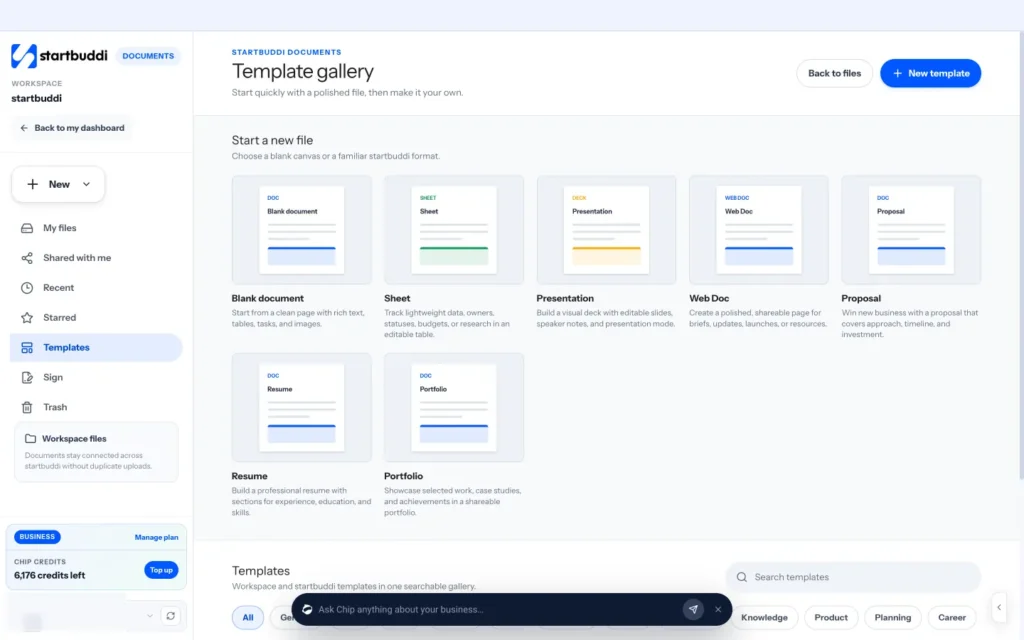
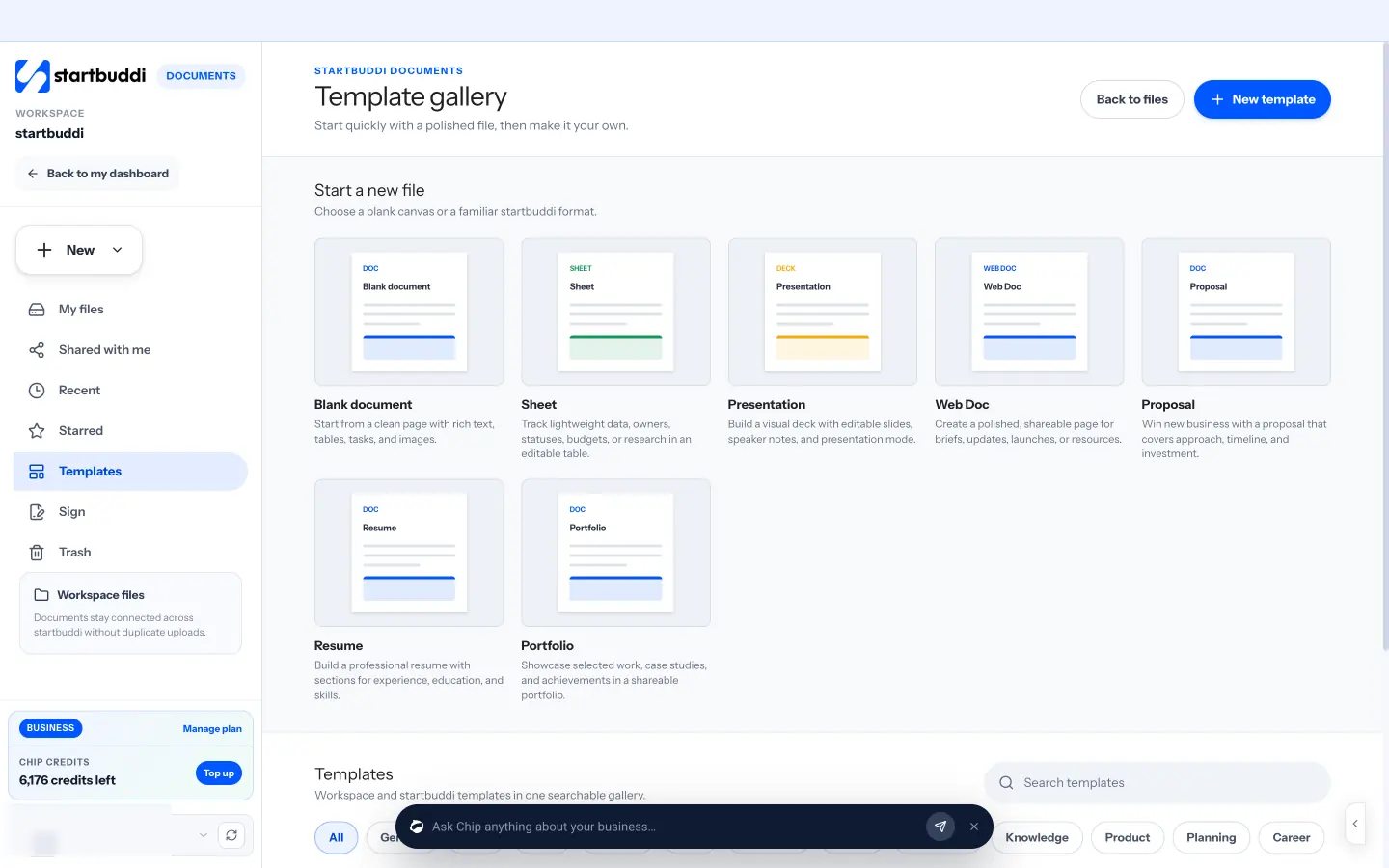
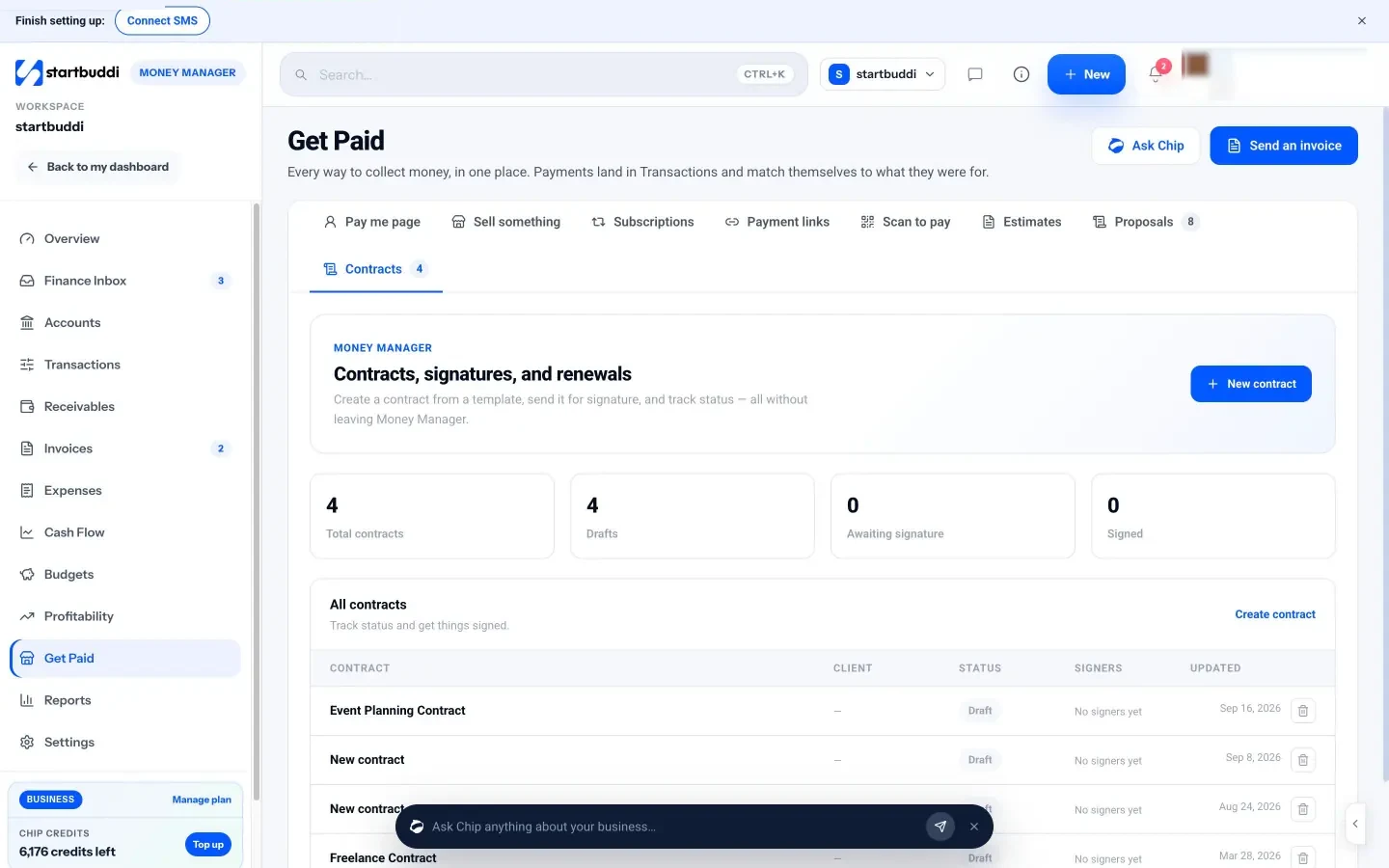
Documents holds your business files: docs, sheets, slides, contracts and e-signatures. The template gallery includes a Service Agreement, Freelance Contract, Non-Disclosure Agreement, Consulting Agreement and a Monthly Retainer Agreement, among others. You can edit a template, add signers and send it for signature, and every version is kept so nothing is lost.
In Money Manager, Get Paid has Estimates, Proposals and Contracts, so you can go from a quote to a signed agreement to an invoice for the same client. The app itself reminds you that templates are a starting point, not legal advice.
Keep everything linked to the right client
A document can be linked to a project, contact, task or booking, so when a client asks "what did we agree?" you find the answer in seconds. For a deeper look at agreements, read our post on writing a client service agreement.
With the legal side in place, it is time to set up the tools you will run the business on and launch. Chapter 4 covers the smallest tool stack that works and a launch plan for your first 30 days.
Step 4: set up your business tools and launch
- Separate apps or one system?
- Keep your tool stack honest
- Week 1: get ready
- Week 2: tell your warm network
- Week 3: deliver brilliantly to your first customers
- Week 4: review and repeat
- Answer four questions and get a starting point
- Use Home as your daily checklist
- Automate the follow-ups you would otherwise forget
- Choose the plan that fits today
You have a tested offer, numbers that add up and the paperwork in hand. The last step is to set up the tools you will run the business on, then launch in a way that brings in your first paying customers quickly. This chapter covers the smallest tool stack that works, a 30-day launch plan, and the weekly routine that keeps a new business moving. Then it shows how to set all of it up in startbuddi in an afternoon.
The business tools a small business actually needs
Search for tools for small business owners and you will find hundreds of apps, each promising to save you hours. Most new businesses need far fewer than they think. Every business, whatever it sells, has the same handful of jobs to do:
| Job | What you need at the start | What can wait |
|---|---|---|
| Be found and look credible | One page with your offer, prices and a way to contact you; a Google Business Profile if you serve a local area | A multi-page website, a blog |
| Collect enquiries | A short form or booking link that saves every enquiry in one list | Complex quizzes, chatbots |
| Keep track of customers | A contact list with notes and a simple view of who is interested | Lead scoring, detailed reports |
| Get paid | Invoices or payment links, and a record of who has paid | Subscriptions, a full online store |
| Stay in touch | Email or WhatsApp to your list, and a follow-up message after every enquiry | Multi-step campaigns, paid ads |
| Get the work done | A task list and, if you have clients, a simple project board | Time tracking, resource planning |
| Know the numbers | Money in, money out, what is owed | Forecasts, dashboards for every metric |
That is seven jobs. You can cover them with seven separate apps, or with one system that connects them. Both can work. The question is how much time you want to spend copying details from one app to another.
Separate apps or one system?
Separate apps let you pick the best tool for each job, and many have useful free plans. The cost is hidden in the gaps: the enquiry that arrives in the form tool but never reaches your contact list, the invoice you forget because it lives in another app, the five logins and five monthly bills. For a one-person business, those gaps cost hours every week.
One connected system trades a little depth in each area for having everything on the same customer record. When someone fills in your form, they become a contact; when you send them an invoice, it sits on the same record; when they pay, the money shows in the same place. Our post comparing an all-in-one workspace with five separate tools runs the numbers, and the small business tool stack guide goes through every category in detail.
Keep your tool stack honest
Some jobs need specialist software, and it is better to know that now. If you sell in person all day, you may need a point-of-sale system. If you have employees, you will need payroll software or a payroll service that follows your country's rules. When you reach the point where you file formal accounts, an accountant will usually want bookkeeping or accounting software. A business system can sit alongside these, but it should not pretend to replace them.
A 30-day launch plan
Launching is not one big day. It is a month of small, steady actions that tell people you exist and make it easy for them to buy. Here is a plan that works for most service businesses and small product businesses.
Week 1: get ready
- Publish your page with your offer sentence, prices (or "from" prices), what happens after someone gets in touch, and a form or booking link.
- Set up your invoice details and at least one way to pay online.
- Write three follow-up messages you can reuse: a reply to a new enquiry, a thank-you after a first job, and a request for a review.
- Make a list of 50 people you know who could buy from you or introduce you to someone who could.
Week 2: tell your warm network
- Send a short personal message to everyone on your list of 50. Not a broadcast, a real message: what you are doing, who it is for, and a simple ask ("do you know anyone who...?").
- Post on your personal social accounts and in two or three groups where your customers already gather, following each group's rules.
- Follow up every reply within the same day. Speed matters more than polish.
Week 3: deliver brilliantly to your first customers
- Over-deliver on the first jobs. These customers are your future reviews and referrals.
- Invoice the same day the work is done, and thank people when they pay.
- Ask every happy customer for a review and one introduction.
Week 4: review and repeat
- Count: enquiries, calls, sales, money in, and where each customer came from.
- Do more of the one channel that brought the most paying customers. Drop the one that brought none.
- Update your one-page plan from chapter 2 with real numbers.
Messages you can copy for your launch
The hardest part of week two is writing the first message. Here are three you can adapt.
To a friend or former colleague
Hi Kemi, I have some news: I have started my own bookkeeping business for small shops and salons. I take the monthly receipts and bank statements off their hands and send a simple report every month. If you know anyone who dreads doing their books, I would be grateful for an introduction. Here is my page: [link].
To a past client or employer (where your contract allows it)
Hi David, I hope the team is well. I have gone independent and now help small businesses with [service]. If you ever need an extra pair of hands on [type of work], I would love to help. I am offering my first five clients [a specific launch offer] until 31 October.
In a community group
Hi everyone, I am a local cleaner who has just started out in [area]. I am taking on six regular clients this month, from £60 a visit, same cleaner every time. Happy to answer any questions here or by message.
Notice what they share: who you help, what you do, one clear ask, and no pressure. Personal messages like these usually get far more replies than a general post, because people respond to being asked directly.
What to measure in your first 90 days
Keep it to a few numbers you can check every week in a few minutes.
| Number | Why it matters |
|---|---|
| New enquiries a week | Tells you if people are finding you |
| Enquiries that become paying customers | Tells you if your offer, price and follow-up work |
| Money in this month | Tells you how close you are to break-even |
| Money owed to you | Tells you what to chase this week |
| Where each customer came from | Tells you which channel deserves more of your time |
If enquiries are low, work on being found. If enquiries are good but few people buy, work on your offer, your price or how fast you reply. If people buy but pay late, work on your invoicing.
The weekly routine that keeps you going
After launch, the risk changes. You are busy doing the work and stop doing the things that bring in the next customer. A fixed weekly routine of about 90 minutes prevents the feast-and-famine cycle:
- Money (20 minutes): send any invoices, chase anything overdue, log expenses, check cash.
- Customers (20 minutes): reply to every open enquiry, follow up anyone who went quiet, ask one happy customer for a referral.
- Marketing (30 minutes): plan and schedule the week's posts or one email to your list.
- Planning (20 minutes): look at next week's jobs and tasks, and note one improvement to try.
Put it in your calendar at the same time each week. Many owners find Monday morning or Friday afternoon works best.
Mistakes to avoid at launch
- Waiting for perfect. Your page, prices and process will change after the first ten customers. Launch with good enough and improve.
- Launching to strangers first. Your warm network converts far better. Start there, then widen.
- Trying every channel. Pick one or two places your customers already are and do them well.
- Forgetting to follow up. Many enquiries are lost simply because nobody replied quickly. Our post on following up with leads has templates.
- Buying tools for the business you hope to have. Choose tools for the next six months, not the next six years.
How to set up and launch your business in startbuddi
This is the moment startbuddi was built for: a new business that needs a page, a form, a contact list, invoices and follow-ups working together without five separate subscriptions.
Answer four questions and get a starting point
When you sign up, onboarding asks four quick questions: who you are, what you do in one sentence, what kind of work you do and who you sell to. It takes about three minutes. Chip then writes your business copy and sets up a contact form matched to your type of business, a published page with that form on it, a draft "About" document, a draft first invoice and a sample contact clearly labelled "sample - replace me". You can skip the optional questions and finish them later from Home. Everything it creates is yours to edit.
Use Home as your daily checklist
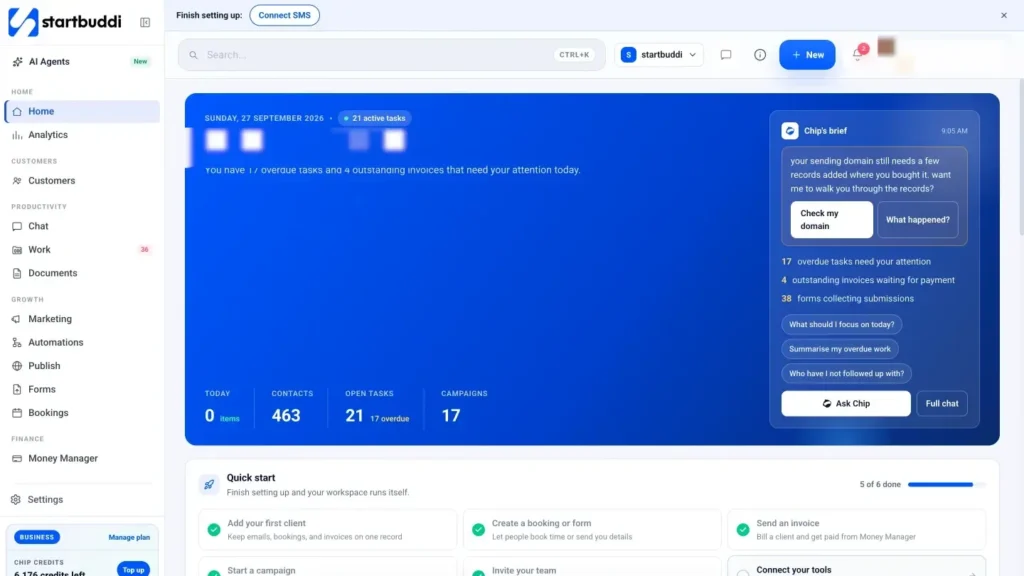
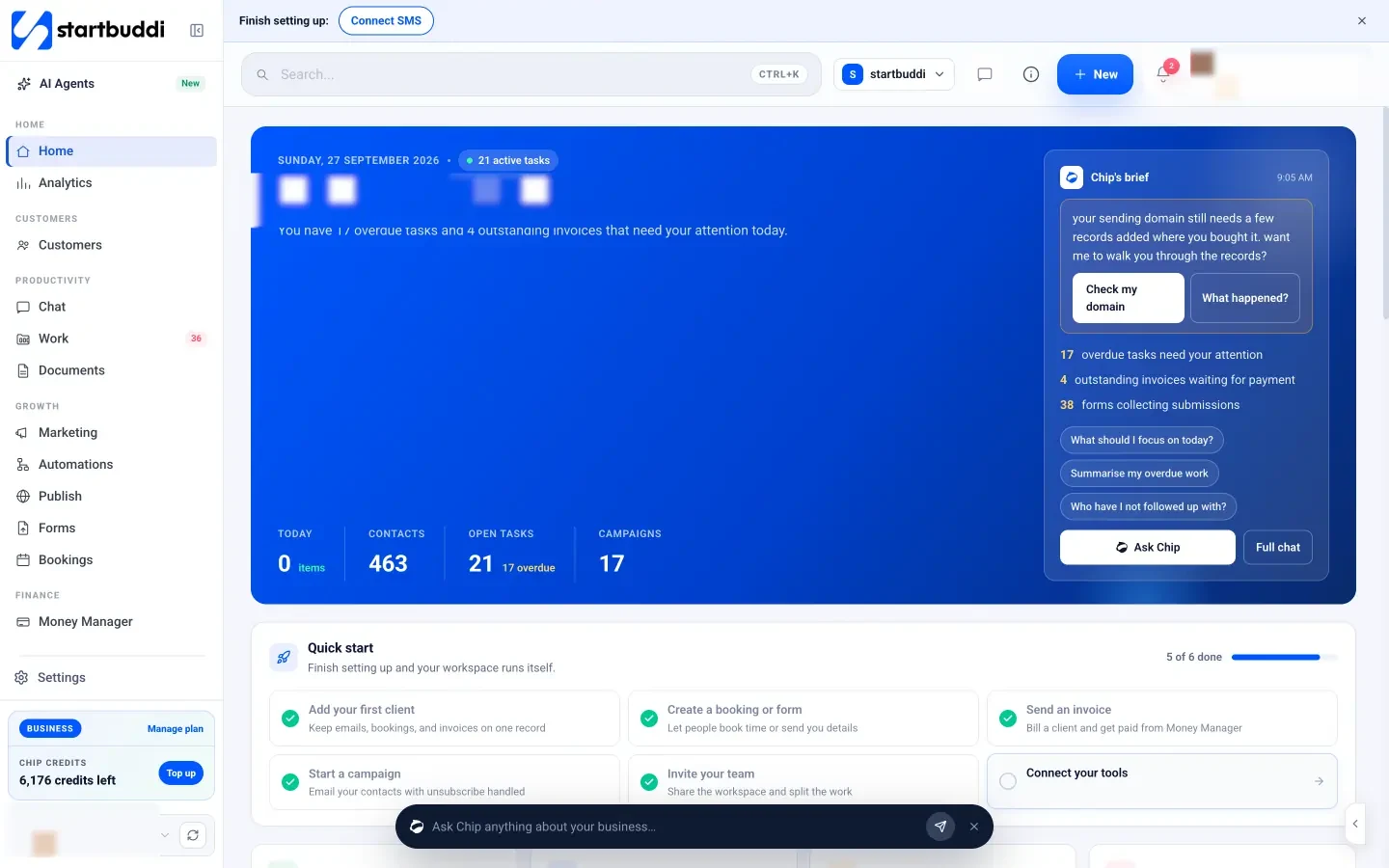
Home shows what is due today, who is waiting on you and what is owed, with Chip's brief on top. In a new workspace, a Quick start card ticks itself off from real activity: add your first client, create a booking or form, send an invoice, start a campaign, invite your team, and connect your tools. The Needs you panel lists overdue tasks and unpaid invoices so nothing slips.
Automate the follow-ups you would otherwise forget
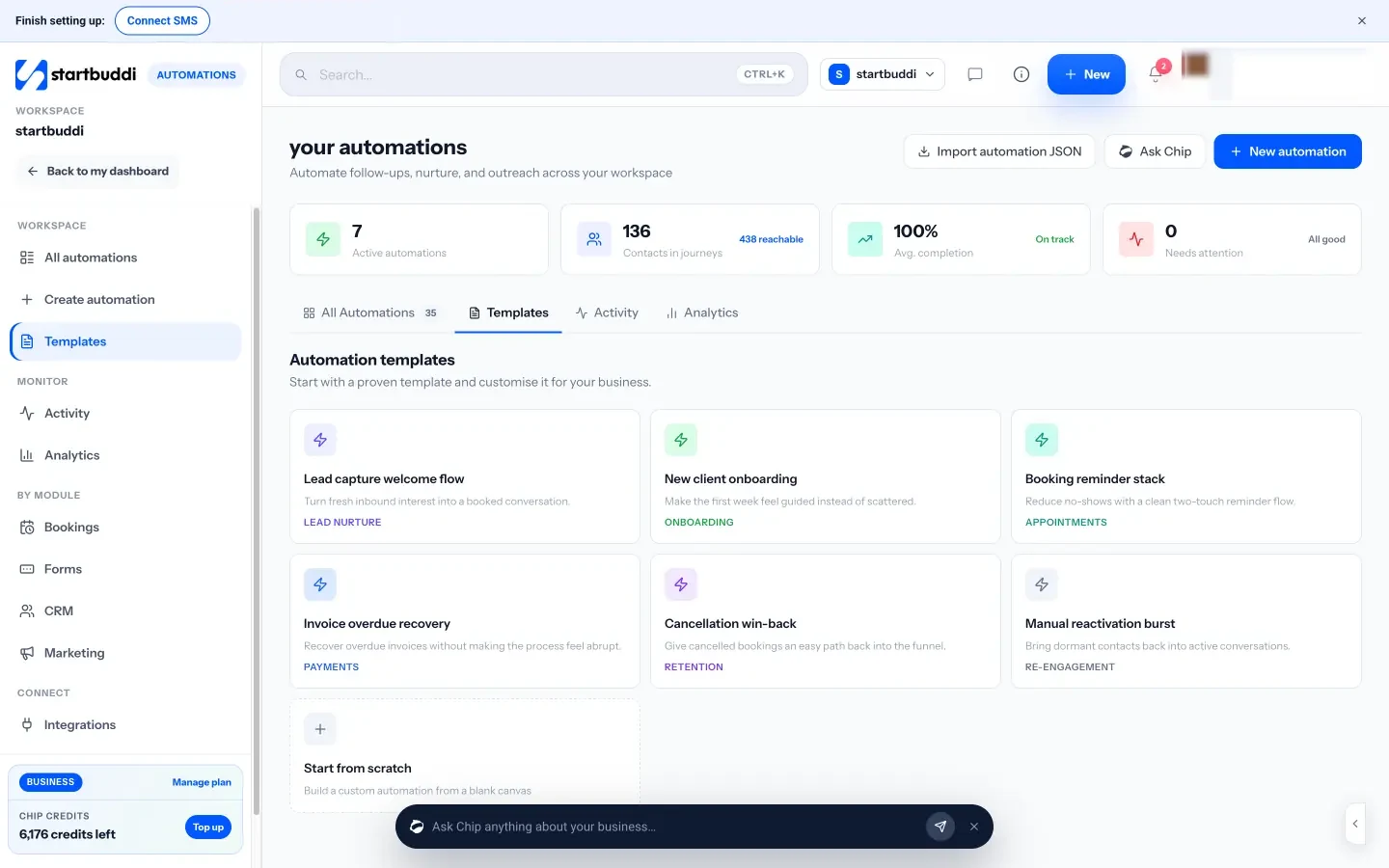
Automations is where you set the "when this happens, do that" rules that save the most time in a new business. You can start from a template, build from scratch, or tell Chip what you want in plain words. Useful templates for a new business include:
- Lead capture welcome flow: starts when a form is submitted and turns fresh interest into a booked conversation.
- Booking reminder stack: starts with a new booking and sends reminders to reduce no-shows.
- Invoice overdue recovery: starts when an invoice is overdue and follows up politely.
- New client onboarding: starts when a new contact is added and guides their first week.
Chip always saves the automations it builds as drafts, and you switch them on after a review that shows how many contacts can be reached. Free includes 2 active automations, and Starter allows 10.
Choose the plan that fits today
The Free plan costs nothing and includes 1 seat, up to 250 contacts, 1 form and 5 invoices, which is enough to run a demand test and serve your first customers. Starter adds the Marketing module, more automations, WhatsApp and SMS, 2 seats, 2,500 contacts and unlimited invoices. Growth adds seats for a small team and Chip auto-replies. Every paid plan starts with a 30-day trial, and paying yearly costs ten times the monthly price. See the pricing page for the full comparison.
Your next step: pick one idea from chapter 1 and run a two-week demand test. If you would like the page, form and contact list ready in a few minutes, start free with startbuddi and let the onboarding questions set up your first draft.
Tiwalade Joanna Okedara-Kalu is the founder, CEO and CTO of startbuddi, the business system that brings clients, bookings, invoices, projects, marketing and the Chip AI assistant into one place. Tiwalade builds software around how service businesses really work day to day, and writes about client management, getting paid on time and why small businesses outgrow the tools they start with.
Founded startbuddi and leads its product and engineering