How to follow up with leads without being pushy
A simple follow-up rhythm, five message templates for WhatsApp and email, and a way to track every lead so nobody slips through.


Chinonye wrote this while on the startbuddi team. The product has changed since, so the team updated it on .
- Reply to new leads within the hour, then follow up four or five times over about two weeks, with something useful in every message. End with a polite close, and keep every lead's next step and date in one place.
Knowing how to follow up with leads is mostly about three things: reply fast, follow up a set number of times with something useful each time, and stop politely when the answer is no. Most small businesses lose leads not because they push too hard, but because they go quiet after one message. The fix is a simple rhythm you can repeat, a few ready-made messages, and one place that reminds you who is next.
This guide gives you that rhythm, message templates for WhatsApp and email, and a way to keep track without a spreadsheet.
Why following up matters more than the first message
A lead is someone who has shown interest: they filled in a form, sent a DM, asked for a price or booked a call and then went quiet. At that moment they are comparing you with other options, or they are simply busy. Your follow-up is often the thing that decides who they pick.
Speed matters most at the start. In a study of more than a million online sales leads published in Harvard Business Review, firms that tried to contact a lead within an hour were nearly seven times as likely to qualify that lead as firms that waited even one more hour. The same research found that many companies took far longer than that, and some never replied at all. You don’t need a sales team to beat that. You need a habit.
After the first reply, persistence carries the rest. People rarely say “no” in writing. They just stop answering, and a short, friendly nudge a few days later is often all it takes to restart the conversation.
Pushy vs helpful: what’s the difference?
Following up feels pushy when every message is about you: “Just checking in”, “Did you see my last message?”, “Are you ready to buy?”. It feels helpful when every message gives the person something: an answer, an example, a next step, or an easy way out.
Use this quick test before you hit send: would this message be useful if they read it without ever buying from you? If yes, send it.
| Feels pushy | Feels helpful |
|---|---|
| “Just following up on my last message.” | “You asked about delivery to Abuja. Here is how it works and what it costs.” |
| Three messages in one day | Three messages spread over two weeks |
| Long paragraphs about your company | Two or three lines with one question |
| “Last chance!” when it isn’t | A real deadline, such as a date your calendar fills up |
| Never letting go | A polite final message that closes the loop |
A simple follow-up schedule you can copy
You don’t need a complex sales process. For most service businesses and small shops, four or five touches over about two weeks is enough. Here is a schedule that works for enquiries that came from a form, a DM or a missed call.
- Within the hour: the first reply. Answer their question, confirm what they asked for and ask one simple question that moves things forward.
- Day 2: the helpful nudge. Share something useful: a short example of similar work, a price guide, or an answer to the question most people ask next.
- Day 5: the easy next step. Offer a specific time for a call, a booking link, or a quote. Make it easy to say yes.
- Day 9 or 10: the change of channel. If you have been emailing, try a short WhatsApp or SMS message, or the other way round, as long as they have agreed to hear from you on that channel.
- Day 14: the polite close. Tell them you will stop following up and leave the door open.
After the close, move the lead into a longer-term group. Send them your newsletter or an occasional update, but stop personal chasing. Some of your best customers will come back months later because you ended well.
Adjust the timing to how people buy from you
A café taking catering orders for Saturday needs a faster rhythm than an agency quoting a six-month project. A good rule: the bigger and slower the decision, the more space between messages. The smaller and more urgent the purchase, the faster you should move, but with fewer total touches.
When they say “not now”
“Not now” is not “no”. Ask one question to understand the timing: “Is it budget, timing or something else?” Then agree when to check back, write that date down, and actually do it. When you come back, lead with something new, such as a recent project, a new service or a change in price, so the message doesn’t feel like a repeat.
Following up after you send a quote
A quote is the point where many leads go silent, usually because they have questions they don’t want to ask. Send the quote with a short summary of what’s included, then follow up two or three days later with a question about the quote itself: “Does the scope match what you had in mind, or should I adjust anything?” That invites a conversation instead of a yes or no. If you use a quote template, our free quote generator helps you get the basics right.
Follow-up message templates for WhatsApp and email
Copy these, then change the details so they sound like you. Keep WhatsApp messages short. Use email when you need to share more detail or attachments.
1. First reply (within the hour)
Hi Amaka, thanks for asking about our cleaning service. Yes, we cover Lekki and Ajah. For a three-bedroom flat, a deep clean usually takes about five hours. Would a weekday or a weekend suit you better?
2. Helpful nudge (day 2)
Hi Amaka, here’s a short checklist of what our deep clean includes, so you can compare it with other quotes. Happy to answer anything that isn’t clear.
Put this into practiceEverything in this article works inside startbuddi, free to start.Start free
3. Easy next step (day 5)
Hi Amaka, I have two slots left next week: Tuesday morning or Thursday afternoon. Would either work? You can also pick a time here: [booking link]
4. Change of channel (day 9 or 10)
Subject: Your cleaning quote
Hi Amaka, I sent a couple of WhatsApp messages but I know those get buried. Your quote is attached, valid until the end of the month. If the timing isn’t right, just say so and I’ll check back later.
5. Polite close (day 14)
Hi Amaka, I don’t want to fill up your inbox, so this is my last message about the quote. If you ever need a hand with cleaning, just reply here and we’ll pick up where we left off. Wishing you a good week.
The polite close often gets the most replies of the whole sequence, because it takes the pressure off. People reply with “sorry, it’s been a busy month, can we do next week?” more often than you’d expect.
For more ready-made wording you can adapt, see our AI prompt pack for service businesses.
How to follow up with leads without annoying them
A few rules keep your follow-ups on the right side of helpful:
- One question per message. “Weekday or weekend?” gets more replies than three questions at once.
- Refer to what they said. Mention their situation, their budget, their location. It proves you read their message.
- Space them out. Never send two follow-ups in one day unless they are replying to you.
- Respect the channel they chose. If someone found you on Instagram, a WhatsApp message out of nowhere can feel intrusive. Ask first.
- Give a real reason to act. A fully booked calendar or a price change on a set date is fine. Fake urgency damages trust.
- Know when to stop. If they say no, thank them and stop. If they ask you not to contact them, remove them from your follow-ups straight away.
Stay on the right side of the rules
Personal replies to someone who contacted you are normal business. Marketing messages are different: they usually need the person’s permission. WhatsApp’s Business Messaging Policy says businesses may only message people who have given their number and agreed to hear from them. In the UK, the ICO’s guidance on email marketing explains when you need consent. In Nigeria, the Nigeria Data Protection Act 2023 sets out how you may use people’s personal data. This is general information, not legal advice.
Keep track of every lead in one place
The biggest reason follow-ups fail is memory. You meant to message Tunde on Thursday, then a delivery went wrong and Thursday disappeared. A reliable follow-up system has three parts:
- One list of every open lead, with where they came from and what they asked for.
- A next step and a date on every lead. “Send quote Tuesday” is a next step. “Follow up” is not.
- A daily look at what’s due. Five minutes every morning to see who needs a message today.
A notebook can do this for ten leads. A spreadsheet can do it for fifty, until two people edit it at once. Past that point a simple contact list with reminders saves real time. If you are weighing that up, our comparison of CRM vs spreadsheet goes into detail.
Track a few numbers
You only need three numbers to know whether your follow-up is working:
- Time to first reply. How long between the enquiry and your first answer.
- Reply rate by touch. Which message in your sequence gets the most replies. If it’s always the polite close, your earlier messages may be too salesy.
- Leads with no next step. This should be zero. Any lead without a date is a lead you will forget.
Common follow-up mistakes to avoid
- Waiting for the “perfect” reply. A quick, honest answer beats a polished one sent tomorrow.
- Sending the same message to everyone. Personal details matter more than clever wording.
- Only following up once. One message and silence is the most common way small businesses lose work.
- Forgetting old leads completely. Someone who said “not now” in March may be ready in September.
- Arguing with a no. Accept it, thank them, and ask if you can check in later.
How startbuddi helps
startbuddi keeps your leads, your conversations and your reminders together, so the follow-up rhythm above runs without sticky notes. Here is what that looks like in practice.
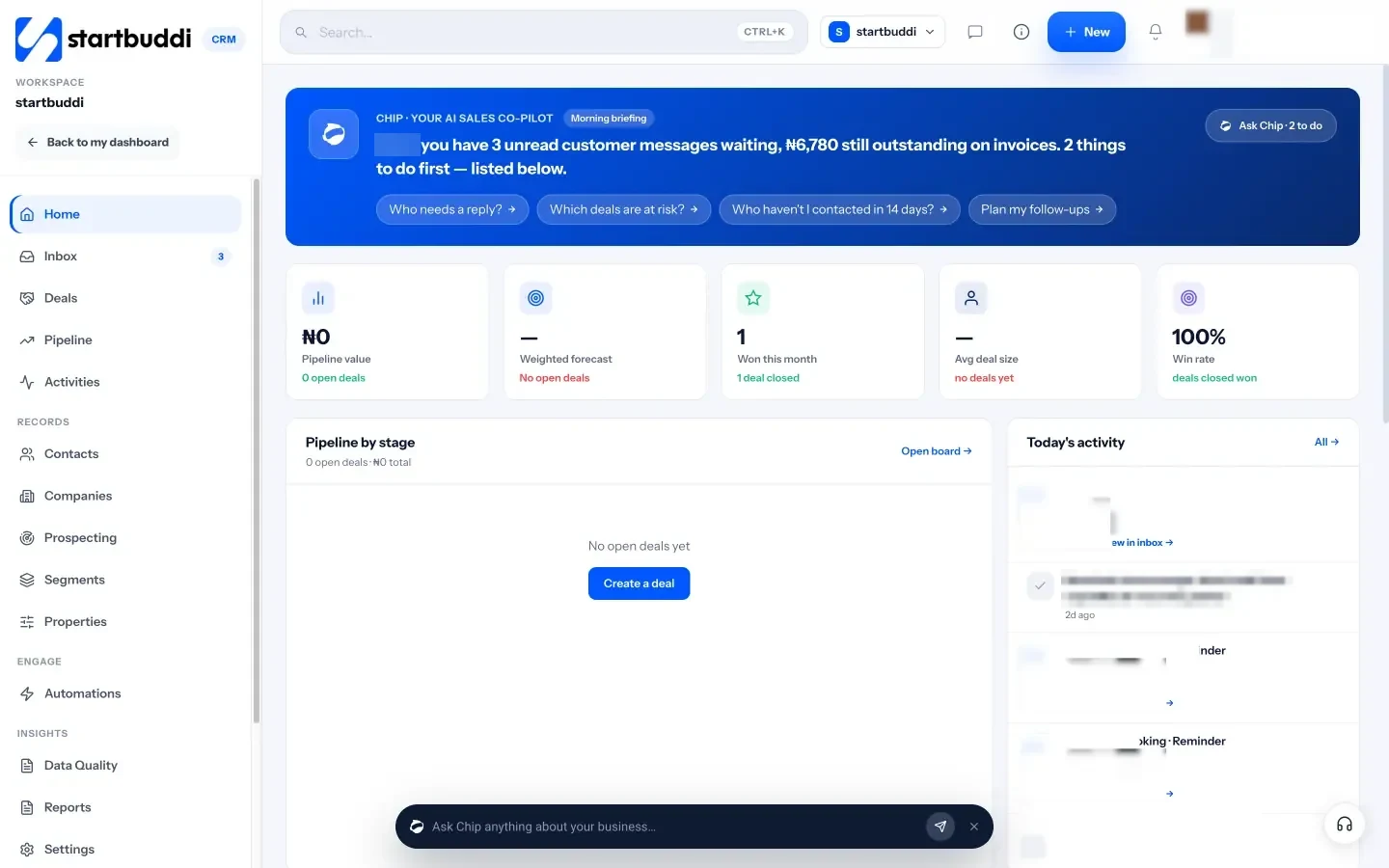
A morning briefing from Chip. The Customers home opens with a short briefing from Chip, the AI assistant, covering unread messages, open deals and money still owed. Prompts such as “Who needs a reply?”, “Who haven’t I contacted in 14 days?” and “Plan my follow-ups” turn it into a to-do list. A “Next best actions” card ranks who to reply to and which deals have stalled.
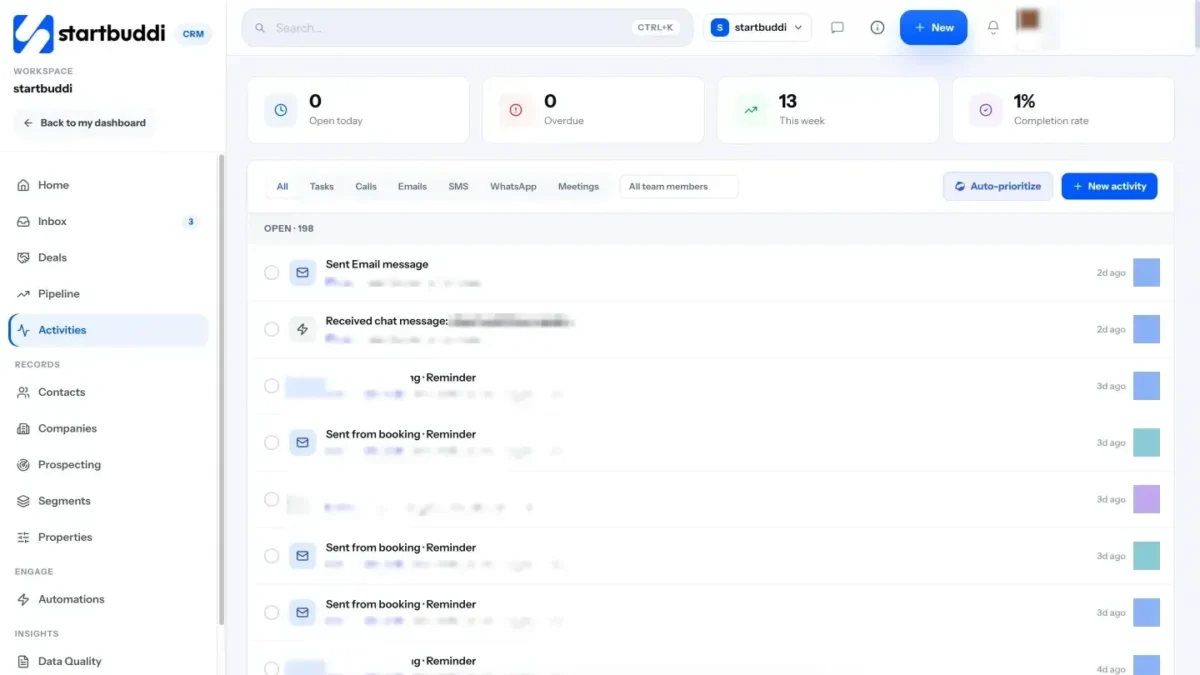
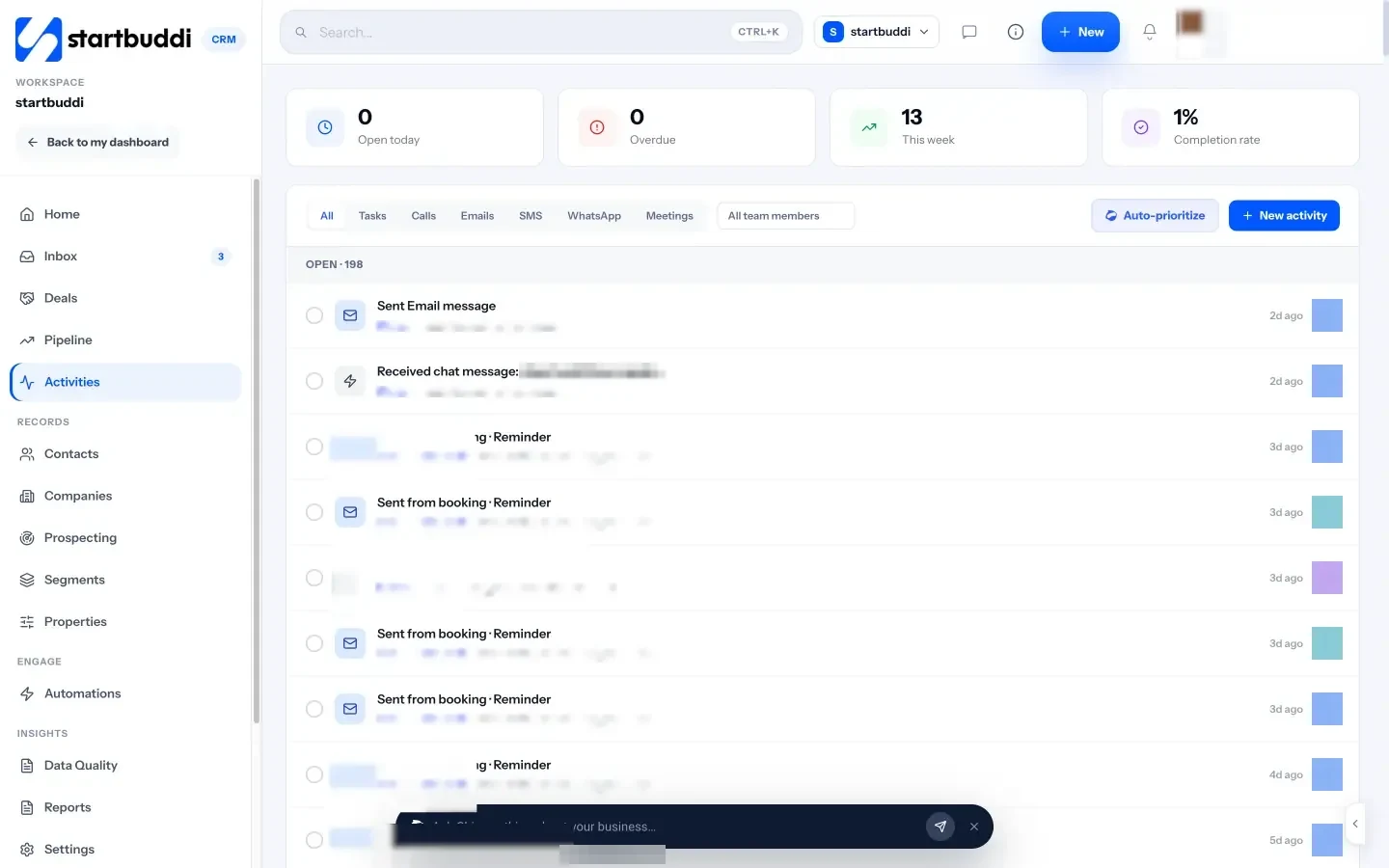
Every follow-up as a dated activity. In Activities you can log a call, email, WhatsApp message, SMS, meeting or follow-up against a contact, with a due date, priority and owner. The top of the page shows what’s open today, what’s overdue and your completion rate, so “leads with no next step” is easy to spot.
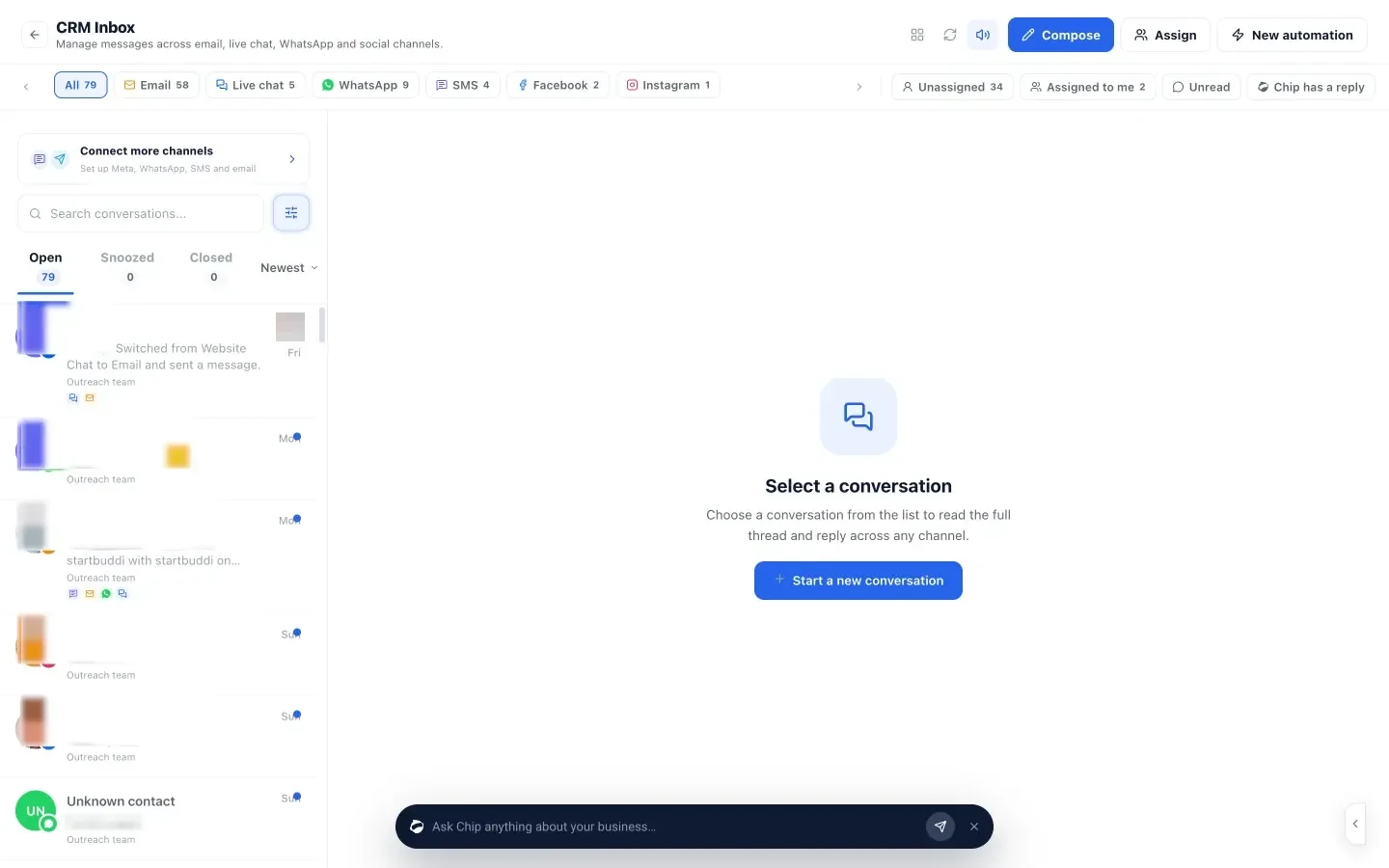
One inbox for every channel. The shared inbox brings email, WhatsApp, SMS, website chat, Instagram and Facebook messages into one place. You can reply on a different channel from the one the message came in on, save quick replies for your most common answers, and schedule a message to send later, even when you’re offline. WhatsApp and SMS need the Starter plan or above.
Follow-up sequences you write once. On any contact, “Nurture with Chip” drafts a short follow-up email sequence from that person’s real history. You edit every step before anyone is enrolled. For rules that run on their own, such as a follow-up task when a new lead is added, use Automations, which come with the Starter plan and above. On Growth and above, “Follow-ups on autopilot” lets Chip send due follow-ups for you and stop after two.
A pipeline that moves itself. In the sales pipeline, a deal moves out of the first stage when the contact replies, and is marked won when an invoice on it is paid.
Your next step
Pick your five most recent leads that went quiet. Write the next message for each one using the templates above, and give each a date. Then set up a place where those dates remind you. You can start free with up to 250 contacts, or compare plans on the pricing page.
Sources
- Harvard Business Review: The Short Life of Online Sales Leads
- WhatsApp Business Messaging Policy
- ICO: Electronic mail marketing
- Nigeria Data Protection Commission: Nigeria Data Protection Act 2023
Frequently asked questions
How many times should I follow up with a lead?
Four or five touches over about two weeks suits most small businesses. After a polite final message, move them to occasional updates instead of personal chasing.
How soon should I reply to a new enquiry?
As fast as you reasonably can, ideally within the hour. Research on online leads shows the chance of qualifying a lead drops quickly after the first hour.
Is it OK to follow up on WhatsApp?
Yes, if the person gave you their number and agreed to hear from you there. If they found you on another channel, ask before switching to WhatsApp.
What should I say in a last follow-up message?
Say this is your last message, leave the door open and wish them well. It takes the pressure off and often gets a reply.
SEO Copywriter| Email growth Specialist| I help businesses increase revenue with strategic SEO content & high-converting email funnels.