
Starting a new client engagement without a written agreement is one of the most common and costly mistakes service business owners make. A verbal understanding feels efficient in…
- What Is a Client Service Agreement Template and When Do You Need One?
- How Do You Define Scope of Services in a Client Agreement?
- What Payment Terms Should a Service Agreement Template Include?
- How Does a Change Order Clause Protect Your Scope and Fees?
- What Should Your Agreement Say About Intellectual Property Ownership?
Starting a new client engagement without a written agreement is one of the most common and costly mistakes service business owners make. A verbal understanding feels efficient in the moment, but it leaves every critical detail open to dispute the moment expectations diverge.
A client service agreement template gives you a reusable, structured starting point you can customize before any engagement begins. It documents what you will deliver, what the client will pay, and what happens when things go sideways. This guide walks you through exactly what to include and why each section matters.
What Is a Client Service Agreement Template and When Do You Need One?
A client service agreement template is a pre-drafted contract that service providers customize for each new client engagement. It covers the terms of the professional relationship before any work begins, including deliverables, fees, intellectual property, and termination rights.
You need one any time you accept payment for a service, regardless of how small the project is. The risk is not just legal. Without a written agreement, scope creep goes unpaid, late payments are harder to enforce, and IP ownership defaults to whoever a court decides created the work. A signed agreement eliminates those ambiguities from day one.
startbuddi lets you attach client agreements directly to client profiles, so your signed contract, project details, and payment schedule all live in one place before you create the first task.
How Do You Define Scope of Services in a Client Agreement?
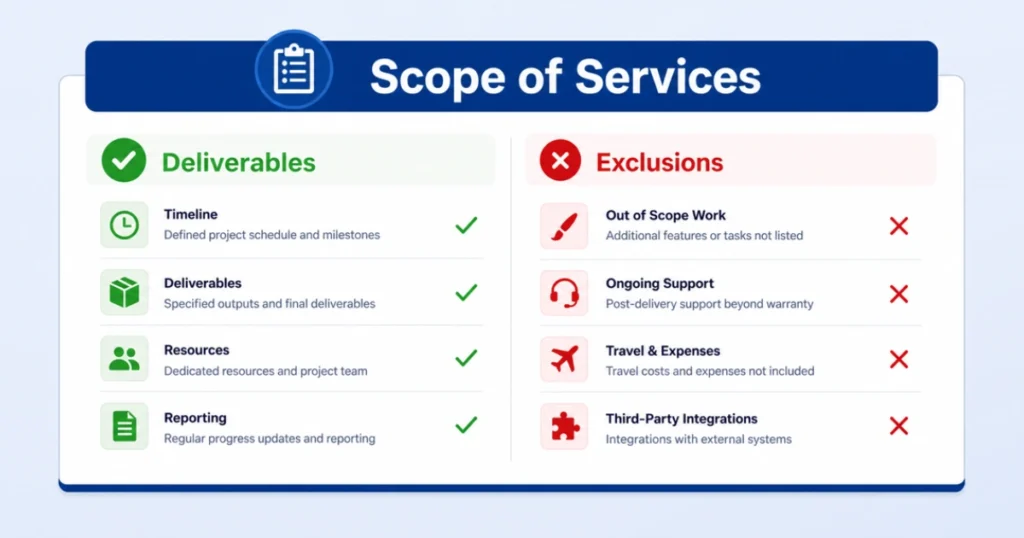
The scope of services section is the most frequently disputed part of any client agreement. It describes what you will deliver, what timeline applies, and what is explicitly excluded.
Vague scope language like “marketing support” or “design work” is what makes agreements unenforceable. Write specific deliverables with measurable criteria. If the engagement is complex, attach a Statement of Work as a separate schedule and reference it in the main agreement.
Also include an exclusions paragraph. Stating what is not included prevents clients from arguing that additional work falls under the original fee. Common exclusions are rush timelines, third-party costs, and services outside a defined geography.
What Payment Terms Should a Service Agreement Template Include?
Your payment terms section should cover the fee structure, invoicing schedule, due date, and what happens when payment is late.
Net 30 from invoice date is the most common commercial standard. Many service providers require a 25 to 50 percent deposit before starting work, with the balance due at defined milestones or on delivery. For recurring engagements, monthly invoicing in advance is standard.
Include a late-fee clause. A rate of 1.5 percent per month on overdue balances is widely accepted. Also add a right to suspend services after a defined period of non-payment, typically 15 days. Without this clause, you have no contractual leverage to stop work when a client falls behind.
How Does a Change Order Clause Protect Your Scope and Fees?
A change order is a written amendment that documents any modification to scope, timeline, or fees after the original agreement is signed. It is one of the highest-value clauses a service agreement can include.
Without a change order requirement, clients request additional work informally and later dispute whether it was covered by the original price. This is how scope creep becomes an unpaid labour problem.
The clause should state clearly that you are not obligated to perform any out-of-scope work until both parties have signed a written change order. Apply this consistently. One instance of performing extra work based on a verbal approval sets a precedent that weakens the clause going forward.
What Should Your Agreement Say About Intellectual Property Ownership?
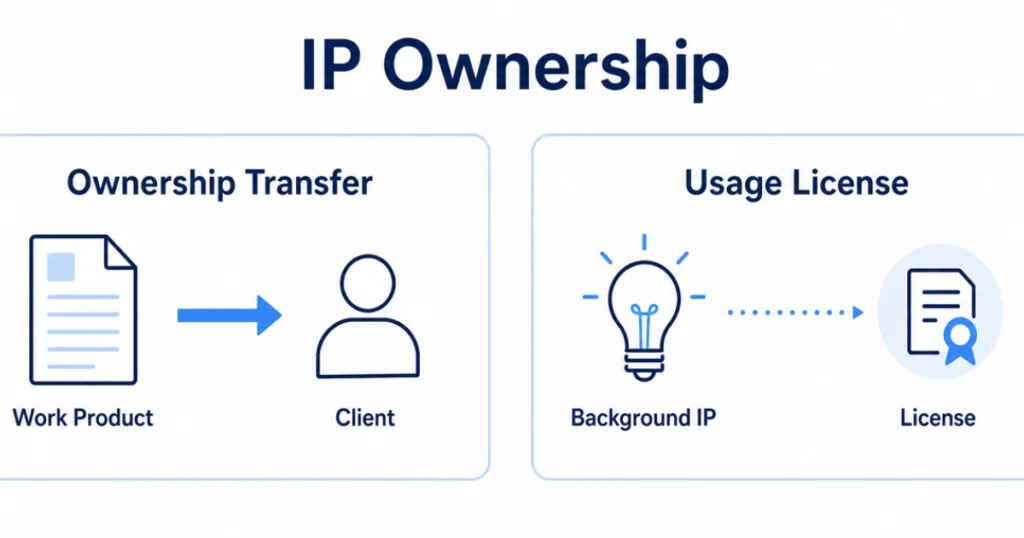
Intellectual property ownership determines who legally controls the work you produce. In most jurisdictions, the creator owns the work by default unless an explicit written assignment transfers that ownership to the client.
This surprises many clients. They assume that paying for something means they own it. Your agreement needs to be specific: state whether ownership transfers to the client upon full payment, or whether you retain background IP and grant a license for use.
If you reuse code, design systems, templates, or frameworks across multiple clients, retain ownership of those assets and grant a license. Assigning them to one client could restrict your ability to use your own tools for other work.
How Do Confidentiality and Limitation of Liability Clauses Work?
Confidentiality obligations prevent both parties from disclosing or misusing the other’s sensitive business information during and after the engagement. Specify what counts as confidential, what permitted disclosures exist, and how long the obligation survives after the agreement ends. Two to three years is typical.
Limitation of liability caps your maximum financial exposure if something goes wrong. Without this clause, a client can pursue you for their lost revenue, lost profits, or downstream losses that far exceed what you were ever paid. The standard approach is to cap total liability at the fees paid in the prior 12 months and exclude indirect, consequential, and punitive damages.
Both clauses are non-negotiable in any serious client agreement.
What Are the Key Termination and Governing Law Terms to Include?
Your agreement should state how long the engagement lasts, how either party can exit without cause, and what triggers an immediate termination for breach.
Termination for convenience typically requires 30 days of written notice. Termination for breach should include a cure period of 10 to 15 days, giving the breaching party a chance to fix the problem before the relationship ends. Courts often decline to enforce immediate termination clauses where no cure period was offered.
Also include a clause stating that the client owes payment for all work completed through the termination date. Without it, clients who exit early may dispute how much they owe.
Governing law specifies which jurisdiction’s rules apply if a dispute goes to court. Choose the jurisdiction where you operate, not a random choice.
Run this from one workspace
Clients, projects, money and marketing — connected, not scattered across five apps.
See how it worksFrequently Asked Questions
What should a client service agreement template include?
A complete client service agreement template should cover scope of services, deliverables, payment terms, change order procedures, intellectual property ownership, confidentiality obligations, limitation of liability, termination rights, and governing law.
Is a service agreement template free to use?
Many service agreement template free downloads are available online as Word or PDF files. These provide a strong starting point, but they should be reviewed by a lawyer for high-value or complex engagements before use.
What is the difference between a service agreement and a professional services contract?
A professional services contract and a service agreement cover the same ground. The term professional services contract is more common in corporate and B2B settings, while service agreement is used broadly across freelance and small business contexts. Both are legally binding when properly executed.
Conclusion
A strong client service agreement template is not a formality. It is the document that determines whether you get paid in full, retain ownership of your work, and exit bad engagements cleanly. Every clause, from scope of services to limitation of liability, exists to close a gap that a verbal arrangement leaves open.
Build the habit of sending a signed agreement before any work begins, and pair it with a reliable tracking system so nothing slips through the gap between contract and delivery. startbuddi gives service businesses both in one place, so the paper trail and the project timeline stay connected from day one.
Put this into practice
Everything in this guide is built into startbuddi — free to start.
Start freeWritten by
Chinonye Umezinne
SEO Copywriter| Email growth Specialist| I help businesses increase revenue with strategic SEO content & high-converting email funnels.
Keep reading
Related playbooks
Stop reading. Start doing.
Free to start. No card needed. Your full workspace is ready in five minutes.