How to write a client service agreement that protects you and sets clear expectations
What to put in a client service agreement: parties, scope, payment, changes, revisions, IP, confidentiality, liability, ending the deal and signatures, plus the clauses people forget.


- A client service agreement records what you will deliver, what the client pays and when, and what happens if plans change or someone wants out. Write specific scope with exclusions, clear payment and late terms, a change and revision process, IP and confidentiality terms, a liability cap and a way to end the deal, then get it signed before work starts.
A client service agreement is a written contract between you and a client that says what you will do, what they will pay, when, and what happens if something changes or goes wrong. To write one, set out the parties, a specific scope with exclusions, payment and late terms, how changes and revisions work, who owns the work, confidentiality, a limit on your liability and how either side can end the deal. Then get it signed before you start.
This guide explains each section in plain words, shows the clauses most freelancers and small agencies forget, and ends with a checklist you can use on your next client. It is for designers, consultants, developers, coaches, marketers, cleaners and any business that sells time and expertise.
General information, not legal advice. Contract rules differ between countries, so have a local lawyer review your template before you rely on it.
What a client service agreement is, and when you need one
A client service agreement (also called a service agreement, client agreement or professional services contract) covers the working relationship before any work begins. The names are used almost interchangeably. What matters is the content and that both sides have agreed to it in writing.
You need one whenever you take money for a service, however small the job. A verbal “yes, go ahead” feels quick, but it leaves every important detail open to memory. When a client later says “I thought the website included the blog” or “I’ll pay when my client pays me”, a signed document is the only thing both of you can point to.
Project agreement or ongoing service agreement?
The same clauses apply to both, but the emphasis differs:
| One-off project | Ongoing service or retainer | |
|---|---|---|
| Length | Ends on delivery | Runs month to month or for a set term |
| Scope | A list of deliverables | A service level, such as hours or outputs per month |
| Payment | Deposit plus milestones or balance on delivery | Monthly fee, usually in advance |
| Ending it | On completion, or early exit terms | Written notice, often 30 days |
| Good for | A logo, a website, a one-day event | Bookkeeping, social media management, ongoing consulting |
Many businesses use one master service agreement with the general terms, plus a short statement of work for each project. Our statement of work template shows what goes in that second document.
Parties, authority and dates
Start with the basics: your legal business name and address, the client’s legal name and address, and the date the agreement starts. If you trade under a brand name, include both, for example “Ada Okafor, trading as Brightline Studio”.
Check that the person signing can actually commit the client’s business. A marketing assistant who loves your proposal may not be able to approve spending. Asking “Who else needs to sign off on this?” early saves an awkward delay at the end.
Scope of services: the section that prevents most disputes
Scope is the most argued-about part of any client agreement, and vague scope is the main cause of scope creep. Replace general phrases with specific, checkable items.
- Weak: “Website design and social media support.”
- Strong: “Design and build a five-page website (Home, About, Services, Contact, Blog listing) on the client’s existing domain, including one contact form. Create 12 social media graphics per month for Instagram and LinkedIn, delivered as PNG files.”
Then add an exclusions list. Stating what is not included is just as important. Common exclusions are copywriting, stock photo licences, paid advertising spend, hosting fees, rush turnaround and work outside agreed hours.
Client responsibilities and timelines
Your deadlines depend on the client doing their part. Write down what they must provide (logins, content, brand files, feedback) and by when. Add a line that says your delivery dates move by the same number of days if their input is late. It is fair, and it stops you carrying the blame for their delays.
Payment terms, deposits and late payment
Your payment section should answer five questions: how much, when, how, what happens if it’s late, and what happens to work already done if the deal ends.
- Fee and structure: a fixed price, an hourly or day rate, or a monthly retainer. State the currency, for example $2,400, £1,900 or ₦1,500,000.
- Deposit: many service businesses take a deposit before starting, with the balance at milestones or on delivery. Pick a figure that covers your early costs and time. Our post on how much deposit to charge clients goes through the options.
- Due dates: say how many days the client has to pay each invoice, such as 7 or 14 days.
- Payment methods: bank transfer, card, payment link, and who pays any transfer fees.
- Late payment: interest or a late fee, and your right to pause work until overdue invoices are paid.
Late payment rules vary by country. In the UK, for example, businesses can claim statutory interest of 8% plus the Bank of England base rate on late business-to-business payments. Elsewhere, what you can charge depends on local law and what the contract says, so check the rules where you and your client are based.
Changes, revisions and approvals
These three clauses protect your time more than any other.
Change requests
State that any change to scope, timeline or price must be agreed in writing before the extra work starts, with a new price or timeline attached. Then stick to it. Doing “just one quick extra” on a verbal request sets a pattern that is hard to undo. Our guide on how to prevent scope creep goes into these conversations in more detail.
Revision rounds
Say how many rounds of revisions are included (two rounds is a sensible starting point for most design work) and define a revision: changes to the agreed deliverable, not a new direction. Extra rounds are charged at your hourly or day rate.
Approval and sign-off
Define what counts as approval, such as a written reply by email or in a shared portal. A thumbs-up emoji in a group chat is easy to dispute later. Written sign-off at each stage gives you a clear record before you move on.
Who owns the work: intellectual property
Clients often assume that paying for something means they own it. Legally, that is not always true. In the United States, for example, work by an independent contractor is only a “work made for hire” in certain categories and when both sides agree in a signed written document, as the US Copyright Office explains. Otherwise the creator usually keeps the copyright unless it is assigned in writing.
So say it clearly. A common approach is:
- Ownership of the final deliverables passes to the client once they have paid in full.
- You keep ownership of your own tools, templates, code libraries and methods, and give the client a licence to use them as part of the deliverable.
- You may show the work in your portfolio unless the client asks you not to in writing.
Confidentiality, liability and the protective clauses
Confidentiality
Both sides will share information that shouldn’t go further: business plans, customer lists, passwords, prices. A confidentiality clause says what counts as confidential, what can be shared (for example with your subcontractors under the same terms) and how long the duty lasts after the work ends. For sensitive projects, a separate non-disclosure agreement may be worth signing first.
Limitation of liability
Without a cap, a client could try to claim for lost profits far bigger than your fee. Many service agreements cap total liability at the fees paid under the agreement, or over a set period, and exclude indirect losses. How far a cap is enforceable depends on local law, which is one reason to have a lawyer check your template.
Events outside your control
A force majeure clause covers delays caused by things neither side controls, such as a natural disaster, a long power or internet outage, or serious illness. It pauses obligations rather than treating the delay as a breach.
Communication and working hours
State your working hours, your usual reply time and the channels you use for project decisions. It sets polite boundaries from day one and stops late-night voice notes becoming an expectation.
Ending the agreement, disputes and signatures
Every agreement needs an exit. Cover:
- Ending without a reason: how much written notice either side must give, which is common in retainers.
- Ending for breach: a short period to fix the problem before the agreement ends.
- Payment on exit: the client pays for all work done up to the end date, and deposits covering work already started are not refundable.
- Handover: what files and access the client receives when it ends.
- Disputes: a step such as talking it through or mediation before anyone goes to court, and which country’s or state’s law applies.
Finally, both parties sign and date it. Electronic signatures are widely accepted for business contracts in many countries, but some document types have special rules, so check locally if you are unsure.
What if a client won’t sign?
Treat it as useful information. A client who won’t agree to basic terms before the work starts is unlikely to respect them later. Offer to talk through any clause they are unsure about, and be ready to walk away if they refuse to sign anything at all.
Client service agreement checklist
Before you send your next agreement, check it covers:
- Legal names, addresses, start date and who can sign.
- Specific deliverables, exclusions and client responsibilities.
- Fee, currency, deposit, due dates, payment methods and late terms.
- Change request process, revision rounds and how approval is given.
- IP ownership on full payment, your retained tools and portfolio use.
- Confidentiality and how long it lasts.
- Liability cap and force majeure.
- Notice period, payment on exit, handover and disputes.
- Signatures and dates from both sides.
Mistakes to avoid
- Copying a template without reading it. A contract written for a US software company may not suit a cleaning business in Leeds or a photographer in Accra. Change every clause that doesn’t fit how you work.
- Starting before it is signed. “We’ll sort the paperwork later” usually means never. Make the signature and deposit the trigger for booking the kick-off.
- Letting the agreement and reality drift apart. When scope changes, update the agreement or add a signed change request. An agreement that describes last year’s project protects nobody.
Want a head start? Our free freelance agreement template, consulting agreement template and agency retainer agreement template cover these sections.
How startbuddi helps you send and track client agreements
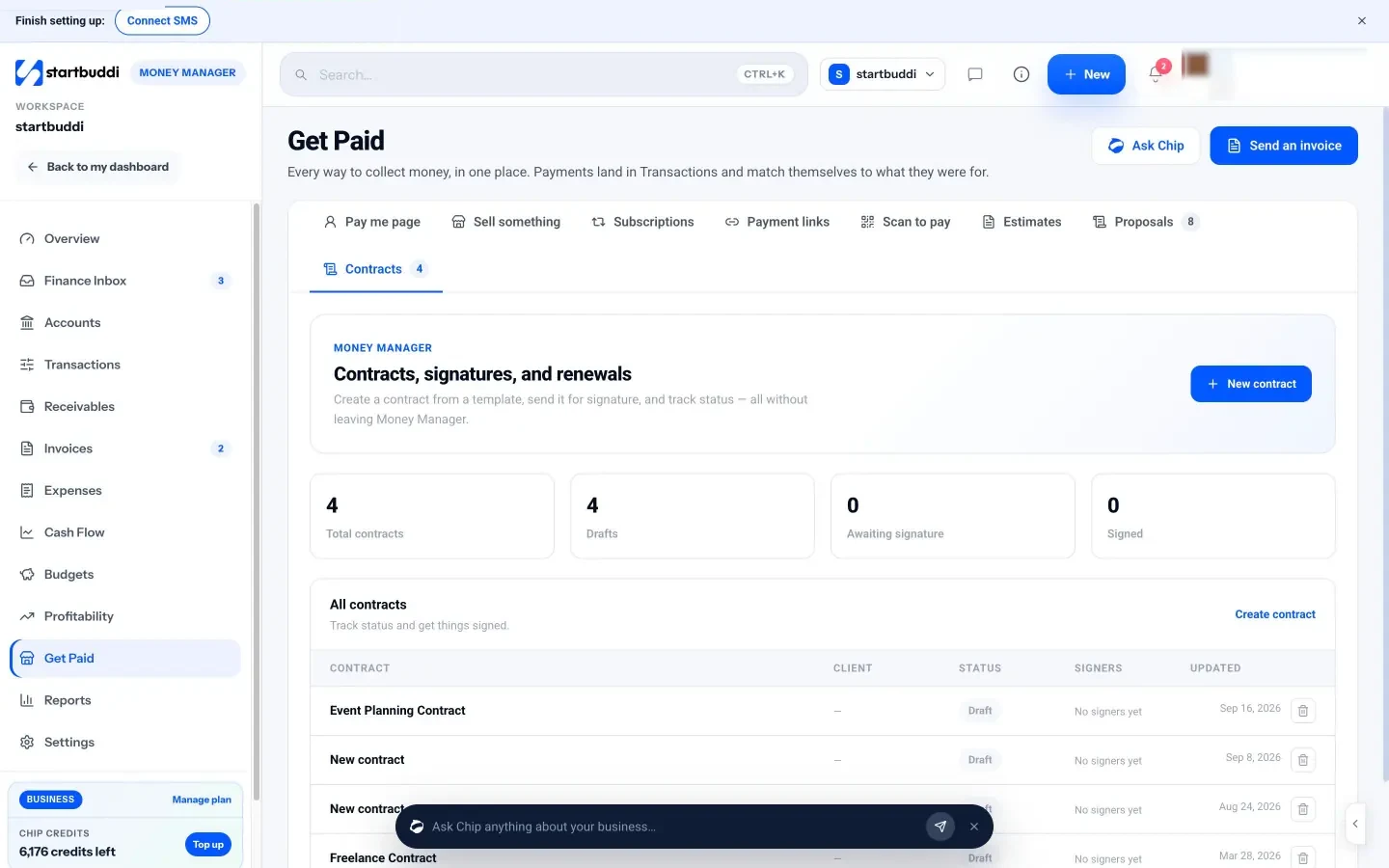
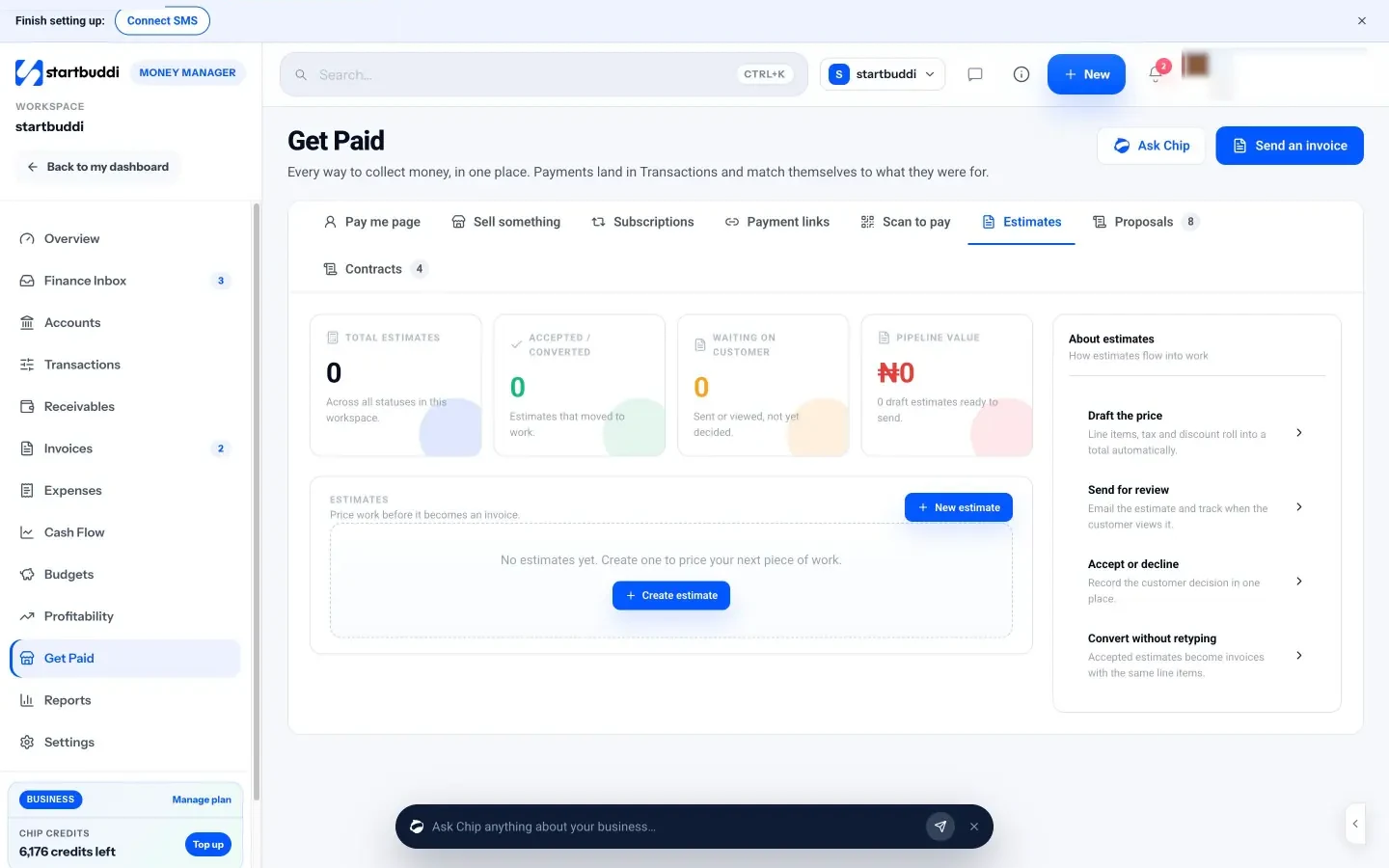
In startbuddi, contracts live in Money Manager under Get Paid, next to your estimates, proposals and invoices, so the paper trail and the money stay connected.
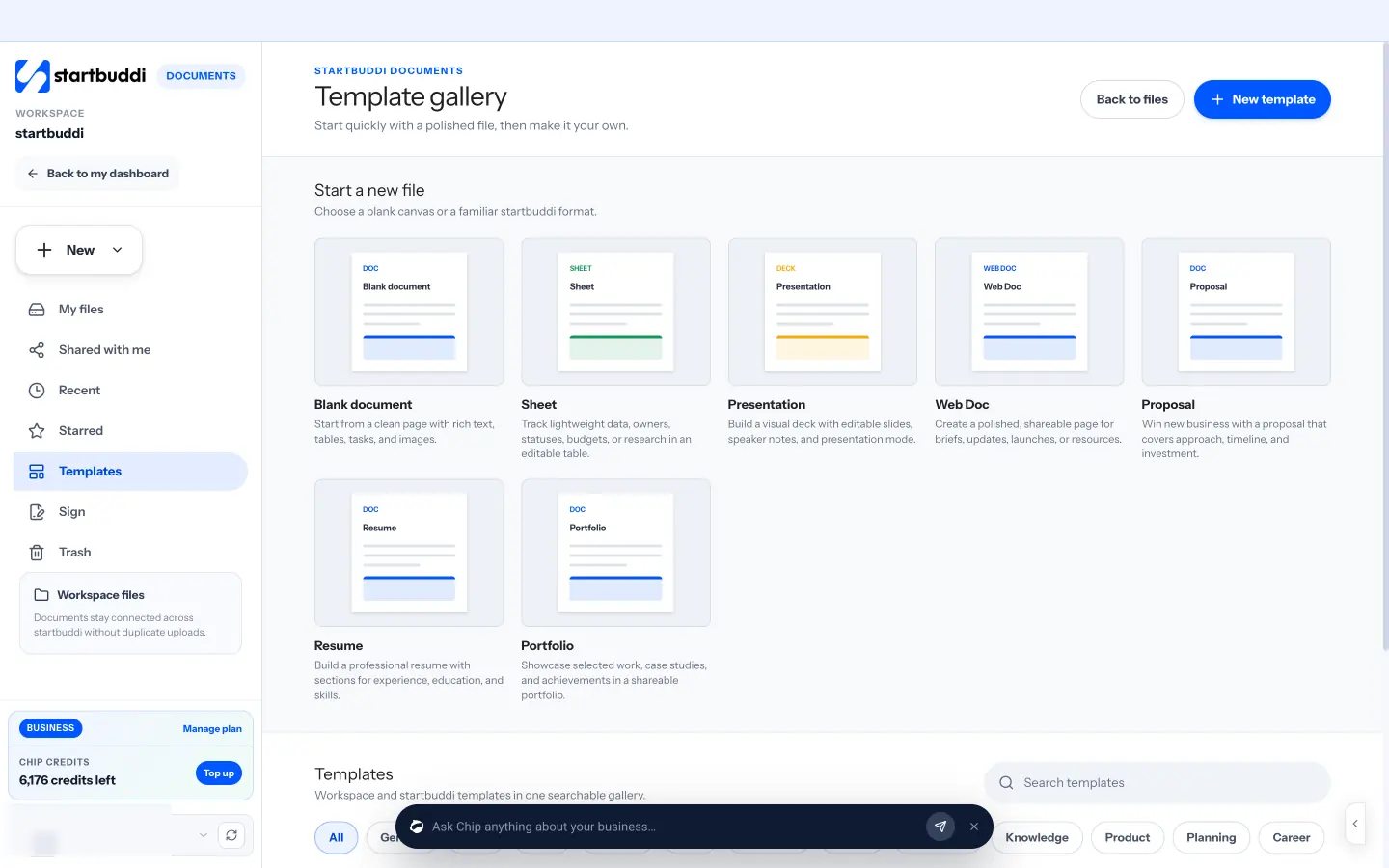
- Start from a template. New contract lets you pick a starting point such as Freelance Contract, Brand Design Contract, Website Development Contract, Photography Contract or Event Planning Contract, or start blank. Documents also has a template gallery with a Service Agreement, Consulting Agreement, Monthly Retainer Agreement and NDA. The built-in templates carry a note that they are a starting point, not legal advice.
- Edit and sign online. Edit the wording in the document editor, add each signer’s name and email, and send it for signature. Each signer signs on their own signing page, and the contract list shows how many have signed.
- Quote first, then bill. Send an estimate with terms like “50% deposit to begin”, mark it accepted when the client agrees, and convert it to an invoice with the same line items.
Once the client has signed, invoices can be paid online by card or bank transfer through Stripe or Paystack, and a client portal can show them their contracts, invoices and approvals in one private place. See estimates, proposals and contracts for the full picture. Contracts and e-signatures are available on the Free plan, where Documents is limited to three documents; paid plans remove that limit.
Your next step
Take your last project and write down everything that went slightly wrong: late feedback, extra revisions, a slow payment. Each one points to a clause your agreement needs. Add those clauses to a template today, have it checked once by a lawyer, and use it for every new client. Then read how to onboard a new client to make the signed agreement part of a smooth first week.
Sources
- GOV.UK: Late commercial payments, charging interest
- US Copyright Office: Circular 30, Works Made for Hire
Frequently asked questions
Is a client agreement the same as a client service agreement?
In everyday use, yes. Both describe a written contract for services. Some businesses use "service agreement" for ongoing work and "project agreement" for one-off jobs, but the key clauses are the same.
How long should a client service agreement be?
Long enough to cover the key terms and short enough that the client reads it. For most small businesses that is two to five pages, with project details in a separate statement of work.
Can I use a free service agreement template?
Yes, as a starting point. Adapt it to your service and your country, and have a lawyer review it once before you rely on it for high-value work.
Are electronic signatures valid on a service agreement?
In many countries they are accepted for ordinary business contracts, but rules vary and some documents need special formalities. Check the law where you and your client are based.
Tiwalade Joanna Okedara-Kalu is the founder, CEO and CTO of startbuddi, the business system that brings clients, bookings, invoices, projects, marketing and the Chip AI assistant into one place. Tiwalade builds software around how service businesses really work day to day, and writes about client management, getting paid on time and why small businesses outgrow the tools they start with.
Founded startbuddi and leads its product and engineering