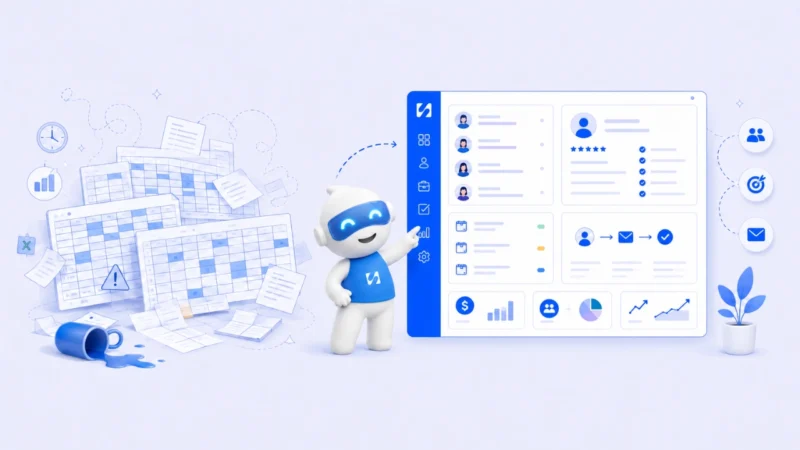
Business management software in Nigeria: what a small business needs, and what it doesn’t
What business management software does for a Nigerian small business running on WhatsApp and bank transfers, what it won't do, and how to choose one and move over.



Photo: yan kolesnyk / Unsplash
- Business management software keeps your customers, WhatsApp messages, bookings, tasks and naira invoices in one place. For a Nigerian small business, look for local payments, naira pricing and phone use. Don't expect it to replace accounting, payroll or a shop till.
Business management software is one app where you keep your customers, your conversations, your bookings, your work and your money, instead of spreading them across WhatsApp chats, a notebook, a bank app and a few spreadsheets. For a small business in Nigeria, good business management software should do five things well: keep one record for each customer, bring your WhatsApp messages in with the rest, send naira invoices people can pay by card, transfer or USSD, show you what is due today, and work on your phone. It should not be expected to replace your accountant, your payroll or your shop’s till.
This guide explains what the category covers, what a Nigerian small business actually needs from it, what it won’t do, and how to choose one and move over without losing a week.
What business management software is (and isn’t)
Think of it as the room where your business lives. When a customer messages you, books a slot or pays an invoice, it all lands in the same place, against the same name. You open one screen in the morning and see who is waiting on you, what is overdue and what money is still outstanding.
The phrase gets used loosely. Some tools called “business management software” are really accounting packages. Others are big enterprise suites built for companies with an IT team. For a small business, the useful version sits in between: a simple customer list (often called a CRM), messaging, bookings, tasks and invoicing, connected to each other. We explain the idea in more depth in our glossary entry on what an all-in-one business workspace is.
What it usually includes
- Customers: names, numbers, notes and the full history with each person.
- Conversations: WhatsApp, email and other channels in one inbox your team can share.
- Bookings: a link people use to pick a time, sometimes with a deposit.
- Work: projects and tasks, so jobs don’t live only in your head.
- Money: invoices, payment links and a record of money in and out.
What it usually doesn’t include
Full bookkeeping, payroll, tax filing and point of sale are separate categories with their own specialist tools. Some suites try to do everything, but for a business with one to ten people, a tool that does the daily running well and hands clean records to your accountant is often the better fit.
How most Nigerian small businesses run today
If you run a small business in Lagos, Abuja, Port Harcourt or anywhere else in Nigeria, this probably sounds familiar. Customers find you on Instagram and move to WhatsApp. Prices, orders and promises live in chat threads. Payments arrive by bank transfer, and you check your bank app to see who has paid. Bookings go in a notebook or your phone’s calendar. A spreadsheet tracks who owes what, when you remember to update it.
That setup is free and it works when you are small. The problems show up as you grow:
- Missed follow-ups. A customer asked for a quote on Tuesday, the chat scrolled away, and nobody replied.
- Unpaid invoices nobody chases. The transfer never came, but nothing reminded you to ask.
- “Please send proof of payment”. Matching transfers to customers by hand, line by line in the bank app.
- Double bookings. Two clients were told the same Saturday slot.
- Everything on one phone. If the owner’s phone is lost or the owner travels, the business stops.
What a Nigerian small business needs from business management software
Feature lists are long. These are the things that matter most when your business runs on WhatsApp and bank transfers.
1. One record per customer
Every message, booking, invoice and payment should attach to the same person. When Ngozi calls, you should see her last order, what she owes and what you promised her, without scrolling through three apps.
2. WhatsApp in the same place as everything else
For many Nigerian businesses, WhatsApp is the shop front. Look for software that connects your business number properly through Meta, so messages arrive in a shared inbox your team can answer, with notes and assignments. Check whether you can keep using the WhatsApp Business app on your phone after you connect the number.
3. Naira invoices and local ways to pay
Your customers want to pay by card, bank transfer or USSD, in naira. Invoices should show a total in ₦, carry a pay button that uses a Nigerian payment provider such as Paystack, and mark themselves paid when the money arrives. For quick sales, a payment link you can paste into a chat saves drafting a full invoice. Our guide on creating a payment link for your business in Nigeria covers the options.
4. Bookings with deposits
If you sell time, such as hair appointments, consultations, photo shoots, cleaning or repairs, a booking link that takes a deposit before the slot is confirmed cuts no-shows and ends the back-and-forth about which day works.
5. Pricing you can plan around
Many international tools bill in dollars on a card. When the exchange rate moves, so does your bill, and some Nigerian cards are declined for foreign subscriptions. Business software priced in naira, paid through a local provider, keeps the monthly cost steady and predictable.
6. It works on your phone
Most owners run the business from their phone between jobs. The software should let you add a contact, send an invoice or check today’s bookings from a phone browser, not only from a laptop.
7. It respects your customers’ data
You are holding people’s names, phone numbers and payment history. The Nigeria Data Protection Commission, set up under the Nigeria Data Protection Act 2023, oversees how businesses collect and keep personal data. Pick software that lets you control who in your team sees what, and export or delete data when you need to.
What not to expect: accounting, payroll and POS
Being honest about limits saves you from buying the wrong thing. Business management software for small businesses in Nigeria is usually not:
| You need | What to look for | Where a business management app fits |
|---|---|---|
| Full bookkeeping, general ledger, bank reconciliation | Accounting software, or an accountant who uses it | Keeps clean records of invoices, payments and expenses and exports them for your accountant |
| Payroll, payslips, PAYE and pension deductions | A payroll service or your accountant | Can hold your team directory and leave, but not pay salaries |
| Tax and VAT filing | Your accountant and the Nigeria Revenue Service portal | Can add VAT to invoices and give you a summary to hand over |
| A shop till with barcode scanning and a receipt printer | A point-of-sale system | Can create a quick payment link for a walk-in sale, but is not a till |
If you are unsure whether you should be charging VAT at all, our guide to VAT for small businesses in Nigeria explains the 2026 rules in plain words. It is general information, not tax advice.
How to choose business management software in Nigeria
Don’t start with the feature list. Start with the week you just had.
- Write down where things went wrong. A missed reply, a late payment, a clash in the diary. Those are the problems your software must fix first.
- List the channels your customers use. If 80% of enquiries come through WhatsApp, WhatsApp support is not optional.
- Check how you will get paid. Can customers pay an invoice by card, transfer and USSD? Does the money go straight to your own bank account, or does the tool hold it?
- Check the currency and the bill. Is the plan priced in naira? What happens when you add a second person or pass the contact limit?
- Try it on your phone. Add a contact and send yourself an invoice from your phone before you commit.
- Ask about getting data out. You should be able to export your contacts and money records at any time.
- Run a real week on the free plan or trial. One real customer, one real invoice, one real booking. That tells you more than any demo.
If you haven’t registered the business yet, you don’t need to wait to get organised. When you are ready, our plain-language guide to registering a business in Nigeria with the CAC walks through business names and companies step by step.
How to move over without losing a week
The biggest risk isn’t picking the wrong tool. It’s setting it up halfway and going back to the notebook. Move in small steps.
Week one: customers and money
- Export your contacts from your phone or your spreadsheet as a CSV file and import them. Tidy names and numbers first, because clean data makes everything else easier.
- Send your next invoice from the new tool, even if it’s just one.
- Write down every customer who currently owes you, and create an invoice for each.
Week two: messages and bookings
- Connect your WhatsApp business number and let new messages land in the shared inbox.
- Replace “what day works for you?” with a booking link in your WhatsApp status and Instagram bio.
Week three: work and team
- Turn the jobs in your head into tasks with due dates.
- Invite the person who helps you most, and agree who answers which messages.
Keep the notebook for a fortnight as a backup, then let it go. The free SMEDAN programmes, including its SME Digital Academy and Cybersecurity SME Tool Kit, are worth a look while you build new habits.
How startbuddi helps
This is the problem startbuddi is built for: an all in one business app for small businesses in Nigeria and elsewhere, charged in your local currency where available, with Paystack built in and Chip, the AI assistant, on every screen.
Your whole business on one screen. The Home dashboard greets you each morning with Chip’s brief: overdue tasks, outstanding invoices and forms collecting submissions, with buttons to ask what to focus on today or who you haven’t followed up with. Chip shows you a preview before it changes anything.
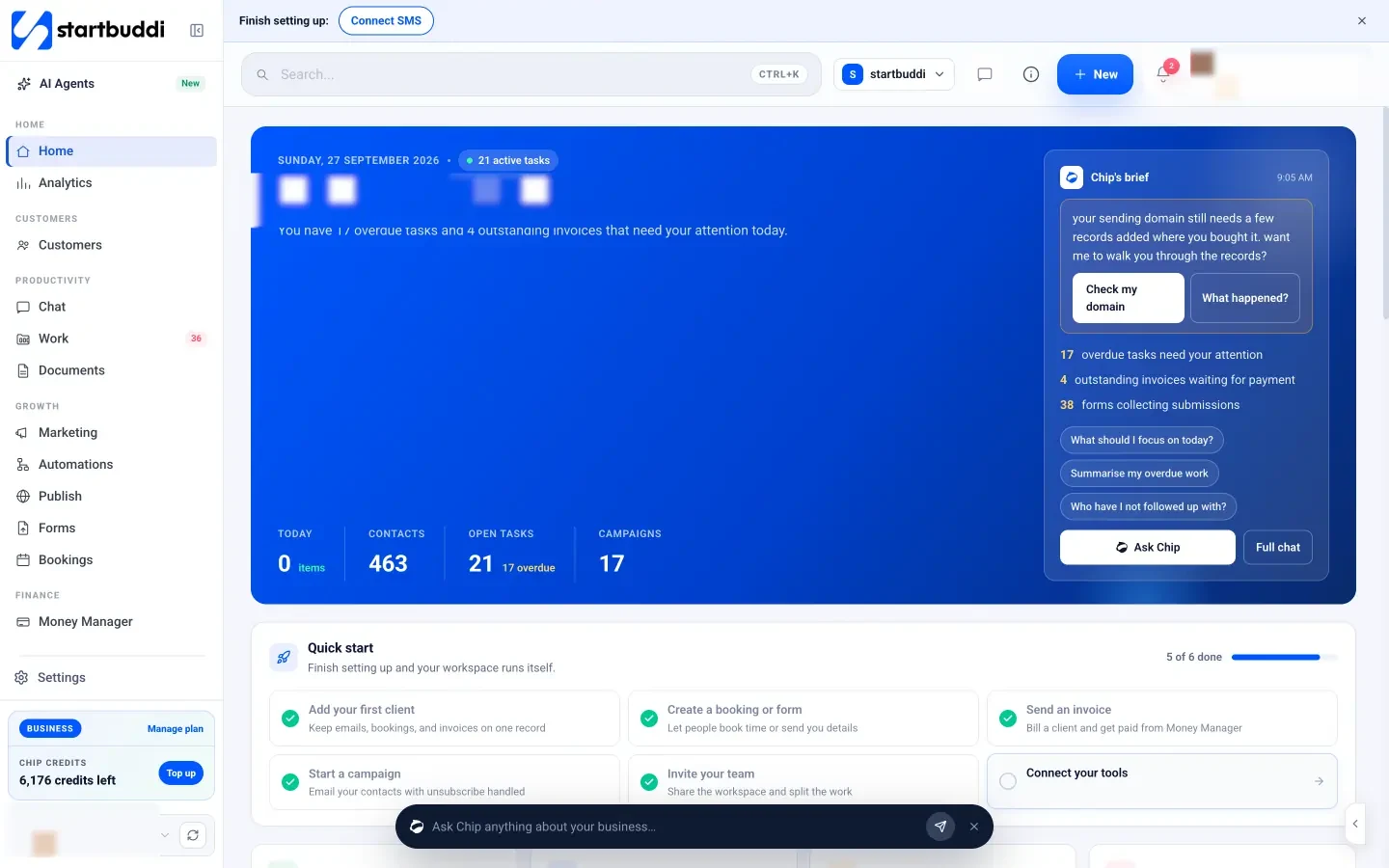
One record per customer. Bookings, forms, invoices and inbox conversations all read and write the same contact. You can bring your list in with a CSV import that maps your columns before anything is saved, up to 10,000 contacts at a time. Our help article on importing contacts shows each step, and you can export contacts to CSV or Excel whenever you like.
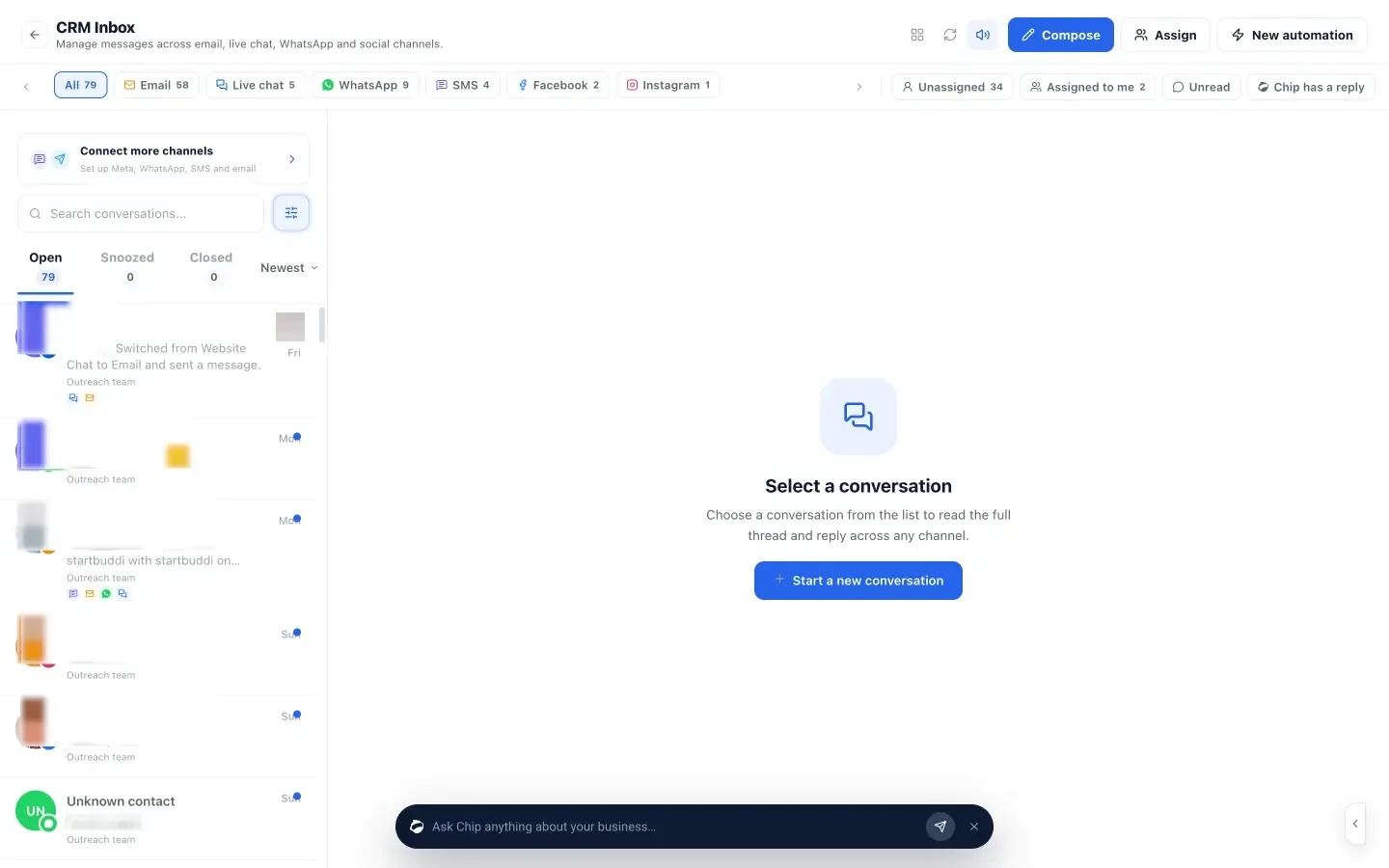
WhatsApp with the rest of your messages. The Inbox brings WhatsApp, email, SMS, website chat, Instagram and Facebook into one shared inbox, with assignments and internal notes your customers never see. WhatsApp connects through Meta, and numbers already on the WhatsApp Business app can be connected too. On Growth and above, Chip can answer customers when nobody on the team is free, and it steps back when you reply.
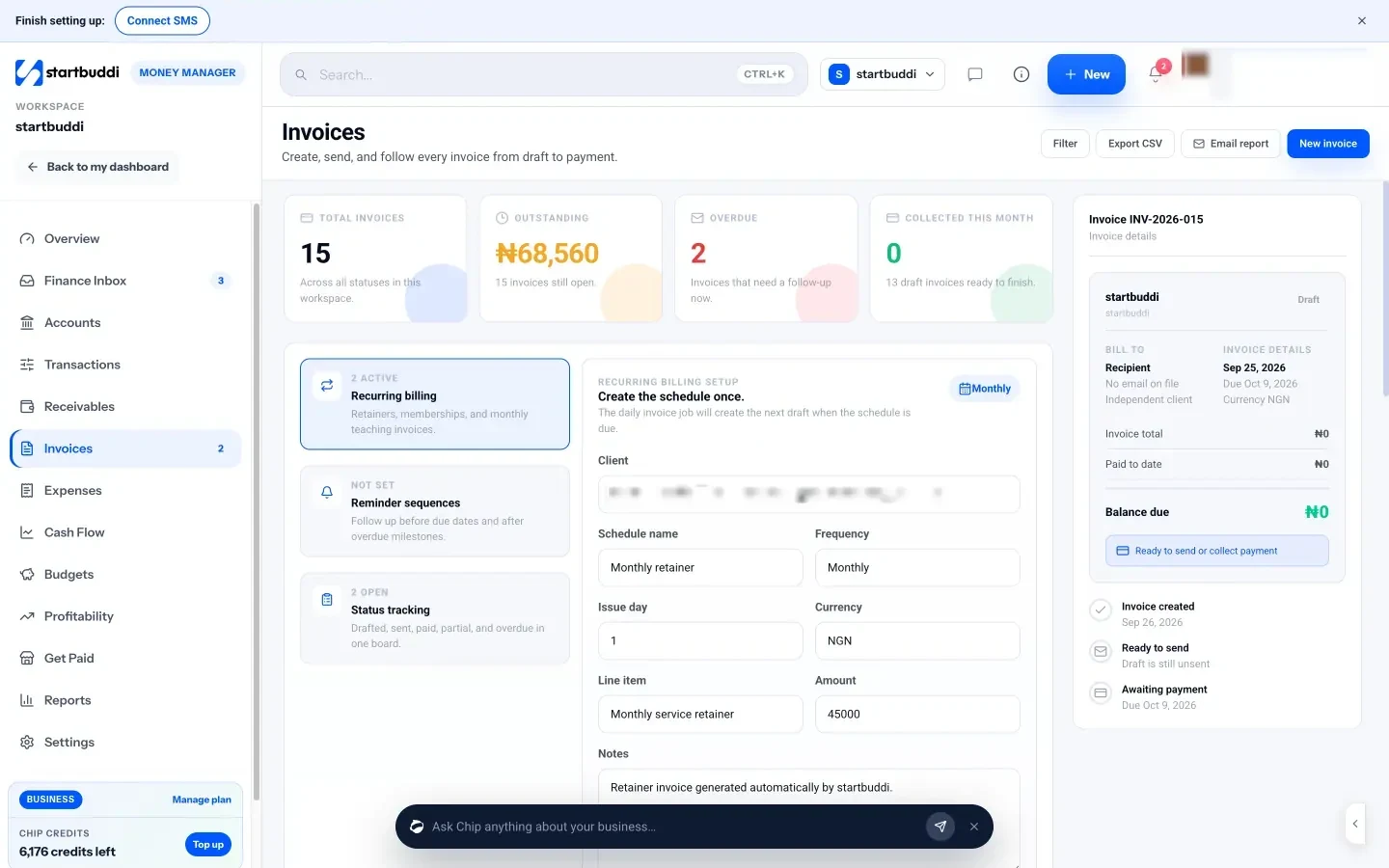
Naira invoices paid through Paystack. Invoices in Money Manager can be in naira, with a Pay button that takes card, bank transfer or USSD through Paystack, plus your bank details for people who prefer a direct transfer. When a customer pays online, the invoice is marked paid automatically and the payment appears in Transactions. Money settles straight to your bank on Paystack’s settlement run, and startbuddi never holds it. For quick sales there are payment links, a pay me page and printable QR codes.
Bookings with a deposit. Bookings gives you a link people use to pick a slot. You can ask for full payment or a deposit through Paystack, and the slot is held while they pay. Each booking creates or updates the customer’s contact.
Work, expenses and reports. Projects and tasks live under Work. Money Manager also records expenses with receipts, and Reports builds a profit and loss from your real invoices and expenses, which you can export as a CSV file for your accountant.
On your phone. The whole workspace runs in your phone’s browser, with a bottom bar and a Create button for a contact, task, booking, invoice or payment link. There is no separate app to download, and a few management screens, such as the automation builder, work best on a computer.
Plans and prices
| Plan | Good for |
|---|---|
| Free | Getting organised: 1 seat, 250 contacts, 5 invoices a month, 1 form and 1 booking page |
| Starter | Unlocks WhatsApp and SMS, the Marketing module, 10 active automations and unlimited invoices, with 2 seats and 2,500 contacts |
| Growth | Chip auto-reply in your inbox and on WhatsApp, 5 seats and 15,000 contacts |
| Scale | 15 seats, 75,000 contacts and advanced roles |
Every paid plan has a 30-day trial, and paying yearly costs ten times the monthly price. Prices are on the pricing page and are charged in your local currency where available, and in Nigeria checkout runs through Paystack.
Your next step
Pick the one thing that went wrong most often last week, whether that was a missed WhatsApp reply, an unpaid invoice or a double booking, and fix that first. Start on the Free plan, import your customers and send one real invoice today. When you are ready for WhatsApp in the inbox or a second pair of hands, compare the plans on our pricing page.
Sources
- DataReportal: Digital 2026 Nigeria
- Nigeria Data Protection Commission
- Small and Medium Enterprises Development Agency of Nigeria (SMEDAN)
Frequently asked questions
What is the best business management software for a small business in Nigeria?
The one that fixes your most common problem. If most customers reach you on WhatsApp and pay by transfer, look for a WhatsApp inbox, naira invoices with local payment options and a phone-friendly layout, then test it with real customers for a week.
Is there business software priced in naira?
Yes. startbuddi is charged in your local currency where available, with checkout through Paystack in Nigeria, a Free plan and a 30-day trial on paid plans. See current prices on the pricing page.
Can an all in one business app replace my accountant?
No. It keeps tidy records of invoices, payments and expenses, which makes your accountant's job faster. Bookkeeping, payroll and tax filing still need an accountant or specialist software.
Does startbuddi work with the WhatsApp Business app?
Yes. You connect your number through Meta, and numbers already on the WhatsApp Business app can be connected. WhatsApp in the inbox needs the Starter plan or above.
Tiwalade Joanna Okedara-Kalu is the founder, CEO and CTO of startbuddi, the business system that brings clients, bookings, invoices, projects, marketing and the Chip AI assistant into one place. Tiwalade builds software around how service businesses really work day to day, and writes about client management, getting paid on time and why small businesses outgrow the tools they start with.
Founded startbuddi and leads its product and engineering