VAT for small businesses in Nigeria: what you need to know in 2026
VAT in Nigeria after the 2026 tax reforms: the 7.5% rate, the new small business exemption, what invoices must show, deadlines, penalties and e-invoicing.


Photo: Paschal Theodory / Unsplash
- VAT in Nigeria is still 7.5%, now under the Nigeria Tax Act 2025. Businesses with turnover of ₦100 million or less, fixed assets of ₦250 million or less and no professional services don't have to charge VAT or file monthly returns. Everyone else issues VAT invoices and files by the 21st of each month.
VAT in Nigeria is charged at 7.5% on most goods and services. Since 1 January 2026 it is governed by the Nigeria Tax Act 2025 and the Nigeria Tax Administration Act 2025, which replaced the old VAT Act. The big change for small businesses: if your yearly turnover is ₦100 million or less, your fixed assets are ₦250 million or less and you don’t provide professional services, you are treated as a small business and don’t have to charge VAT or file monthly VAT returns. Everyone else charges 7.5%, issues proper VAT invoices and files by the 21st of every month.
This guide explains what applies as of 28 September 2026, the date we last checked the law and the Nigeria Revenue Service (NRS) notices.
General information, not tax advice. Tax rules change and your situation may differ, so confirm with the Nigeria Revenue Service or a qualified accountant before you act.
What changed for VAT in Nigeria in 2026
Nigeria rewrote most of its tax laws in 2025. The Nigeria Tax Act 2025 (the one that sets the tax rules) took effect on 1 January 2026 and repealed the Value Added Tax Act, along with the old company and personal income tax laws. The Nigeria Tax Administration Act 2025 sets out how you register, file and pay. The Federal Inland Revenue Service (FIRS) is now the Nigeria Revenue Service (NRS).
For a small business owner, five changes matter most:
- The rate stayed at 7.5%. Section 147 of the Nigeria Tax Act keeps the standard rate unchanged.
- A bigger small business exemption. The old rule freed businesses with turnover under ₦25 million from VAT. The new small business line is ₦100 million turnover and ₦250 million in fixed assets, with professional services left out.
- You can now reclaim VAT on services and fixed assets. Under the old law, input VAT was mostly limited to goods bought for resale or production. Now VAT you pay on services and assets can be deducted, as long as they are used to make taxable sales.
- More items are zero-rated or exempt. Basic food, medical products and services, school tuition and educational materials, among others, now carry 0% VAT.
- E-invoicing is coming for everyone. The NRS is rolling out an electronic invoicing system in phases, starting with the largest companies.
You may still find older articles quoting the ₦25 million threshold, and some newer ones quoting ₦50 million. The figures in the Acts as published in the Official Gazette are the ones we use below.
Do you have to charge VAT? The small business test
Under section 22 of the Nigeria Tax Administration Act, a small business does not have to file monthly VAT returns, and the exemption also covers registering for VAT and charging VAT on its sales. The Act defines a small business as one that earns gross turnover of ₦100,000,000 or less a year, with total fixed assets of no more than ₦250,000,000. Any business providing professional services is excluded, whatever its size.
Three quick questions
- Is your yearly turnover ₦100 million or less? Turnover means total sales before costs, not profit. A shop that sells ₦9 million of goods a month has turnover of ₦108 million a year and is over the line.
- Are your fixed assets worth ₦250 million or less? Fixed assets are things you keep and use, such as equipment, vehicles and property.
- Do you provide professional services? The Act doesn’t list them in this section. If you work as a lawyer, accountant, consultant, architect, doctor or in a similar regulated profession, get advice before assuming you are exempt.
If you answered yes, yes and no, you are likely a small business for VAT purposes. You still need a Tax ID: section 4 of the Administration Act says every taxable person must register with the relevant tax authority and get one. The exemption is about charging and filing VAT, not about staying off the tax register.
Things that don’t count towards the threshold
Leave out two kinds of sale when you check the threshold: selling one of your own capital assets (such as your old delivery van), and selling all or part of the business or closing it down.
You can choose to opt in
A small business can write to the NRS to opt out of the exemption. That can make sense if you pay a lot of VAT on equipment and services, because registering lets you reclaim it. Weigh the monthly filing work against the VAT you would get back.
When you grow past the line
The Act is clear that once you stop being a small business, you must file monthly VAT returns. Watch your rolling 12-month sales so you notice in time.
How VAT works: output, input and what you pay
You add VAT to your sales, pay it on your purchases, and hand over the difference.
- Output VAT is the VAT you charge customers on your sales.
- Input VAT is the VAT you pay suppliers on things you buy for the business.
- What you pay the NRS is output VAT minus input VAT for the month.
Section 155 of the Nigeria Tax Act says that if your input VAT is bigger than your output VAT, you can carry the extra forward as a credit against later months, or ask the NRS for a refund. Input VAT can be claimed within five years of the period you paid it. If you make both taxable and non-taxable sales, you can only claim the share that relates to your taxable sales.
A worked example
Imagine a small branding studio in Lagos that is over the threshold. In March it invoices clients ₦2,000,000 for design work and buys ₦400,000 of software, printing and a new laptop, all with VAT.
| Item | Amount before VAT | VAT at 7.5% |
|---|---|---|
| Sales to clients (output VAT) | ₦2,000,000 | ₦150,000 |
| Purchases for the business (input VAT) | ₦400,000 | ₦30,000 |
| VAT to pay the NRS by 21 April | ₦120,000 |
Under the old law, the studio could not have deducted most of that ₦30,000 because it was spent on services and a fixed asset. Under the new rules it can, as long as those purchases are used to make its taxable sales.
Watch your prices
Section 148 says that where you are paid in money, the value of the supply is the amount which, with VAT added, equals what the customer paid. In plain words: if you are VAT-registered and quote ₦100,000 without saying “plus VAT”, the tax authority can treat VAT as already inside that ₦100,000. You would then owe about ₦6,977 out of your own margin. Always state prices as “₦100,000 + VAT” or “₦107,500 including VAT”.
What is zero-rated and what is exempt
Not every sale carries 7.5%. The Nigeria Tax Act has two separate lists, and the difference matters.
| Zero-rated (section 186) | Exempt (section 185) | |
|---|---|---|
| VAT charged to the customer | 0% | None |
| Can you reclaim input VAT? | Yes | Generally no |
| Examples | Basic food items, medical and pharmaceutical products, medical services and equipment, educational books and materials, tuition from nursery to tertiary, fertilisers, exported goods (not oil and gas) and exported services | Baby products, locally made sanitary pads, shared passenger road transport, agricultural tractors and equipment, land and buildings, money and securities, government licences, assistive devices for people with disabilities |
Two points often surprise people. First, exported services are zero-rated. If you are a Nigerian freelancer or agency invoicing clients abroad, those sales carry 0% VAT and you can still reclaim VAT on your costs if you are registered. Second, VAT on some items, such as petroleum products and renewable energy equipment, can be suspended or delayed by a ministerial order, so check the current position if you sell them.
Some items have specific definitions, so read sections 185 and 186 of the Act, or ask your accountant, if your products are close to the line.
What a VAT invoice must show
If you are VAT-registered, section 152 of the Nigeria Tax Act says you must number your invoices in sequence and give each buyer a VAT invoice, whether or not they have paid yet. The invoice must include:
- Your Tax ID.
- Your business name and address, and a sequential invoice number.
- Your CAC incorporation or business registration number, where you have one.
- The date of supply.
- The name of the buyer or client.
- The gross amount of the transaction.
- The VAT charged and the rate.
The date matters too. Section 146 says a sale happens for VAT purposes at the earliest of: when you issue the invoice or receipt, when you deliver the goods, or when payment is due or received. If a client pays a deposit in March for work delivered in May, the VAT on that deposit belongs to March.
If you are exempt as a small business, don’t add VAT to your invoices. A plain, professional invoice with your business details is enough. Our guide on how to create a professional invoice that gets paid faster covers the rest, and the difference between an invoice and a receipt is worth knowing for your records.
Filing and paying: the monthly routine
Section 22 of the Nigeria Tax Administration Act says a VAT-registered business must file a return on or before the 21st day of the following month, showing input VAT paid, output VAT collected and the VAT payable. You must file whether or not you traded that month, so a quiet month still needs a nil return. An extension to file does not extend the time to pay.
A simple monthly checklist
- By the 5th: make sure every invoice from last month is issued and every business receipt is saved.
- By the 10th: total your output VAT from sales invoices and your input VAT from purchase receipts.
- By the 15th: check anything unusual, such as refunds, credit notes, zero-rated export sales or deposits.
- By the 21st: file the return and pay what you owe through the NRS self-service portal.
If you sell to government ministries, departments or agencies, they are required to withhold the VAT on your invoice and pay it to the NRS themselves (section 154 of the Nigeria Tax Act). Keep the evidence they give you, because it shows that VAT has already been paid.
The Administration Act also requires you to keep books and records for at least six years. That includes sales invoices, purchase receipts and your returns.
Penalties to avoid
The Nigeria Tax Administration Act sets fixed penalties that add up quickly for a small business:
| What went wrong | Penalty (Nigeria Tax Administration Act) |
|---|---|
| Not registering for tax when you should (section 100) | ₦50,000 for the first month, then ₦25,000 for each month it continues |
| Not filing a return, or filing an incomplete or wrong one (section 101) | ₦100,000 for the first month, then ₦50,000 for each month it continues |
| Collecting VAT but not paying it over by the 21st (section 107) | The VAT itself, plus 10% a year of the amount and interest at the Central Bank of Nigeria monetary policy rate |
| Not putting a sale through the fiscalisation system once it applies to you (section 104) | ₦200,000 plus 100% of the tax due, plus interest |
The cheapest protection is a routine: a calendar reminder for the 10th and another for the 21st.
E-invoicing: what is coming and when
Both Acts let the NRS require businesses to use an electronic fiscal system, which records every taxable sale and reports it to the tax authority. The NRS system is called the Merchant-Buyer Solution (MBS). According to an NRS public notice summarised by KPMG in February 2026, the rollout runs in phases:
| Group | Yearly turnover | Go-live | Penalties enforced from |
|---|---|---|---|
| Large taxpayers | Above ₦5 billion | Started November 2025 | April to June 2026 |
| Medium taxpayers | ₦1 billion to ₦5 billion | 1 July 2026 | January to March 2027 |
| Emerging taxpayers | Below ₦1 billion | 1 July 2027 | January to March 2028 |
If you are a VAT-registered small company, you have until mid-2027 before this reaches you, but the direction is clear. Businesses that already raise every invoice in software, with clean customer details and consistent numbering, will find the switch much easier than those still writing invoices in a notebook or a spreadsheet.
How startbuddi helps with VAT
startbuddi doesn’t file tax returns and isn’t accounting software, so you will still file with the NRS yourself or through your accountant. What it does is keep the records that make VAT month quick and accurate.
Invoices with VAT built in
In Money Manager invoicing, every invoice and estimate has a tax rate and a tax label, and the label defaults to “VAT”. Set your default rate once in Money Manager settings under invoice defaults, along with your invoice prefix, due days and footer. If you are a small business that doesn’t charge VAT, set the rate to zero. Put your Tax ID and CAC number in the notes or footer so they appear on every invoice, and the subtotal, tax and total are worked out as you type.
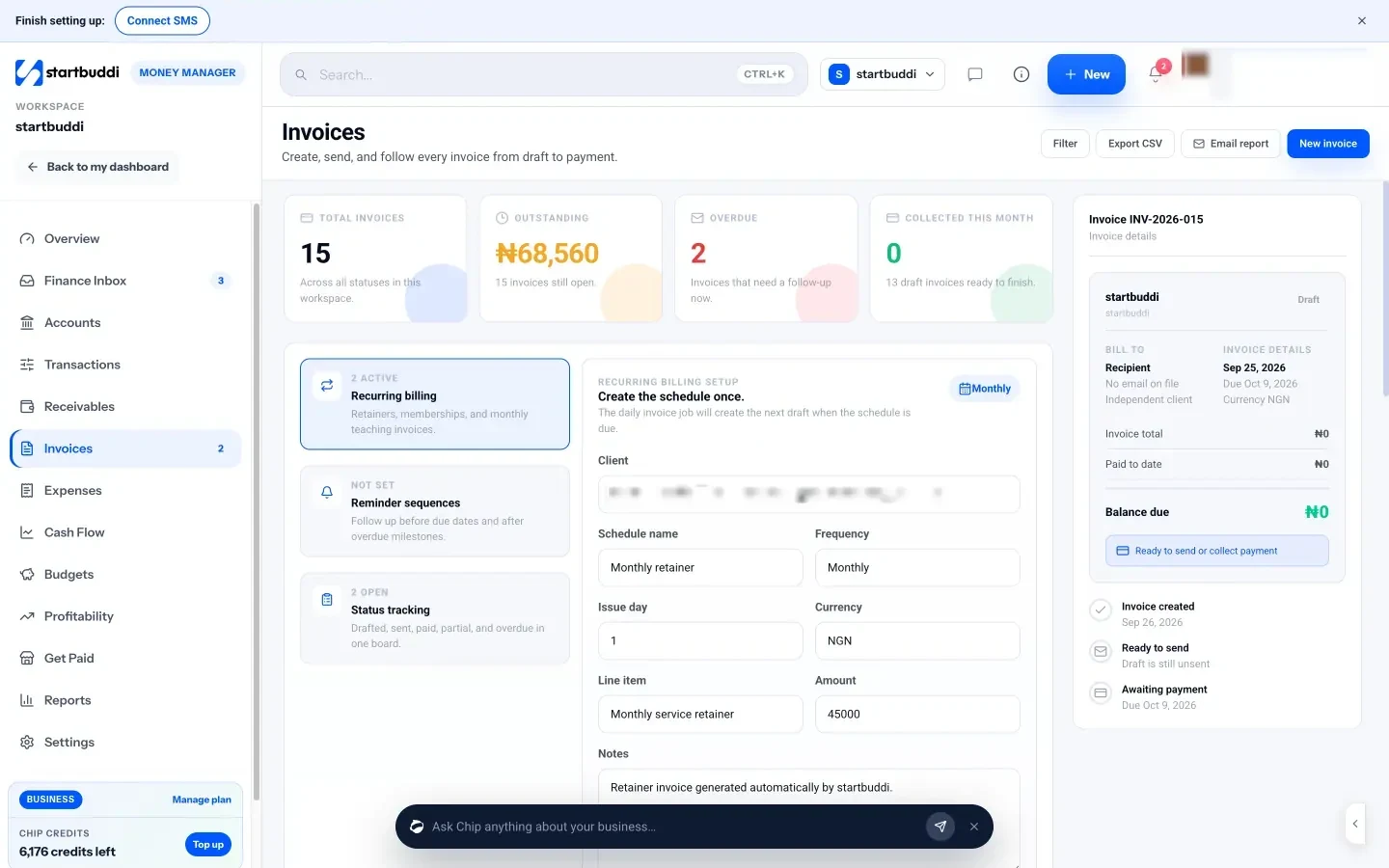
Customers can pay online through Paystack or Stripe, straight to your own account. If a client pays by bank transfer outside startbuddi, record the payment on the invoice so your records match your bank.
A running total of VAT collected
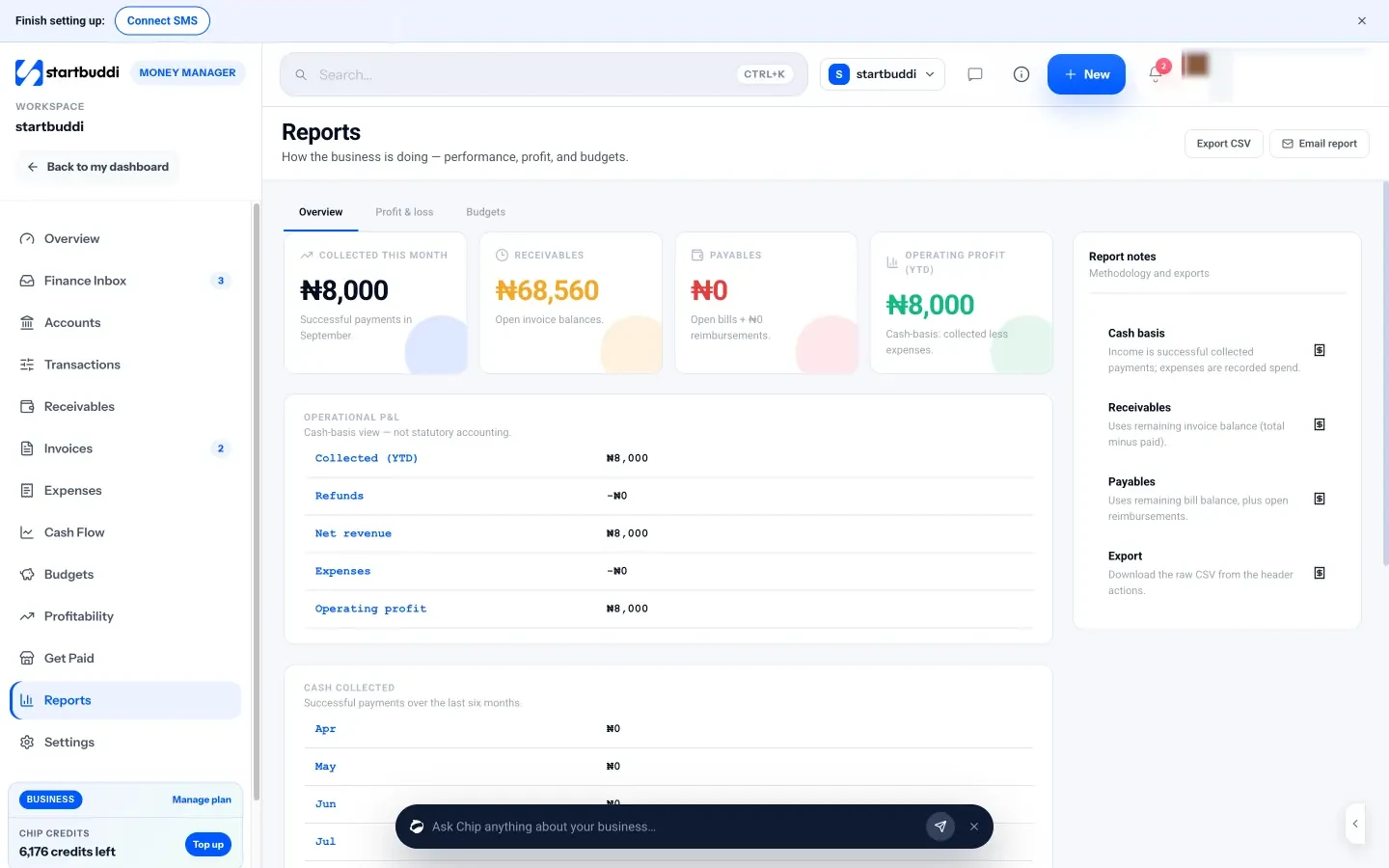
In Reports, the profit and loss tab shows revenue, expenses, net profit and the tax collected on invoices for the month, quarter or year, with a tax summary underneath. It is a reference figure, not a filing, but it gives you your output VAT in seconds. Use Export CSV to hand the numbers to your accountant.
Receipts for your input VAT
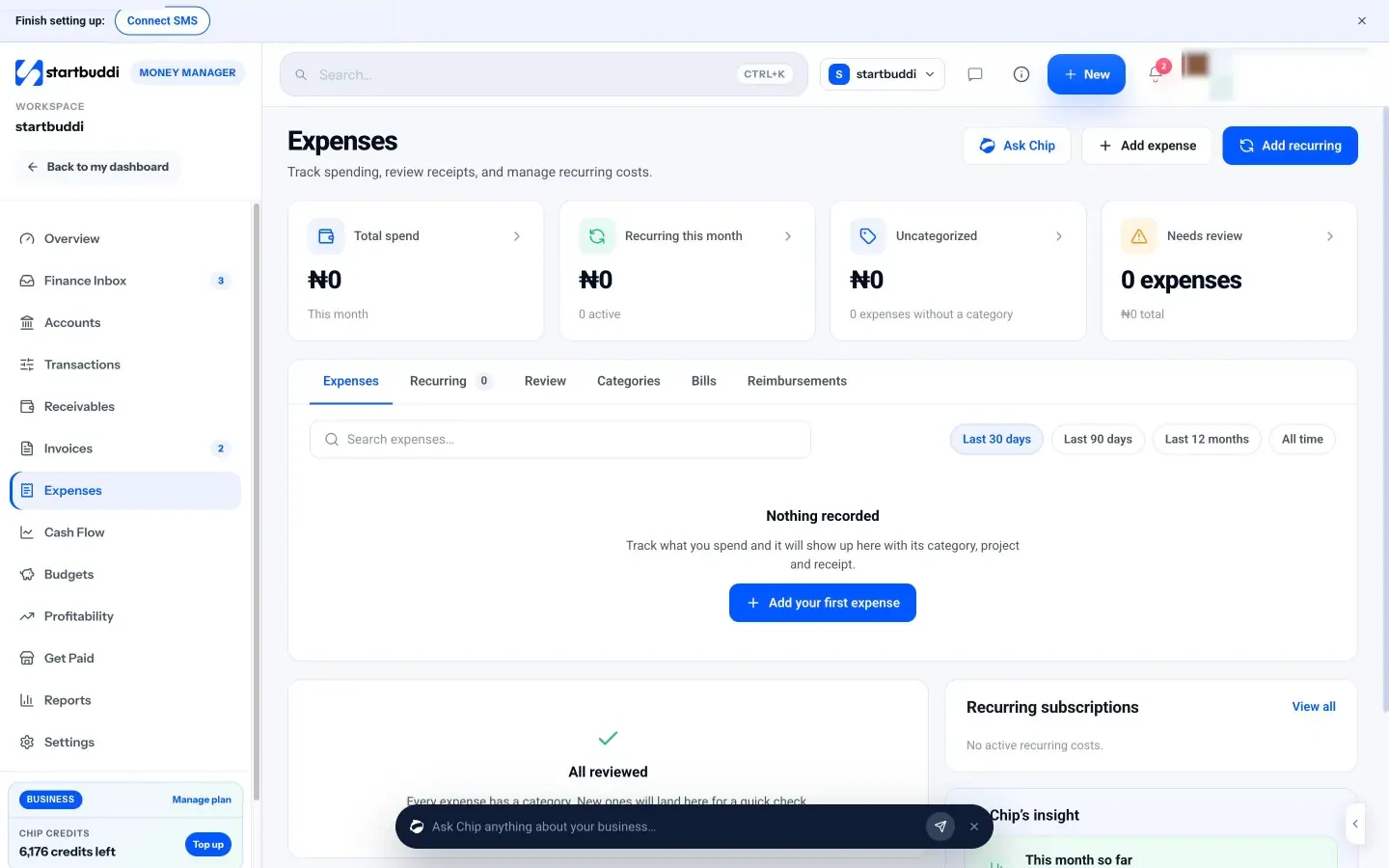
Log each business purchase in Expenses with the vendor, amount, category and date, and attach the receipt as an image or PDF. That receipt is your evidence for the input VAT you claim, and it is in one place for the six years the law expects you to keep it.
Money Manager is on every plan, including Free, which allows 5 invoices a month. Starter and above give you unlimited invoices. If you want a quick one-off invoice first, try the free invoice generator.
Your next step
Take ten minutes today to answer the three small business questions above using your last 12 months of sales. If you are under the line, keep your invoices VAT-free and watch your turnover each month. If you are over it, make sure you have a Tax ID, set your invoice defaults to 7.5% VAT and put the 21st in your calendar. When you are ready to keep invoices, expenses and a tax summary in one place, you can start with Money Manager on the Free plan, or compare plans on the pricing page.
Sources
- Nigeria Tax Act, 2025 (Act No. 7), Official Gazette, via the Tax Appeal Tribunal
- Nigeria Tax Administration Act, 2025 (Act No. 5), Official Gazette, via the Tax Appeal Tribunal
- Nigeria Revenue Service and its self-service portal
- KPMG Nigeria: implementation of the phased rollout of the e-invoicing and electronic fiscal system regime (February 2026)
- BDO: Nigeria, new legislation includes important changes to VAT rules
Frequently asked questions
What is the VAT rate in Nigeria in 2026?
The standard rate is 7.5%, set by section 147 of the Nigeria Tax Act 2025. Some items are zero-rated at 0% and some are exempt.
Do I need to register for VAT if my turnover is under ₦100 million?
If you also have fixed assets of ₦250 million or less and don't provide professional services, the small business exemption covers VAT registration, charging and filing. You still need a Tax ID.
When is the VAT return due in Nigeria?
On or before the 21st day of the month after the sale, even if you had no sales that month.
Do Nigerian freelancers charge VAT to foreign clients?
Exported services are zero-rated, so VAT-registered freelancers charge 0% on them and can still reclaim VAT on their business costs.
Does startbuddi file my VAT return?
No. startbuddi adds VAT to invoices and shows a running tax summary you can export, but you or your accountant file with the NRS.
Chinedu Kalu is the co-founder and chief operating officer of startbuddi, responsible for how the company runs day to day. Chinedu writes about the operational side of a small business: registering and running the company, money, hiring and the routines that keep a team on track.
Co-founded startbuddi and runs its operations