How to write a business proposal that wins the job
The eight parts of a business proposal that wins, a template you can copy, how to price it and how to follow up so proposals stop going quiet.



Photo: Nasim Keshmiri / Unsplash
- A business proposal shows the client you understand their goal, how you will reach it and what it costs. Keep it short, lead with a one-paragraph summary, offer two or three price options with a validity date, then follow up on a schedule.
A business proposal is a short document that shows a potential client you understand their problem, explains how you will solve it, and tells them what it will cost and what happens next. A winning proposal is not the longest or the prettiest. It is the one that makes the client feel understood and makes saying yes easy.
For most small businesses a good proposal fits on two to five pages and has eight parts: a summary, the client’s goal, your approach, scope, timeline, price, proof and next steps. This guide walks through each part, gives you a template, and shows how to send and follow up so fewer proposals go quiet.
What is a business proposal (and what it is not)?
People use “proposal”, “quote” and “contract” as if they mean the same thing. They do different jobs, and knowing which one you need saves time.
| Document | Its job | When to use it |
|---|---|---|
| Quote or estimate | States a price for defined work | The client already knows what they want and is comparing prices |
| Business proposal | Persuades: shows understanding, the plan and the value, then the price | The work needs explaining, the fee is significant, or you are up against other providers |
| Contract | Makes the deal binding: scope, payment terms, ownership, cancellation | After the client says yes |
If a client asks “How much for a logo?”, send a quote. You can make one in minutes with the quote generator. If they say “We want to grow bookings for our clinic and are not sure where to start”, they need a proposal.
Before you write: the discovery conversation
Proposals are won or lost before you type a word. A 20 to 30 minute call, or a short set of questions by WhatsApp or email, gives you the material that makes the proposal feel written for this client alone. Ask:
- What made you look for help now?
- What does success look like in three months? How will you know it worked?
- What have you already tried, and what happened?
- Who else is involved in the decision?
- Is there a date this needs to be done by, and why?
- Do you have a budget range in mind?
Write down their exact words. When your proposal repeats “we’re losing customers to the new place across the road” back to them, it lands far harder than “increase market share”.
If they will not share a budget, that is fine. Offer options at different prices instead (more on that below).
The eight parts of a business proposal that wins
1. A one-paragraph summary
Many decision-makers only read the first page. Put the whole deal in one paragraph: their goal, your solution, the timeline and the investment. For example: “Ada’s Kitchen wants 40% more weekday lunch orders by March. We will run a six-week WhatsApp and Instagram campaign with a new lunch menu page, starting 4 November, for ₦650,000.”
2. Their situation and goal
Two or three short paragraphs in their words. Show that you listened: the problem, why it matters now, and what success looks like. No talk about yourself yet.
3. Your approach
Explain how you will get them from where they are to where they want to be. Keep it to the key steps and why each one matters. Avoid jargon: “we’ll message past customers who haven’t ordered in 60 days” beats “re-engagement funnel”.
4. Scope and deliverables
List exactly what they get, and just as important, what is not included. A clear “not included” list prevents the arguments that start in week three. For bigger projects, attach a scope of work; the statement of work template helps.
5. Timeline
Show phases with dates, and what you need from the client at each stage (content, approvals, access). Clients forget that delays on their side move the finish date; writing it down reminds them.
6. Price and payment terms
State the price plainly, what it includes, how it is paid and when. Most service businesses ask for part of the fee upfront. Our guide on deposits and upfront payments covers how much to ask for, and the deposit calculator works out the numbers.
7. Why you
Short and specific: a relevant past project, a result you can point to, a line from a real client (with their permission). One strong example beats a page of claims.
8. Next steps and validity
Tell them exactly how to say yes: “Reply to this email to confirm and I’ll send the agreement and deposit invoice the same day.” Add a validity date, such as “valid for 14 days”, so the proposal does not drift for months at an old price.
How to price a proposal so clients say yes
Price is where proposals stall. A few habits make it easier for the client to decide.
- Offer two or three options. For example, a basic option, a recommended one and a complete one. The client’s question changes from “Should I hire them?” to “Which one?”.
- Put the recommended option in the middle and say why you recommend it.
- Link price to their goal. “₦650,000 to fill 40 more lunch seats a week” reads differently from “₦650,000 for social media”.
- Show what is included in each option as a simple table, not paragraphs.
- Be clear about extras. Name your rate for extra rounds of changes or extra deliverables.
- Offer ongoing work if it fits. If the client will need you every month afterwards, include a monthly option. See how to sell and bill monthly retainers.
If you are unsure what to charge in the first place, start with how to price your services.
A business proposal template you can copy
Use this outline for a small service project. Replace the brackets and cut anything that does not help this client decide. For a formatted version, use our free business proposal template.
Proposal for [Client name]: [their goal in their words]
Prepared by [Your business] on [date]. Valid until [date].
Summary. [Client] wants [goal] by [date]. We will [solution] over [timeline], for [price].
Where you are now. [Their situation, the problem, why now, in 2 to 3 short paragraphs.]
How we’ll get there. Step 1: [what and why]. Step 2: [what and why]. Step 3: [what and why].
What you get. [Deliverable 1], [deliverable 2], [deliverable 3]. Not included: [items].
Timeline. Week 1: [phase], we need [input] from you. Weeks 2 to 3: [phase]. Week 4: [handover].
Investment. Option A [price]: [includes]. Option B, recommended [price]: [includes]. Option C [price]: [includes]. Payment: [deposit]% to start, balance on [milestone]. Extra changes: [rate].
Why us. [One relevant project and its result.]
Next steps. Reply to confirm your option. We’ll send the agreement and deposit invoice within one working day, and start on [date].
Common proposal mistakes
- Starting with your company history. The client cares about their problem first. Put “About us” near the end, or leave it out.
- Copying the last proposal without changing the story. Clients can tell. Keep a template for structure, but rewrite the situation and approach every time.
- Vague scope. “Social media management” means ten different things to ten people. Count the posts.
- Hiding the price. Burying the fee on page nine feels evasive. Put it in the summary.
- No expiry date. Without one, a client can accept six months later at last year’s price.
- No clear next step. If the client has to work out how to say yes, many will not bother.
- Treating the proposal as the contract. A proposal persuades. Once they agree, send a proper agreement with payment terms, ownership and cancellation, and get it signed.
A quick checklist before you hit send
Read your business proposal once as if you were the client, then check each of these:
- The client’s name and business are spelt correctly everywhere, including the file name.
- The first paragraph states the goal, the solution, the timeline and the price.
- The situation section uses at least one phrase the client actually said to you.
- Every deliverable is countable, and there is a “not included” list.
- Dates depend on things you control, or say clearly what you need from the client and when.
- Prices add up, tax is shown, and the currency is stated (₦, $ or £).
- Payment terms say how much is due upfront and when the balance is due.
- There is a validity date and a single, clear way to say yes.
- It reads well on a phone. Many clients will open it on WhatsApp or in their email app, so keep paragraphs short and tables narrow.
If a colleague or friend can read the first page and tell you what the client is buying and for how much, it is ready.
Sending and following up
Send it quickly
Speed matters in sales. In a Harvard Business Review study of 2,241 companies, firms that contacted a web lead within an hour were nearly seven times as likely to qualify it as firms that waited even an hour longer. That research is about first replies, not proposals, but the lesson carries over: interest cools. Aim to send your proposal within one or two working days of the discovery call, while the conversation is fresh.
Walk them through it
Where you can, present the proposal on a short call instead of only emailing it. You can answer questions as they come up, and you hear objections you would otherwise never know about.
Follow up on a schedule
- Day 2: “Did everything come through? Happy to talk through the options.”
- Day 5: Share something useful: an idea for their business, a relevant example, an answer to a question they raised.
- Day 10: “The proposal is valid until Friday. Would you like me to hold the start date?”
- Day 14: A polite close: “I’ll assume the timing isn’t right for now. If anything changes, I’m here.”
That last message often gets a reply. For more on timing and tone, read how to follow up with leads without being pushy.
Get it signed
Once they say yes, move straight to an agreement and a deposit invoice. E-signatures make this quick: in Nigeria, section 93 of the Evidence Act 2011 recognises electronic signatures, and the Law Commission for England and Wales has concluded that an electronic signature can execute a document when the signer intends to authenticate it. This is general information, not legal advice.
How startbuddi helps you write and win proposals
In startbuddi, the proposal sits next to the client’s record, the deal, the contract and the invoice, so nothing needs retyping.
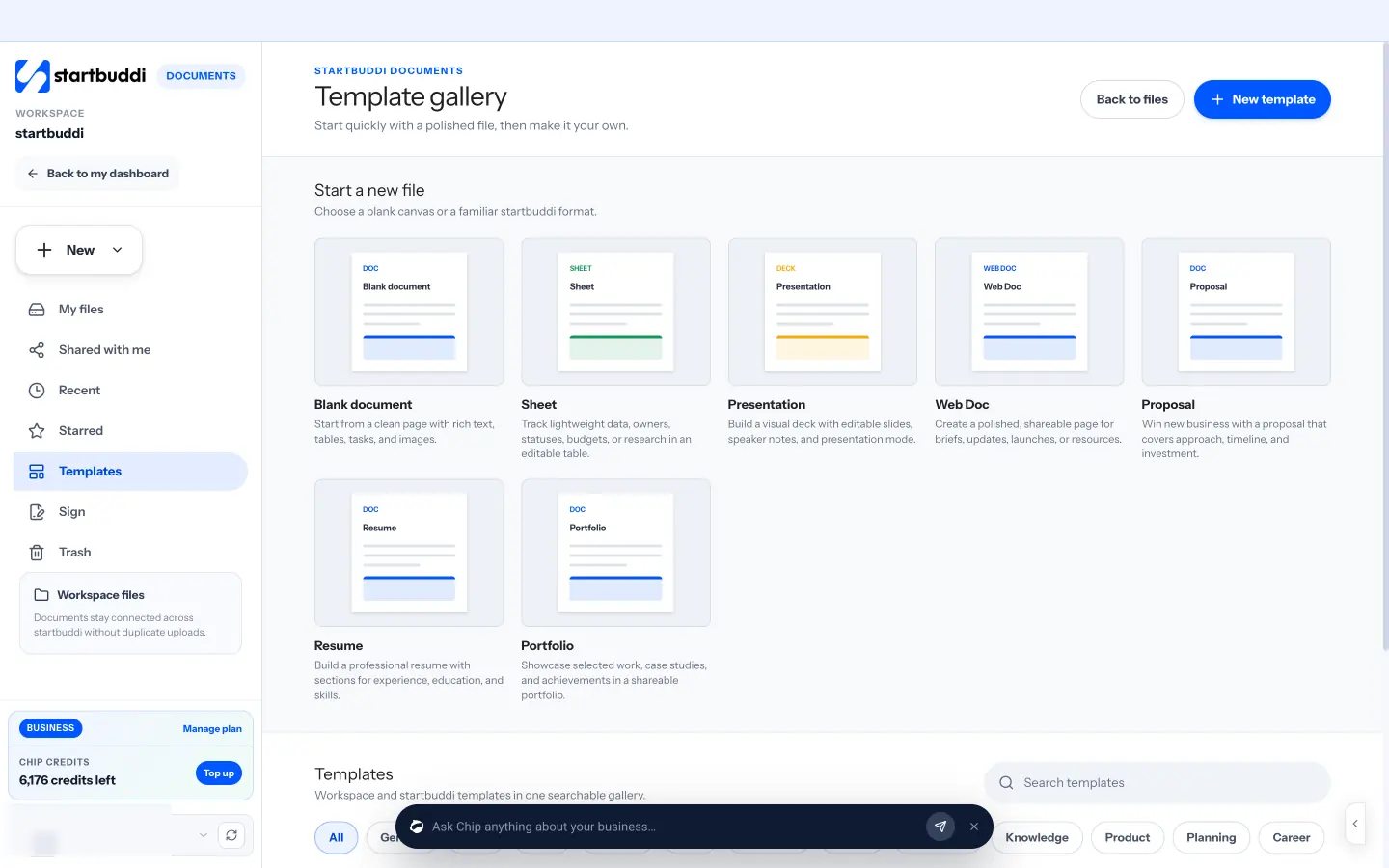
Write it with a head start. In Documents, choose New, then Proposal, or start from the Project Proposal template. The editor has headings, tables and slash commands, and you can ask Chip from inside the document to add a concise scope, timeline and next-step section or to list what is missing before it is ready to send. Every save keeps a version, so you can go back.
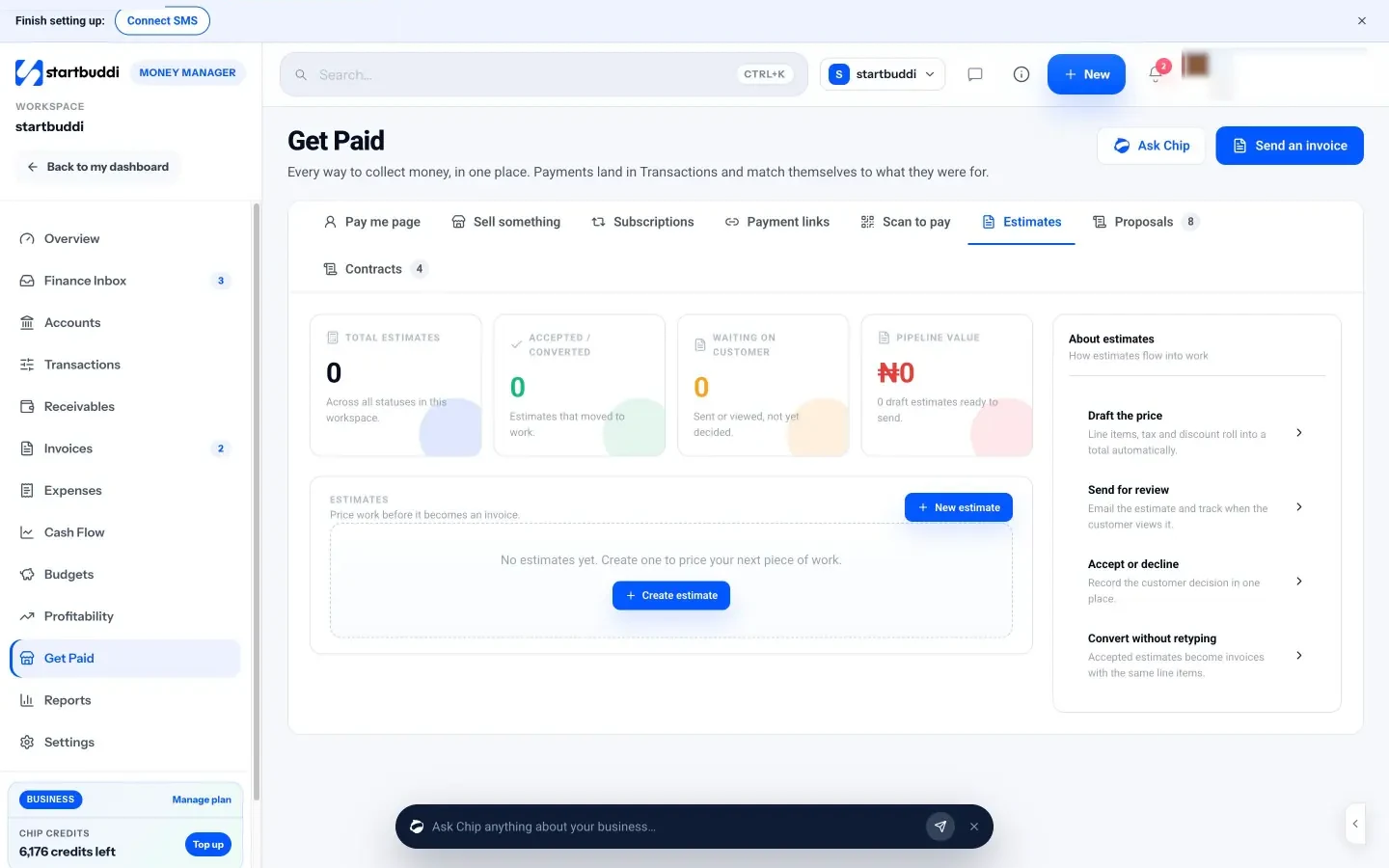
Quote it, then bill it. For work that only needs a price, create an estimate from the Estimates tab in Money Manager’s Get Paid page, with line items, tax, discount and terms such as “50% deposit to begin”. The client replies to accept; you mark it accepted and convert it to an invoice with the same line items. See estimates, proposals and contracts.
Get the agreement signed. Add signers to a contract and send it for e-signature. The Contracts tab shows drafts, documents awaiting signature and signed agreements.
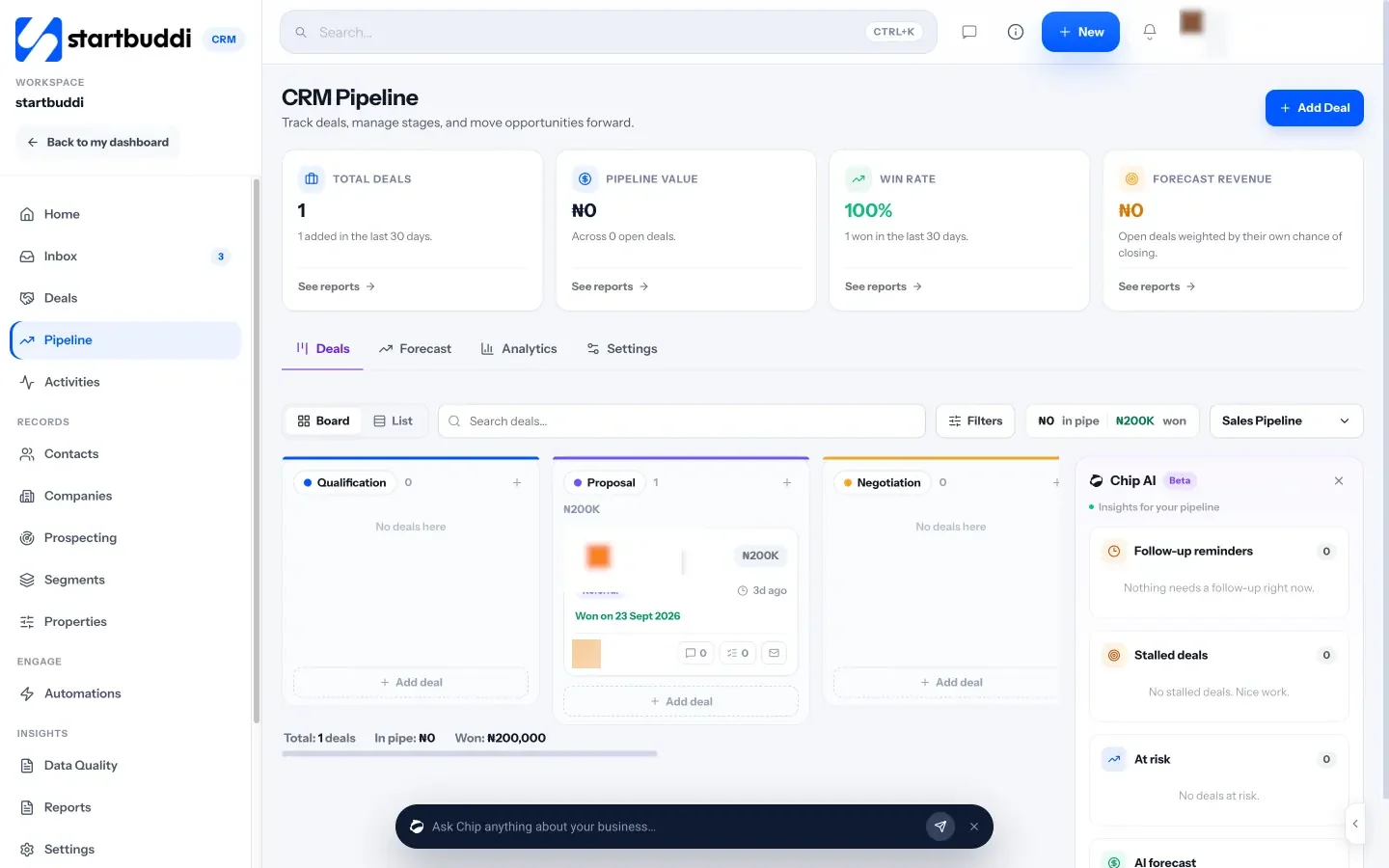
Keep every proposal in your pipeline. Track each opportunity as a deal in your sales pipeline, so you can see which proposals are out, which need a follow-up and what they are worth. New to pipelines? Start with what a sales pipeline is.
Free includes 3 documents; paid plans have unlimited documents. Every paid plan starts with a 30-day trial.
Your next step
Take the last proposal you sent that went quiet. Rewrite the first page as a one-paragraph summary in the client’s words, add two price options and a validity date, and send it back with a short note. Then set up the template in Documents so the next one takes half the time, or see what each plan includes on the pricing page.
Sources
- Harvard Business Review: The Short Life of Online Sales Leads (2011)
- Section 93, Nigerian Evidence Act 2011 (LawGlobal Hub)
- Law Commission: Electronic execution of documents
Frequently asked questions
How long should a business proposal be?
For most small service jobs, two to five pages. Put the whole deal in the first paragraph so a busy reader can decide from page one.
Should I include the price in a proposal?
Yes, clearly and early. Two or three options help the client choose rather than decide whether to hire you at all.
What is the difference between a proposal and a quote?
A quote states a price for defined work. A proposal explains the problem, your plan and the value, then the price.
How long should a proposal stay valid?
Many small businesses use 14 to 30 days. Long enough to decide, short enough that prices and your calendar stay current.
Tiwalade Joanna Okedara-Kalu is the founder, CEO and CTO of startbuddi, the business system that brings clients, bookings, invoices, projects, marketing and the Chip AI assistant into one place. Tiwalade builds software around how service businesses really work day to day, and writes about client management, getting paid on time and why small businesses outgrow the tools they start with.
Founded startbuddi and leads its product and engineering