What is a sales pipeline?
Also called: Sales pipeline, deal pipeline, deal board, opportunity pipeline

A sales pipeline is a visual view of every deal you are working on, grouped into stages such as new lead, proposal sent and negotiation, so you can see what to do next and how much income is likely to come in.
How to calculate it
Use your own win rate from the last few months, not a number from someone else’s business.
A sales pipeline is a visual picture of every potential sale you are working on and how close each one is to closing. Deals are grouped into stages, such as “new lead”, “proposal sent” and “negotiation”, and move from left to right until they are won or lost.
If you have ever kept a list of “people who might buy” with notes like “sent quote, waiting”, you already have a pipeline. Writing it down in stages, with a value on each deal, turns that list into a tool for deciding what to do next and predicting how much money is coming.
What is a sales pipeline, in plain words?
Picture a board with columns. Each column is a stage in your sales process. Each card on the board is a deal: a specific opportunity with a customer, a value and usually an expected close date. As you talk to the customer, you drag the card to the next column.
A pipeline is not the same as a sales funnel, although people often mix them up. A funnel describes the buyer’s journey in general and how many people drop out at each step. A pipeline tracks your actual deals and what you need to do to move each one forward.
Why a sales pipeline matters for a small business
- You know who to call today. Deals sitting too long in one stage stand out.
- You can predict income. Adding up deal values by stage shows roughly what could come in over the next few weeks.
- You spot where deals get stuck. If most deals die after the proposal, the problem might be your pricing or your follow-up.
- Your team stays in sync. Everyone sees the same deals, so two people do not chase the same customer.
- You stop relying on memory. Every promise to a potential customer has a place.
Typical sales pipeline stages
Stages should match how your customers actually buy. A common starting point for a service business:
| Stage | What it means | Your next action |
|---|---|---|
| New lead | Someone has shown interest. | Reply quickly and learn what they need. |
| Qualified | They have a real need, a budget and a timeline. | Book a call or send details. |
| Proposal sent | They have your quote or proposal. | Follow up and answer questions. |
| Negotiation | You are agreeing on price, scope or timing. | Settle the terms and confirm. |
| Won | They said yes and paid, or signed. | Start onboarding. |
| Lost | They said no or went quiet for good. | Note the reason and learn from it. |
How a sales pipeline works: an example
Emeka runs a small IT support company. This month his pipeline has 12 deals:
- 5 in New lead, worth ₦1.5 million in total.
- 3 in Qualified, worth ₦1.2 million.
- 3 in Proposal sent, worth ₦2 million.
- 1 in Negotiation, worth ₦900,000.
At his Monday review, he sees that two of the proposals have not moved in ten days. He calls both. One asks for a smaller package, which he sends that afternoon. The other has gone with a competitor, so he marks it lost with the reason “price”. After a few months of noting reasons, he can see which objections come up most often and adjust his offer.
Key pipeline numbers to watch
- Pipeline value: the total value of open deals.
- Win rate: the share of closed deals you win.
- Average deal size: helps you plan how many deals you need.
- Weighted forecast: deal values multiplied by the chance of closing, which gives a more realistic income estimate.
- Time in stage: how long deals sit still, which is often where they die.
Common mistakes
- Too many stages. Five or six is plenty. If you cannot explain the difference between two stages, merge them.
- Never removing dead deals. A pipeline full of deals that will never close gives you false hope. Mark them lost.
- No next step on a deal. Every open deal should have a clear next action and date.
- Updating it once a month. A pipeline is only useful if it is current. A quick weekly review works well.
Related terms
A CRM is the software that usually holds your pipeline, along with contacts and conversations. Lead nurturing keeps early-stage deals warm, and CRM automation can move deals and create follow-up tasks for you. For day-to-day tips, read how to manage client pipelines without losing your mind.
Sales pipelines in startbuddi
The sales pipeline in startbuddi lives in Customers. New pipelines start with the stages New Leads, Qualified, Proposal Sent, Negotiation, Won and Lost, and you can rename, recolour and reorder them. You can run several pipelines, for example one for new business and one for renewals.
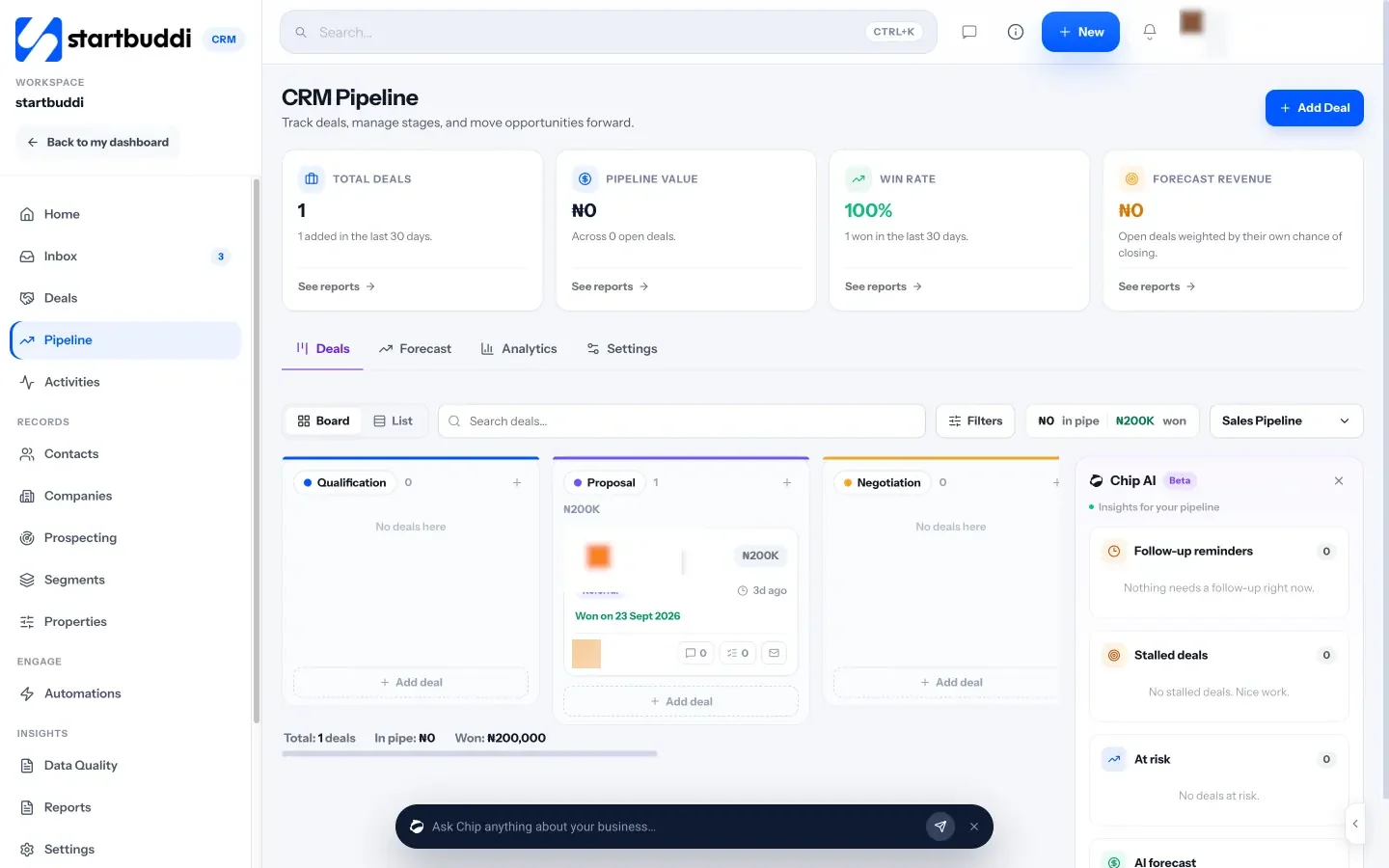
Each deal has a name, contact, value, stage, expected close date, owner and probability. You can drag deals between stages on a board, switch to a list, mark deals won or lost with a reason, and filter by owner, stage, value or close date. The Forecast and Analytics tabs show forecast revenue, win rate and how deals are spread across stages.
The pipeline also keeps itself up to date: when a contact replies, their deal moves out of the first stage, and when an invoice on a deal is paid in Money, the deal is marked won. Chip flags stalled and at-risk deals and suggests which stage a deal should move to. Your next step: add your five most promising deals to a pipeline with a value and a next step for each. You can start on the Free plan.
Related terms
FAQ
How many stages should a sales pipeline have?
Five or six is enough for most small businesses. Each stage should mean something clear, with an obvious next action.
What is the difference between a sales pipeline and a sales funnel?
A funnel describes the buyer's journey and how many people drop out at each step. A pipeline tracks your actual deals and what you need to do to move each one forward.
How often should I update my pipeline?
Update deals as things happen, and do a short review every week to move stuck deals, set next steps and close out dead ones.
Do I need software for a sales pipeline?
You can start with a spreadsheet, but a CRM makes it easier to drag deals, see totals and keep notes and messages next to each deal.
Omolola Akiyode is the operations and project manager at startbuddi, leading cross-functional projects and the content that helps founders get set up. Omolola writes about projects, websites and getting found online, and turns complex ideas into clear, practical steps.
Runs operations and projects at startbuddi