What is a CRM?
Also called: Customer relationship management, CRM software, CRM system, customer database, contact management software

A CRM (customer relationship management system) is software that keeps all your customer information in one place: contact details, conversation history, deals, tasks and follow-ups, so you can serve customers well and sell more.
A CRM (customer relationship management system) is one organised place for everything about your customers and potential customers: who they are, how to reach them, what you have talked about, what they bought, what they owe and what you need to do next. In plain words, it is a smart contact list that remembers every conversation for you. People also call it a CRM system or CRM software; they all mean the same thing.
The term can mean two things. It is the approach of managing customer relationships carefully, and it is the software that helps you do it. When small business owners say “we need a CRM”, they usually mean the software.
What is a CRM used for?
Without a CRM, customer information is scattered: phone numbers in your contacts app, conversations in WhatsApp and email, quotes in a folder, notes in a notebook and payment status in a spreadsheet. When a customer calls, you scramble to remember the last conversation. A CRM brings those pieces together on one page per customer.
Typical uses include:
- Keeping a clean, searchable list of contacts and companies.
- Seeing the full history with a customer: messages, calls, meetings, notes and purchases.
- Tracking potential sales as deals in a pipeline.
- Setting follow-up reminders and tasks so nobody is forgotten.
- Grouping customers so you can send the right message to the right people.
- Seeing basic reports: new contacts, deals won and where customers came from.
Why a CRM matters for a small business
Big companies adopted CRMs to manage thousands of customers. Small businesses need one for a simpler reason: you cannot afford to lose a single good customer because a message slipped through the cracks.
- Faster, better replies. You see the whole history before you answer.
- More repeat business. Reminders prompt you to check in with past customers at the right time.
- Easier teamwork. When you hire help, the customer knowledge is in the system, not only in your head.
- Less admin. Forms, bookings and chats can add contacts for you instead of you copying details by hand.
- Better decisions. You can see which services sell, which channels bring customers and where deals get stuck.
If you are still deciding whether you have outgrown a spreadsheet, our article on CRM vs spreadsheet walks through the signs.
How a CRM works: an example
Blessing runs a cleaning company in Abuja. A property manager fills in the quote form on her website. The CRM:
- Creates a contact with his name, phone number, email and company.
- Logs the form answers on his record so Blessing knows the size of the building.
- Creates a deal worth ₦350,000 a month in the “New lead” stage.
- Reminds Blessing to call him the next morning.
After the call, she adds a note, sends a quote and moves the deal to “Proposal sent”. Three months later, when he messages on WhatsApp about a second building, she opens his record and sees every detail in seconds.
Key parts of a CRM
| Part | What it does |
|---|---|
| Contacts and companies | The people and businesses you deal with, with their details. |
| Activity timeline | Every email, message, call, meeting and note in date order. |
| Deals and pipeline | Potential sales, grouped by stage and value. |
| Tasks and reminders | The next action for each customer. |
| Tags and segments | Groups such as “past customers” or “Lagos leads”. |
| Inbox | Customer messages from different channels in one place. |
| Automation | Follow-ups and updates that happen without you. |
| Reports | Numbers on contacts, deals and results. |
Common mistakes when starting with a CRM
- Importing messy data. Clean up duplicates and old contacts first, or you start with a mess.
- Choosing something too complex. Enterprise tools built for large sales teams can overwhelm a small business. Pick something your team will actually open every day.
- Not logging conversations. A CRM is only as good as what goes into it. Make “add a note after every call” a habit.
- Keeping customers in two places. If the real conversations stay in personal WhatsApp, the CRM never gets the full picture.
- Ignoring data protection. Collect only what you need and keep it secure. In Nigeria the Nigeria Data Protection Commission oversees how personal data is used. This is general information, not legal advice.
Related terms
A sales pipeline is the part of a CRM that tracks deals by stage. CRM automation adds rules that send follow-ups and create tasks for you, and lead nurturing is how you keep interested people warm until they buy. For more on choosing one, read what a CRM is and why your agency needs one.
The CRM in startbuddi
In startbuddi, the CRM is called Customers. It holds your contacts and companies, a customer inbox for email, SMS and WhatsApp conversations, your sales pipeline and deals, activities and reports. Contacts arrive from forms, bookings, website chat and imports, and you can import a CSV of up to 10,000 contacts at a time.
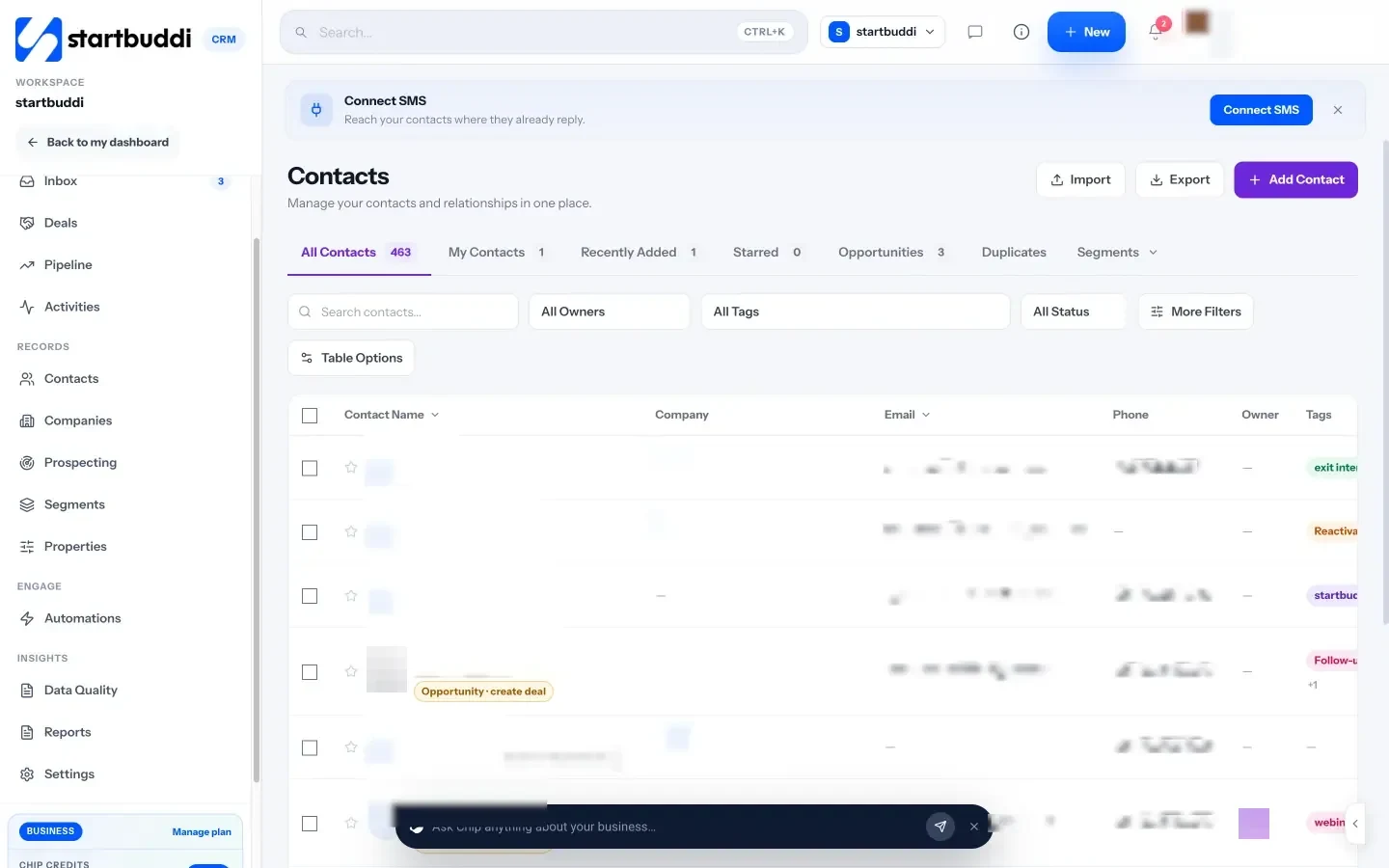
Each contact has one page with their activity, notes, tasks, deals, files and communications, plus a money summary of what they have been invoiced, paid and still owe. The Customers home opens with a short briefing from Chip on who is waiting for a reply and which deals need attention, and you can ask Chip questions such as “Who haven’t I contacted in 14 days?”
The Free plan includes up to 250 contacts; Starter includes 2,500, Growth 15,000 and Scale 75,000. Your next step: import your customer list, even a rough one, and add a note to your five most important customers. Compare plans on the pricing page.
Related terms
FAQ
What does CRM stand for?
CRM stands for customer relationship management. It describes both the practice of managing customer relationships and the software used to do it.
Does a small business really need a CRM?
If you have more customers than you can remember, work with a team, or lose track of follow-ups, a simple CRM usually saves time and wins back sales you would otherwise miss.
Is a spreadsheet a CRM?
A spreadsheet can list contacts, but it does not keep conversation history, remind you to follow up or update itself when customers act. Most businesses outgrow it quickly.
Is there a free CRM?
Several CRMs have free plans. The startbuddi Free plan includes up to 250 contacts, with the contacts list, pipeline and Chip included.
Omolola Akiyode is the operations and project manager at startbuddi, leading cross-functional projects and the content that helps founders get set up. Omolola writes about projects, websites and getting found online, and turns complex ideas into clear, practical steps.
Runs operations and projects at startbuddi