How to price your services when you’re starting out
A step-by-step way to price services: find your minimum rate, check the market, price the value and package it, with a worked example and templates.



- Work out your minimum rate from what you want to earn, your costs and your real billable hours. Check what the market pays, then price on the value you deliver and package it in two or three options. Review your prices every few months.
Pricing is the decision most new founders dread, and the one that shapes everything else: how many clients you need, how hard you work and whether the business survives. Here is how to price services when you are starting out, in one sentence. Work out the minimum you must charge to cover your costs and pay yourself, check what the market pays for similar work, then set a price based on the value you deliver, packaged so clients can choose. Review it every few months.
This guide walks through each step with a worked example, a simple formula, package ideas and the words to use when you raise your prices later.
How to price services: the three main methods
Almost every pricing method is a mix of three ideas. You will use all three, but in a specific order.
| Method | The question it answers | Strength | Weakness |
|---|---|---|---|
| Cost-plus | What do I need to charge to cover costs and pay myself? | Stops you working at a loss | Ignores what clients would happily pay |
| Market-based | What do others charge for similar work? | Keeps you realistic | Copies other people’s mistakes |
| Value-based | What is the result worth to this client? | Often the most profitable | Harder to work out, needs confidence |
Start with cost to find your floor, use the market to find the range, and use value to decide where in that range you sit.
Step 1: work out your minimum price
Your floor price is the lowest rate at which the business still pays you properly. Below it, every new client makes you poorer. The formula is simple:
Minimum hourly rate = (what you want to earn + business costs + a buffer for tax and savings) ÷ billable hours in a year
1. Decide what you want to earn
Be honest. Use what you need to live on, not what feels polite to ask for. If you left a job, your old salary is a sensible starting point.
2. Add up your business costs
List everything the business pays for in a year: internet and data, phone, software subscriptions, equipment, transport, workspace, marketing, bank and payment fees, and professional help such as an accountant.
3. Add a buffer
Set aside a percentage for tax, slow months and savings. Tax rules vary by country and by how your business is set up, so check with your tax authority or an accountant. If you register for VAT in Nigeria, for example, the standard rate is 7.5%, and it is added on top of your price rather than coming out of it. This is general information, not tax advice; the Nigeria Revenue Service is the official source.
4. Count your real billable hours
This is where most beginners go wrong. You will not bill 40 hours a week for 52 weeks. You need holidays and sick days, and a large share of your week goes on admin, sales, invoicing and learning, none of which a client pays for directly. If you are new to the idea, read what billable hours are.
A worked example
Ada is a freelance designer in Lagos.
- She wants to earn ₦6,000,000 a year (₦500,000 a month).
- Her business costs are ₦1,200,000 a year for software, data, a laptop fund and transport.
- She adds a 20% buffer for tax and quiet months: (₦6,000,000 + ₦1,200,000) × 1.2 = ₦8,640,000.
- She plans to work 46 weeks a year at 40 hours a week, which is 1,840 hours. She expects about 60% of that to be billable: roughly 1,104 hours.
- ₦8,640,000 ÷ 1,104 hours = about ₦7,800 an hour. She rounds up to ₦8,000 an hour, or ₦48,000 for a day with six billable hours.
That figure is not her price. It is the line she should not go below. Our free hourly rate calculator does this maths for you.
Step 2: check what the market pays
Next, find out what clients already pay for similar work. The US Small Business Administration suggests that part of your market research should answer a simple question: what do potential customers pay for the alternatives?
Ways to find out, without spending money:
- Look at published price lists on competitors’ websites and social pages.
- Ask two or three people in your field what they charge. Many will tell you if you share your numbers too.
- Read job posts and project briefs that include a budget.
- Ask your first clients what they paid last time and why they are looking for someone new.
Then decide where you want to sit. Budget, middle or premium are all valid choices, but be clear which one you have picked. If the market rate is below your minimum from Step 1, you have three options: find clients who pay more, cut costs, or change what you offer. Pricing below your floor is not a fourth option.
Step 3: price the value, not just the hours
Clients do not buy your hours. They buy a result: more customers, a site that works, a clean set of books, a stress-free event. When the result is worth a lot to the client, your price can reflect that, even if the work takes you less time than it used to.
Ask these questions on your first call:
- What problem are you trying to solve, and what is it costing you now?
- What would a good result mean for your business in the next year?
- What happens if you do nothing?
For example, a caterer who gets one extra corporate booking a month from a new website gains far more than the site costs. A bookkeeper who saves a shop owner eight hours a month and helps avoid tax penalties is worth more than eight hours of someone’s time. You are not inventing a number; you are pricing against what the client gains.
As you get faster, value pricing also stops you being punished for your own skill. Hourly billing pays experts less for doing the same job more quickly.
Step 4: package your services
Packages make your price easier to understand and easier to buy. They also move the conversation from “how much per hour?” to “which option suits us?”.
Choose a pricing model
| Model | Works well for | Watch out for |
|---|---|---|
| Hourly or day rate | Unclear scope, advice, small fixes | Clients watch the clock; you earn less as you get faster |
| Fixed project price | Clear deliverables, such as a logo or a website | Scope creep, so write down exactly what is included |
| Packages | Services you sell often in a similar shape | Too many options confuse people |
| Monthly retainer | Ongoing work such as social media, bookkeeping or support | Agree what happens to unused hours |
Use good, better, best
Offering three tiers helps both price-sensitive clients and those who want more. The approach is described in the Harvard Business Review article “The Good-Better-Best Approach to Pricing”. For a social media manager, it might look like this:
| Package | What is included | Monthly price |
|---|---|---|
| Starter | 12 posts a month on two platforms | ₦120,000 |
| Standard | 20 posts on three platforms, stories and a monthly report | ₦200,000 |
| Premium | Everything in Standard, plus content planning calls and ad management | ₦320,000 |
Check each package against your floor. If Standard takes about 20 hours a month, then at Ada’s ₦8,000 minimum it must cost at least ₦160,000. At ₦200,000 it clears the floor with room to spare. Put your packages on a simple page with our price list template.
Pricing for local and international clients
Many founders in Nigeria and across Africa sell to clients at home and abroad. That raises a fair question: should you charge everyone the same?
Not necessarily. Prices are set by what each market pays and what the result is worth to that client, so it is normal for a London agency and a Lagos boutique to pay different amounts for similar work. What matters is that each price clears your floor and that you are consistent within each market.
A few practical rules help:
- Quote international clients in their currency, such as US dollars or pounds. It is easier for them to approve, and it protects you if your local currency moves while the project is running.
- Quote local clients in your local currency, and say how long the quote is valid, especially if your own costs are priced in dollars.
- Add the cost of getting paid. Card and cross-border payments carry fees and sometimes conversion costs. Build them into your price rather than absorbing them.
- Keep separate price lists if you serve very different markets, so you never have to invent a number on a call.
Whichever currency you use, write it clearly on every quote and invoice, next to every amount. It sounds obvious, but mixed-up currencies cause some of the most awkward payment conversations.
How to present your price with confidence
- Send a written quote. List what is included, what is not, the price, the payment terms and how long the quote is valid.
- Lead with the result. Restate the client’s goal before the number, so the price is read against the value.
- Say the number and stop. Do not rush to justify or discount it.
- Trade, don’t cave. If a client wants a lower price, remove something from the scope rather than cutting your rate for the same work.
- Ask for a deposit. It is normal and signals a professional business. See how much deposit to ask for.
When and how to raise your prices
Small price changes have a big effect on profit. A well-known 1992 Harvard Business Review study of 2,463 companies, “Managing Price, Gaining Profit”, found that on average a 1% improvement in price raised operating profit by about 11%. Your numbers will differ, but the lesson holds: when margins are thin, a modest increase matters more than you might expect.
Signs it is time to raise your prices:
- You are booked up weeks ahead.
- Almost every quote is accepted without any questions.
- Your costs have gone up since you last set your rates.
- You have added skills, results or testimonials since you started.
Raise prices for new clients first. For existing clients, give notice, usually a month or two, and keep the message short:
Hi [Name], thank you for another great quarter working together. From [1 February], my rate for [service] will be [₦220,000] a month. Nothing changes before then, and I’m happy to talk through the scope if that helps. [Your name]
Pricing mistakes to avoid
- Pricing from fear. Charging less “until I’m good enough” usually means you never have the time or money to get better.
- Forgetting unbillable time. Admin, travel and revisions all eat into your hours.
- Unlimited revisions. Always state how many rounds are included.
- Copying the cheapest competitor. They may be losing money or planning to quit.
- Never checking the numbers. Track the hours each job really takes and compare them with what you charged.
How startbuddi helps you price with real numbers
The best pricing decisions use your own data: how long jobs take, and which clients and services actually make money. In startbuddi, that data sits next to your quotes and invoices.
- Know how long work takes. In Time tracking you start a timer on a task or log time by hand, and tick whether it is billable. The weekly view shows total hours, billable hours and their billable value. Our post on tracking billable hours without a spreadsheet explains the habit.
- Quote clearly. Estimates let you set out line items, tax, discount and terms, and turn an accepted estimate into an invoice without retyping it.
- See what is profitable. Profitability in Money Manager ranks projects, customers, products or services and campaigns by profit and margin, using money collected minus the expenses you linked to them.
- Ask Chip. Chip, the AI assistant, can help you think through a quote or explain which clients bring in the most, using the numbers already in your account.
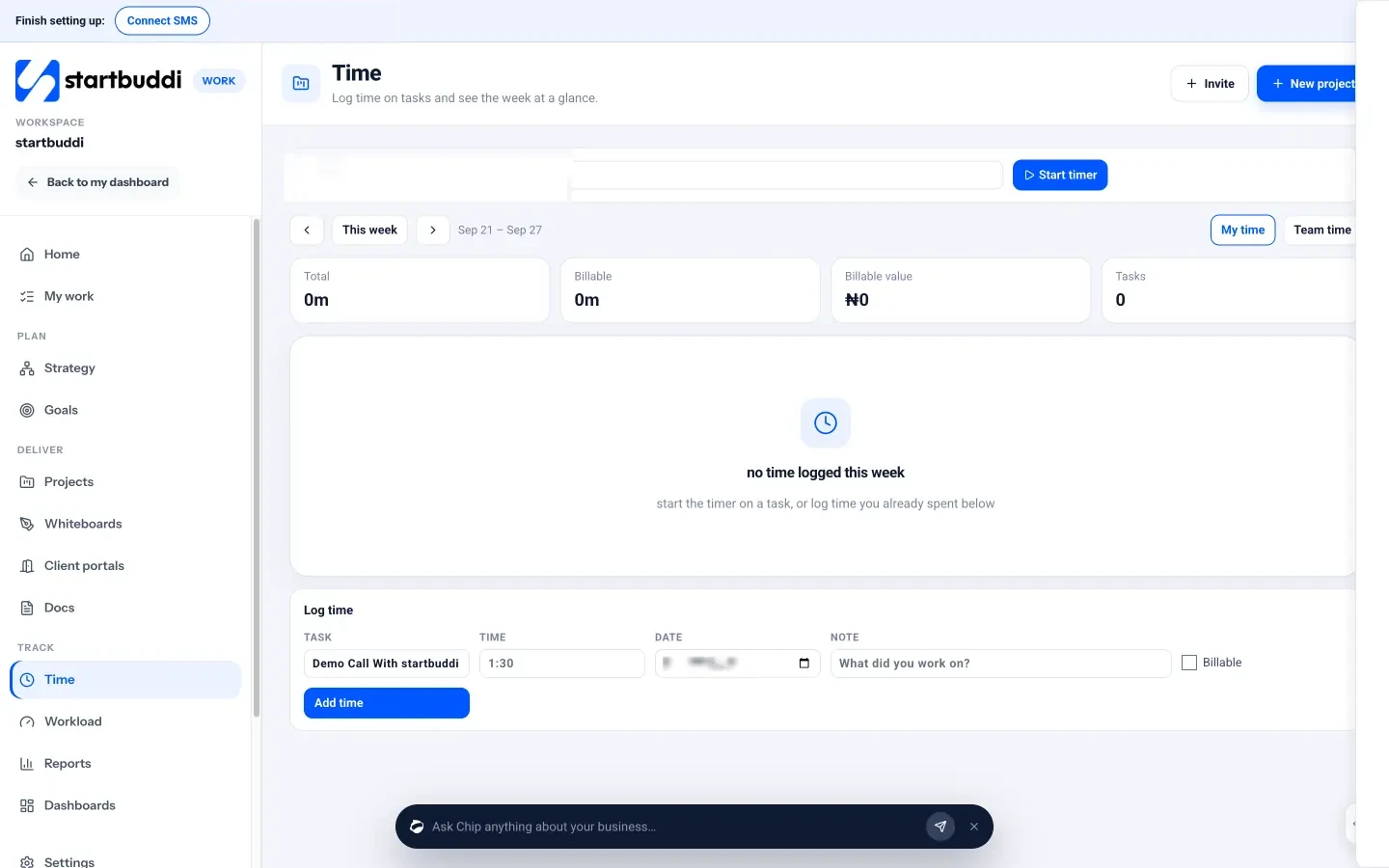
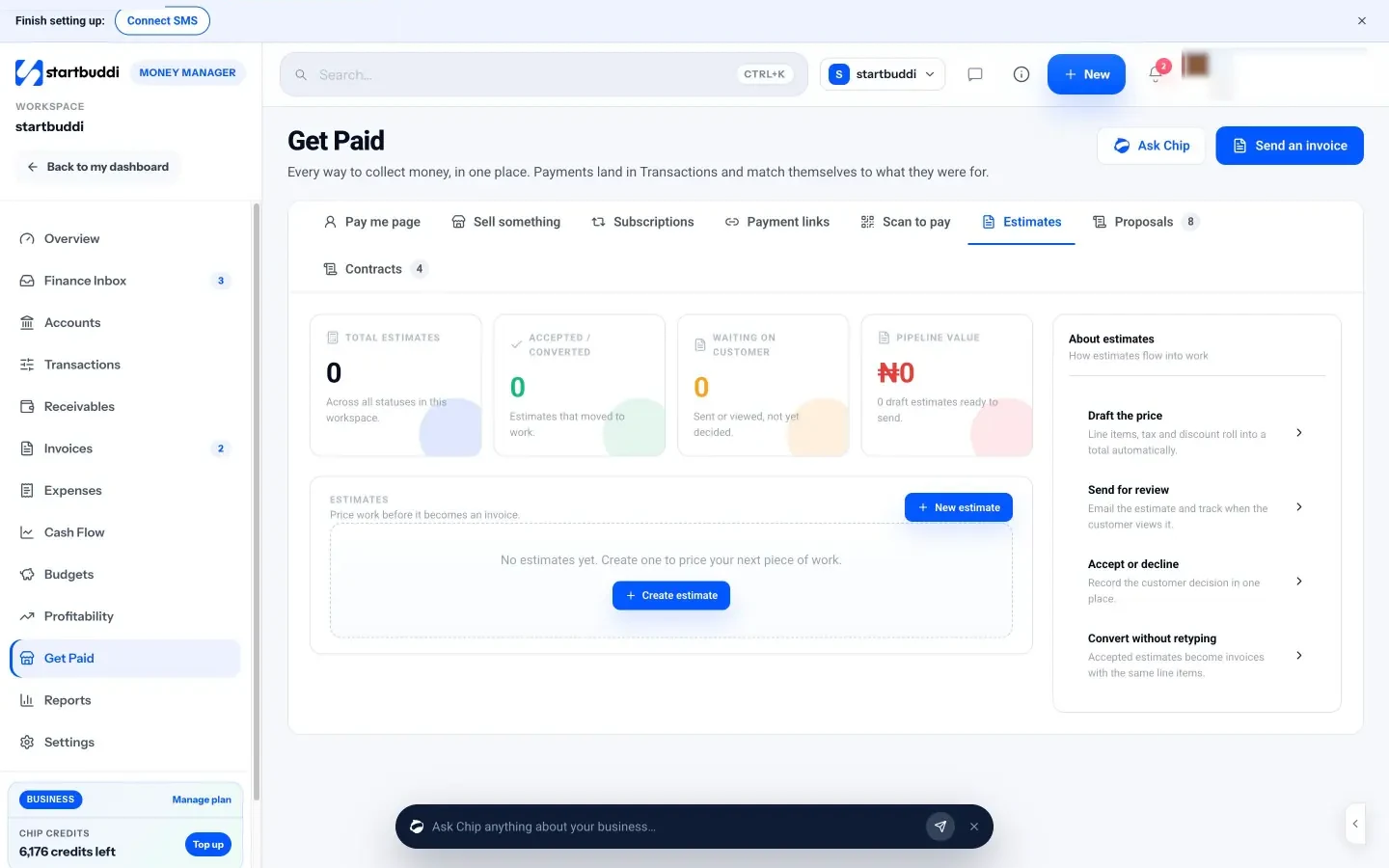
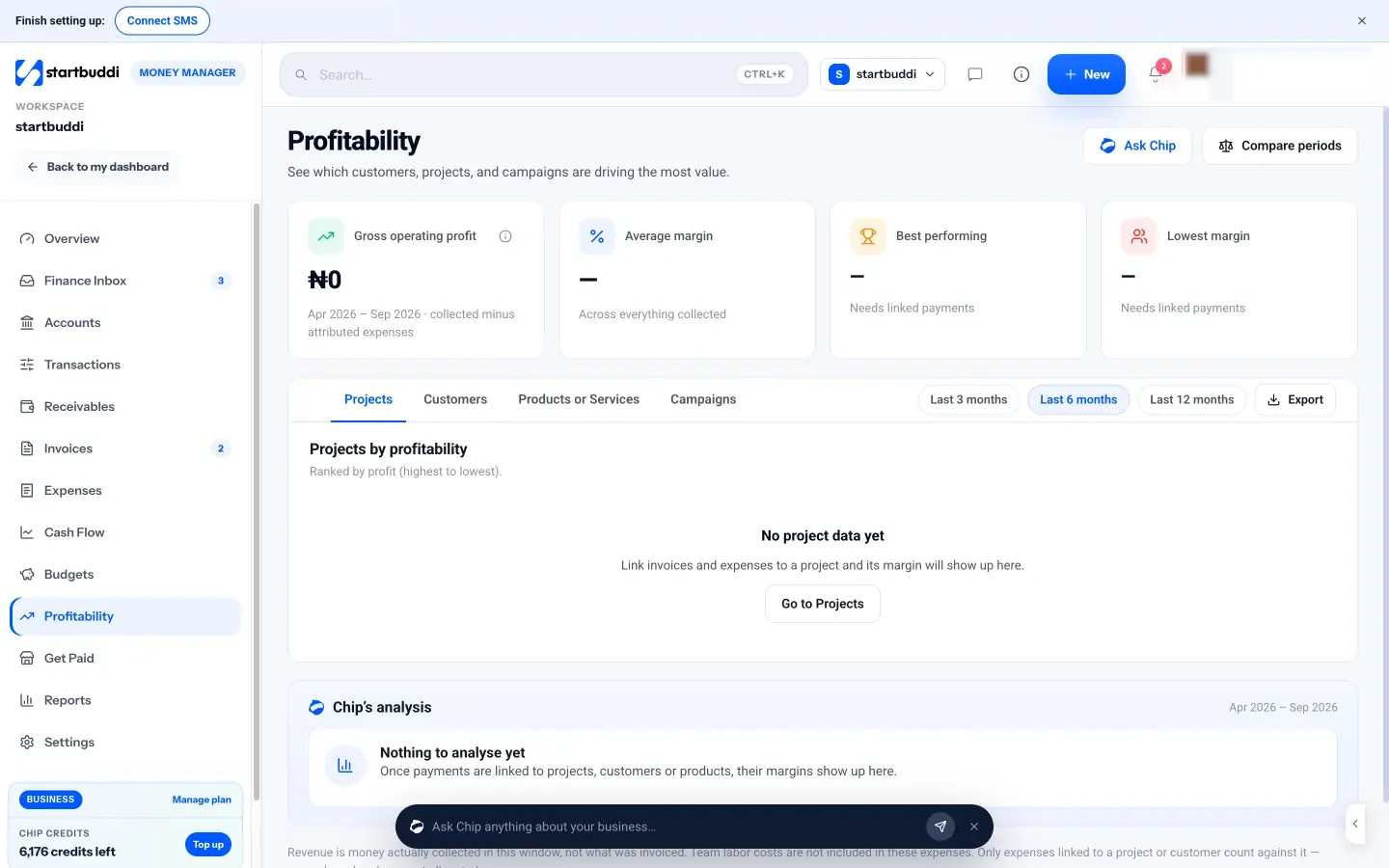
Estimates, time tracking and profitability are available on the Free plan, so you can test your prices on real jobs before paying anything.
Your next step
Spend 20 minutes on Step 1 today: write down what you want to earn, your yearly costs and your realistic billable hours, and work out your floor. Then compare it with the prices you are charging now. If you want the hours and the profit numbers to update themselves, start tracking your next job in startbuddi and check the plans and prices when you are ready. You can also check your margins with our profit margin calculator.
Sources
- U.S. Small Business Administration: Market research and competitive analysis
- Harvard Business Review: The Good-Better-Best Approach to Pricing (Rafi Mohammed, 2018)
- Harvard Business Review: Managing Price, Gaining Profit (Marn and Rosiello, 1992)
- Forvis Mazars: VAT and Nigeria’s 2025 tax reforms
- Nigeria Revenue Service
Frequently asked questions
Should I charge by the hour or by the project?
Hourly suits work with an unclear scope. Fixed project prices or packages usually suit clear deliverables and reward you for getting faster.
Is it bad to be the cheapest?
Usually, yes. Low prices attract clients who shop on price alone, and they leave little room for the time and tools you need to do good work.
How often should I review my prices?
Every three to six months is a good rhythm, and whenever your costs rise or you are fully booked.
What if a client says my price is too high?
Ask what budget they have, then offer a smaller scope that fits it. Keep your rate the same and change what is included.
Tiwalade Joanna Okedara-Kalu is the founder, CEO and CTO of startbuddi, the business system that brings clients, bookings, invoices, projects, marketing and the Chip AI assistant into one place. Tiwalade builds software around how service businesses really work day to day, and writes about client management, getting paid on time and why small businesses outgrow the tools they start with.
Founded startbuddi and leads its product and engineering