Retainer agreements: how to sell and bill monthly retainers
How to choose, price and pitch a monthly retainer, what your retainer agreement should say, and how to bill it without chasing.



- A retainer agreement is a monthly fee, paid in advance, for a clear scope of your time or deliverables. Sell it to clients who already come back, price it from real hours, write down scope, rollover and notice, and bill at the start of each month.
A retainer agreement is a contract where a client pays you a fixed amount every month, in advance, for an agreed amount of your time, your availability or a set list of deliverables. For a freelancer or small agency, it turns a stop-start income into something you can plan around. This guide shows you how to choose the right type of retainer, price it, pitch it, write it down and bill it every month without chasing anyone.
The short version: sell a retainer to a client you have already done good work for, tie the fee to a clear monthly scope, bill at the start of the month, and review it every quarter.
What is a retainer agreement?
The word comes from law. Cornell’s Legal Information Institute describes a retainer as payment either for reserving a professional’s time or for future services. Service businesses borrowed the idea: the client “retains” you, so you keep space in your month for them.
In practice, a retainer agreement sets out four things: what the client gets each month, what it costs, when they pay, and how either side can end it. Everything else is detail that protects those four.
The three types of retainer
| Type | What the client buys | Works well for | Watch out for |
|---|---|---|---|
| Availability retainer | Priority access to you, for example “on call for questions, reply within one working day” | Consultants, advisers, lawyers, IT support | Clients who treat “access” as unlimited work |
| Hours retainer | A bank of hours each month, for example 20 hours of design or development | Designers, developers, bookkeepers, virtual assistants | Unused hours piling up and turning into a debt you owe |
| Deliverables retainer | A fixed list of outputs, for example eight social posts, two blog articles and one report | Marketing, social media and content agencies | Requests that quietly grow beyond the list |
Most small businesses do best with deliverables or a small hours bank. Clients understand what they are paying for, and you can see at a glance when a request sits outside the deal.
Is a retainer right for your business?
Retainers suit work that repeats. If a client needs you every month, not just once, a retainer saves you both the effort of quoting, approving and invoicing each small job. Look for these signs:
- The same client has come back three or more times in the last six months.
- The work is ongoing by nature: social media, website updates, bookkeeping, IT support, content, coaching.
- You keep sending small invoices for “quick changes” that add up.
- The client asks, “Can we just have you on hand?”
Retainers suit you less if your work is a one-off (a logo, a wedding shoot, a single website build) or if a client’s needs swing wildly month to month. In those cases a clear project quote works better. You can still offer a small care plan after the project ends.
How to price a monthly retainer
Price the retainer from the work, not from a number you hope the client will accept. Here is a simple way to do it.
- List the monthly work. Write down every task the client needs in a normal month. Be specific: “4 Instagram posts with captions” beats “social media”.
- Estimate the hours. Add time for meetings, messages, revisions and reporting. These hidden hours are where retainers lose money. If you have tracked time on past work for this client, use those numbers.
- Multiply by your hourly rate. If you are not sure what your rate should be, work it out with the hourly rate calculator.
- Decide on a small commitment discount, or none. Some businesses take 5 to 10% off in exchange for a 3 or 6 month commitment. Others charge the full rate because guaranteed availability is worth something. Both are fair; just be deliberate.
- Set an overage rate. Say what extra work costs, per hour or per item, before it happens.
A worked example
A Lagos social media manager looks after a restaurant. A normal month is 12 posts, a monthly content plan, a short performance report and replies to comments three times a week. She estimates 22 hours, including a planning call and two rounds of edits. At ₦15,000 an hour that is ₦330,000. She offers ₦300,000 a month on a six-month term, with extra posts at ₦20,000 each. The client knows what they get, and she knows her real hourly rate stays healthy.
For more on setting the rate itself, read how to price your services when you’re starting out.
How to sell a retainer to a client
The easiest retainer to sell is the one that follows a successful project. The client already trusts you, and you already know what they need next.
When to bring it up
- At the end of a project, when you hand over the work and the client is happy.
- When a client sends their third “small favour” request in a month.
- At a quarterly review, when you can show what the work achieved.
A message you can adapt
Hi Amaka, really glad the new menu launch went well. Over the last two months you’ve asked for updates most weeks, so I wanted to suggest something simpler for both of us. For ₦300,000 a month I’d handle 12 posts, a monthly plan and a short report, with replies to comments three times a week. You’d have one fixed bill paid at the start of each month, and no separate quotes for small jobs. Want me to send over the details?
Put this into practiceEverything in this article works inside startbuddi, free to start.Start free
Notice what the message does: it names a pattern the client has already noticed, offers a fixed price, lists what is included, and ends with an easy yes. Put the full offer in a short proposal. Our guide on how to write a business proposal that wins the job walks through the structure.
Offer two or three options
Give the client a choice of levels, for example “Essentials”, “Growth” and “Full service”. People like choosing, and the middle option often becomes the natural pick. Keep the differences clear: more deliverables, faster response times or extra channels, not vague words like “premium support”.
What to put in a retainer agreement
A retainer agreement does not need to be long, but it needs to be written down and signed. Use this checklist, or start from the agency retainer agreement template.
- Parties and start date. Who the agreement is between and when it begins.
- Monthly scope. The exact deliverables, hours or availability, and what is not included.
- Fee and currency. The monthly amount and whether tax is added on top.
- Payment timing. Paid in advance, for example on the 1st of each month, with a due date.
- Unused hours. Whether they expire, roll over for one month only, or roll over up to a cap. “Use it or lose it within the month” is the simplest rule; a one-month rollover is a friendly middle ground.
- Extra work. The overage rate and how extra work is approved (for example, in writing before you start).
- Response times. How fast you reply and in which working hours.
- Term and notice. Minimum term, then month to month, with 30 days’ notice from either side.
- Late payment. What happens if payment is late, for example work pauses after 7 days.
- Price reviews. When the fee can change and how much notice you give.
- Ownership. Who owns the work, and when ownership passes (usually once paid).
E-signatures are widely accepted. In Nigeria, section 93 of the Evidence Act 2011 recognises electronic signatures, and the Law Commission for England and Wales concluded that an electronic signature can be used to execute a document when the signer means to authenticate it. This is general information, not legal advice; ask a lawyer to review your agreement if the amounts are large.
How to bill retainers every month
Bill retainers at the start of the period, not the end. You are selling reserved time, so it makes sense to be paid before you spend it. It also means a client who stops paying stops receiving work straight away, instead of owing you a month.
Recurring invoice or subscription?
| Recurring invoice | Subscription (card on file) | |
|---|---|---|
| How the client pays | Opens an invoice each month and pays by transfer, card or link | Card is charged automatically each period |
| Best for | Businesses that pay by bank transfer or need a proper invoice for their records | Individuals and small clients happy to pay by card |
| Effort each month | Check it went out, follow up if unpaid | Almost none, unless a card fails |
| Changing the amount | Easy: edit the next invoice | Usually means a new plan |
Payment providers handle the automatic charging for subscriptions. Paystack’s subscriptions charge customers on a plan’s interval, and Stripe’s documentation explains that it generates invoices and attempts payment for each billing period. If your clients are companies that pay by transfer, a recurring invoice is usually the better fit.
A simple monthly billing routine
- Invoice or charge on the same day every month.
- Set the due date 5 to 7 days later.
- Send a friendly reminder the day before it is due, and again 3 days after.
- Pause work after the grace period set in your agreement.
- Send a short monthly report with the invoice, so the client sees what they paid for.
If a retainer client does fall behind, our guide to handling late payments professionally has scripts for each stage.
Keeping retainers healthy
Retainers end for two reasons: the client stops seeing the value, or you stop making money on them. Both are avoidable.
- Track your time, even on deliverables retainers. If a “20 hour” client is taking 35, you need to know before month three, not month twelve. See what billable hours are if you are new to tracking them.
- Report every month. Three or four lines on what you did and what happened as a result. Clients rarely cancel something they can see working.
- Review every quarter. Compare hours worked with hours paid for, and adjust scope or price at the renewal point.
- Say no politely to out-of-scope work, or quote it. “Happy to do that. It sits outside the monthly plan, so it would be ₦40,000 extra. Shall I go ahead?” Our guide to preventing scope creep goes deeper.
- Do not let one client become most of your income. A retainer is steady, not guaranteed. Keep marketing while it runs.
How startbuddi helps you run retainers
With startbuddi, the whole retainer lives in one place: the proposal, the signed agreement, the monthly billing, the time you spend and whether the client is profitable.
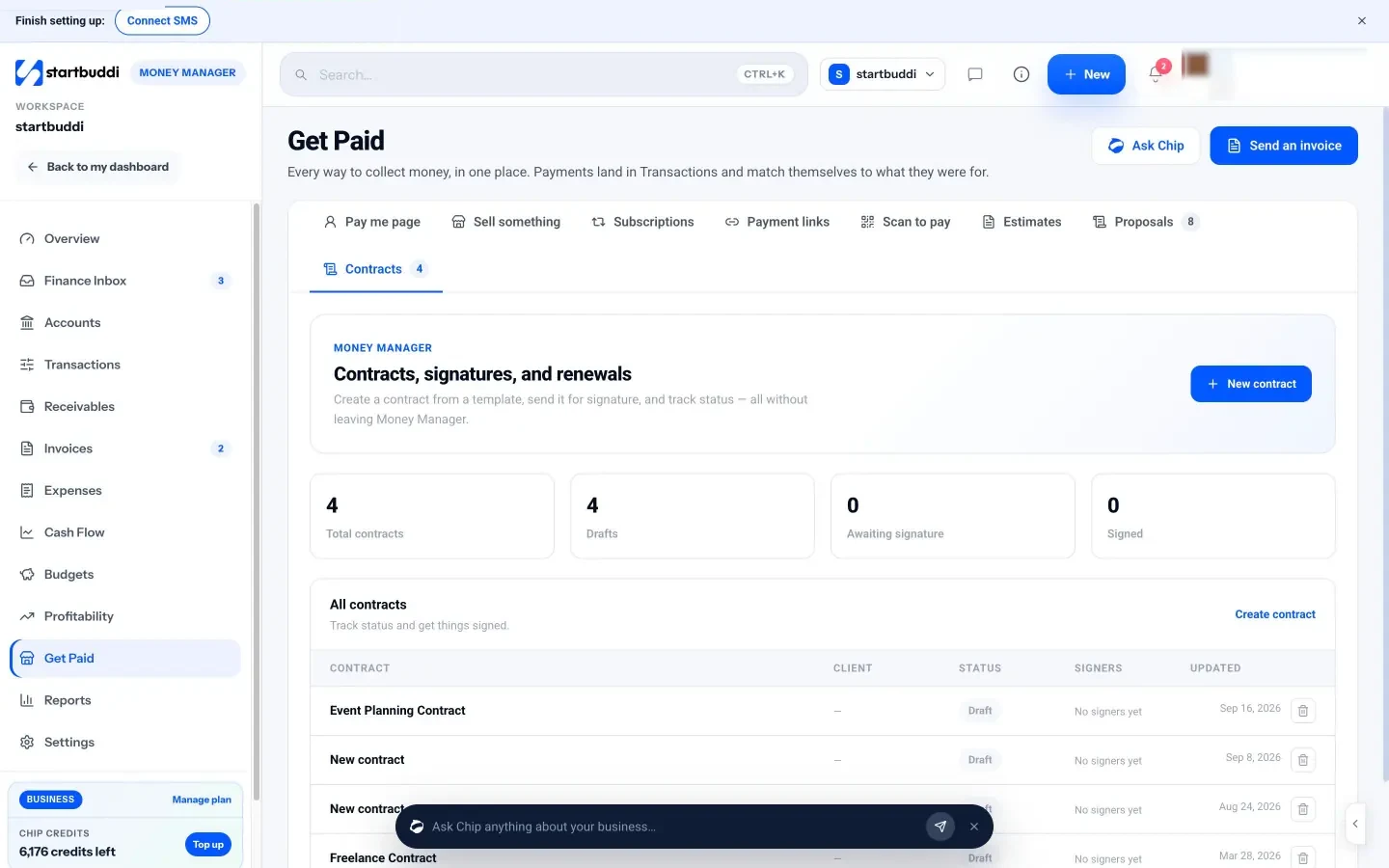
Put the agreement in writing. Documents has a Monthly Retainer Agreement template alongside contracts such as Freelance and Social Media Management. Edit the wording, add signers and send it for e-signature. In Money Manager, the Proposals and Contracts tabs under Get Paid track what is drafted, awaiting signature and signed. Read more about estimates, proposals and contracts.
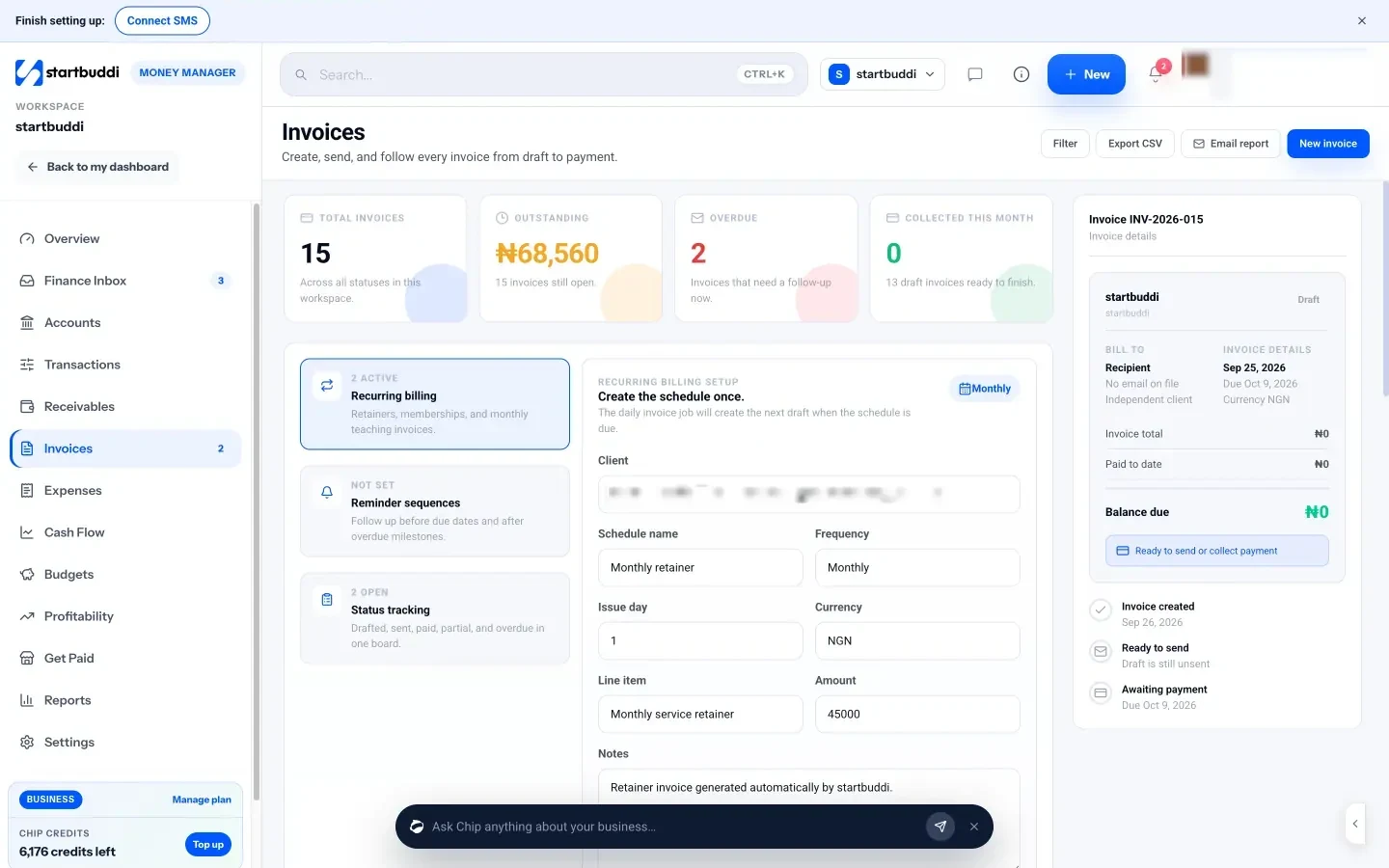
Bill by invoice. On the Invoices page, the Recurring billing card lets you save a retainer schedule once: the client, monthly or quarterly, the issue day, the amount and a note. You can generate the first draft straight away. Clients pay online with Paystack or Stripe, or by bank transfer, and you can set up a reminder sequence before and after the due date. See invoicing.
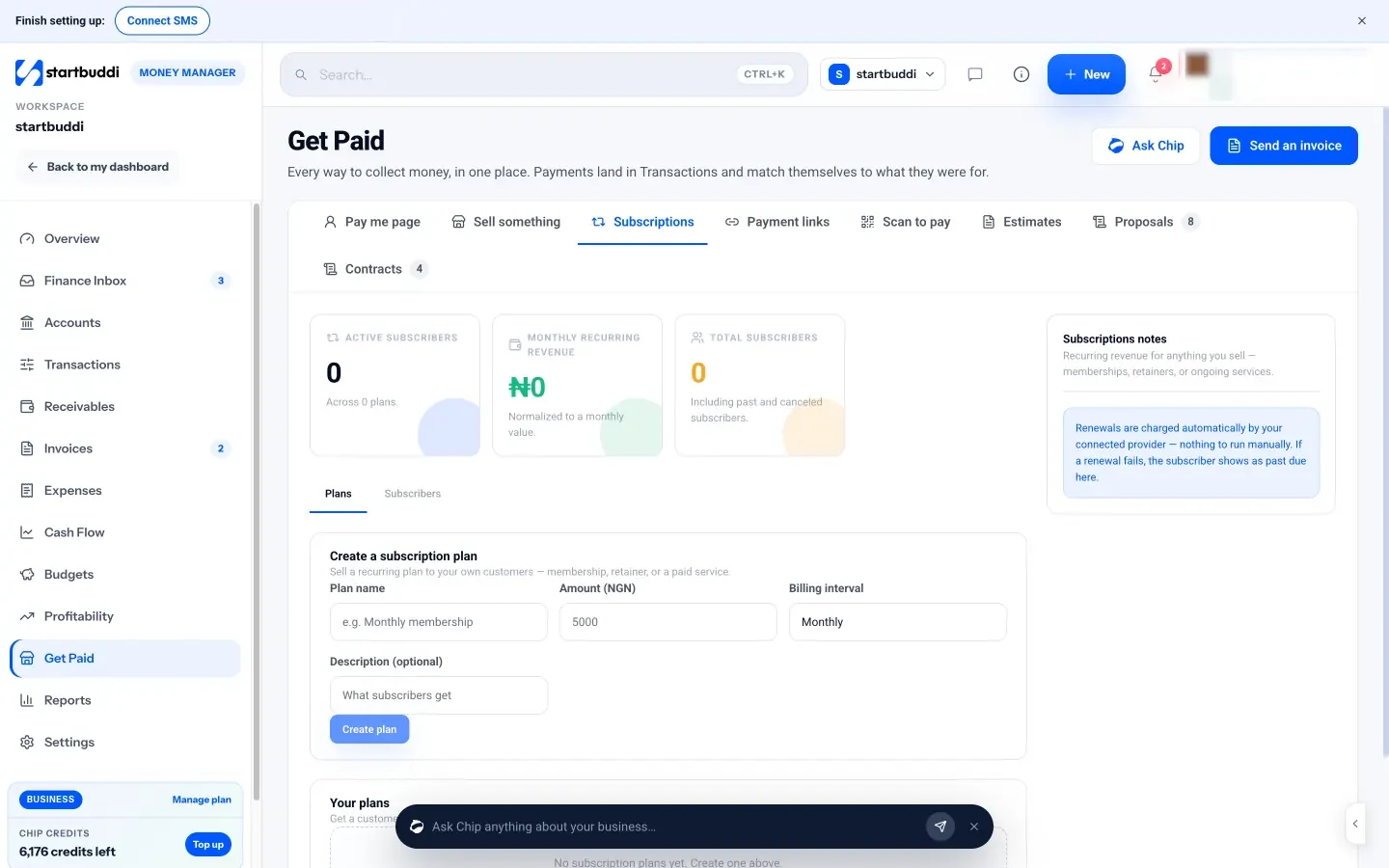
Or bill by subscription. Under Get Paid, Subscriptions lets you create a monthly or annual plan, add a subscriber and share a subscribe link. Renewals are charged by your connected Paystack or Stripe account, and the page shows active subscribers and monthly recurring revenue. See subscriptions.
Check the retainer pays. Log hours against the client’s project with time tracking, then open Profitability in Money Manager to see revenue against attributed expenses for each customer. If a retainer is slipping, you will spot it at the quarterly review.
Money Manager is on every plan, including Free, which includes 5 invoices a month. Starter and above include unlimited invoices.
Your next step
Pick one client who has come back to you at least three times this year. List their normal monthly work, price it with the steps above and send them a two-option offer this week. When they say yes, set up the contract and the billing in Money Manager, or compare plans on the pricing page.
Sources
- Cornell Law School, Legal Information Institute: Retainer
- Paystack documentation: Subscriptions
- Stripe documentation: How subscriptions work
- Section 93, Nigerian Evidence Act 2011 (LawGlobal Hub)
- Law Commission: Electronic execution of documents
Frequently asked questions
Should retainer clients pay in advance or in arrears?
In advance. You are reserving time for them, so bill at the start of the month and pause work if payment is late.
What happens to unused retainer hours?
Whatever your agreement says. The simplest rule is that hours expire at the end of the month; a one-month rollover with a cap is a common friendly alternative.
How long should a retainer agreement last?
Many small businesses use a 3 or 6 month minimum term, then month to month with 30 days' notice from either side.
Is a retainer the same as a deposit?
No. A deposit is an upfront part-payment for one project. A retainer is a repeating monthly fee for ongoing work or availability.
Tiwalade Joanna Okedara-Kalu is the founder, CEO and CTO of startbuddi, the business system that brings clients, bookings, invoices, projects, marketing and the Chip AI assistant into one place. Tiwalade builds software around how service businesses really work day to day, and writes about client management, getting paid on time and why small businesses outgrow the tools they start with.
Founded startbuddi and leads its product and engineering