The best invoicing software for agencies in Nigeria (2026): what to look for
What Nigerian agencies need from invoicing software: retainers, deposits, naira and foreign-currency payments, VAT and withholding tax, reminders, and published plans.



Photo: Paul Esch-Laurent / Unsplash
- Agencies need invoicing software that handles retainers, deposits and milestone billing, lets clients pay from the invoice, records partial payments such as withholding tax deductions, and chases late payers. Check payment options for local and foreign clients before you choose.
Good invoicing software for agencies in Nigeria handles the way agencies actually bill: monthly retainers, deposits before work starts, milestone payments, clients who pay by bank transfer, and clients abroad who pay in dollars or pounds. It should let a client pay straight from the invoice, show you who owes what at a glance, send reminders without you writing each one, and keep tax lines such as VAT correct. A free invoice generator is fine for your first few clients. Once you have retainers and a team, you need something that remembers the schedule for you.
This guide explains what Nigerian agencies should look for, how VAT and withholding tax affect agency invoices, and compares the published plans of well-known tools. The billing advice applies to agencies anywhere.
Why agencies outgrow an invoice template
A freelancer might send four invoices a month. A ten-person agency can send forty, across several billing models at once:
- Retainers: the same amount every month for ongoing social media, SEO or support.
- Project fees: a website or brand identity billed as a deposit, a midpoint payment and a final payment.
- Time and materials: extra hours or ad spend billed at the end of the month.
- Pass-through costs: printing, stock photos or media buying billed at cost or with a margin.
Keeping track of all that in Word files and a spreadsheet works until it doesn’t. The usual failure is quiet: a retainer invoice nobody sent in March, or a final payment nobody chased because the account manager left.
Late payment is a problem everywhere. In May 2026 the UK government said late payments cost its economy £11 billion a year and close 38 businesses a day (GOV.UK). Software can’t make a client pay, but it removes the excuses: a clear invoice, sent on time, with a pay button and a polite reminder when it is due.
How Nigerian agencies get paid
Local clients
Most local clients pay by bank transfer, and many now pay by card or transfer through a payment page. Paystack’s published fee for local payments is 1.5% plus ₦100, with the ₦100 waived under ₦2,500 and fees capped at ₦2,000 per transaction (Paystack). On a ₦500,000 retainer, the fee hits the ₦2,000 cap. Decide whether you absorb that or build it into your prices.
Paystack also has its own invoices: a simple version with an amount and a note, and a professional version with line items, tax, discounts and due dates. You can send reminders and mark invoices paid when a client pays offline (Paystack Invoices). That covers basic billing if you only need payment collection.
Clients abroad
Agencies with UK, US or European clients often need to invoice in dollars, pounds or euros. Stripe lists Nigeria in its “extended network” rather than as a country where businesses sign up directly (Stripe), so check how any tool you choose collects foreign-currency payments before you promise a client a card payment option. Paystack’s international card rate is 3.9% plus ₦100 (Paystack). Many agencies also list bank details for a domiciliary account or a PayPal link on the invoice.
Tax on agency invoices in Nigeria: VAT and withholding tax
General information, not tax advice. Confirm with the Nigeria Revenue Service or a qualified accountant before you act.
VAT
Since 1 January 2026, VAT is governed by the Nigeria Tax Act 2025, and the standard rate stays at 7.5% (BDO). Small companies get relief, but the definition excludes businesses providing professional services, whatever their size (EY). Many agencies and consultancies may fall into that category, so don’t assume you are exempt because you are small. Ask your accountant how your services are classed.
If you charge VAT, your invoice should show the VAT amount as its own line, your Tax ID, and the total including VAT. Good invoicing software adds the tax line for you and keeps the rate consistent.
Withholding tax
Corporate clients often deduct withholding tax before they pay you. Under the current rules summarised by PwC, the rate on consultancy, professional, management and technical fees paid to a Nigerian resident is 5% (PwC Worldwide Tax Summaries). So on a ₦1,000,000 fee, the client may pay ₦950,000 and remit ₦50,000 to the tax authority on your behalf.
Two practical points. First, record the payment as ₦1,000,000 settled (₦950,000 received plus ₦50,000 withheld), not as a ₦50,000 shortfall, or your receivables will be wrong. Second, ask the client for the withholding tax credit evidence, because you may be able to use it against your own tax. Software that allows partial payments and notes makes this easier to track.
Outside Nigeria, the details differ. In the UK, for example, GOV.UK lists what an invoice must include, and in the US the IRS explains which records to keep. Check the rules where you are.
What to look for in invoicing software for agencies in Nigeria
| Feature | Why agencies need it |
|---|---|
| Recurring invoices | Retainers go out on the same day every month without anyone remembering |
| Estimates that convert to invoices | No retyping line items once a client says yes |
| Pay button on the invoice | Card, transfer or USSD in naira, and a route for foreign currency |
| Partial payments | Deposits, instalments and withholding tax deductions |
| Tax lines | VAT at the right rate, shown clearly |
| Reminders | Polite chasing before and after the due date |
| Receivables view | Who owes what, how overdue, and who to chase first |
| Multiple currencies | Naira for local clients, dollars or pounds for foreign ones |
| Client history | Every invoice, payment and note for a client in one place |
| Team access | Account managers can raise invoices without seeing everything |
Popular invoicing tools and their published plans
These tools are widely used by small agencies. Free plans and prices are as published on their own pages when we checked in September 2026; some show introductory offers, so confirm on the linked page. We haven’t ranked them, and not every tool supports every Nigerian payment method.
| Tool | What it is | Free plan | Published pricing |
|---|---|---|---|
| Paystack Invoices | Invoices inside a payment gateway | No subscription; transaction fees apply | See Paystack fees |
| Zoho Invoice | Invoicing and estimates | Yes: 2 users, 500 invoices a year | Free, with Zoho branding |
| Wave | Invoicing and bookkeeping | Yes: Starter plan | Pro $19 a month billed monthly, or $190 a year |
| FreshBooks | Invoicing and accounting | No, 30-day trial | Lite $23 a month billed monthly at the regular price, 5 billable clients |
| Invoice Ninja | Invoicing and payments | Yes: up to 5 clients | Pro $14 a month or $140 a year |
Our list of invoicing software for service businesses and the startbuddi vs FreshBooks comparison go into more detail.
Billing models that protect agency cash flow
Deposits on projects
Ask for 40% to 50% before you start a project. For a ₦2,400,000 website, that might be ₦1,200,000 upfront, ₦720,000 at design approval and ₦480,000 at launch. Put the schedule in the proposal and raise each invoice the day the milestone is approved.
Retainers billed in advance
Bill retainers at the start of the month for that month’s work, with a clear due date such as the 7th. A signed retainer agreement that says what happens if payment is late gives you something to point to.
Short payment terms
Seven or fourteen days is normal for small agencies. Thirty days is common with larger corporates, whose finance teams run fixed payment cycles. Ask about the client’s cycle before you invoice, so your invoice lands in the right batch.
Reminders that don’t feel awkward
A friendly note three days before the due date, another on the day, then follow-ups at 3, 7 and 14 days overdue covers most cases. Write the messages once and let the software send them. Our guide to creating an invoice that gets paid faster has wording you can copy.
What every agency invoice should show
Whatever tool you use, check that each invoice includes:
- your agency’s registered name, address and Tax ID, plus your logo;
- the client’s company name and the name of the person who approves payment;
- a unique invoice number and the invoice date;
- a clear description of the work, such as “Social media management, October 2026: 12 posts, 2 reports”;
- the client’s purchase order number, if their finance team uses one;
- subtotal, VAT as its own line where it applies, and the total due;
- the due date written as a date, not “net 14”;
- how to pay: a pay link, bank details and any reference the client should use.
Missing purchase order numbers are one of the most common reasons large clients hold invoices back. Ask for the number when the work is approved, not when the invoice is overdue.
Common invoicing mistakes agencies make
- Invoicing late. An invoice sent two weeks after delivery tells the client it isn’t urgent. Send it the day the work is approved.
- Vague line items. “Marketing services” invites questions. Specific descriptions get approved faster.
- No owner for collections. Decide who chases unpaid invoices, and when. Otherwise everyone assumes someone else did.
- Mixing currencies in one total. Keep naira and dollar invoices separate in your reports, so exchange rate swings don’t hide what is really owed.
- Starting work before the deposit lands. A deposit is only protection if you wait for it.
How to choose
- Map your billing models. If you run retainers, recurring invoices are essential. If you run projects, you need estimates and deposits.
- Check payment options. Can local clients pay by transfer or card in naira, and can foreign clients pay in their currency?
- Test a withholding tax payment. Record a partial payment with a note and see whether the balance makes sense.
- Look at the receivables view. Can you see in ten seconds who to chase today?
- Count the whole cost. Subscription, per-user fees, payment fees and the cost of the time you spend moving data between tools.
How startbuddi helps agencies get paid
In startbuddi, invoicing lives in Money Manager, alongside estimates, contracts and payment links, and it uses the same client records as your projects and marketing.
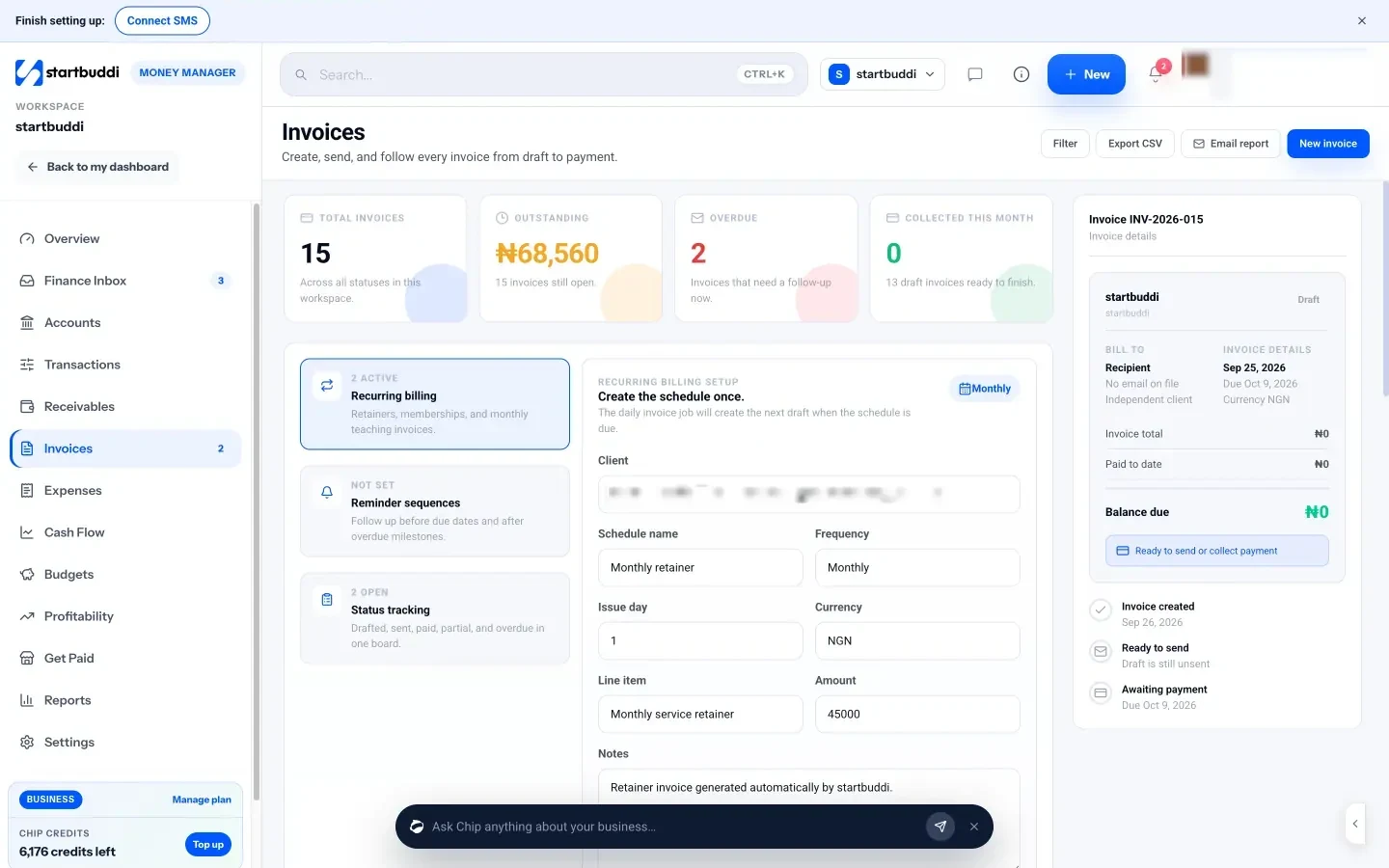
Invoices clients can pay. Invoice an existing client or a one-off recipient, add line items, tax and discount, and set the currency per invoice with any three-letter code. Turn on Paystack and Stripe payments and the client gets a Pay button on the invoice page, which also shows your bank transfer details and a PayPal link if you add them. Stripe and Paystack payments mark the invoice paid automatically.
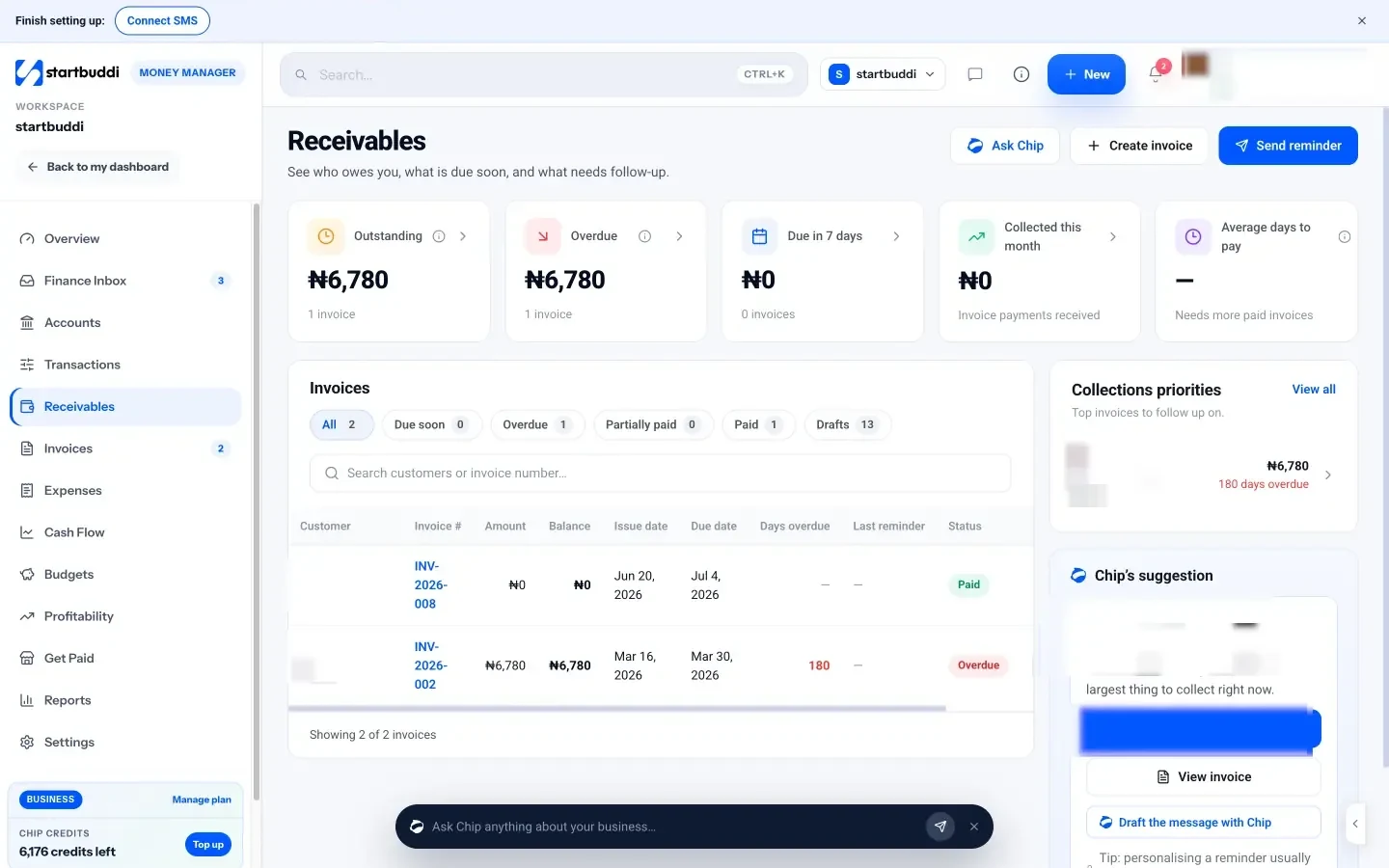
Partial payments. Record payments that arrive outside startbuddi, such as a bank transfer, with the amount, method, date and a note. Partial amounts are allowed, so a deposit or a payment net of withholding tax shows correctly.
Retainers and reminders. Recurring billing creates a draft on the day you choose, monthly or quarterly. Reminder sequences follow up before the due date, on the due date and on overdue days you pick, such as 3, 7 and 14.
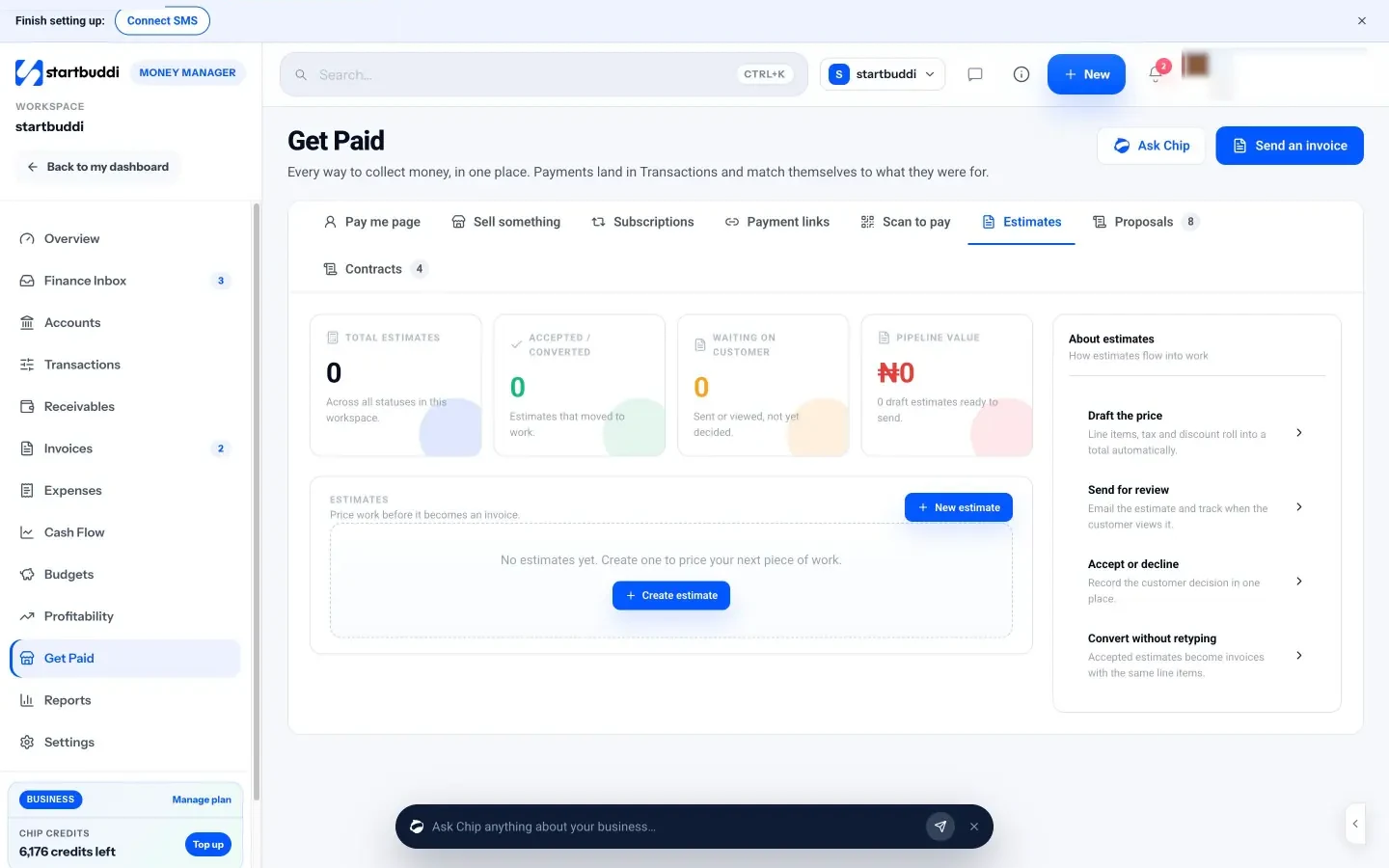
From quote to invoice. In Estimates, proposals and contracts, send an estimate, mark it accepted when the client agrees, and convert it into an invoice with the same line items. Contracts can be sent for e-signature.
Plans. Free includes 5 invoices a month. Starter and above include unlimited invoices (see pricing), with a 30-day trial.
Honest limits. This is not accounting software. It shows tax lines on invoices and a tax summary in reports, but it doesn’t file VAT or withholding tax returns, and it doesn’t sync with bank feeds, QuickBooks or Xero. Clients accept estimates by replying to your email rather than clicking an online button. PayPal and bank transfer payments are recorded by you, not confirmed automatically.
Your next step
List every client with their billing model, amount and due day. Set up the retainers as recurring invoices first, because they are the most predictable money you have. Try the free invoice generator for a one-off, see how startbuddi works for agencies, or read our guide to getting paid via Paystack.
Sources
- GOV.UK: largest crackdown on late payments in over 25 years
- Paystack Support: transaction fees and Paystack Invoices
- Stripe: global availability
- Nigeria Revenue Service
- BDO: Nigeria, new legislation includes important changes to VAT rules
- EY: Nigeria Tax Act 2025 has been signed, highlights
- PwC Worldwide Tax Summaries: Nigeria withholding taxes
- GOV.UK: what an invoice must include and IRS: recordkeeping
- Zoho Invoice pricing, Wave pricing, FreshBooks pricing, Invoice Ninja pricing
Frequently asked questions
Do Nigerian agencies have to charge VAT?
Many will. The standard rate is 7.5%, and the small company relief excludes professional services. Ask the Nigeria Revenue Service or an accountant how your services are classed.
How should I record a payment with withholding tax deducted?
Record the full invoice as settled: the amount received plus the tax withheld. Keep the client's evidence of the deduction, as you may be able to use it against your own tax.
Can clients abroad pay my agency by card?
It depends on your payment provider. Check which currencies and card types your provider supports for Nigerian businesses, and list bank or PayPal details as a backup.
Is invoicing software the same as accounting software?
No. Invoicing software creates bills and collects payments. Accounting software handles bookkeeping, reconciliation and tax returns. Many agencies use both, or an accountant for the second part.
Tiwalade Joanna Okedara-Kalu is the founder, CEO and CTO of startbuddi, the business system that brings clients, bookings, invoices, projects, marketing and the Chip AI assistant into one place. Tiwalade builds software around how service businesses really work day to day, and writes about client management, getting paid on time and why small businesses outgrow the tools they start with.
Founded startbuddi and leads its product and engineering