Client not paying an invoice? Why it keeps happening and what to do
Why a client keeps not paying your invoice, and a calm step-by-step response: find the reason, offer a plan, pause work, charge interest where allowed, send a final notice.


Chinonye wrote this while on the startbuddi team. The product has changed since, so the team updated it on .

- Treat a late payment as a process, not a fight. Confirm the invoice arrived, find out why it is late, agree a date or a payment plan, pause work if needed, then send a final notice before any formal action, keeping a written record throughout.
A client not paying invoice after invoice is something almost every business meets sooner or later. The way you respond decides whether you get your money and keep the relationship, or lose both. Handling a late payment professionally means following a calm, written escalation: confirm the invoice arrived, find out why it is late, agree a firm date or a payment plan, pause further work if needed, and only then move to late fees, a formal letter of demand or a claim. At every step, keep it factual and keep a record.
This guide covers each step, with templates for the firmer messages, a sample payment plan, what the law allows in some countries, and how to stop the same thing happening next time.
Why a client is not paying your invoice
Before you escalate, find out what kind of late payer you are dealing with. The right response depends on the reason.
| Reason | What it looks like | Best response |
|---|---|---|
| No clear terms | No due date, deposit or late policy was ever agreed | Agree a date in writing now, and set terms upfront next time |
| Admin problem | Invoice sent to the wrong person, missing purchase order number, lost in email | Resend to the right person with everything they need |
| Forgot | Friendly reply, “so sorry, paying today” | A clear reminder with the payment link |
| Cash problem | Client goes quiet or asks for more time | Agree a written payment plan |
| Dispute | Client is unhappy with the work or the amount | Talk it through, fix what is fair, invoice the rest |
| Won’t pay | Repeated promises, no payment, then silence | Formal escalation |
Most late payments fall into the first three rows. Treat every client as an honest one until they show you otherwise. It keeps your messages polite, and it keeps the door open for future work.
The late payment escalation ladder
Decide your steps in advance, so you never have to decide how angry to be on a bad day. Here is a ladder that works for most small businesses. If you have not yet sent friendly reminders, start with our guide on how to collect payment from a client, which covers the days around the due date.
| Days overdue | Action | Channel |
|---|---|---|
| 1 to 3 | Friendly check that the invoice arrived | Email or WhatsApp |
| 7 | Ask for a specific payment date | |
| 14 | Phone call, then an email confirming what was agreed | Phone and email |
| 21 | Pause new work and explain why | |
| 30 | Final notice with a deadline and next steps | Email, and a letter if you have an address |
| 45 or more | Letter of demand, then a claim or a collection agency | Formal letter |
You can move faster for small amounts or slower for long-standing clients. What matters is that each step is written down and the client always knows what happens next.
Step 1: make it easy to say yes
Before assuming the worst, remove every barrier. Resend the invoice as a PDF and as a link. Include the payment link and your bank details in the body of the email. Ask whether there is anyone else, such as an accounts team, who should receive it. Many “late” invoices are sitting unopened in an inbox nobody checks.
Then ask one direct question: “When can I expect payment?” A date is something you can hold them to. “Soon” is not.
Step 2: offer a payment plan when cash is the problem
If the client says they cannot pay in full, a payment plan often gets you more money, sooner, than a stand-off. Keep it simple and put it in writing.
Sample payment plan
Hi [Name], thanks for being open about this. To help, I’m happy to split invoice [INV-051] for [₦450,000] into three payments:
- [₦150,000] by [Friday 10 October]
- [₦150,000] by [Friday 24 October]
- [₦150,000] by [Friday 7 November]
If a payment is missed, the full remaining balance becomes due straight away. Could you reply to confirm this works? Here is the link for the first payment: [payment link].
Record each payment as it arrives, and send a short thank-you each time. It builds good habits on both sides.
Step 3: pause further work
If you are still working for a client who owes you money, you are lending to them for free. After a couple of missed dates, it is reasonable to pause new work until the account is up to date. Say it plainly and without drama:
Hi [Name], invoice [INV-051] for [₦450,000] is now 21 days overdue. As set out in our agreement, I’ll pause work on [next phase] until the account is up to date. As soon as payment arrives, I’ll pick up where we left off. Payment link: [link].
This works best when your terms already say so. If they don’t yet, add a line to your contract or proposal for next time. Our freelance agreement template is a good starting point.
Step 4: charge late fees and interest where allowed
Charging a late fee (our late fee calculator works out the amount) can encourage prompt payment, but only if it is agreed in advance and applied consistently. Put the fee in your terms, show it on your invoices, and mention it in reminders before you add it.
In some countries the law gives you rights even if your contract says nothing. In the UK, for business-to-business sales:
- If no payment date was agreed, a payment is late after 30 days from the invoice or delivery, whichever is later.
- You can usually claim statutory interest at 8% plus the Bank of England base rate, unless your contract sets a different rate.
- You can also claim fixed debt recovery costs of £40 for debts under £1,000, £70 for debts from £1,000 to £9,999.99, and £100 for £10,000 or more.
The UK government has also introduced a Commercial Payments Bill that would cap payment terms at 60 days and make late payment interest mandatory. It cites late payments as costing the UK economy £11 billion a year.
In New York State, the Freelance Isn’t Free Act requires a written contract for freelance work and payment within 30 days of completion unless the contract says otherwise, with double damages available when a hiring party breaks those rules.
Many countries have no specific late payment law for small suppliers, and where that is the case, your own written terms matter even more. This is general information, not legal advice. Check the rules where you and your client are based, and speak to a lawyer before taking formal action.
Step 5: send a final notice
If a date passes with no payment and no reply, send a final notice. It should be calm, factual and specific about what happens next.
Subject: Final notice: invoice [INV-051], [₦450,000], 30 days overdue
Dear [Name],
Invoice [INV-051] for [₦450,000], issued on [date] and due on [date], remains unpaid despite reminders on [dates]. Please pay the full amount by [date, 7 days from now] using [payment link] or the bank details below.
If payment is not received by then, I will [send a formal letter of demand / refer the debt for collection / start a small claim] without further notice. If there is a problem I am not aware of, please contact me before that date so we can resolve it.
Regards, [Your name, business name, phone]
Only name a next step you are really prepared to take. Empty threats teach clients to ignore you. For more variations, try our free late payment email writer.
Step 6: formal options if they still won’t pay
When messages have failed, you have a few formal routes. Weigh the amount owed against the time, cost and stress of each.
Letter of demand
A formal letter stating the debt, the amount, the deadline and the action you will take. A letter on a lawyer’s letterhead often gets a response when your own emails did not. In some courts, sending one is a required first step.
Small claims court
Many places have a simpler court for smaller debts where you can often represent yourself. In Lagos, for example, the small claims court was set up for straightforward money claims and has handled claims of up to ₦5,000,000, excluding interest and costs, with a letter of demand in the prescribed form served first. Limits and rules change, so confirm the current details with the court before you file.
Debt collection agency
An agency chases the debt for you and usually keeps a percentage of what it recovers. It can make sense for larger debts when you would rather spend your time on paying clients. Check that the agency is reputable and treats debtors fairly, because its behaviour reflects on your business.
Writing it off
Sometimes the most sensible business decision is to stop chasing. If the amount is small and the client has disappeared, write the invoice off, learn from it, and move on. Ask your accountant how to record it; in many tax systems a bad debt can reduce your taxable profit.
Keep a clear record at every step
Whatever route you take, a tidy paper trail makes it stronger. For each overdue invoice, keep:
- The signed quote, contract or written agreement.
- The invoice and proof that it was sent.
- Every reminder, with dates.
- Notes from phone calls, including any dates the client promised.
- Any partial payments received.
This record is also useful for your own planning. If one client is always 30 days late, your cash forecast should assume that. Our guide to cash flow management for small businesses shows how.
How to prevent late payments next time
The cheapest late payment is the one that never happens. For new work:
- Take a deposit on every project. See how much deposit to ask for.
- Agree terms in writing, including the due date, late fees and what happens to the work if payment stops.
- Invoice promptly with a clear due date and a way to pay online.
- Put the final payment before handover or launch, not after.
- Remind before the due date, not only after it.
- Check new clients, for example by asking how they usually pay suppliers and who approves invoices.
- Offer easy ways to pay, such as a card link as well as bank transfer, so a busy client can pay from their phone in a minute.
- Reward good payers with priority booking or a small loyalty discount, and keep firmer terms, such as full payment upfront, for clients who have paid late before.
How startbuddi helps you handle late payments
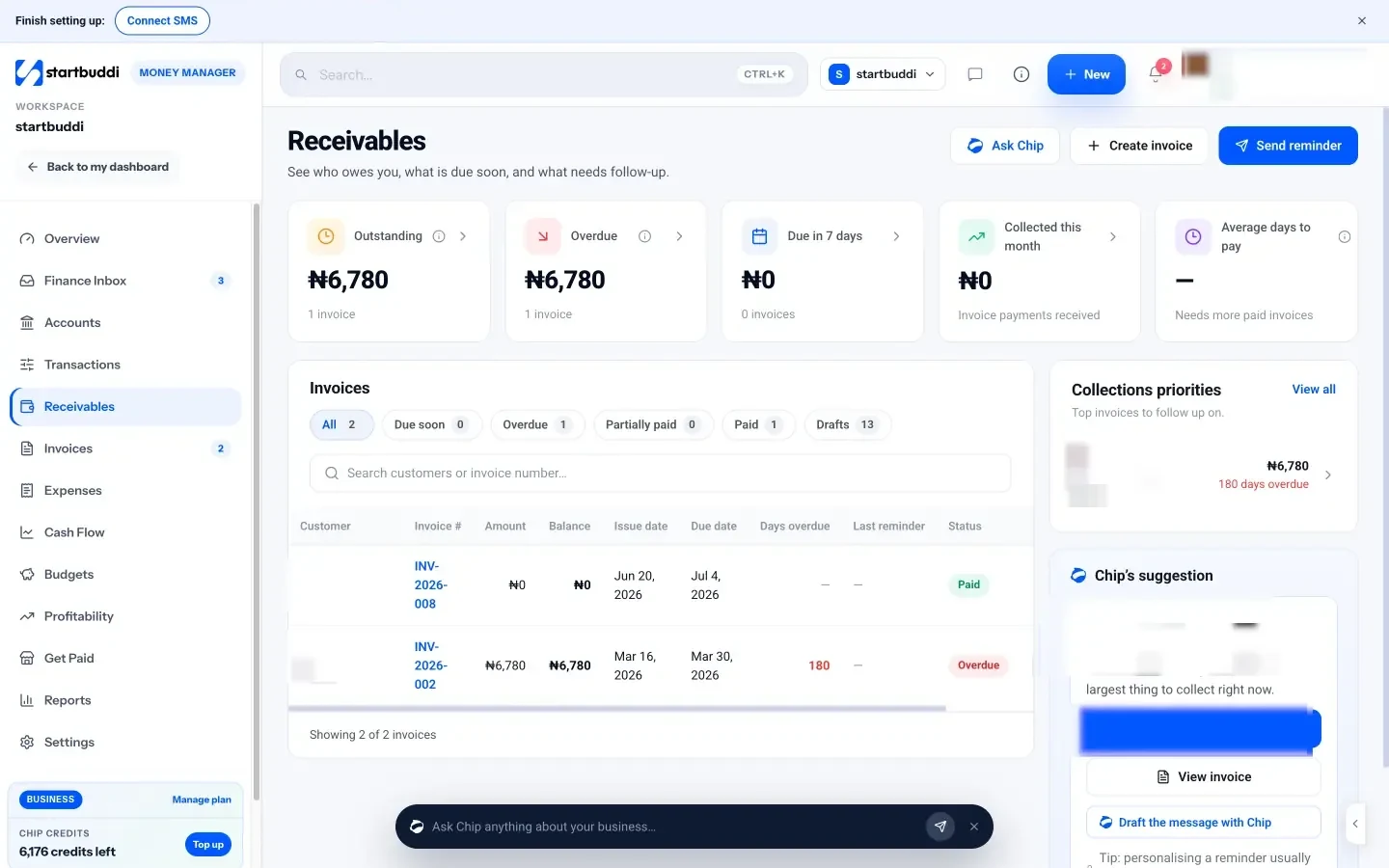
Money Manager in startbuddi shows you who owes what and gives you the tools to follow up, all next to the invoice itself.
- See overdue invoices first. Receivables shows what is outstanding and overdue, what is due in the next 7 days and the average days your clients take to pay. Collections priorities list the invoices to chase first, and each open invoice has a one-click Remind button.
- Draft the message with Chip. On an overdue invoice, Chip can draft a firm but friendly payment reminder, which you review and send. Chip can also answer “which invoices should I chase first, and why?”.
- Set your reminder schedule once. In Invoicing, reminder sequences let you choose reminders before the due date, on the due date and on overdue days such as 3, 7 and 14.
- Record part-payments. When a client pays some of an invoice by bank transfer or cash, Record payment updates the balance and the invoice shows Partially paid, which is ideal for payment plans.
- Keep the history. Each invoice has a timeline of when it was created, sent, viewed and paid, and resending an invoice logs a reminder on the client’s record.
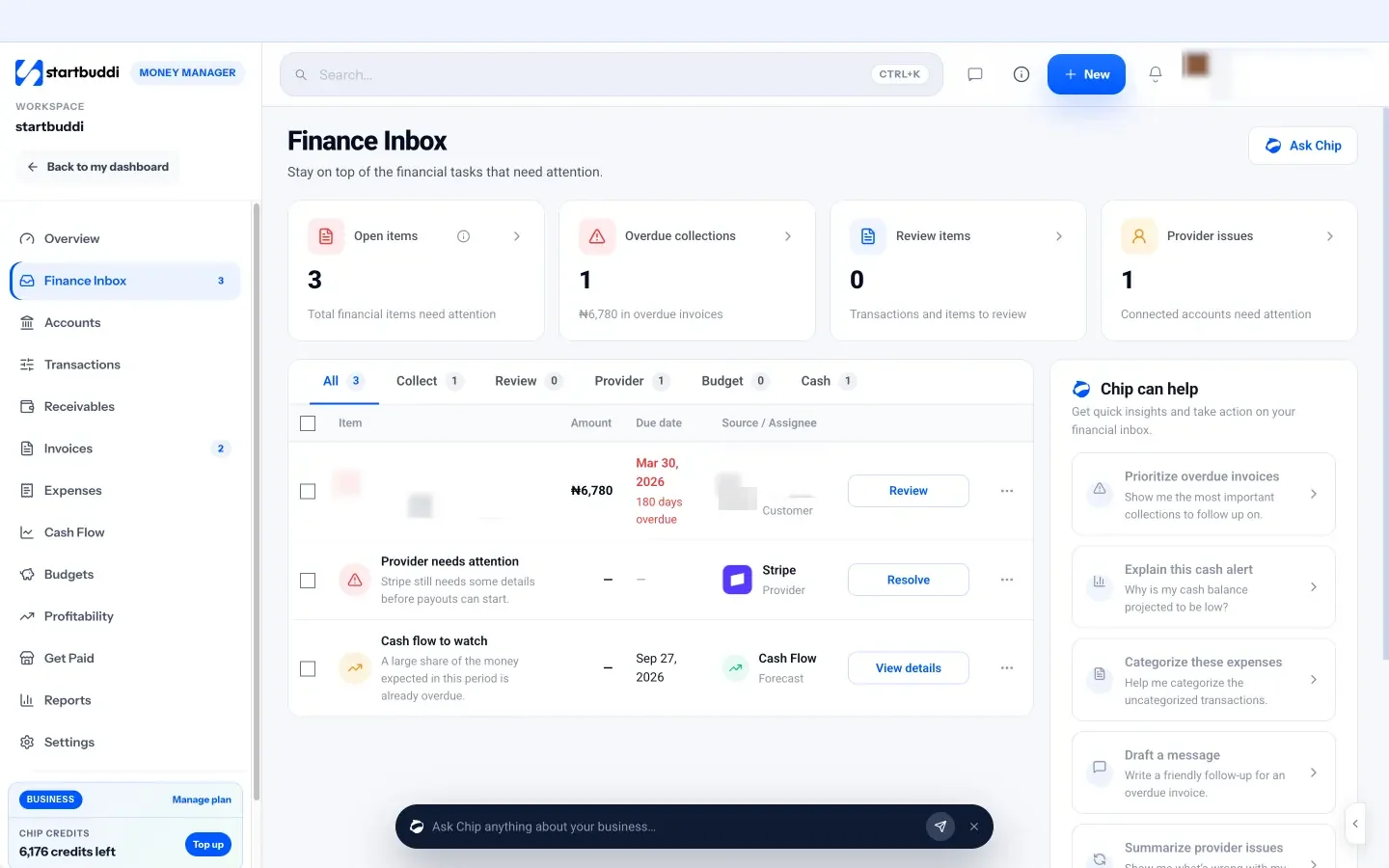
- Get told when something slips. The Finance Inbox flags overdue invoices and a projected cash shortfall, so you don’t have to remember to look.
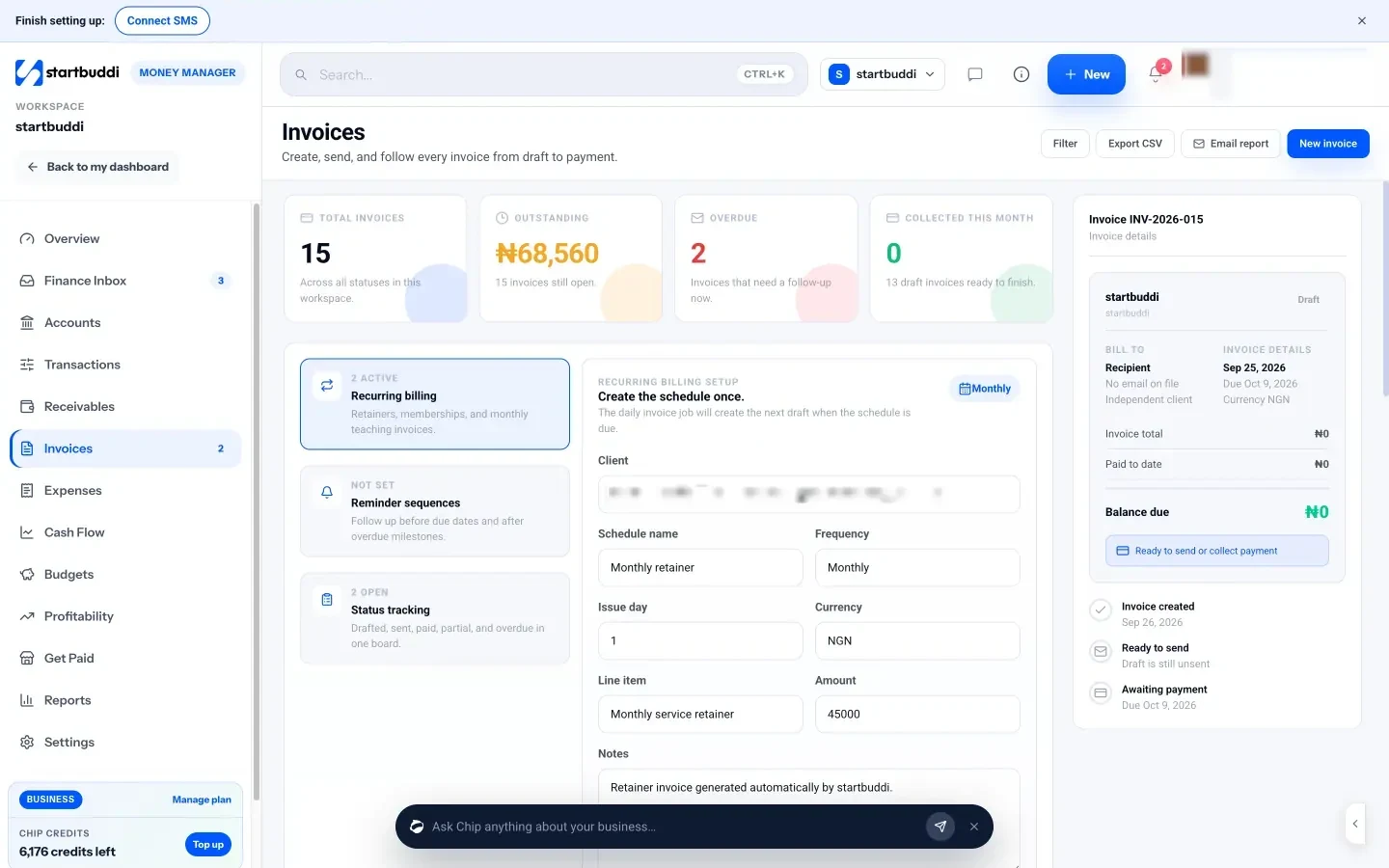
Invoicing is available on every plan, with 5 invoices a month on Free and unlimited invoices from Starter.
Your next step
Open your list of unpaid invoices today and sort them by how many days overdue they are. For each one, decide which step of the ladder it is on, and send that message now. Then add a late payment clause and a deposit to your standard terms so the next project starts on a firmer footing. When you want overdue invoices, reminders and payment plans in one place, see how invoicing works in startbuddi or compare the plans.
Sources
- GOV.UK: Late commercial payments
- GOV.UK: Interest on late commercial payments
- GOV.UK: Claim debt recovery costs on late payments
- GOV.UK: Commercial Payments Bill overview
- New York State Senate: Bill S5026 (Freelance Isn’t Free Act)
- Banwo & Ighodalo: Lagos State Small Claims Court
Frequently asked questions
When is an invoice officially late?
The day after the due date on the invoice or in your agreement. If no date was agreed, the law in some countries sets one, such as 30 days in the UK for business sales.
Can I charge a late fee if it wasn't in my terms?
Usually only if the law gives you that right, as the UK does for business-to-business sales. Otherwise, add a late fee to your terms for future work.
Should I stop working for a client who hasn't paid?
Pausing new work after missed payment dates is reasonable, especially if your terms say so. Tell the client clearly and restart as soon as they pay.
Is it worth going to court over a small invoice?
Sometimes. Small claims courts are designed for simple debts, but weigh the time and cost against the amount owed. A letter of demand often works first.
SEO Copywriter| Email growth Specialist| I help businesses increase revenue with strategic SEO content & high-converting email funnels.