Business Audit Checklist: Step-by-Step List + Free Template
A business audit checklist for small businesses: money, customers, marketing, operations, team, systems and risk, plus a scorecard template you can copy.


A business audit checklist is a structured review of how your business is really doing: money, customers, marketing, operations, team, systems and risk. You score each area, write down what’s weak and set one action with an owner and a date. For a small business, a full audit takes a day and is worth doing every six to twelve months.
Key takeaways
- An internal business audit is a health check you run yourself. It isn’t the statutory audit an accountant signs, which many small companies are exempt from.
- Audit seven areas in order: money first, then customers, marketing, operations, team, systems and risk.
- Use numbers wherever you can. “Cash is fine” is an opinion; “38 days of costs in the bank” is a finding.
- Score each area red, amber or green, and fix the two reds that matter most before anything else.
- It sits alongside, not instead of, a year-end checklist and a compliance checklist.
What a business audit is (and isn’t)
Two different things share the name.
- An internal business audit is what this checklist covers: the owner, sometimes with a manager or adviser, reviewing performance and processes to find what’s working, what’s leaking money and what to fix next.
- A statutory or external audit is an independent check of your financial statements by a qualified auditor. Whether you need one depends on your country, structure and size. In the UK, for example, a private company can usually skip the statutory audit if it meets two of three conditions: turnover of £15 million or less, assets of £7.5 million or less, and 50 or fewer employees on average (checked on 1 October 2026). Ask your accountant what applies to you in Nigeria, Kenya or elsewhere.
This checklist also isn’t a list of legal filings. For those, use our small business compliance checklist. For closing the books each year, use the business year end checklist. The audit asks a different question: is the business healthy, and where should your effort go next?
The business audit checklist
Work through the areas in order, writing the actual number next to each item where there is one. Skip items that don’t apply to your business.
1. Money
2. Customers
3. Marketing and sales
4. Operations
5. Team
6. Systems and records
7. Risk and the year ahead
Business audit scorecard template
Copy this table into a document or spreadsheet. Give each area a rating, one key finding, one action, an owner and a date. One action per area is enough; seven actions done beat twenty planned.
| Area | Rating (red, amber, green) | Key finding | Action | Owner | Due |
|---|---|---|---|---|---|
| Money | |||||
| Customers | |||||
| Marketing and sales | |||||
| Operations | |||||
| Team | |||||
| Systems and records | |||||
| Risk and the year ahead |
Rating guide: green means working and measured; amber means working but not measured, or slipping; red means it’s costing you money or customers now.
Worked example: a Lagos design agency’s audit
A six-person design agency in Lagos runs the checklist in November. These figures are illustrative.
| Measure | Finding | Rating |
|---|---|---|
| Revenue, last 12 months | ₦24,000,000 | Green |
| Largest client’s share | ₦10,800,000, or 45% | Red |
| Owed to the agency | ₦6,000,000, of which ₦3,600,000 (60%) is over 30 days overdue | Red |
| Cash in the bank | ₦2,400,000 against ₦1,800,000 monthly costs, about 40 days | Amber |
| Unused subscriptions | Three tools at ₦45,000 a month in total | Amber |
| Written steps for repeat work | None for brand projects | Amber |
Two reds stand out. First, if the largest client leaves, the agency loses 45% of its revenue overnight. The action: win two new retainer clients in the next quarter, owned by the founder. Second, ₦3,600,000 is sitting in overdue invoices, which is two months of running costs. The action: chase every overdue invoice this week, and from next month take a 50% deposit before starting work.
Cancelling the three unused tools saves ₦45,000 a month, or ₦540,000 a year (₦45,000 × 12), for ten minutes’ work. Not every finding needs a project.
How often to run a business audit
| Business stage | How often | Tip |
|---|---|---|
| First year | Every six months | Focus on money and customers; the rest can be light. |
| Established, owner-run | Once a year, plus a quick money check each quarter | Run it a month before year end, so actions feed next year’s plan. |
| Growing team | Once a year in full, one area a month in between | Rotate areas so the audit never becomes a one-day panic. |
Common business audit mistakes
- Auditing from memory. Pull the real numbers first; most surprises are in the money section.
- Trying to fix everything. Pick the two reds that matter most and finish them.
- Doing it alone in your head. Ask one team member or an adviser to challenge your ratings.
- Treating it as a compliance exercise. Filings and deadlines belong on your compliance calendar; the audit is about performance.
- Not booking the next one. Put the date in your calendar before you finish.
How to do this business audit checklist in startbuddi
startbuddi isn’t accounting software and doesn’t replace an accountant, but it holds many of the numbers this audit needs and turns the actions into tasks.
- Save the checklist as a task. In Work, add a task called “Business audit” with a subtask for each area and a due date. If you audit one area a month, set Repeats to Monthly.
- Check the money section. In Money Manager, the Receivables page shows outstanding and overdue invoices, and Reports shows a profit and loss you can export as CSV for your accountant.
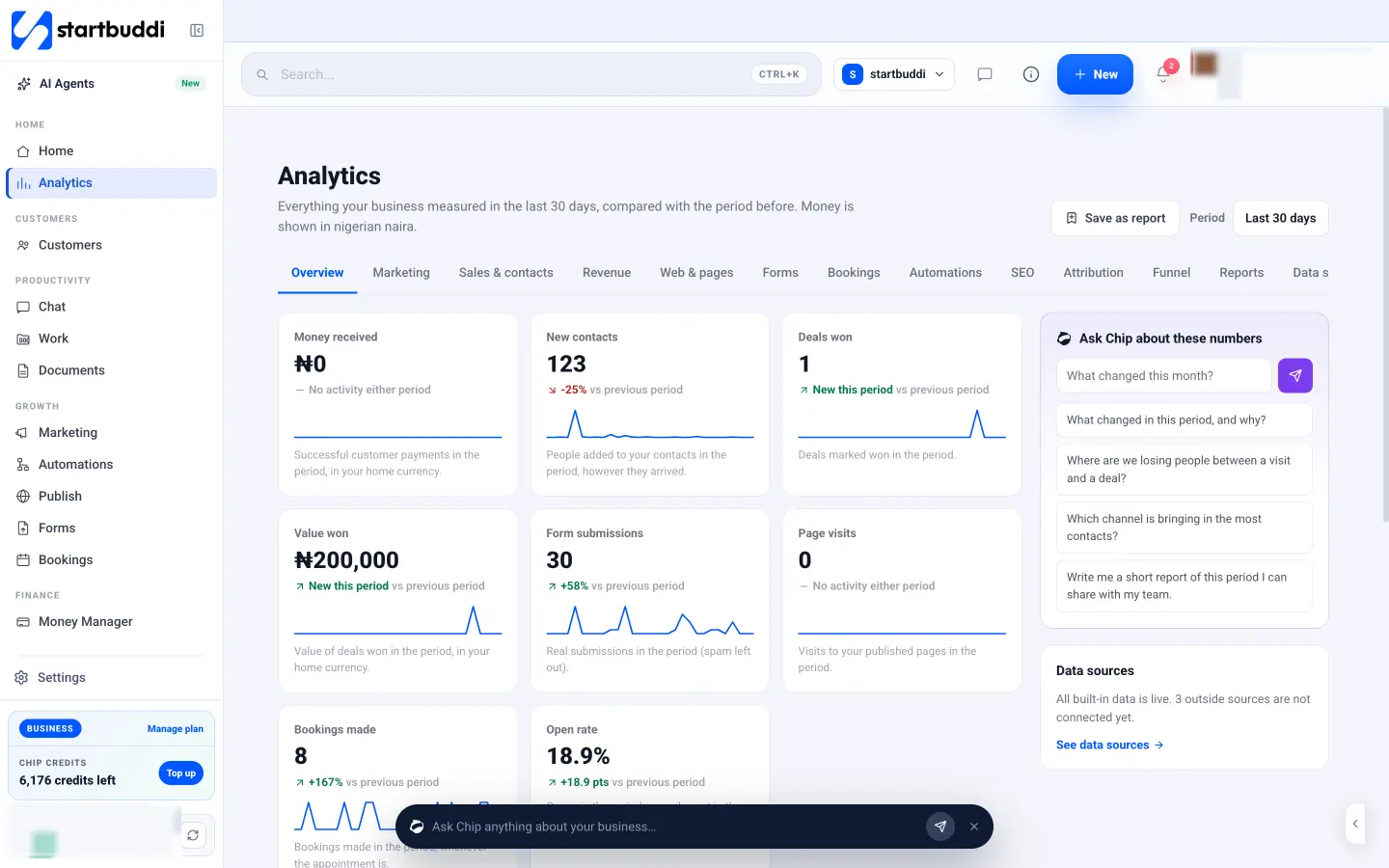
- Compare with last period. Analytics compares money, contacts, deals, bookings and more with the previous period, so you can see what changed.
- Review customers. In Customers, filter contacts by last contacted to find clients who have gone quiet.
- Assign the actions. Turn each action from the scorecard into a task with an owner and a due date, so it doesn’t stay in a spreadsheet.
For more on keeping money under control between audits, read our guide to managing small business finances, or see how startbuddi works as a business finance manager. A free plan is available; see pricing.
Turn your audit into actions
Copy the checklist and scorecard, run them this month, and track every action to the end. Start free with startbuddi to keep your numbers, customers and tasks in one place.
Frequently asked questions
What should be on a business audit checklist?
A business audit checklist should cover money, customers, marketing and sales, operations, team, systems and records, and risk. For each area, record the real numbers, rate it red, amber or green, and set one action with an owner and a date. The money section usually matters most for a small business.
How often should a small business do an internal audit?
Most small businesses should run a full internal audit once a year, with a quick check of cash, receivables and margins each quarter. In the first year of trading, every six months is better, because things change fast. Growing teams can audit one area a month instead of everything at once.
Is a business audit the same as a financial audit?
No. A business audit, as used here, is an internal review of how the whole business is performing. A financial or statutory audit is an independent check of your accounts by a qualified auditor, and many small companies are exempt from it. Your accountant can tell you whether you need one.
Does a small business need an external audit?
It depends on your country, company type and size. In the UK, private companies that meet two of three conditions (turnover of £15 million or less, assets of £7.5 million or less, 50 or fewer employees) are usually exempt. Other countries have their own thresholds, and lenders or investors may ask for audited accounts anyway.
How long does a small business audit take?
Expect one full day for a small business with good records, plus time beforehand to pull the numbers. If your invoices, expenses and customer details are scattered, gathering them can take longer than the audit itself. That's a finding in its own right.
Tiwalade Joanna Okedara-Kalu is the founder, CEO and CTO of startbuddi, the business system that brings clients, bookings, invoices, projects, marketing and the Chip AI assistant into one place. Tiwalade builds software around how service businesses really work day to day, and writes about client management, getting paid on time and why small businesses outgrow the tools they start with.
Founded startbuddi and leads its product and engineering