What is profit margin?
Also called: Margin, profit percentage, gross margin, net margin, operating margin
Profit margin is the share of your revenue that you keep as profit, shown as a percentage. It is profit divided by revenue, times 100: a 25% margin means you keep $25 of every $100 you sell.
How to calculate it
For gross margin, count only the direct cost of delivering the work. For net profit margin, count every cost.
Profit margin is the percentage of each sale that you keep as profit after costs. If you sell something for $100 and your costs are $75, your profit is $25 and your profit margin is 25%. So what is profit margin really telling you? It shows how efficiently your business turns sales into money you can keep, reinvest or pay yourself.
Revenue on its own can fool you. A business that sells $500,000 a year with a 2% margin keeps $10,000. One that sells $150,000 with a 30% margin keeps $45,000. Margin is what tells them apart.
How to calculate profit margin
The formula is the same for every type of margin:
Profit margin = (profit ÷ revenue) × 100
What changes is which costs you subtract to get “profit”. Here is a worked example for a small cleaning company in one month:
| Line | Amount |
|---|---|
| Revenue from cleaning jobs | $12,000 |
| Direct costs (cleaners’ pay per job, supplies) | $7,200 |
| Gross profit | $4,800 (gross margin 40%) |
| Running costs (van, software, phone, office) | $2,400 |
| Operating profit | $2,400 (operating margin 20%) |
| Loan interest and tax | $600 |
| Net profit | $1,800 (net margin 15%) |
If you want to try your own numbers, our profit margin calculator does the maths for you.
The three main types of profit margin
Gross margin
Revenue minus the direct cost of delivering what you sold (materials, stock, the pay of the people doing the job), divided by revenue. It tells you whether your pricing covers the work itself.
Operating margin
Gross profit minus your running costs (rent, software, marketing, admin), divided by revenue. It tells you whether the business as a whole runs at a profit before financing and tax.
Net margin
What is left after every cost, including interest and tax, divided by revenue. It is the “bottom line”. Our entry on gross vs net profit explains the difference in more detail.
What is profit margin used for in a small business?
- It tests your prices. A low gross margin usually means you are charging too little for the work. See our guide on how to price your services.
- It shows which work to do more of. Two clients paying the same fee can have very different margins if one needs twice the hours.
- It protects cash. Thin margins leave no room for a late payer or a price rise from a supplier.
- It helps you compare over time. Margin going down while sales go up is an early warning.
- It guides growth decisions. Before you hire, rent a bigger space or run ads, margin tells you how much new revenue each extra cost needs. At a 20% net margin, a new $1,000 monthly cost needs about $5,000 of extra monthly sales just to stand still.
Profit margin vs markup
These two are often confused, and the mix-up leads to underpricing. Markup is profit as a percentage of cost. Margin is profit as a percentage of price.
Example: a caterer in Lagos spends ₦60,000 on ingredients and labour for an order and charges ₦80,000. The profit is ₦20,000. The markup is 33% (₦20,000 ÷ ₦60,000), but the margin is 25% (₦20,000 ÷ ₦80,000). If she wanted a 33% margin she would need to charge about ₦90,000, not ₦80,000.
Common mistakes
- Leaving out your own time. If you do the work yourself and do not count your pay as a cost, your margin looks healthier than it is.
- Forgetting small costs. Payment fees, software and travel add up. Expense tracking catches them.
- Only looking at the whole business. Check margin by client, service or product, not just the total.
- Chasing revenue at any price. Discounts and “free extras” can win work that loses money.
Related terms
Gross and net profit are the amounts behind gross and net margin. Billable hours matter for service businesses because unbilled time quietly eats margin. Upselling can raise margin when premium tiers cost little extra to deliver.
Profit margin in startbuddi
Money Manager has a Profitability page that shows revenue collected minus attributed expenses for each project, customer, product or service, and marketing campaign, with profit and margin side by side. Stat cards show gross operating profit, average margin, your best performer and your lowest margin. Team labour costs are not included, so add your own time to the picture when you read it.
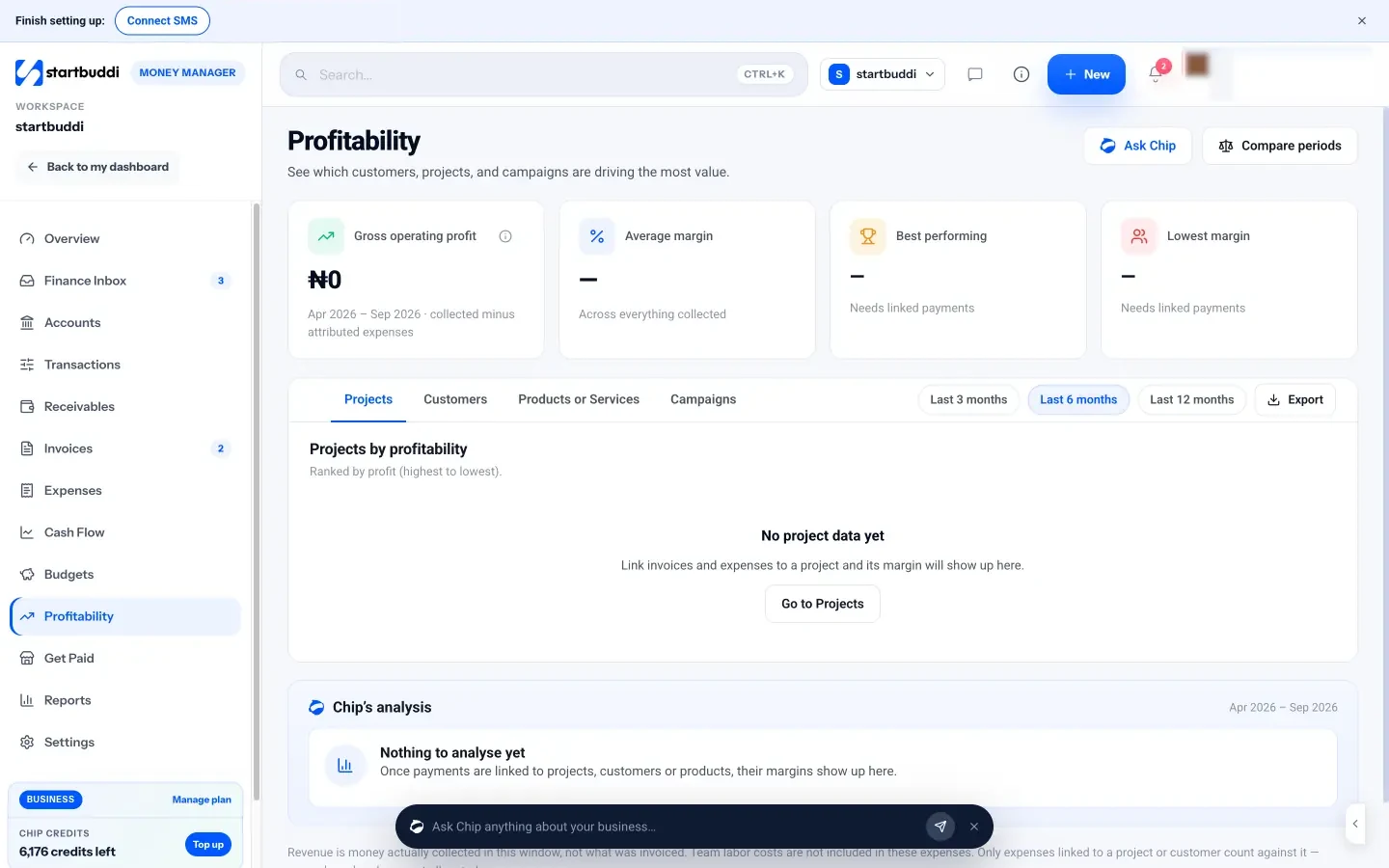
The figures come from the invoices and expenses you already record, and the Reports tab adds a cash-basis profit and loss for the month, quarter or year. It is a management view, not statutory accounting, so your accountant still prepares official accounts. Your next step: pick your three biggest clients and check the margin on each. The cash flow, budgets and profitability page explains what the views show.
Related terms
FAQ
What is a good profit margin for a small business?
It depends on the industry. Service businesses often have higher gross margins than shops that resell stock. Compare yourself with similar businesses and with your own past results.
How do I calculate profit margin?
Divide profit by revenue and multiply by 100. If you earn $2,000 profit on $10,000 of sales, your margin is 20%.
What is the difference between margin and markup?
Markup is profit as a percentage of cost. Margin is profit as a percentage of the selling price. The same sale always has a higher markup than margin.
How can I improve my profit margin?
Raise prices where your value supports it, cut costs that do not help customers, stop taking unprofitable work, and sell more of your highest-margin services.
Chinedu Kalu is the co-founder and chief operating officer of startbuddi, responsible for how the company runs day to day. Chinedu writes about the operational side of a small business: registering and running the company, money, hiring and the routines that keep a team on track.
Co-founded startbuddi and runs its operations