Small Business Compliance Checklist: Step-by-Step List + Free Template
A small business compliance checklist for registration, tax, staff, data, licences and yearly filings, with notes for Nigeria, Kenya, the UK and the US.



A small business compliance checklist lists the legal jobs that keep your business in good standing: registering it, registering and filing for tax, meeting employer duties when you hire, protecting customer data, holding the right licences and insurance, and filing annual returns on time. Most items repeat, so a dated calendar matters as much as the list.
This page is general information, not legal or tax advice. Rules differ by country, state and industry, and they change, so confirm each item with the official body or a qualified adviser where you operate.
Key takeaways
- Compliance comes in waves: once when you register, again when you hire, and then on a monthly and yearly cycle.
- The deadlines that catch small businesses out are rarely the big ones. They’re annual returns, renewals and payroll remittances nobody owns.
- Hiring your first employee adds the most new duties at once: payroll tax, pension and insurance.
- Data protection applies to small businesses too. A contact list and a WhatsApp customer group both count as personal data.
- Give every item an owner, a due date and a place where the proof lives.
What a small business compliance checklist covers
Compliance means following the rules that apply to your business because of what it is (a company or sole trader), where it trades, who it employs and what it does. A business compliance checklist turns those rules into tasks you can tick off.
For a service business, the list usually covers six areas: the business’s legal registration, tax, employment, data protection and marketing, licences and insurance, and record keeping. Sector rules sit on top: a clinic, a food business or an electrician has extra licences that a consultant doesn’t.
The small business compliance checklist
Copy this list into your own document or task manager, delete what doesn’t apply, and add your sector’s rules.
1. When you set up the business
2. Tax, every month and every year
3. When you hire your first employee
4. Customer data and marketing
5. Licences, permits and insurance
6. Every year
Country notes: what this looks like in practice
These are the obligations small service businesses most often miss in four countries we write for. Each list is a starting point, not the full set.
Nigeria
- Annual returns. Registered companies and business names file annual returns with the Corporate Affairs Commission (CAC). The CAC began applying the full late-filing penalties in the Companies Regulations 2021 from 1 January 2024, against companies and their directors. Our guide on registering a business in Nigeria covers the set-up side.
- Tax. The Nigeria Tax Act 2025 took effect on 1 January 2026, and the Federal Inland Revenue Service is now the Nigeria Revenue Service (NRS). Sole traders pay income tax to their state internal revenue service. See the Nigeria section of our tax checklist and our page on VAT for small businesses in Nigeria.
- Pension. PenCom says the Pension Reform Act 2014 applies to private organisations with three or more employees, which must remit contributions into each employee’s retirement savings account.
- Data protection. The Nigeria Data Protection Act 2023 applies to businesses that handle personal data. Some must register with the Nigeria Data Protection Commission. According to the NDPC’s FAQs (checked on 1 October 2026), those that file Compliance Audit Returns do so each year before 31 March, through a licensed Data Protection Compliance Organisation.
Kenya
- Turnover tax. Residents with gross turnover above KSh 1 million and up to KSh 25 million pay turnover tax at 1.5% of gross sales, filed and paid by the 20th of the following month (KRA, checked on 1 October 2026). It doesn’t apply to rental income or professional fees, so many consultants follow the normal income tax rules instead.
- Annual returns. Companies file annual returns with the Business Registration Service through eCitizen.
- Data protection. The Office of the Data Protection Commissioner says organisations processing personal data must register, unless both their annual turnover is below KSh 5 million and they have fewer than 10 employees. Some sectors, such as health, education and financial services, must register whatever their size. A certificate lasts 24 months.
United Kingdom
- Confirmation statement. Every company must file at least one confirmation statement every 12 months. It costs £50 online and £110 by post (GOV.UK, checked on 1 October 2026), on top of annual accounts and the Company Tax Return.
- Identity verification. Since 18 November 2025, existing company directors confirm their identity has been verified when they file their next confirmation statement, during a 12-month transition.
- VAT. You must register if your taxable turnover goes over £90,000 in the last 12 months, or you expect it to in the next 30 days.
- Employers. Employer’s liability insurance with at least £5 million of cover is compulsory once you employ someone, with limited exceptions, and the fine for not having it is up to £2,500 for every day you’re not properly insured.
- Data protection. The ICO says organisations, including sole traders, that use personal information must pay a data protection fee unless they’re exempt.
United States
- State filings. The SBA’s guide to staying legally compliant (checked on 1 October 2026) notes that most states require an annual report or biennial statement, and that fees can exceed $300.
- Federal tax and employees. Get an EIN, collect a W-4 from each new employee, and pay federal and state employment taxes. The SBA suggests keeping employment records for at least four years.
- Licences. Licences and permits come from federal, state, county and city agencies depending on what you do and where, and many expire and must be renewed.
- Beneficial ownership. FinCEN now exempts companies created in the US from beneficial ownership information (BOI) reporting. Foreign companies registered to do business in a state may still need to file.
Your compliance calendar template
A checklist tells you what to do. A calendar tells you when. Copy this table and add one row per obligation.
| Obligation | Applies because | How often | Next due | Owner | Proof kept in |
|---|---|---|---|---|---|
| Annual return or confirmation statement | Registered company | Yearly | |||
| Tax return | Registered for income or company tax | Yearly | |||
| VAT or turnover tax return | Registered for VAT or turnover tax | Monthly or quarterly | |||
| Payroll tax remittance | Employer | Monthly | |||
| Pension remittance | Employer above the threshold | Monthly | |||
| Employer’s insurance renewal | Employer | Yearly | |||
| Data protection registration or fee | Uses personal data | Yearly or as set | |||
| Trade licence or permit | Regulated activity | As stated on the licence | |||
| Policy review | Has staff | Yearly |
Fill in “Next due” from the official notice or your registration documents, not from memory. “Proof kept in” is where the receipt, filing confirmation or certificate lives, so you can show it if a client, bank or regulator asks.
Worked example: a monthly compliance hour in Nairobi
Wanjiru runs a small cleaning business in Nairobi with turnover that qualifies for turnover tax. The figures are illustrative.
In one month her business invoices KSh 260,000 of cleaning services. Turnover tax at 1.5% is KSh 260,000 × 0.015 = KSh 3,900, due by the 20th of the next month. Over a year with similar months (KSh 3,120,000 of sales), that’s KSh 46,800 in turnover tax, paid in twelve small amounts instead of one surprise.
Her monthly compliance hour, booked for the 10th of each month:
- Total last month’s invoices and confirm the turnover figure.
- File and pay turnover tax, and save the payment slip.
- Pay staff and remit statutory deductions on time.
- Check the calendar for anything due in the next 60 days, such as a county business permit or insurance renewal.
- File receipts and bank statements for the month.
One hour a month, with an owner and a date, is what keeps the yearly filings easy. Our business year end checklist covers the bigger close-off.
Common compliance mistakes
- Nobody owns it. “The accountant handles that” often means nobody is watching the registry deadline.
- Missing the hiring trigger. Employer duties start with your first employee, not when payroll feels big.
- Forgetting nil returns. Some tax offices expect a return even when you owe nothing.
- Letting the public register go stale. Old directors, addresses or owners on the register cause problems at the bank and with clients.
- Treating data protection as a big-company problem. A customer list on a phone is personal data. See our cybersecurity checklist for the security side.
- Keeping proof in someone’s inbox. If the person leaves, the evidence goes with them.
How to do this compliance checklist in startbuddi
startbuddi isn’t accounting or tax software and doesn’t file returns for you. What it does well is make sure each obligation has an owner, a date and a place for the proof.
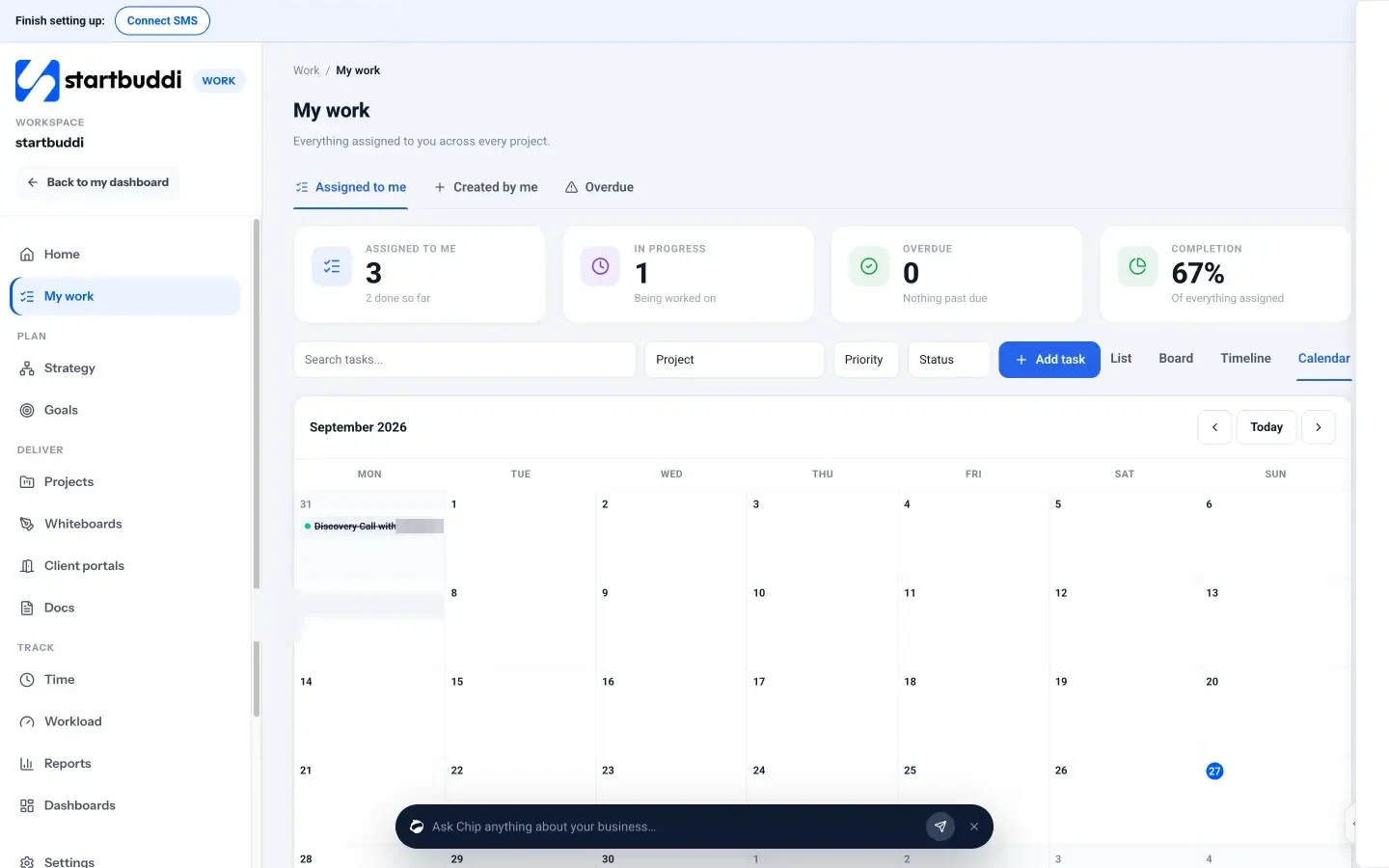
- Turn each obligation into a task. In Work, open My work, click Add task and give it a due date and an owner. For monthly duties such as tax or payroll remittances, set Repeats to Monthly. For yearly filings, create the task with this year’s due date and add next year’s when you file.
- Break big filings into subtasks. Open the task and use “+ Add subtask” for each step, such as “collect bank statements” or “send figures to accountant”.
- Keep the proof with the task. Attach the filing confirmation or certificate to the task, or link a document, so the evidence sits next to the deadline.
- Get staff policies acknowledged. In People, publish your workplace policies and track who has acknowledged them. When a policy changes, everyone is asked to acknowledge it again. Pair this with good employee onboarding and a clear employee handbook.
- Record marketing consent. In Forms, mark the consent question as “Counts as marketing consent” so you know who agreed to hear from you. A double opt-in gives you stronger proof.
A free plan is available, so you can set up your compliance calendar before you pay for anything. See pricing for what each plan includes, or how startbuddi works as a CRM for service businesses. For the full set-up journey, read our guide to starting a service business.
Make compliance a monthly habit
Copy the checklist, fill in the calendar and give each line an owner. Start free with startbuddi to turn every deadline into a dated task with the proof attached.
Frequently asked questions
What should be on a small business compliance checklist?
A small business compliance checklist should cover business registration, tax registration and filings, employer duties, data protection and marketing consent, licences and insurance, and annual filings with the business registry. Add rules specific to your industry and location. Each item needs a due date and an owner.
How often should I review my compliance checklist?
Check upcoming deadlines every month and review the whole list once a year. Also review it whenever something changes: you hire your first employee, cross a tax threshold, open a new location or start a regulated service. Laws change too, so check official sources each year.
What compliance does a business need when it hires its first employee?
Most countries require you to check the right to work, give written terms, register as an employer, deduct and pay payroll tax, and make pension or social security contributions. Some also require employer's insurance. In the UK, employer's liability insurance with at least £5 million of cover is compulsory for most employers.
Do small businesses need to follow data protection law?
Yes. Data protection laws such as the UK GDPR, Nigeria's Data Protection Act 2023 and Kenya's Data Protection Act 2019 apply to businesses of all sizes that handle personal data. Some regulators require registration or a fee, with exemptions for very small businesses in certain countries.
What happens if I miss an annual return?
Late annual returns usually lead to penalties, and repeated failure can lead to the business being struck off the register. In Nigeria, the CAC applies penalties to companies and their directors. File as soon as you notice, and set a reminder for next year.
Is a compliance checklist the same as legal advice?
No. A checklist helps you organise what to do, but it can't tell you exactly which rules apply to your business. For your structure, sector and location, confirm with the official body or a qualified lawyer or accountant.
Omolola Akiyode is the operations and project manager at startbuddi, leading cross-functional projects and the content that helps founders get set up. Omolola writes about projects, websites and getting found online, and turns complex ideas into clear, practical steps.
Runs operations and projects at startbuddi