What is employee onboarding?
Also called: New hire onboarding, staff induction, employee induction, preboarding, orientation
Employee onboarding is the process of welcoming a new hire and preparing them to do their job, from paperwork, equipment and accounts before day one to training and first goals over the first weeks.
What is employee onboarding? It is the process of welcoming a new hire and getting them ready to do their job well: the paperwork, the equipment and logins, the introductions, the training and the first goals. Good onboarding starts before day one and usually runs for the first few weeks or months, not just the first morning.
It is different from orientation. Orientation is a single session about the company. Onboarding is the whole journey from “offer accepted” to “fully up to speed”.
Why employee onboarding matters for a small business
In a small team, every hire is a big investment, and a slow or confused start is expensive. There is no HR department to catch what the owner forgets.
- Faster productivity. A new hire with a laptop, logins and a clear first week is useful sooner.
- Better retention. People decide early whether they made the right choice. A chaotic first week plants doubt.
- Fewer mistakes. Training people on how you do things avoids learning by trial and error on real customers.
- Less of your time. A repeatable checklist means you are not reinventing the process for each hire.
What is employee onboarding in practice? An example
Chinedu owns a digital marketing agency in Abuja with six staff. He hires a junior designer, Ada, starting on the 1st. His onboarding plan:
- Before day one: send the signed offer and a welcome email, order her laptop, create her email and tool accounts, and tell the team who she is.
- Day one: a tour, lunch with the team, a walk through the company handbook, and a meeting with her manager to agree the first two weeks.
- Week one: shadow a senior designer, read the brand guidelines for the three main clients, complete the tool training.
- First month: take on her first small client task, weekly check-ins with her manager.
- Day 90: a review of her 30/60/90-day goals and the end of probation.
Each step has an owner (Chinedu, the manager, the office admin or Ada herself) and a due date, so nothing depends on anyone remembering.
The four stages of onboarding
| Stage | When | What happens |
|---|---|---|
| Preboarding | Offer accepted to day one | Contracts, right-to-work checks, equipment, accounts, welcome message |
| Orientation | Day one and week one | Introductions, company values, policies, tools, where things are |
| Training | First weeks | Role-specific skills, shadowing, first real tasks |
| Transition | Up to 90 days | Goals, feedback, end of probation, full responsibility |
Best practices and common mistakes
- Use a checklist. Write the steps once and reuse them for every hire. Our client onboarding checklist is built for clients, but the same structure works for staff.
- Get the basics ready before day one. Nothing says “we were not expecting you” like a missing laptop.
- Involve the manager. The person they will work with every day should own the plan, set the first tasks and hold the early check-ins. Onboarding handed entirely to admin feels like paperwork, not a welcome.
- Give them a buddy. A friendly colleague who is not their manager answers the small questions people feel silly asking: where things are saved, how to book leave, who to ask about what.
- Do not dump everything on day one. Spread information over weeks. Nobody remembers twenty policies from one morning.
- Set early goals. A 30/60/90-day plan gives the new hire a clear picture of success.
- Ask for feedback. After a month, ask what was confusing. Fix it for the next person.
For the full step-by-step, read our post on how to onboard a new employee, and our guide on how to train employees covers the training stage in depth.
Related terms
Employee offboarding is the mirror image: handing over work and closing access when someone leaves. A performance review often marks the end of probation. An org chart helps new hires see who is who.
Employee onboarding in startbuddi
Onboarding in People walks you through a short wizard: choose who is starting (a brand-new hire, who gets an email invite, or someone already in your account), add their job title, department, manager, start date and location, pick a checklist template and start. Due dates count from the start date.
The built-in “Company onboarding” template covers the standard first two weeks, including a request to prepare a laptop and set up workspace access. Each step has an owner (the new hire, their manager, HR or IT / Admin), and everyone is notified when a step is assigned to them. You can add steps, send reminders for overdue ones, and complete onboarding when every step is done; the hire then becomes an active employee.
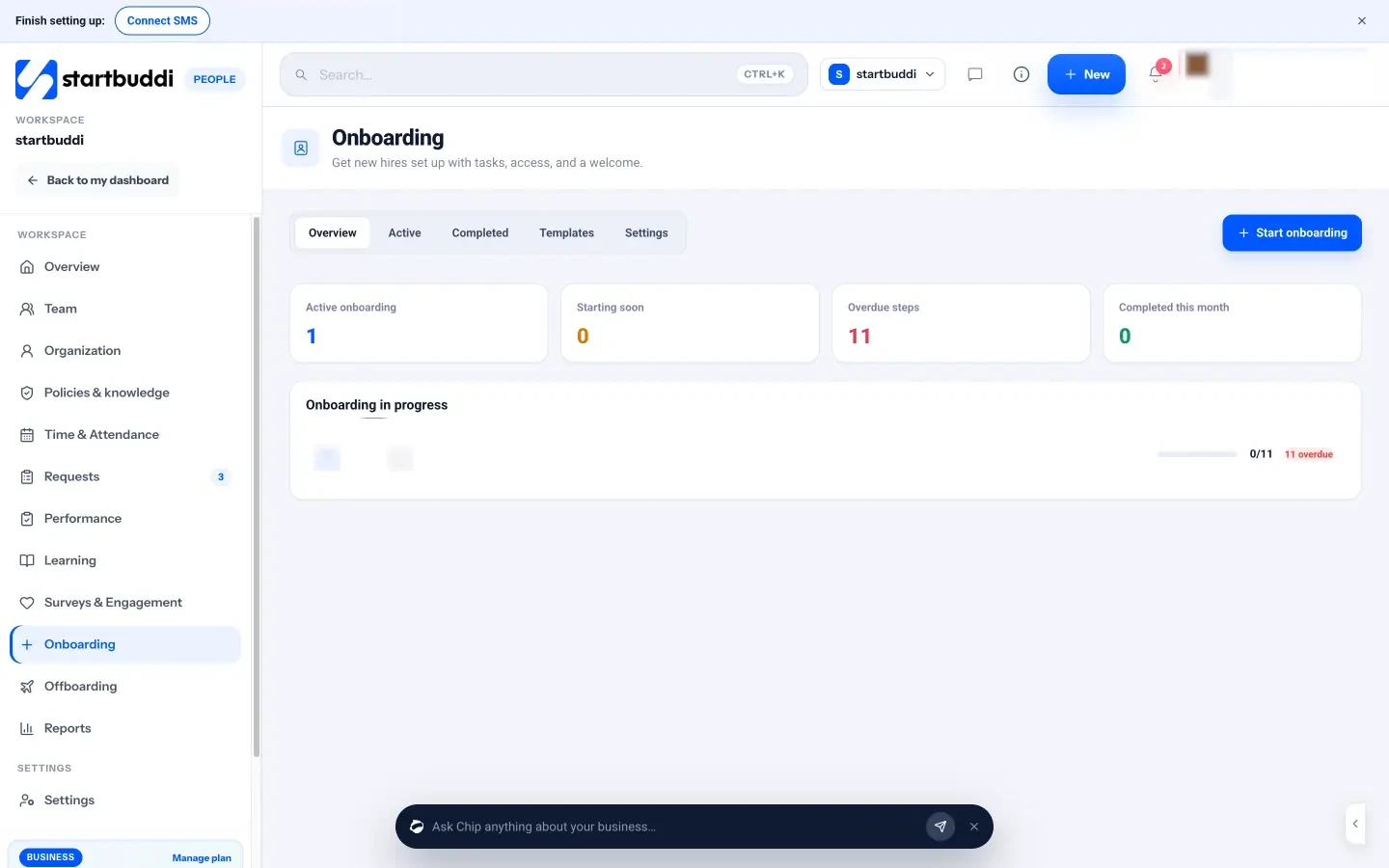
In settings you can create the checklist automatically when someone joins, assign required learning and policy sign-offs, and send a welcome memo. Chip can draft a 30/60/90 plan for a new hire in Documents. Inviting a brand-new hire needs a paid plan with an extra seat. Your next step: write down every step of your last hire’s first two weeks, and turn it into a template.
Related terms
FAQ
How long should employee onboarding last?
Many businesses plan the first 90 days, with the most structure in the first two weeks. Some roles need longer.
What is the difference between onboarding and orientation?
Orientation is a one-off introduction to the company, usually on day one. Onboarding is the whole process, from accepting the offer to being fully up to speed.
What is preboarding?
Preboarding is everything between a signed offer and the first day: paperwork, equipment, accounts and a welcome message.
Who is responsible for onboarding in a small business?
Usually the owner or the new hire's manager, with help from whoever handles equipment and accounts. A shared checklist with owners for each step keeps it on track.
Chinedu Kalu is the co-founder and chief operating officer of startbuddi, responsible for how the company runs day to day. Chinedu writes about the operational side of a small business: registering and running the company, money, hiring and the routines that keep a team on track.
Co-founded startbuddi and runs its operations