What is employee offboarding?
Also called: Offboarding, exit process, employee exit, leaver process, separation process
Employee offboarding is the process of managing someone's exit from a business: handing over their work, collecting equipment, removing system access, settling final pay and holding an exit conversation.
Employee offboarding is the process of managing someone’s exit from your business when they resign, retire, reach the end of a contract or are let go. It covers handing over their work, collecting company equipment, removing their access to systems, settling final pay, holding an exit conversation and telling the people who need to know. Done well, it protects your business and lets the person leave on good terms.
Offboarding is the mirror image of employee onboarding. It gets less attention, but mistakes here tend to cost more: a lost client relationship, a missing laptop or a former employee who can still log in.
Why employee offboarding matters for a small business
- Security. Every account a leaver can still open is a risk, however friendly the parting.
- Continuity. In a small team, one person may be the only one who knows a client, a supplier or a process. Their knowledge needs to be written down before they go.
- Equipment and money. Laptops, phones, keys and cards need to come back, and final pay needs to be right.
- Reputation. Former staff talk to future hires and customers. A respectful exit keeps that conversation positive.
- Learning. An honest exit conversation often tells you something about your business you would not hear otherwise.
How employee offboarding works: an example
Sophie runs a five-person accountancy practice in Leeds. Her office manager, Ben, resigns with four weeks’ notice. Sophie starts an exit checklist the same day:
- Confirm Ben’s last working day and notice period in writing.
- Decide who takes over his tasks, and ask him to write a handover note for each.
- Tell the team, then the suppliers and clients he deals with, and introduce his replacement.
- Move his files and shared documents to a colleague’s ownership.
- Hold an exit interview in his final week.
- Collect his laptop, office key and payment card on his last day.
- Work out final pay, including any unused holiday, with her payroll provider.
- Remove his email, software and bank access at the end of his last day.
Because the list existed from day one of his notice, nothing was left to the final afternoon.
Key parts of an offboarding checklist
| Area | What to cover |
|---|---|
| Paperwork | Resignation or termination letter, last day, notice period, any references |
| Handover | Open tasks, client relationships, passwords held, written procedures |
| Communication | Tell the team, then clients and suppliers, with a named new contact |
| Equipment | Laptop, phone, keys, cards, uniforms, anything on loan |
| Access | Email, software, shared accounts, building entry, bank and payment tools |
| Pay | Final salary, unused holiday, expenses owed, deductions |
| Exit interview | Why they are leaving, what worked, what should change |
Best practices and common mistakes
- Use the same checklist every time. Exits are stressful and rushed. A fixed list stops you forgetting things.
- Start the handover early. The last week is too late to capture years of knowledge.
- Keep history, remove access. Past messages, files and decisions should stay in your systems; only the ability to log in should go.
- Plan the goodbye. A short thank-you from the team, or a card and lunch, costs little. People remember how you treated them on the way out, and good leavers often come back or send you customers.
- Do not skip the exit interview. Keep it short and relaxed, and ask what would have made them stay.
- Treat everyone the same. A consistent process is fairer and easier to defend if an exit is ever disputed.
- Update your org chart and team lists so clients and colleagues are not sent to someone who has gone.
Your employee handbook is a good place to write down notice periods and what happens when someone leaves, so expectations are clear from the start.
Related terms
Employee onboarding is the joining process, and a good offboarding checklist often mirrors it step for step. An org chart needs updating when someone leaves. Paid time off matters at exit, because unused holiday may need paying out.
Employee offboarding in startbuddi
Offboarding in People starts with a short wizard: who is leaving, their last working day, the reason (resignation, end of contract, termination or retirement) and private notes for HR. You then get an exit checklist covering the last day and notice period, telling the team and clients, a handover note, transferring document ownership, the exit interview, returning equipment, settling final pay and expenses, and removing access.
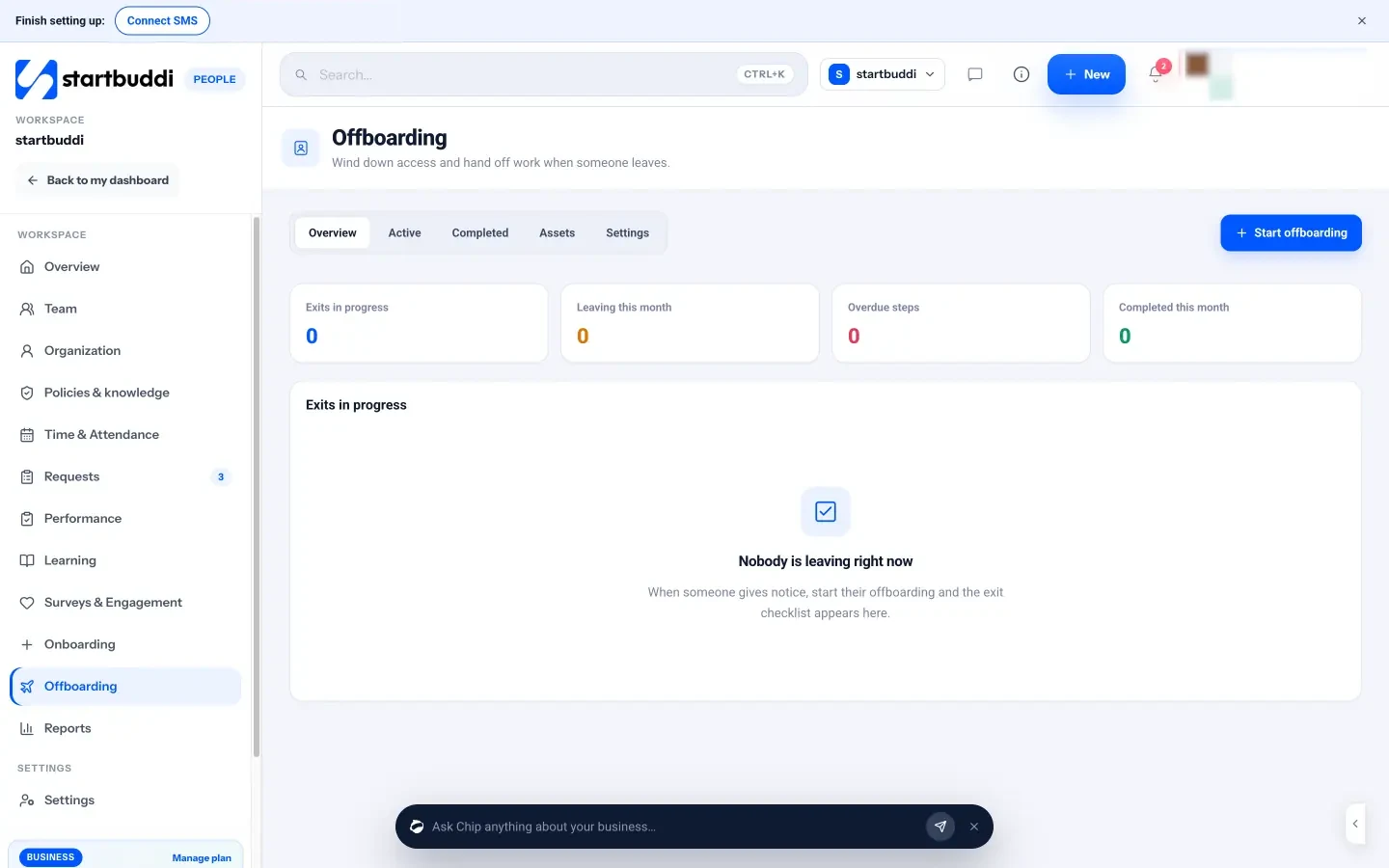
You choose who takes over the person’s work, and their history stays attributed to them. It is safe by default: their access stays until you complete the checklist, and the steps that remove things stay off in settings until you turn them on. “Settle final pay” is a manual step, because startbuddi does not calculate pay, so use your payroll provider for that. You can also start offboarding straight from a person’s profile. Your next step: write your own exit checklist now, before you need it.
Related terms
FAQ
What is the difference between onboarding and offboarding?
Onboarding brings a new person in and gets them up to speed. Offboarding manages their exit: handover, equipment, access and final pay.
When should offboarding start?
As soon as you know someone is leaving, usually the day they give or receive notice. That leaves time for a proper handover.
What should I ask in an exit interview?
Why they are leaving, what they enjoyed, what frustrated them, and what would have made them stay. Keep it short and listen more than you talk.
When should I remove a leaver's access?
Usually at the end of their last working day. In a dismissal, it is often safer to remove it at the time they are told.
Chinedu Kalu is the co-founder and chief operating officer of startbuddi, responsible for how the company runs day to day. Chinedu writes about the operational side of a small business: registering and running the company, money, hiring and the routines that keep a team on track.
Co-founded startbuddi and runs its operations