
Small Business Tax Deductions Checklist: Records and Deadlines
A small business tax deductions checklist for sole traders: records to keep, costs you can claim and 2026 deadlines in the US, UK, Canada and Nigeria.

A small business tax deductions checklist has three parts: the records you keep for every sale and cost, the business expenses your tax authority lets you deduct, and the dates you register, file and pay. Most deductible costs are ones spent only for the business, and you can only claim what you can prove with a receipt or record.
Key takeaways
- The test is similar everywhere: a cost must be for the business. The US asks for “ordinary and necessary” costs, the UK and Nigeria for costs “wholly and exclusively” for the business, Canada for reasonable costs incurred to earn income.
- Personal spending, fines and the income tax itself are not deductible. Mixed costs, such as a phone or car, are split between business and personal use.
- Every claim needs proof. A cost without a receipt or record is the first thing a tax officer removes.
- Write your deadlines into your calendar on the day you register, and set money aside each month.
- Several 2026 numbers changed: the US mileage rate went up mid-year, the UK mileage rate is now 55p, and Nigeria’s new tax law took effect on 1 January 2026.
What a small business tax deductions checklist covers
This chapter is the “make it official” money step in our guide to starting a service business. It’s written for sole traders and small owner-run companies selling services, with notes for four countries: the US, the UK, Canada and Nigeria.
Tax itself is covered in plain language in our guide to small business taxes for beginners. This chapter is the working list: what to keep, what to claim and when to act.
Deductions lower your taxable profit, not your sales. If you’re unsure of the difference, see gross vs net profit. A ₦100,000 deduction at an 18% tax rate saves ₦18,000 of tax, not ₦100,000.
Part 1: the records checklist
Every deduction rests on records. Set this up in your first week, not in the week before the deadline.
- Open a separate bank account for the business and use it for every business payment.
- Send a numbered invoice or receipt for every sale, including cash and transfer payments.
- Keep every receipt for what you spend: a photo the same day is fine.
- Record each expense with the date, supplier, amount, category and what it was for.
- Note the business share of mixed costs (phone, internet, car, home) and how you worked it out.
- Keep a mileage log if you claim vehicle costs: date, destination, purpose and distance.
- Keep bank statements, contracts, and records of anything you buy that lasts several years.
- Get your tax ID and put it on your invoices where your country requires it.
- Back everything up somewhere other than your phone.
Good expense tracking takes about 15 minutes a week. Our guide on how to track business expenses shows a simple routine, and our free expense report template works if you prefer a spreadsheet.
How long to keep your records
| Country | Minimum period | Source |
|---|---|---|
| US | Generally 3 years; 4 years for employment tax records; longer in some cases (6 or 7 years) | IRS, “How long should I keep records?” |
| UK (sole traders) | At least 5 years after the 31 January filing deadline for that tax year | GOV.UK, “Business records if you’re self-employed” |
| Canada | 6 years from the end of the last tax year the records relate to | CRA, “Keeping records” |
| Nigeria | Proper books and records are required, and the Lagos State Internal Revenue Service has announced penalties for not keeping them from 1 January 2026 | LIRS notice under the Nigeria Tax Administration Act 2025 |
In Nigeria, ask the Nigeria Revenue Service (NRS) or your state tax office for the exact period. Keeping records for at least six years covers the US, UK and Canadian minimums in most cases and is a sensible habit anywhere.
Part 2: the small business tax deductions checklist
These are the costs service businesses most often claim. Tick the ones that apply to you, and check each against your country’s rules below.
Running costs
- Rent for business premises, a desk or a co-working space
- Utilities for business premises
- Phone and internet (business share)
- Software and subscriptions used for the business
- Stationery, printing and postage
- Bank charges and payment processing fees
- Business insurance
People
- Staff wages and employer contributions
- Payments to freelancers and subcontractors
- Approved pension contributions where your country allows them
Getting work and doing it
- Advertising, website hosting and domain names
- Materials and supplies used on client jobs
- Uniforms or protective clothing (everyday clothes don’t count)
- Training directly related to your current business
- Professional fees: accountant, lawyer, registration and licence fees
- Trade body and professional memberships
Travel and vehicles
- Travel to client sites (commuting to your own regular workplace usually doesn’t count)
- Vehicle costs, by actual cost or a flat mileage rate where allowed
- Hotels and fares for business trips
- Business meals, where allowed and only the allowed share
Home and equipment
- Business use of your home, if you meet your country’s test
- Equipment, computers and tools, usually spread over several years or claimed through allowances
- Repairs to business equipment and premises
- Interest on business loans
What you usually can’t claim
Personal or household spending, fines and penalties, and income tax on your own profit. Client entertainment is disallowed in many countries, and big purchases usually can’t be claimed in one go.
Deductions that work differently in each country
The general rule is close in all four countries. The details for home, vehicle, meals and equipment are where they differ.
United States (IRS)
- The test. A cost must be “ordinary and necessary”: common in your trade, and helpful and appropriate for your business. Sole proprietors report income and costs on Schedule C; IRS Publication 334 (Tax Guide for Small Business) lists the categories.
- Home office. The simplified method allows $5 per square foot, up to 300 square feet ($1,500). The space must be used regularly and exclusively for the business.
- Vehicle. The standard mileage rate is 70 cents a mile for 2025. For 2026 it is 72.5 cents from 1 January to 30 June and 76 cents from 1 July to 31 December, after the IRS raised it mid-year.
- Meals and entertainment. Business meals are generally 50% deductible. Entertainment is not deductible.
- Equipment. The de minimis safe harbour lets many small businesses expense items costing up to $2,500 per item or invoice. Larger purchases are depreciated or expensed under Section 179.
- Self-employment tax. It is 15.3% of net self-employment earnings, and you deduct the employer-equivalent half when working out adjusted gross income. Deductions that lower your profit lower this tax too.
United Kingdom (HMRC)
- The test. Costs must be “wholly and exclusively” for the business, though a clear business part of a mixed cost can be claimed. GOV.UK’s page on expenses if you’re self-employed lists the allowable categories.
- Trading allowance. You can take a £1,000 tax-free trading allowance instead of claiming actual expenses, but not both. If your costs are above £1,000, claiming them is usually better.
- Home. Simplified flat rates for working from home are £10 a month for 25 to 50 hours, £18 for 51 to 100 hours and £26 for 101 hours or more. Phone and internet are claimed separately.
- Vehicle. From the 2026 to 2027 tax year, simplified mileage for cars and vans is 55p a mile for the first 10,000 business miles and 25p after that (it was 45p for the first 10,000 before 6 April 2026).
- Equipment. Cash basis has been the default since 6 April 2024. Under it, most equipment is claimed as an expense, while cars go through capital allowances. If you use traditional accounting, the Annual Investment Allowance covers most plant and machinery.
Canada (CRA)
- The test. You can deduct any reasonable current expense you incur to earn business income. Sole proprietors use Form T2125; the CRA’s business and professional income guide (T4002) explains each expense line.
- Home. You qualify if your home is your principal place of business, or if you use the space only for the business and regularly meet clients there. The claim can’t create or increase a business loss; unused amounts carry forward.
- Vehicle. Keep a logbook with the date, destination, purpose and kilometres of each trip, and odometer readings at the start and end of the year.
- Meals and entertainment. Generally limited to 50% of the reasonable amount.
- Equipment. You claim capital cost allowance over several years rather than the full cost at once. For example, furniture and equipment (Class 8) is 20% a year and computers (Class 50) 55%, with a half-year rule in the first year.
Nigeria (NRS and state tax offices)
- The law. The Nigeria Tax Act 2025 took effect on 1 January 2026. The Federal Inland Revenue Service is now the Nigeria Revenue Service (NRS).
- The test. Section 20 of the Nigeria Tax Act 2025 allows expenses “wholly and exclusively incurred in the production of the income”, including interest, rent, salaries, repairs and approved pension contributions. Section 21 disallows capital spending, domestic or private expenses and income taxes.
- Who you pay as a sole trader. If you trade in your own name or a business name, your income tax goes to your state’s internal revenue service. In Lagos, self-employed people file annual returns with the Lagos State Internal Revenue Service (LIRS).
- Personal income tax. The first ₦800,000 of chargeable income is taxed at 0%, then 15% on the next ₦2.2 million, 18% on the next ₦9 million, 21% on the next ₦13 million, 23% on the next ₦25 million and 25% above ₦50 million.
- Rent relief. Individuals can claim relief of 20% of annual rent paid, up to ₦500,000.
- Companies. A small company pays 0% company income tax and other companies 30%. The gazetted Act defines a small company as one with gross turnover of ₦50 million or less and fixed assets of no more than ₦250 million, and says a business providing professional services is not a small company. A copy released as the National Assembly’s approved version says ₦100 million, and the laws have been ordered re-gazetted, so plan on ₦50 million until that’s settled. Many consultancies, agencies and other professional firms pay 30% either way, so check your position with an adviser.
- Tax ID. Your Tax ID must appear on tax returns and transaction documents, and banks ask for it to open or keep a business account.
- VAT. The rate is 7.5%. Ask the NRS or an adviser whether your business must register and how often to file.
Part 3: tax deadlines to put in your calendar
| Country | What | When |
|---|---|---|
| US | Estimated tax for 2026 | 15 April 2026, 15 June 2026, 15 September 2026 and 15 January 2027 |
| US | Annual return (Form 1040 with Schedule C) | The 2025 return was due 15 April 2026; the 2026 return is normally due in mid-April 2027 (the IRS confirms the date each year) |
| UK | Register for Self Assessment | By 5 October after the end of the tax year you started trading |
| UK | 2025 to 2026 return | 31 October 2026 on paper, 31 January 2027 online, with any tax due |
| UK | Payments on account | 31 January and 31 July, unless last year’s bill was under £1,000 or more than 80% of your tax was already collected another way |
| UK | Making Tax Digital for Income Tax | From 6 April 2026 if qualifying income is over £50,000; over £30,000 from 6 April 2027; over £20,000 from 6 April 2028 |
| Canada | 2025 taxes for self-employed people | File by 15 June 2026; pay any balance by 30 April 2026 |
| Canada | Instalments for 2026 | 15 March, 15 June, 15 September and 15 December 2026 |
| Nigeria | Individual annual return | Within 90 days of the new assessment year, which is 31 March; LIRS extended the 2026 date in Lagos to 21 April |
| Nigeria | VAT returns, if registered | On the schedule the NRS sets; confirm when you register |
Two habits make deadlines painless:
- Put the dates in your calendar today, with a reminder two weeks before each one.
- Move a share of every payment into a tax savings account. Your accountant can suggest a percentage from last year’s figures.
Worked example: what missing receipts cost a Lagos photographer
The figures below are illustrative and simplified (no pension or other reliefs), to show how records change a tax bill under the Nigeria Tax Act 2025 bands.
Tolu runs a photography business in her own name in Lagos. In 2026 she earns ₦9,000,000 and spends ₦3,000,000 on equipment repairs, data, transport to shoots, editing software and studio hire. She pays ₦1,500,000 a year in rent, so her rent relief is ₦300,000 (20%, under the ₦500,000 cap).
| With all receipts | With only ₦1,000,000 of receipts | |
|---|---|---|
| Income | ₦9,000,000 | ₦9,000,000 |
| Expenses she can prove | ₦3,000,000 | ₦1,000,000 |
| Profit | ₦6,000,000 | ₦8,000,000 |
| Less rent relief | ₦300,000 | ₦300,000 |
| Chargeable income | ₦5,700,000 | ₦7,700,000 |
| Tax on first ₦800,000 at 0% | ₦0 | ₦0 |
| Tax on next ₦2,200,000 at 15% | ₦330,000 | ₦330,000 |
| Tax on the rest at 18% | ₦486,000 (on ₦2,700,000) | ₦846,000 (on ₦4,700,000) |
| Total tax | ₦816,000 | ₦1,176,000 |
₦2,000,000 of costs she couldn’t prove cost her ₦360,000 in extra tax. That is ₦2,000,000 at her top rate of 18%. A photo of each receipt on the day would have saved it.
When to hire an accountant
You can handle a simple sole-trader return yourself with good records. Get an accountant once you employ staff, register for VAT, GST/HST or sales tax, form a limited company, sell abroad, or buy expensive equipment. In Nigeria, get advice before you incorporate: whether a professional services firm counts as a small company makes the difference between 0% and 30% company income tax.
How to keep tax records in startbuddi
startbuddi isn’t accounting software and doesn’t file tax returns. It keeps the records your accountant needs in one place, next to your invoices and clients:
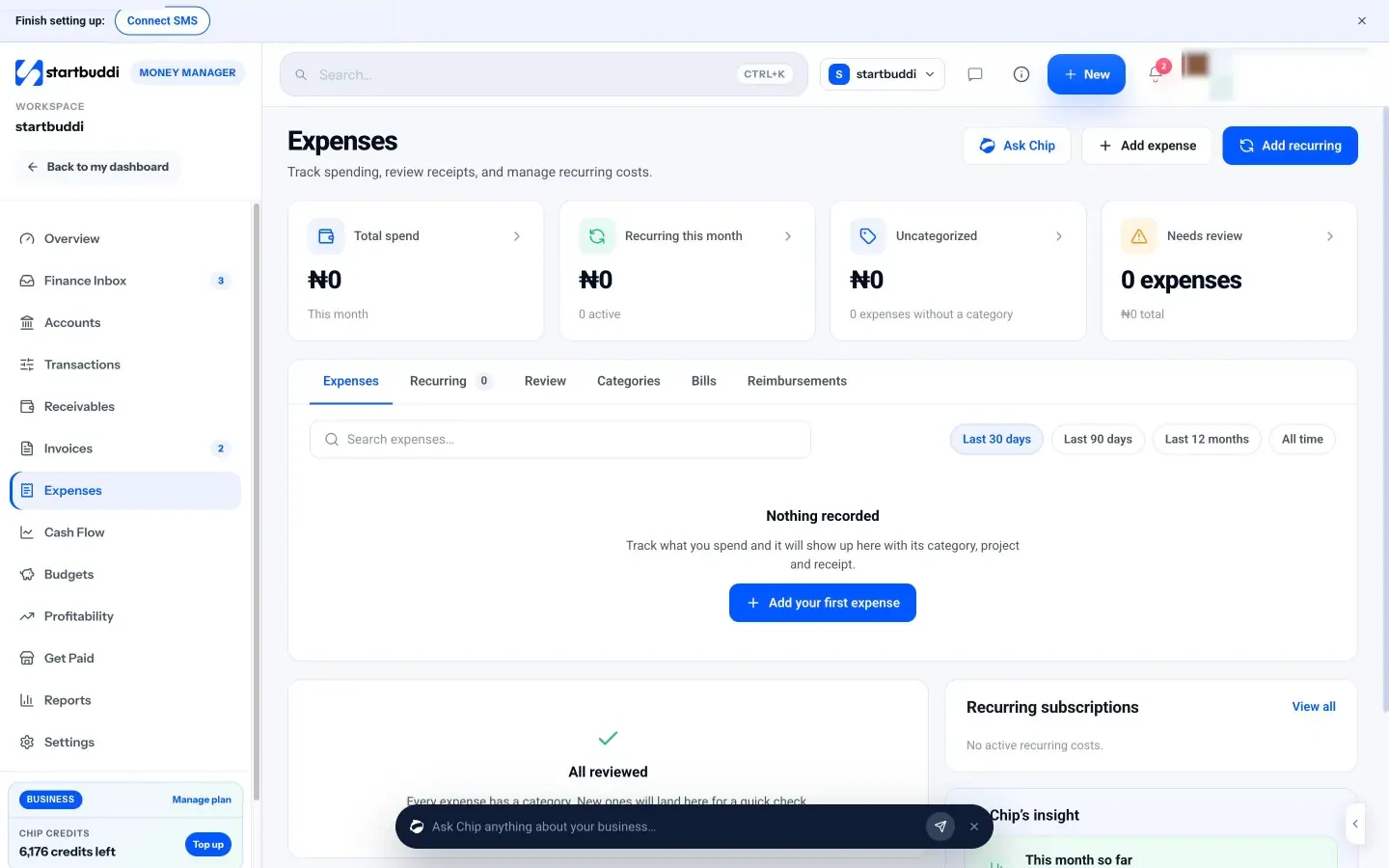
- Log expenses with receipts. In Money Manager → Expenses, click Add expense and enter the vendor, amount, category and date, then attach the receipt as a photo or PDF. Link it to a project or customer if it was for a specific job.
- Clear the review queue weekly. Expenses saved as Uncategorized wait in the Review tab, which suggests the category the vendor had last time.
- Set up recurring costs. Use Add recurring for rent, software and other regular bills, so they’re never missed.
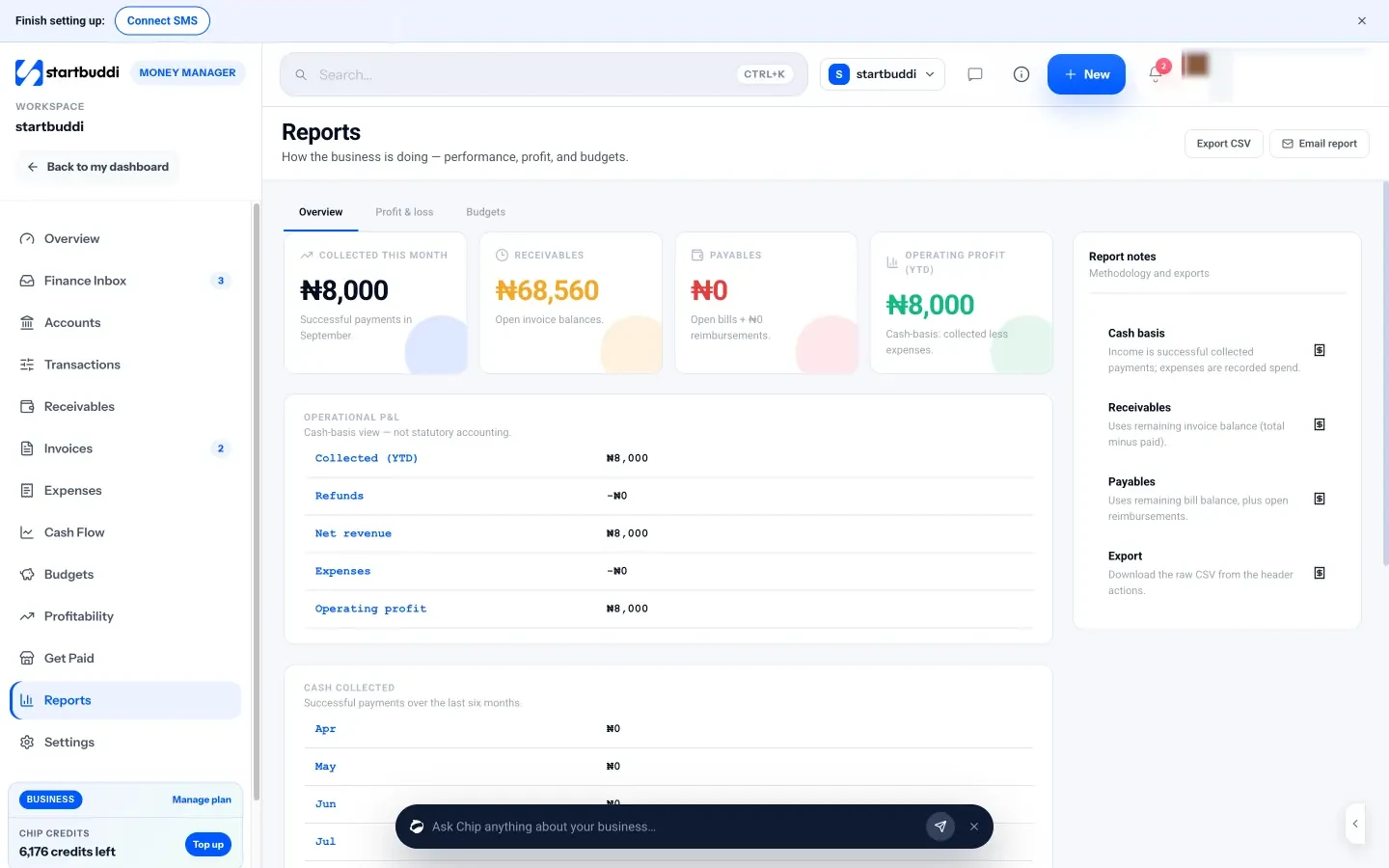
- Invoice every sale from one place. Invoices from Money Manager record the tax you add, and Reports → Profit & loss shows revenue, expenses, net profit and a tax summary.
- Send the year to your accountant. Choose the period in Reports and use Export CSV.
- Add your deadlines as tasks. In Work → My work, add each filing and payment date as a task with a due date two weeks early, so it shows in your list and calendar.
A free plan is available; see pricing for what each plan includes.
Frequently asked questions
What can a small business deduct from taxes?
Most countries let you deduct costs spent only for the business: rent, software, phone and internet (business share), advertising, supplies, staff and freelancers, professional fees, insurance, business travel and bank charges. Equipment is usually claimed over several years. Personal costs, fines and income tax itself are not deductible.
Is there a small business tax deductions checklist PDF?
You can copy the checklist on this page into a document or spreadsheet and print it. Use it with your own country’s rules, because what’s allowed, the rates and the limits differ between the US, UK, Canada, Nigeria and elsewhere.
Can I deduct expenses without receipts?
You need proof for every claim. Bank statements and invoices help, but a tax authority can refuse a cost you can’t support. If a receipt is lost, write a note straight away with the date, supplier, amount and purpose, and keep the bank record that shows the payment.
Can I claim my home office as a small business?
Often yes, if you meet your country’s test. In the US the space must be used regularly and exclusively for the business; in the UK you can use flat monthly rates if you work at least 25 hours a month from home; in Canada it must be your principal place of business or used only for the business with regular client meetings. In Nigeria, domestic or private expenses are not deductible, so only a clearly business share can be claimed.
When are small business taxes due?
It depends on the country. US estimated tax is paid four times a year and the annual return is normally due in mid-April. UK online returns and payment are due by 31 January after the tax year ends. Canadian self-employed people file by 15 June but pay by 30 April. In Nigeria, individual returns are due within 90 days of the new assessment year, by 31 March.
Does a small company pay tax in Nigeria?
Under the Nigeria Tax Act 2025, a small company pays 0% company income tax. The gazetted Act sets the limit at ₦50 million turnover and ₦250 million in fixed assets, and excludes businesses providing professional services. Another published version of the Act says ₦100 million and the laws are being re-gazetted, so plan on ₦50 million for now. Other companies pay 30%.
Turn this checklist into a weekly habit
Set up your records this week, put every deadline in your calendar, and spend 15 minutes each Friday on receipts. Start startbuddi free to log expenses, send invoices and hand your accountant one clean export at the end of the year.
Chinedu Kalu is the co-founder and chief operating officer of startbuddi, responsible for how the company runs day to day. Chinedu writes about the operational side of a small business: registering and running the company, money, hiring and the routines that keep a team on track.
Co-founded startbuddi and runs its operations