Small business taxes for beginners: what to pay, keep and set aside
A plain-English guide to small business taxes for beginners: the main taxes, which records to keep, how much to set aside, key deadlines and how to prepare for tax time.

This guide explains small business taxes for beginners: which taxes a small business usually pays, what records to keep, how much to set aside, when to pay and how to prepare for tax time without panic. It is written for freelancers, sole traders and small company owners in their first years of business, wherever they are.
Here is the short answer. Most small businesses deal with three kinds of tax: tax on profit (income tax for sole traders, company tax for companies), social contributions on self-employed earnings in some countries, and sales tax such as VAT or GST once they pass a threshold. You keep records of every sale and business cost, set aside a share of each payment in a separate account, pay on the dates your tax authority sets, and hand clean records to an accountant or tax software at the end of the year.
Tax rules differ a lot between countries, so each chapter explains the general principle first, then gives real examples from the US, UK, Canada, Nigeria, South Africa and Kenya with links to the official bodies. Each chapter ends with how startbuddi helps you keep the records, and where it does not.
This guide is general information, not tax or legal advice. Rules change, so check your tax authority’s current guidance or speak to a qualified accountant before you act.
Small business taxes for beginners: how tax works
- The four kinds of tax most small businesses meet
- How your business structure changes your tax
- What the rules look like in different countries
- What "small" means to a tax authority
- Profit tax or turnover tax: two ways of taxing small firms
- Withholding tax: when clients take tax off your payment
- Your first-month tax checklist
- Selling to customers in other countries
- Sales tax and VAT: when you have to start charging it
- Beginner mistakes that cost the most
- Getting tax right on your invoices in startbuddi
Tax feels complicated because it is described in the language of law. Underneath, the ideas are simple. Governments tax what you earn, what you sell and who you employ, and they want you to keep proof. This chapter explains the main types of tax a small business meets, how your business structure changes things, and what the rules look like in a few countries.
The four kinds of tax most small businesses meet
1. Tax on profit. This is the big one. If you are a sole trader or freelancer, your business profit is usually added to your other income and taxed as personal income tax. If you run a limited company or corporation, the company pays company (corporate) tax on its profit, and you pay personal tax on the salary or dividends you take out. Profit means income minus allowable business costs, which is why the records in chapter 2 matter so much.
2. Social contributions on self-employed income. Many countries fund pensions, healthcare or social security through a separate charge on earnings. In the US, the IRS says the self-employment tax rate is 15.3%, made up of 12.4% for social security and 2.9% for Medicare, and you generally must file if your net earnings from self-employment were $400 or more. Other countries have their own versions.
3. Sales tax on what you sell. VAT, GST or sales tax is added to the price of goods and services. You collect it from customers and pass it to the tax authority, usually after deducting the tax you paid on your own business purchases. Small businesses below a turnover threshold often do not have to register. Once you pass it, you must charge the tax, show it on invoices and file returns.
4. Employer taxes. Once you hire staff, you usually deduct income tax and social contributions from their pay and pay employer contributions on top. This is payroll, and it has its own deadlines and records. If you are hiring, speak to an accountant or use dedicated payroll software, because the penalties for getting payroll wrong are steep.
Depending on where you are, you may also meet local business taxes, licence fees, stamp duties or withholding tax (where a client deducts tax from your payment and pays it to the tax authority for you). Ask your accountant which apply to you.
How your business structure changes your tax
The way you set up your business affects which taxes you pay and how much paperwork there is. The names differ by country, but the pattern is similar.
| Sole trader / sole proprietor / freelancer | Limited company / corporation | |
|---|---|---|
| Who is taxed on profit | You, personally, through your own tax return | The company, then you on what you take out |
| Paperwork | Usually simpler: one personal return with a business section | Company accounts and a company tax return, plus your own return |
| Personal liability | You are personally responsible for business debts | The company is a separate legal person, which usually protects your personal assets |
| Typical fit | Freelancers, side businesses, very small operations | Growing businesses, those taking on staff or investment, or where liability matters |
Many people start as sole traders because it is quick and cheap, then form a company once profits grow. Which is better for you depends on your country, your profit level and your plans, so this is a good first conversation to have with an accountant. If you are in Nigeria, our post on registering a business in Nigeria covers the business name and company routes.
What the rules look like in different countries
These examples show how differently countries treat small businesses. They are starting points for your own research, correct at the time of writing, and they change often. Always check the official source before relying on them.
| Country | Some rules that matter to small businesses | Official body |
|---|---|---|
| United States | Self-employment tax of 15.3% on net self-employment earnings. Sole proprietors generally make estimated tax payments if they expect to owe $1,000 or more. Sales tax is set by states, not federally. | IRS |
| United Kingdom | A trading allowance of up to £1,000 a year; above it you must tell HMRC. VAT registration is required once taxable turnover goes over £90,000 in 12 months. | HMRC |
| Canada | You generally do not have to register for GST/HST while you stay under the $30,000 small supplier threshold over four consecutive calendar quarters. | CRA |
| Nigeria | Under the Nigeria Tax Act 2025, in force from 1 January 2026, a small company pays 0% company income tax, no capital gains tax and no development levy; other companies pay 30%. Section 202 of the gazetted Act defines a small company as one with gross turnover of ₦50 million or less a year and fixed assets of no more than ₦250 million, and says a business providing professional services is not a small company. VAT is 7.5%. | Nigeria Revenue Service (NRS) |
| South Africa | Micro businesses can use turnover tax, a simplified regime whose qualifying limit rose to R2.3 million from 1 April 2026. Compulsory VAT registration applies once taxable supplies exceed the threshold SARS sets. | SARS |
| Kenya | Turnover tax of 1.5% on gross sales for businesses with turnover above KES 1 million and up to KES 25 million. | KRA |
What "small" means to a tax authority
Almost every small business rule depends on a threshold, and almost every threshold is measured on turnover, not profit. Turnover means your total sales before any costs. A business can make very little profit and still be over a threshold. A reseller who sells $120,000 of goods a year with a 10% margin has $12,000 of profit but $120,000 of turnover, and it is the $120,000 that counts for most registration rules.
Some thresholds also look at other things: the value of fixed assets (as in Nigeria's small company definition), the number of employees, or the type of work (professional services are sometimes treated differently). And the period matters. Some thresholds use the calendar year or your financial year; others, like the UK VAT threshold, look at any rolling 12 months. Write down which thresholds apply to you, how they are measured, and check your position every quarter.
Profit tax or turnover tax: two ways of taxing small firms
Most tax systems tax profit: what is left after costs. Some countries also offer a simplified turnover tax for the smallest businesses, charged as a small percentage of sales with no deduction for costs. Kenya's turnover tax and South Africa's turnover tax for micro businesses are examples.
Turnover tax is simpler, because you only need to know your sales. But it can cost more if your costs are high, because you pay the same percentage whether your margin is 10% or 80%. A trader who buys stock for 85% of the selling price keeps a thin margin, and a tax on sales takes a large share of it. A consultant with almost no costs may find turnover tax cheaper and much less work. Where you have a choice, ask an accountant to compare both for your real numbers before you register.
Withholding tax: when clients take tax off your payment
In some countries, and with some large clients, the customer deducts a percentage of your invoice as tax and pays it to the tax authority on your behalf. You receive less than the invoice total, and the difference counts as tax you have already paid. Nigeria, Kenya and several other countries use withholding tax on certain payments for services, and many corporate clients apply it automatically.
Two things matter. First, record the full invoice as income and the withheld amount as tax paid, not as a discount or a bad debt. Second, ask the client for the certificate or receipt showing the tax they paid for you. Without it, you may not be able to claim the credit, and you could end up paying the same tax twice.
Your first-month tax checklist
If you are just starting, these steps cover most of what you need to do in the first few weeks. The details differ by country, but the list is almost universal.
- Register with your tax authority as self-employed or as a company, and get your tax identification number. In the UK, for example, you must register for Self Assessment by 5 October after the end of the tax year in which you need to file.
- Check whether you need to register for VAT, GST or sales tax now, or which threshold to watch.
- Open a separate business bank account and a second savings account for tax.
- Choose how you will record income and costs, and start from your very first sale.
- Write your tax dates in a calendar (chapter 3 has a template).
- Find an accountant, even if you only speak once a year.
Selling to customers in other countries
Many small businesses sell across borders from day one: a Lagos designer with clients in London, a Toronto developer with US customers, a Nairobi consultant working for a South African firm. Cross-border sales raise questions about which country's sales tax applies, whether you must register abroad, and how foreign income is taxed at home. For services sold to businesses, the customer's country often handles the sales tax, and exports from your own country may be zero-rated. For digital products sold to consumers, some countries require foreign sellers to register. This is an area where an hour with an accountant is well spent.
Sales tax and VAT: when you have to start charging it
For many new businesses, the first real tax decision is whether to register for VAT or sales tax. The general pattern:
- Below the threshold, registration is usually optional. You do not charge the tax and cannot reclaim tax on your purchases.
- Above the threshold, registration is compulsory, often within a short deadline. From then on you add the tax to your prices, show it on invoices and file returns.
- Voluntary registration can make sense if your customers are mostly VAT-registered businesses (they can reclaim it, so it does not raise their real cost) and you have significant purchases to reclaim tax on.
Keep an eye on your rolling 12-month turnover, not just your calendar-year total. Thresholds such as the UK's are measured over any 12-month period, so you can cross them mid-year.
Beginner mistakes that cost the most
- Assuming small means tax-free. Thresholds and exemptions exist, but you often still need to register, keep records or file a return even if you owe nothing.
- Spending the tax money. Money in your account is not all yours. Part of it belongs to the tax authority. Chapter 3 shows how to set it aside.
- Not registering on time. Most tax authorities charge penalties for late registration, late filing and late payment, even when the tax itself is small.
- Mixing personal and business money. It makes it much harder to prove which costs were business costs.
- Relying on social media tax tips. Rules are country-specific and change often. Use official sources and a qualified adviser.
Getting tax right on your invoices in startbuddi
Money Manager is not tax software and does not file returns for you. What it can do is make sure the tax on your invoices is right and recorded, so the figure is ready when you or your accountant need it.
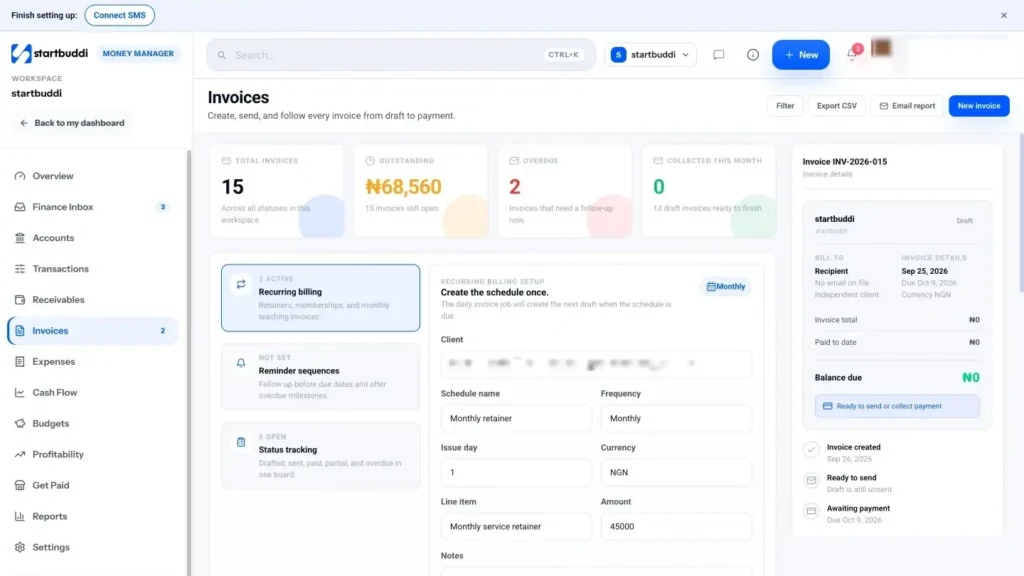
Set your defaults once. In Money Manager, open Settings and the Invoice defaults tab. Set your default tax rate and tax label (for example "VAT", "GST" or "Sales tax"), your invoice prefix, default due days and footer. There is a live invoice preview, and these defaults apply the next time you create an invoice or payment request. If you are not registered for VAT or GST, set the rate to zero so you do not charge tax you are not allowed to collect.
Adjust per invoice when you need to. On each invoice you can change the tax rate and add a discount, and the subtotal and total update as you type. This helps when some customers are abroad or some items are taxed differently. Each invoice can also have its own currency code.
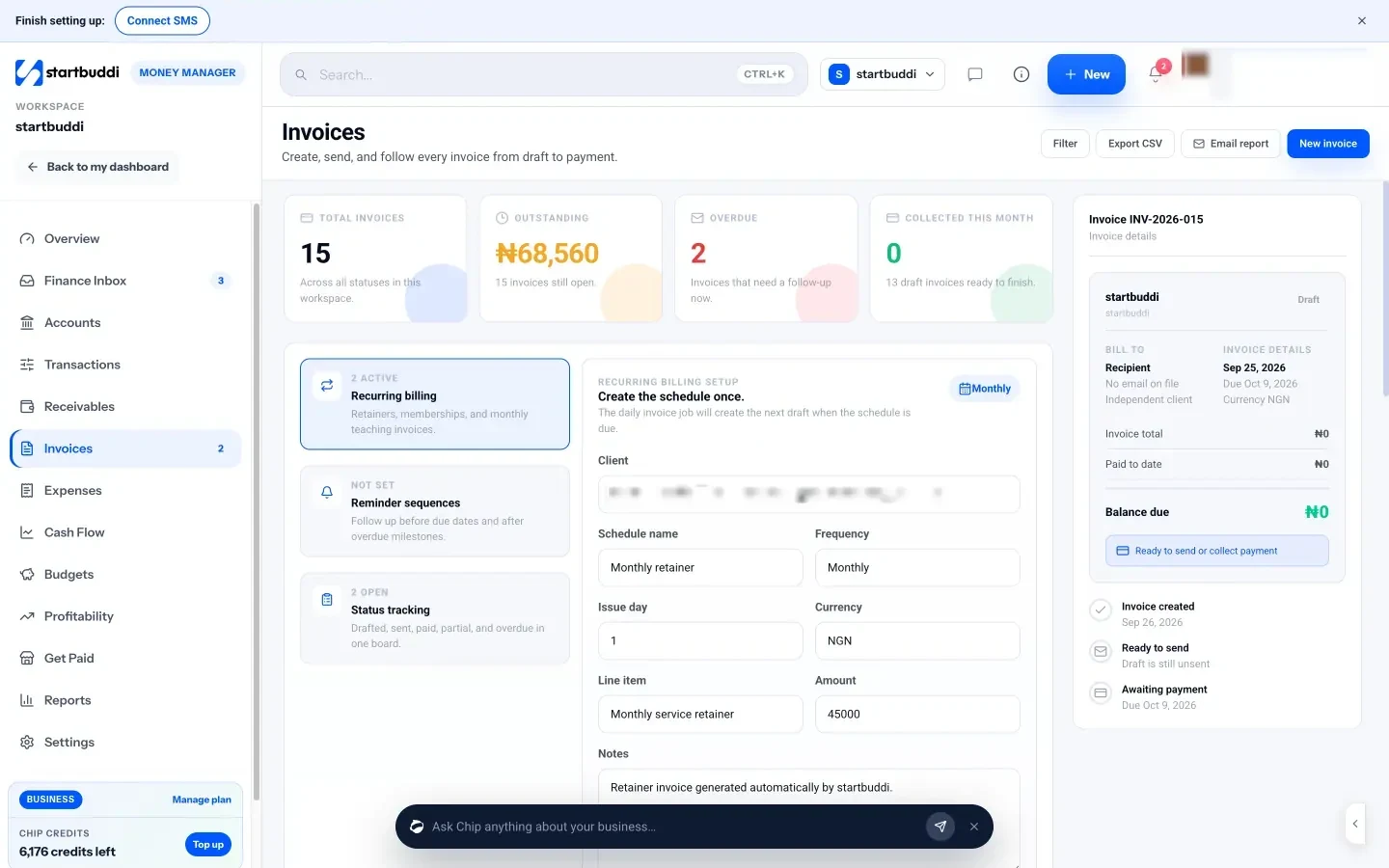
Keep customer details complete. Tax invoices in many countries must show the customer's name and address, and sometimes their tax number. Invoicing a saved contact keeps those details consistent. If you are new to invoicing, our guide on how to send your first invoice covers what a complete invoice includes, and what an invoice is explains the basics.
The next chapter covers the other half of the tax picture: recording your costs so you only pay tax on real profit.
Records and expenses: what to keep and for how long
- What counts as a tax record
- Which business expenses are usually deductible
- How long to keep records
- A weekly record-keeping habit that takes 15 minutes
- Cash basis or accrual: when income and costs count
- Home office and vehicle costs
- Invoices that meet tax rules
- What happens in a tax check
- Worked example: what a missing receipt costs
- When you did not get a receipt
- Records for money you receive outside your main tools
- Keep business and personal money apart
- Mistakes that make tax time hard
- Keeping tax records in startbuddi
You pay tax on profit, and profit is income minus allowable business costs. Every genuine business cost you fail to record means paying tax on money you never kept. Every cost you cannot prove may be disallowed if you are ever checked. This chapter covers what records to keep, which costs are usually deductible, how long to keep everything and how to build a record-keeping habit that takes minutes a week.
What counts as a tax record
The IRS puts it simply: purchases, sales, payroll, and other transactions you have in your business generate supporting documents, and those documents hold the information you need for your books. Tax authorities elsewhere say much the same. For a small business, the core records are:
- Sales records: every invoice you issue, receipts you give, and records of cash or card sales.
- Payment records: proof of money received, such as bank statements or payment provider reports.
- Purchase and expense records: receipts, supplier invoices and bills for everything you buy for the business.
- Bank and card statements for every account the business uses.
- Payroll records if you employ anyone.
- Asset records: what you paid for equipment and vehicles, and when.
- Tax paperwork: returns you filed, letters from the tax authority, registration numbers.
Photos and PDFs are generally acceptable as long as they are clear and complete, but check your own tax authority's rules on digital records.
Which business expenses are usually deductible
The general principle in most countries: costs incurred wholly (or mainly) for running the business are deductible from income before tax. Personal costs are not. Exact rules differ, especially for mixed-use items, so treat the list below as typical categories, not a guarantee for your country.
| Category | Typical examples | Watch out for |
|---|---|---|
| Software and tools | Design software, cloud storage, business apps | Personal subscriptions on the same card |
| Marketing | Ads, printing, website hosting, domain names | Gifts and entertainment often have special rules |
| Travel | Transport to client sites, business trips | Commuting to a regular workplace is often not allowed |
| Office and supplies | Stationery, co-working fees, equipment under a set value | Home office costs usually need a fair split |
| Contractors and freelancers | People you pay per job | You may need their tax details or to deduct withholding tax |
| Professional fees | Accountant, lawyer, business registration | Fines and penalties are usually not deductible |
| Bank and payment fees | Account fees, card processing fees | Interest on personal loans |
Bigger purchases that last several years, such as computers, vehicles and machinery, are often claimed differently from day-to-day costs, spread over time or through special allowances. The rules vary widely, so ask your accountant before a large purchase.
How long to keep records
Every tax authority sets a minimum period for keeping records, and they differ. A few examples:
- United States: the IRS says to keep records for 3 years in the general case, longer in some situations (for example 4 years for employment tax records, 6 or 7 years in others).
- United Kingdom: sole traders must keep records for at least 5 years after the 31 January submission deadline of the relevant tax year. Companies have different rules.
- Canada: the CRA generally requires records to be kept for six years from the end of the tax year they relate to.
- Nigeria: record-keeping duties are set out in the Nigeria Tax Administration Act 2025; check the current requirement with the NRS.
A simple rule that covers most situations: keep everything for at least six to seven years, stored somewhere safe and backed up.
A weekly record-keeping habit that takes 15 minutes
The worst time to organise a year of receipts is the week before your return is due. A small weekly habit removes that stress entirely.
- Capture receipts as you go. Photograph each receipt the day you get it, or forward email receipts to one place.
- Record every expense with a category. Vendor, amount, date, category and what it was for. If it was for a client or project, note that too.
- Check that every sale has an invoice or receipt. Cash and transfer payments without paperwork are the easiest to forget.
- Match payments to invoices. Mark invoices paid when the money arrives, so you know what is still owed.
- Flag anything odd. Duplicates, personal spending on the business card, missing receipts. Fix them now, while you remember.
Our post on tracking profit and loss shows how these records turn into a monthly profit figure, which is the number your tax is based on.
Cash basis or accrual: when income and costs count
There are two ways to decide which year a sale or cost belongs to. The SBA describes the difference simply: the accrual method puts transactions on the books immediately, while the cash method records them only once payment has been received.
Say you invoice a client $3,000 on 20 December and they pay on 10 January. On the cash basis, the $3,000 is income in January, in the new tax year. On accrual, it belongs to December. Cash basis is simpler and matches your bank account, which is why many sole traders use it. In the UK, the cash basis is now the default for most self-employed people. Companies and larger businesses often have to use accrual. Check which method you are allowed or required to use, pick one, and stick to it.
Home office and vehicle costs
These two categories cause more confusion than any others, because they mix business and personal use.
Working from home. If you run your business from home, you can often claim a share of household costs such as heating, electricity and internet. Tax authorities usually either let you claim a fair proportion of actual costs (based on how much of the home you use and for how long) or offer a simplified flat rate. Keep a note of how you calculated your share.
Vehicles. If you use a car or motorbike for business trips, you can usually claim either a share of the running costs or a mileage rate per business mile or kilometre, depending on the country. Either way, you need a record of business journeys: date, destination, purpose and distance. A simple log in your phone is enough, as long as you keep it up to date.
Invoices that meet tax rules
Your invoices are tax records too. Once you are registered for VAT or GST, many countries set out what a valid tax invoice must show: usually your business name and tax number, the customer's details, a unique invoice number, the date, a description of what was supplied, the amount before tax, the tax rate and amount, and the total. A missing tax number or unclear description can stop a business customer reclaiming the tax, which means a delayed payment for you.
Keep invoice numbers in one unbroken sequence. Gaps and duplicates are the first thing a tax inspector notices. If you cancel an invoice, keep it with a note rather than deleting it and reusing the number.
What happens in a tax check
Tax authorities check a small share of returns each year, sometimes at random and sometimes because something looks unusual. A check usually starts with a letter asking for records to support particular figures. If your records are complete, it is mostly paperwork: you send the invoices, receipts and statements they ask for. If they are not, you may have to pay extra tax, interest and penalties on anything you cannot prove. Good records are your best protection, which is why this chapter matters more than any clever tax trick.
Worked example: what a missing receipt costs
Imagine a freelance photographer in Manchester who spends £2,400 over the year on travel, editing software and memory cards, but only keeps receipts for £1,500. If she is a basic-rate taxpayer, the income tax on the £900 of unclaimed costs is 20%, about £180, before National Insurance. The same pattern applies anywhere: unrecorded costs are paid for twice, once when you buy them and again in tax. For UK rates, check the current figures on GOV.UK, because thresholds and rates change.
When you did not get a receipt
It happens: a taxi with no receipt, a market purchase in cash, a receipt that faded. Tax authorities generally prefer original evidence but accept that small gaps happen. Write your own note the same day with the date, the amount, who you paid, what it was for and how you paid, and keep any other proof you have, such as a bank or mobile money entry or a message confirming the order. Do not make this a habit for large amounts. For anything significant, ask the supplier for a replacement receipt or invoice.
Records for money you receive outside your main tools
Cash, bank transfers and mobile money are the payments most likely to go unrecorded, because nothing records them for you. Yet tax authorities in many countries now receive data from banks and payment providers, so unrecorded income is increasingly easy to spot. Every time money arrives this way, match it to the invoice it paid, or issue a receipt if there was no invoice. If a customer pays a round amount that covers several invoices, record which invoices it covered. Five seconds at the time saves an hour of detective work at year end.
Keep business and personal money apart
A separate business bank account is the single most useful thing you can do for your taxes. It means every business payment is in one place, every personal payment is somewhere else, and your statements become a ready-made record. If you must use one account for now, tag every business transaction and never pay business costs in cash without a receipt.
Mistakes that make tax time hard
- Keeping receipts in a shoebox. Paper fades and gets lost. Photograph or scan them.
- Vague descriptions. "Supplies, £84" tells nobody anything in two years. "Printer ink and paper for client proposals" does.
- Forgetting small, frequent costs. Parking, delivery fees and small subscriptions add up across a year.
- Not recording income paid in cash or by transfer. Tax authorities increasingly receive data from banks and payment providers. Record everything.
- Waiting until year end. By then, you will not remember what half of the transactions were for.
Keeping tax records in startbuddi
Money Manager is built to make the weekly habit quick. It does not replace an accountant or tax software, but it keeps your sales, payments and expenses together with their proof.
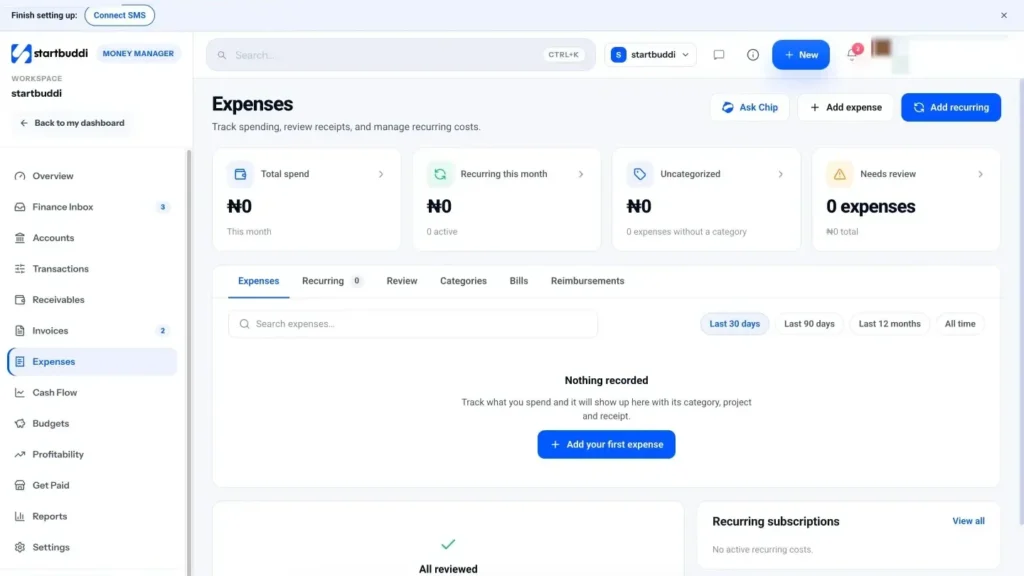
Record expenses with receipts. Use Add expense on the Money Manager overview or the Expenses page. Enter the vendor, amount, currency, category, date and how you paid, then attach the receipt as an image or PDF. You can also link the cost to a project and a customer, and add notes. The categories include software and tools, marketing, travel, office and supplies, contractor or freelancer, taxes and fees, bank fees and other. If you are unsure, leave it as Uncategorized and it will show up for review. Our help article on recording expenses walks through it.
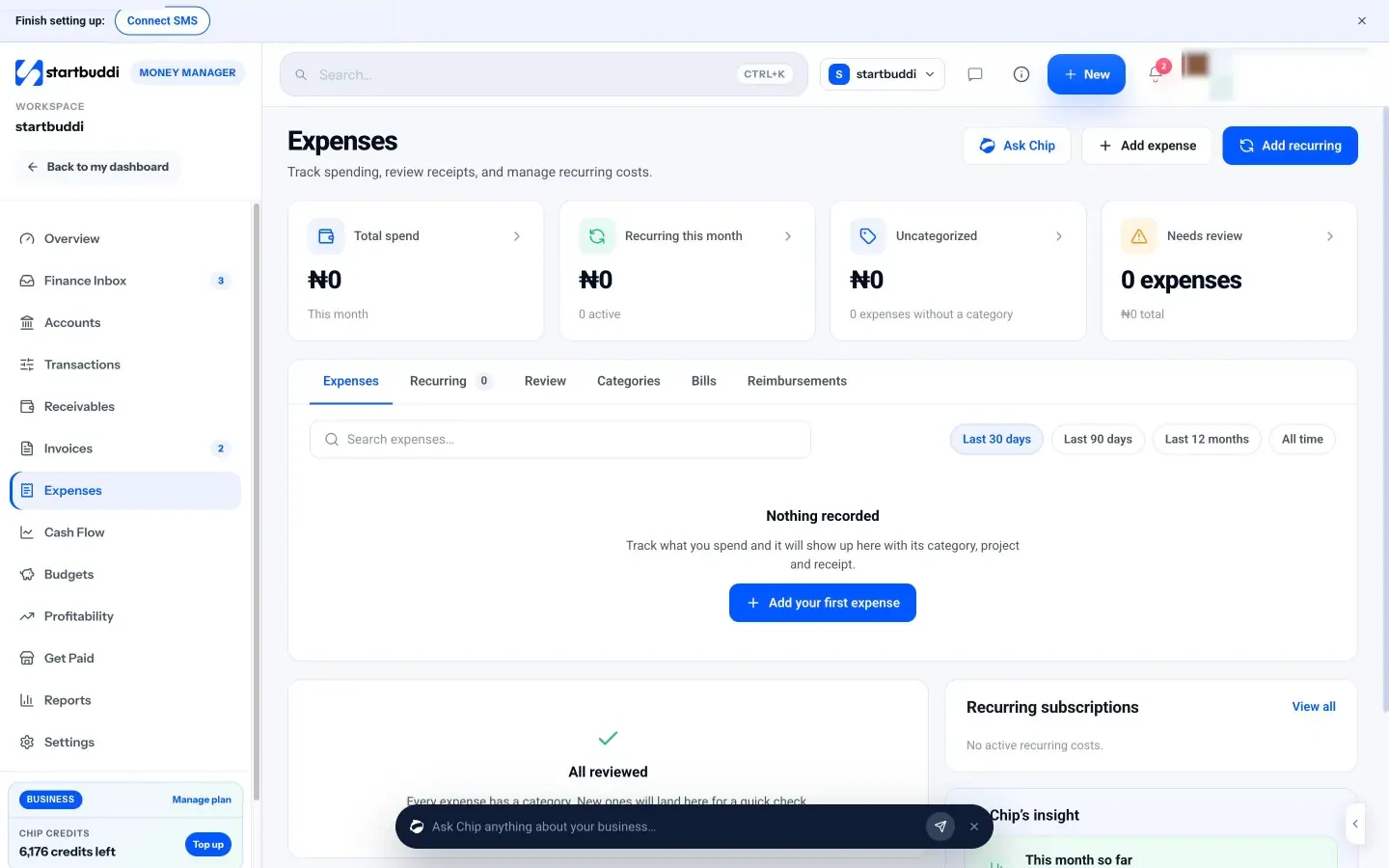
Clear the review queue weekly. The Review tab steps through uncategorised expenses one at a time and suggests the category and project that vendor was given last time. The Finance Inbox also flags possible duplicates ("This looks like a duplicate") and uncategorised expenses, so your records stay clean.
See every money movement in one feed. Transactions brings together payments, expenses, bills and reimbursements, with filters for money in, money out, Stripe, Paystack, manual entries, uncategorised and more, and ranges up to all time. Open any transaction to see its details, category, receipt and the invoice it paid. Payments that arrived outside startbuddi, such as a bank transfer, can be recorded against the invoice with Record payment, which creates a receipt too.
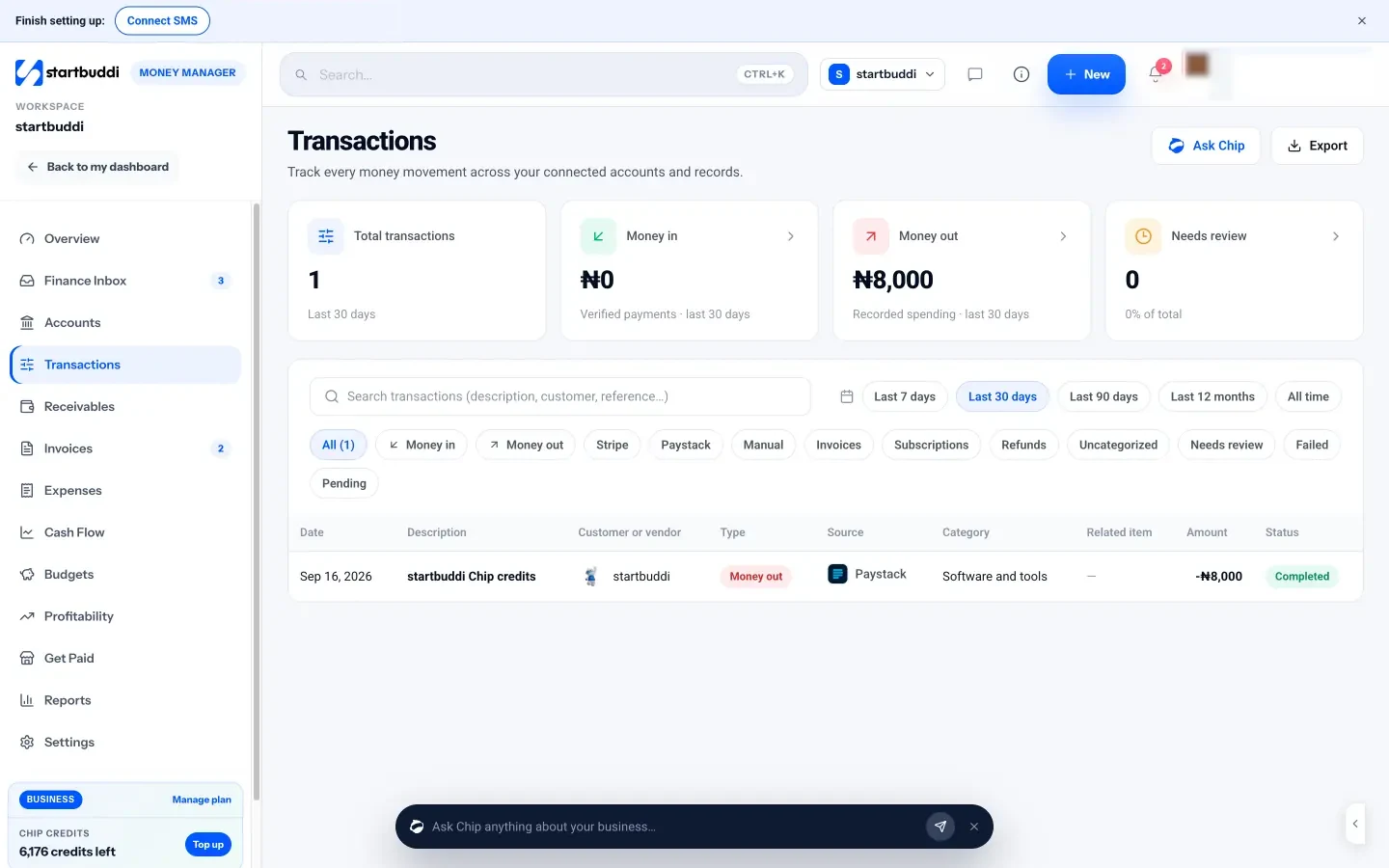
A limit to know: Money Manager has no bank feed, so expenses paid from your bank or card are entered by hand. Budget five minutes a week for that, and your records will be complete. For more on the habit itself, see what expense tracking is.
Set money aside and never miss a tax deadline
- Why tax bills catch small businesses out
- How to estimate how much to set aside
- Worked example: a US freelancer's tax pot
- Worked example: a Lagos agency's VAT month
- Worked example: turnover tax in Kenya
- Setting up the tax pot in practice
- Income in foreign currencies
- Paying during the year: estimated tax and instalments
- Build your tax calendar
- Planning for your first tax bill
- Use your quiet months for tax planning
- What to do if you cannot pay
- Mistakes to avoid
- Planning for tax in startbuddi
The most common tax problem for new business owners is not getting the rules wrong. It is having the right number and no money to pay it. This chapter shows you how to estimate your tax, how to set money aside every time you are paid, and how to build a tax calendar so no deadline surprises you.
Why tax bills catch small businesses out
When you are employed, tax is taken from your pay before you see it. When you work for yourself, you receive the full amount and pay the tax later, sometimes much later. In the UK, for example, the Self Assessment deadline for both filing online and paying for the 2025 to 2026 tax year is 31 January 2027, with a further payment on account due by 31 July. That is up to 21 months after you earned the first pound of that year's income.
Long gaps like that make it easy to spend money that is not really yours. The fix is to treat tax as a cost you pay a little of every time you are paid, even if the tax authority collects it later.
How to estimate how much to set aside
You do not need a perfect number. You need a safe one. Here is a simple method that works in most countries:
- Estimate your yearly profit. Use your budget (see how to create a business budget) or last year's figures: income minus business costs.
- Work out the tax on that profit. Use your tax authority's published rates and allowances, an official calculator if one exists, or ask your accountant. Include social contributions if they apply to you.
- Turn it into a percentage of income. Divide the estimated total tax by your expected income. That is your set-aside percentage.
- Add a safety margin. Round up by a few percentage points. Any surplus at the end of the year is savings, not a problem.
- Add sales tax separately. If you are registered for VAT or GST, the tax you collect is never yours. Move all of it (less the tax you can reclaim on purchases) into the tax account.
Worked example: a US freelancer's tax pot
Jordan is a freelance web developer in Texas, a sole proprietor. He expects about $72,000 of income and $12,000 of business costs this year, so roughly $60,000 of profit. He checks the IRS self-employment tax rules and federal income tax brackets with an online estimator and his accountant, and they estimate his combined federal tax at around $14,000 to $15,000. (Texas has no state income tax; many states do.)
$15,000 divided by $72,000 is about 21%. Jordan rounds up to 25% and moves a quarter of every client payment into a separate savings account the day it arrives. When a $4,000 invoice is paid, $1,000 goes straight to the tax account.
Because he expects to owe more than $1,000, the IRS says he generally has to make estimated tax payments during the year. He pays from the tax account on each due date. The figures here are illustrative; your own will depend on your deductions, filing status and state.
Worked example: a Lagos agency's VAT month
Sales tax works differently from income tax, because you collect it and pass it on. Here is a simple month for a VAT-registered branding studio in Lagos charging VAT at 7.5%.
| Item | Amount before VAT | VAT at 7.5% |
|---|---|---|
| Sales to clients (VAT charged) | ₦2,000,000 | ₦150,000 |
| Business purchases (VAT paid) | ₦400,000 | ₦30,000 |
| VAT to pay the NRS | ₦120,000 |
The studio collected ₦150,000 of VAT from clients. That money was never income. As each client paid, the VAT portion went straight to the tax account. When the return is due the following month, the ₦120,000 is sitting there. Businesses that treat VAT as income are the ones who find the return due and the money gone. For the full picture of how VAT works for small businesses in Nigeria, including who is exempt under the 2025 rules, see our post on VAT in Nigeria.
Worked example: turnover tax in Kenya
A small events business in Mombasa with yearly turnover of about KES 9 million, well inside the turnover tax band, sells KES 800,000 in March. Turnover tax at 1.5% of gross sales is KES 12,000, due by 20 April. There is no deduction for costs, so the calculation is quick, but the owner still keeps records of every sale, and sets aside 1.5% of each payment as it arrives so April's payment is ready.
Setting up the tax pot in practice
The method only works if moving the money is automatic, or close to it.
- Open a separate savings account just for tax. Name it "Tax: do not touch" if your bank allows.
- Move the money the same day you are paid. Not at the end of the month, when it has already been spent.
- If your bank supports it, automate a transfer of a set percentage of each incoming payment.
- Keep income tax and sales tax apart, or at least track them separately, because they are due on different dates.
- Check the balance against your estimate every quarter. If profit has grown, raise the percentage.
Income in foreign currencies
If clients pay you in dollars, pounds or euros while you report tax in naira, rand or shillings, you need to convert that income for your records. Most tax authorities expect you to use a consistent, reasonable exchange rate, such as the rate on the day you were paid or an official average rate, and to keep a note of the rate used. Set aside tax in the currency you will pay it in, because a currency swing between earning and paying can change the real amount you owe.
Paying during the year: estimated tax and instalments
Many tax systems ask self-employed people and companies to pay during the year rather than all at the end. The names and dates differ:
- United States: the IRS divides the year into four payment periods, with estimated tax due on April 15, June 15, September 15 and January 15 of the following year (moved to the next working day if it falls on a weekend or holiday).
- United Kingdom: once your bill passes a certain size, HMRC asks for payments on account, due by 31 January and 31 July, towards the next year's bill.
- Kenya: turnover tax returns and payments are due on or before the twentieth day of the month following the end of the tax period.
- Nigeria: VAT-registered businesses file a VAT return on or before the 21st day of the following month under the Nigeria Tax Administration Act 2025.
If you miss instalments, many tax authorities charge interest or penalties even if you pay the full amount at year end. The tax pot makes paying on time painless, because the money is already there.
Build your tax calendar
Write every tax date for your business in one calendar, with a reminder a week before each. Most small businesses have between 4 and 15 dates a year. A template:
| What | How often | Where to find the date |
|---|---|---|
| Registration deadlines (income tax, VAT or GST) | Once, when you start or pass a threshold | Your tax authority's "starting a business" pages |
| Sales tax, VAT or GST returns | Monthly, quarterly or yearly | Your registration letter or online account |
| Instalments or estimated tax | Usually quarterly or twice a year | Tax authority guidance for the self-employed |
| Annual income or company tax return | Yearly | Tax authority deadlines page |
| Payroll filings and payments | Monthly, if you have staff | Payroll guidance or your payroll provider |
| Company filings (annual accounts, confirmation statements) | Yearly, for companies | Your company registry, for example Companies House or the CAC |
Planning for your first tax bill
The first year is the riskiest, for two reasons. You have no history to base your estimate on, and in some systems the first bill is bigger than later ones. In the UK, for example, once payments on account apply, the January bill can include the balance for the year just finished plus the first advance payment towards the current year. Many new sole traders are caught out by this.
The safe approach in your first year is to set aside a higher percentage than you think you need, and check it with an accountant around the middle of the year when you have six months of real figures. If the estimate turns out too high, the surplus is a head start on your buffer. If it turns out too low, you have found out while there is still time to catch up.
Use your quiet months for tax planning
Most businesses have a slow period each year. Use part of it for tax: update your records, check your set-aside percentage, review which costs you are claiming, and look ahead to the next year's deadlines. An afternoon in a quiet month means you are never doing tax work in your busiest weeks, which is exactly when mistakes happen.
What to do if you cannot pay
It happens, especially in a first year. The worst thing to do is nothing. Most tax authorities treat people who contact them early far better than those who ignore letters.
- File on time anyway. Late filing penalties are often separate from late payment penalties. Filing on time and paying late is usually cheaper than both.
- Contact the tax authority before the deadline. Many offer payment plans or time-to-pay arrangements for businesses that ask.
- Talk to an accountant. They may spot costs or allowances you have missed.
- Fix the cause. Start the tax pot from your very next payment so it does not happen again.
Mistakes to avoid
- Keeping tax money in your main account. If you can see it, you will spend it. Use a separate account.
- Setting the percentage once and forgetting it. If your profit grows, your tax rate may rise too. Review the percentage every quarter.
- Treating VAT as income. VAT or GST you collect was never yours, even if it sits in your account for three months.
- Missing the first-year catch-up. In some systems, your first tax bill includes a whole year plus an advance on the next. Ask your accountant whether this applies to you.
Planning for tax in startbuddi
Money Manager does not calculate your income tax or file anything. It helps you see the numbers your tax is based on, and plan for the payments.
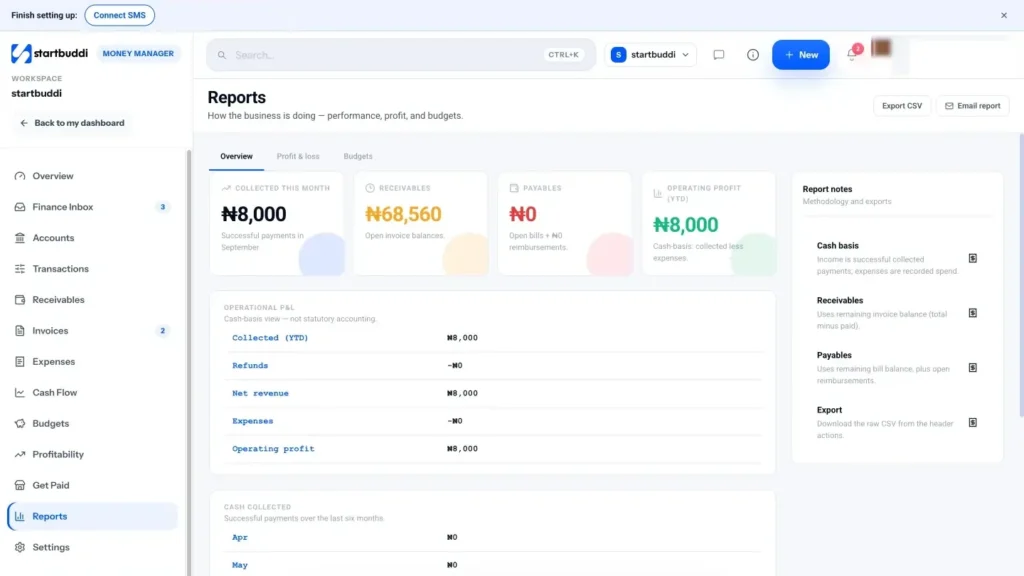
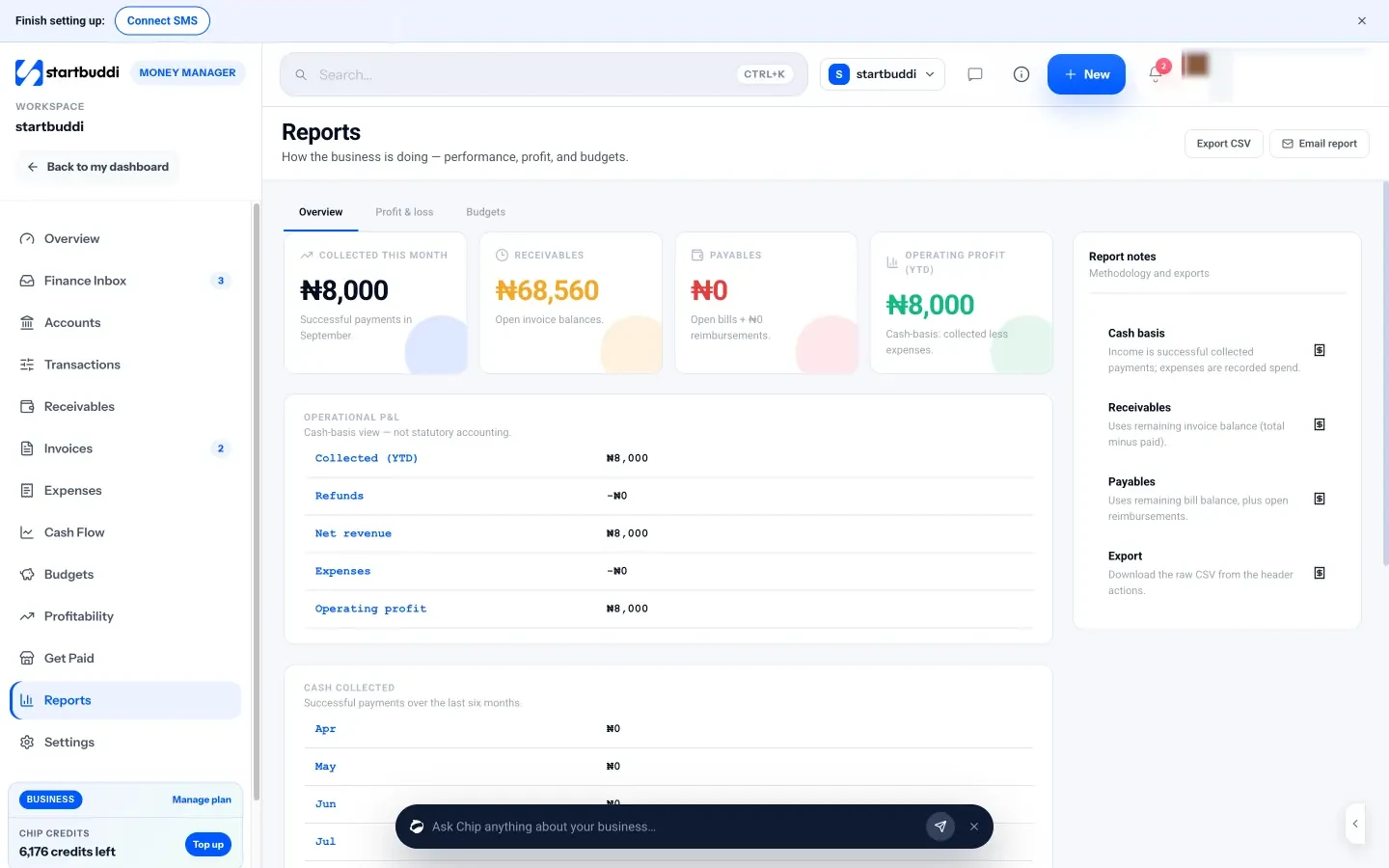
Watch your profit and the tax you have charged. In Money Manager, open Reports and the Profit & loss tab. It is built from your real invoices, payments and expenses, and you can switch between this month, this quarter, this year and year to date. It shows revenue, expenses and net profit, plus a tax summary: a running total of tax added to your invoices. The page is clear that this is "a reference figure, not tax advice" and that you should talk to an accountant before filing, which is the right way to use it.
Put tax payments into your cash forecast. Record your tax instalments as bills or recurring costs with their due dates. The Cash Flow page builds its balance forecast from open invoices, subscriptions, recurring expenses and bills, so a big tax payment shows up as a dip weeks in advance rather than as a surprise. Run a scenario to see what happens to your balance if revenue drops while a payment is due.
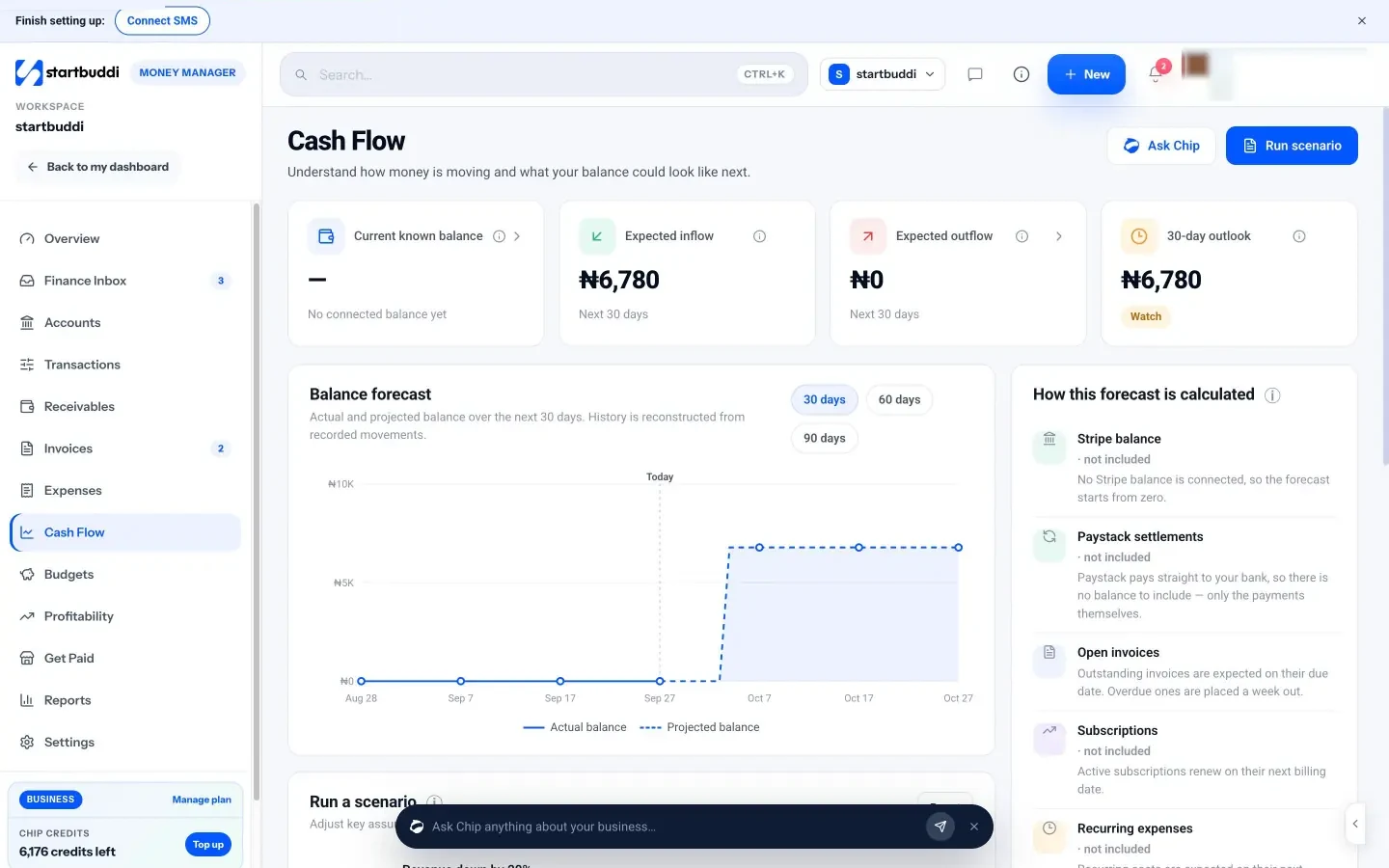
Track tax payments against a plan. Record each tax payment as an expense in the Taxes and fees category, and set a company budget for it in Budgets, so you can see what you have paid against what you planned. The cash flow, budgets and profitability page explains how these pieces fit together.
Ask Chip to summarise the quarter. From the Money Manager overview, Ask Chip can summarise what came in, what went out and what is owed. It is a quick way to get the numbers together before your instalment date, but always check tax figures with your accountant.
Tax preparation and tax management tools for small businesses
- Three ways to prepare your tax return
- What to hand your accountant
- How to find and work with a good accountant
- Questions to ask your accountant in your first year
- Digital records and e-invoicing are spreading
- Tax management tools for small businesses: what the categories do
- How to choose the right tax tools
- Signs you have outgrown simple tools
- A year-end tax checklist
- Keep one tax file for each year
- Mistakes to avoid at tax time
- Where startbuddi fits, and where it does not
- Preparing your tax pack from startbuddi
- Your next step
Tax preparation is the work of turning a year's records into a tax return. If you have kept records through the year, it is mostly checking and sending. If you have not, it is a scramble. This chapter explains your options (do it yourself, use software or hire an accountant), what to hand over, how to choose between tax management tools for small businesses, and where startbuddi fits and where it does not.
Three ways to prepare your tax return
| Option | Good for | Watch out for |
|---|---|---|
| Do it yourself using the tax authority's online service | Simple sole trader businesses with few costs and no staff | Easy to miss allowances; you carry all the risk of mistakes |
| Tax or accounting software | Businesses with regular transactions that want to file themselves, or where digital filing is required | Only as good as the data you put in; still needs you to understand the basics |
| An accountant or tax adviser | Companies, anyone with staff, VAT registration, several income sources or big purchases | Costs money, but usually saves more in errors avoided and allowances claimed |
Many small businesses use a mix: they keep their own records in an invoicing and expense tool through the year, then hand those to an accountant once a year. That keeps accountant fees down, because the accountant spends time advising rather than sorting receipts.
What to hand your accountant
Accountants spend a surprising amount of time chasing missing information. Send this pack at once and your return will be faster and usually cheaper.
- A summary of income for the year, split by source (clients, sales, subscriptions), plus the list of invoices and payments behind it.
- A list of expenses by category, with receipts available if asked.
- Bank and payment provider statements for every business account.
- Details of big purchases (equipment, vehicles) with dates and prices.
- Money still owed to you and by you at the year end, if your accountant uses accrual accounting.
- Tax already paid, including instalments, estimated payments and any tax deducted by clients.
- Last year's return and any letters from the tax authority.
- Personal information the return needs, such as other income or pension contributions.
How to find and work with a good accountant
A good accountant is one of the best investments a small business makes. A poor fit is expensive and stressful. Here is how to find the right one.
- Look for small business experience. An accountant whose clients are mostly freelancers and small firms will know the allowances and pitfalls you face. Ask other business owners in your industry who they use.
- Check qualifications and registration. Most countries have professional bodies for accountants and tax advisers. Membership usually means training, rules of conduct and insurance.
- Agree the scope and fee in writing. Is it just the annual return, or also VAT returns, payroll, bookkeeping and advice during the year? Fixed monthly or annual fees are easier to budget than hourly bills.
- Ask how they want your records. A CSV export, access to your software, or a folder of receipts? Matching their preferred format saves you both time.
- Meet at least twice a year: once after year end for the return, and once mid-year to check your set-aside percentage and plan for anything big.
Questions to ask your accountant in your first year
- Should I be a sole trader or a company, given my expected profit?
- Do I need to register for VAT, GST or sales tax now, and if not, what should I watch?
- What percentage of income should I set aside for tax?
- Which payment dates apply to me, including any instalments?
- Which expenses can I claim, and how should I handle home office and vehicle costs?
- Which record-keeping method (cash or accrual) should I use?
- Do I need to use approved software for digital records or filing?
- What happens to tax when clients abroad pay me?
Digital records and e-invoicing are spreading
Tax authorities increasingly want records kept digitally and sent through approved software. The UK's Making Tax Digital programme now applies to many sole traders and landlords for income tax, with quarterly updates. In Nigeria, the NRS is phasing in electronic invoicing and a fiscal system, starting with large taxpayers, as summarised by KPMG in February 2026. Other countries have similar programmes. Even if they do not apply to you yet, keeping clean digital records now makes the switch easy when they do.
Tax management tools for small businesses: what the categories do
"Tax tools" covers several different kinds of software. It helps to know which job each does before you buy anything.
- Accounting software keeps a full set of books: a general ledger, bank reconciliation, a balance sheet, and usually tax reports such as VAT returns. Some are recognised by tax authorities for digital filing. This is the category you need if your tax authority requires digital records or you want to file VAT returns directly.
- Tax filing software helps you complete and submit a return, often for individuals and sole traders. It asks questions and fills in the forms.
- Invoicing and expense tools create invoices, take payments, record expenses and receipts, and report income and costs. They produce the raw data your accountant or accounting software needs, but do not file tax.
- Receipt capture apps photograph and read receipts, then send them to your accounting system.
- Payroll software calculates pay, deductions and employer contributions, and files payroll reports.
How to choose the right tax tools
Work through these questions in order.
- What does your tax authority require? If you must keep digital records or file through approved software (as with Making Tax Digital in the UK for many sole traders from 2026), start by checking the authority's list of compatible software.
- What does your accountant use? If you have one, using the same software or one that exports cleanly to it saves hours.
- Do you need a full ledger? Companies, VAT-registered businesses and those with staff usually do. A freelancer with a few clients and a dozen expense categories may not.
- Where do your sales happen? If most of your income comes through invoices and payment links, choose tools that record those automatically so you are not copying numbers by hand.
- How much will you really use? The best tool is the one you open every week. A simple tool used consistently beats a complex one you abandon in March.
If you are comparing accounting options, our QuickBooks alternatives list and startbuddi vs QuickBooks Online comparison explain the difference between an accounting ledger and an all-in-one business app.
Signs you have outgrown simple tools
Many businesses start with an invoicing app, a folder of receipts and an accountant once a year, and that is exactly right for them. Watch for these signs that it is time to add proper accounting software or more accountant time:
- You have registered for VAT or GST and file returns monthly or quarterly.
- You have employees, or are about to hire.
- You hold stock, or buy and sell goods rather than services.
- You have taken a loan or investment, and lenders or investors want formal accounts.
- Your tax authority requires digital records through approved software.
- Your accountant is spending more time sorting your records than advising you.
Adding accounting software does not mean abandoning the tools you use to run the business day to day. Many owners keep invoicing, payments and client work in one app and send the figures to accounting software or their accountant each month.
A year-end tax checklist
- All invoices for the year issued, and all payments received recorded against them.
- All expenses recorded, categorised and backed by a receipt or invoice.
- No uncategorised or duplicate transactions left.
- Bank balances match your records (or differences explained).
- Big purchases listed with dates and amounts.
- VAT or GST returns for the year filed and paid, if registered.
- Estimated tax or instalments paid, with dates and amounts listed.
- Pack sent to your accountant or loaded into your software.
- Next year's set-aside percentage reviewed and updated.
Keep one tax file for each year
Once your return is filed, put everything for that year in one place: the return itself, the exported figures, the accountant's working papers if you have them, receipts of tax payments and any letters from the tax authority. Label it clearly by tax year. When a question comes up two years later, or when you apply for a loan or a visa and need proof of income, you will find what you need in minutes instead of days. A cloud folder with one sub-folder per year is enough, as long as it is backed up and you keep it for the full retention period your tax authority requires.
Mistakes to avoid at tax time
- Leaving it to the last week. Rushed returns miss allowances and contain errors.
- Choosing tools by price alone. A cheap tool that does not match your tax authority's rules or your accountant's workflow costs more in time.
- Using several tools that do not talk to each other. Invoices in one place, expenses in another and payments in a third means reconciling three sets of numbers.
- Not keeping a copy of what you filed. You will need last year's return to prepare this year's.
Where startbuddi fits, and where it does not
Being clear about this saves you from buying the wrong thing. In short, startbuddi's Money Manager is an invoicing, payments and expense tool with reports, built into the same app as your clients, projects and marketing. It is not accounting software. It has no general ledger, no bank reconciliation, no bank feeds, no payroll and no tax filing, and it does not sync with QuickBooks or Xero. The Reports page says its profit and loss is a "cash-basis view, not statutory accounting".
What it does well is capture the raw material for your tax return as you work:
- Every sale. Invoices, payment links, bookings, subscriptions and store sales, with payments from Stripe and Paystack recorded automatically and bank transfers recorded by hand with Record payment.
- Every cost. Expenses with receipts and categories, recurring costs, vendor bills and team reimbursements.
- The totals. Reports shows revenue, expenses, net profit, income by source, expenses by category and a tax summary for the month, quarter, year or year to date.
Preparing your tax pack from startbuddi
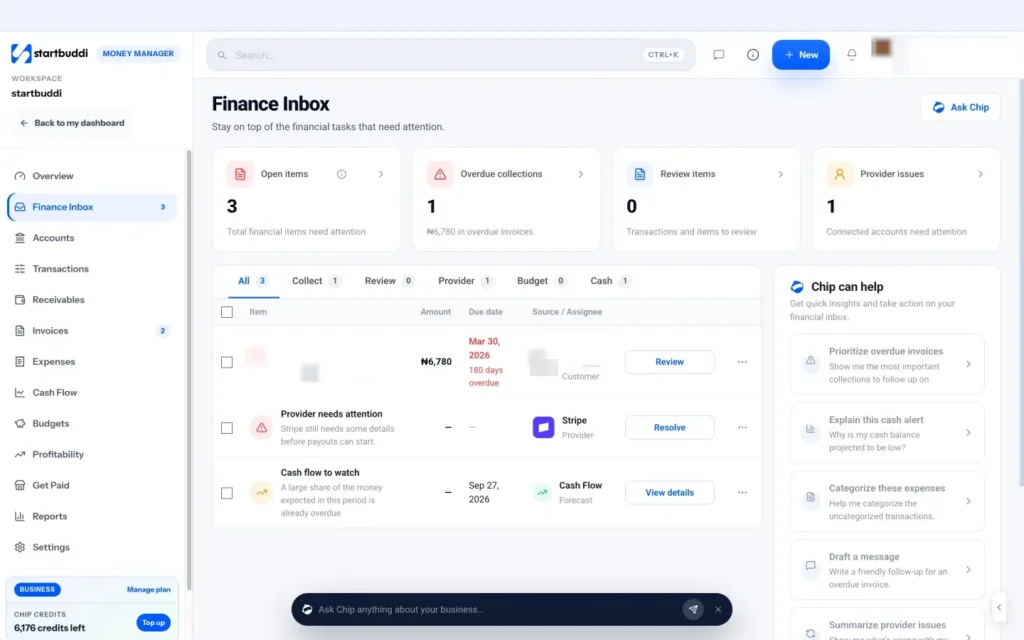
1. Clear the Finance Inbox. Work through overdue invoices, uncategorised expenses, possible duplicates and payments that need matching until it shows nothing left to do.
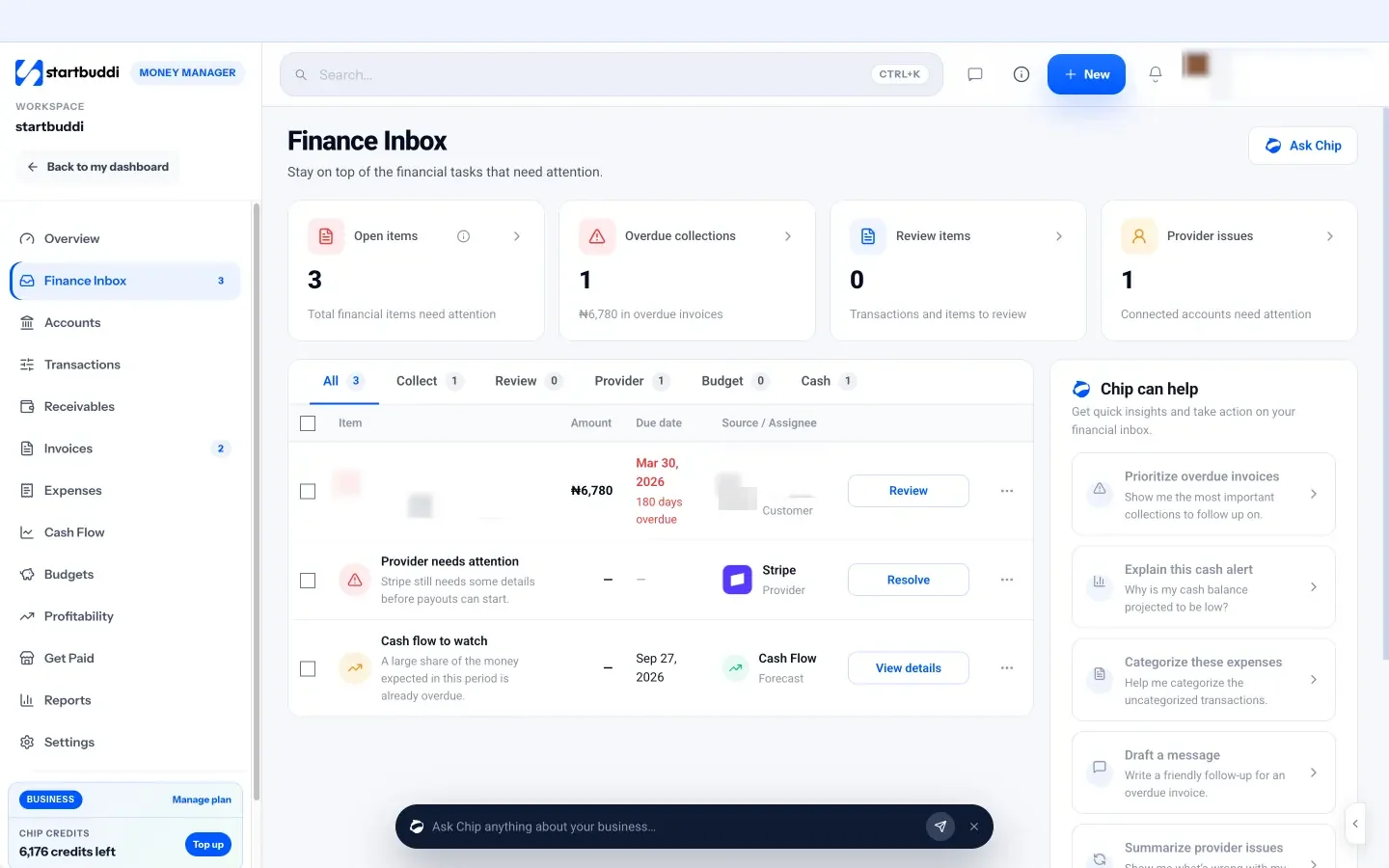
2. Check the Receivables and Bills. Receivables shows who still owes you and the average days to pay. Expenses has a Bills tab for money you owe vendors, with statuses and partial payments. Both matter if your accountant uses accrual accounting.
3. Export the year. In Reports, choose the Profit & loss tab and the year, review the figures, then use Export CSV for the raw data. Email report sends a copy to your inbox. Send both to your accountant with the checklist above, or import the CSV into your accounting or tax software.
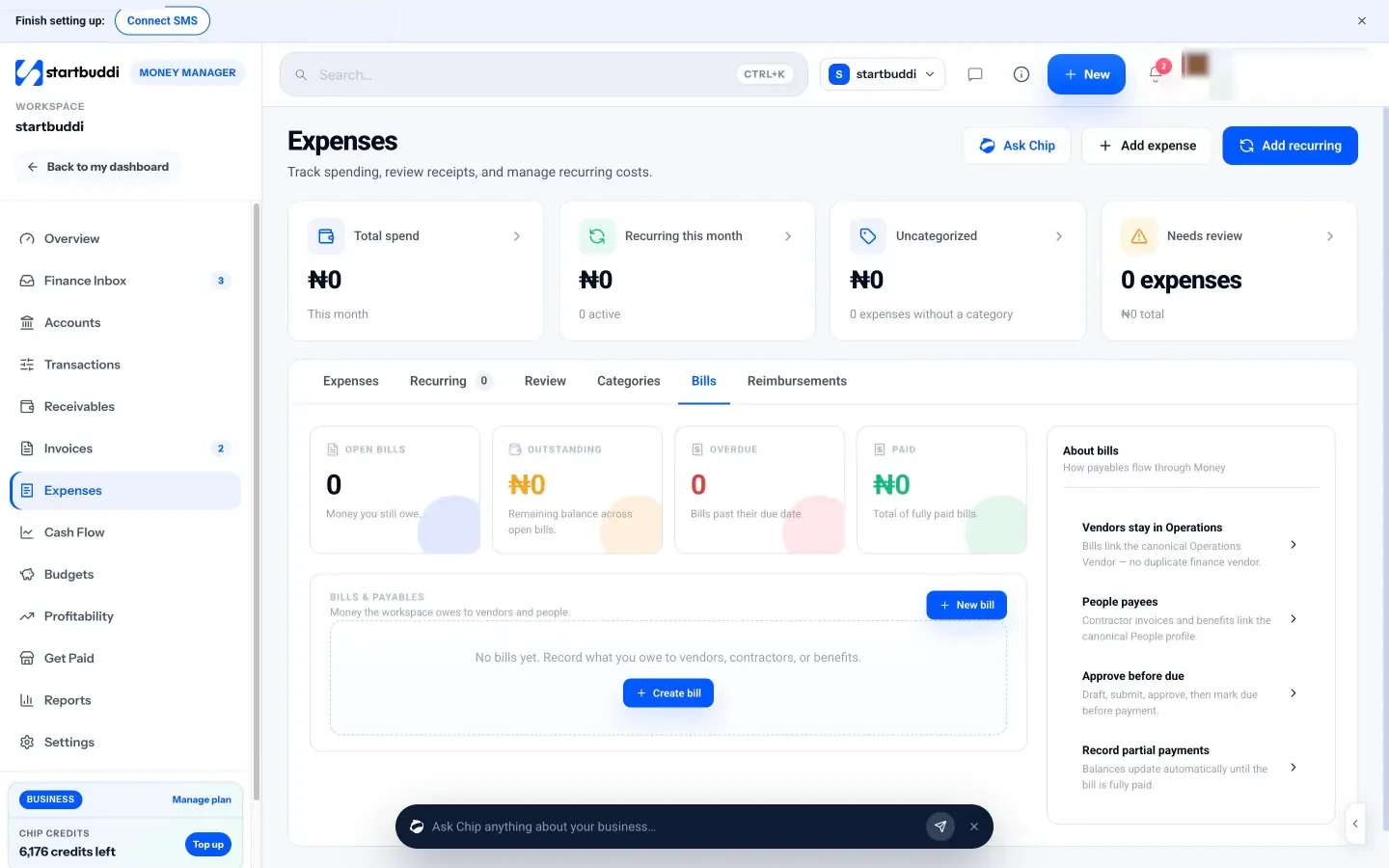
4. Ask Chip for a plain-language summary. Chip can explain what changed in your money this year and what is still owed, which is a useful note to include with your pack. Your accountant still makes the tax decisions.
Money Manager, including expenses and 5 invoices a month, is on the Free plan; Starter and above include unlimited invoices, and every paid plan has a 30-day trial.
Your next step
This week, do three things: open a separate account for tax, write your tax dates into a calendar, and pick one place to record every sale and expense from now on. If you want that place to be the same app you use for clients and projects, you can start free and see the options on the pricing page. Then book a short call with an accountant to confirm your set-aside percentage and deadlines.
Chinedu Kalu is the co-founder and chief operating officer of startbuddi, responsible for how the company runs day to day. Chinedu writes about the operational side of a small business: registering and running the company, money, hiring and the routines that keep a team on track.
Co-founded startbuddi and runs its operations