Profit and loss tracker: a simple way to know if your business is actually making money
How to use a simple profit and loss tracker: what to record, spreadsheet or app, the categories to use, a 30-minute monthly routine and how to read the numbers.


Chinonye wrote this while on the startbuddi team. The product has changed since, so the team updated it on .

- Profit and loss is income minus expenses for a period. Record every sale and cost, use a short list of categories, and produce a cash-basis P&L in 30 minutes each month. Keep profit and cash separate in your head, and keep records that support every figure for tax.
A profit and loss tracker is simply one place where you record every sale and every cost, so you can see whether the business actually made money. To use one, record every sale and every cost as it happens, put each one in a simple category, and once a month add them up for that month: money earned, minus money spent, equals profit (or loss). You don’t need an accountant or accounting software to start. You need one business account, a tracker (a spreadsheet or an app), a list of categories, and 30 minutes at the end of each month.
This guide uses a small branding studio in Lagos as its worked example, but the method works the same in London, Nairobi, Toronto or Sydney. It covers what a profit and loss statement shows, how to choose a tracker, why profit isn’t the same as cash, how to set up categories, a monthly routine, what to know about tax and records, and how to read the numbers once you have them.
This is general information, not tax or accounting advice. For your own situation, speak to a qualified accountant or the tax authority where you operate.
What a profit and loss statement shows
A profit and loss statement (P&L, also called an income statement) covers a period of time, usually a month, a quarter or a year. It lists what came in, what went out, and what’s left. For a small service or retail business it has five lines that matter:
- Revenue: sales to customers in the period.
- Cost of sales: costs tied directly to what you sold, such as stock, materials, or a freelancer you paid to deliver a specific job.
- Gross profit: revenue minus cost of sales.
- Operating expenses: the costs of running the business whatever you sell, such as rent, salaries, fuel, data, software and marketing.
- Net profit: gross profit minus operating expenses. If it’s negative, it’s a loss.
Here’s a simple monthly P&L for a small branding studio in Lagos:
| Line | Amount (₦) |
|---|---|
| Revenue: client projects | 2,400,000 |
| Revenue: monthly retainers | 900,000 |
| Total revenue | 3,300,000 |
| Cost of sales: freelance illustrators | (450,000) |
| Cost of sales: printing for client jobs | (180,000) |
| Gross profit | 2,670,000 |
| Salaries (two staff) | (1,100,000) |
| Rent and service charge | (350,000) |
| Diesel and generator maintenance | (160,000) |
| Internet and data | (70,000) |
| Software subscriptions | (95,000) |
| Transport | (60,000) |
| Bank and payment charges | (25,000) |
| Net profit | 810,000 |
From one table, the owner can see gross margin (about 81%), net margin (about 25%), and that diesel and data together cost about two-thirds as much as rent. That’s the whole point: turning a pile of transfers and receipts into a few numbers you can act on. The free profit margin calculator does the margin maths for you.
Profit is not the same as cash in the bank
Many owners check their bank balance and assume that’s their profit. It isn’t, and confusing the two causes real trouble. A few common reasons they differ:
- Unpaid invoices. If you count sales when you invoice, a ₦500,000 job can show as profit while the client hasn’t paid.
- Owner withdrawals. Money you take out for yourself isn’t a business expense, but it leaves the account.
- Loans. A loan puts cash in the account but isn’t income. Repaying it takes cash out, but only the interest is an expense.
- Big purchases. A new laptop or generator is paid for in one day but used for years. Accountants spread that cost over its life.
- Personal spending through the business account. This muddies everything. Keep a separate business account, even if you’re a sole trader.
A business can be profitable on paper and still run out of cash, usually because customers pay late. That’s why you track both. Your P&L tells you whether the business model works. Your cash position tells you whether you can pay next week’s bills. Our post on managing your finances without an accountant covers the cash side in more depth.
Spreadsheet or app: choosing a profit and loss tracker
A profit and loss tracker can be as simple as a spreadsheet with one row per transaction and a column for the category, then a summary tab that totals each category by month. That works well while you have a few dozen transactions a month and one person recording them.
An app earns its place when the typing becomes the problem. Look for one that pulls in the payments you already receive (from invoices or a payment provider), lets you snap a receipt, remembers categories for repeat suppliers, and shows the P&L by month without you building formulas. Check two things before you commit: whether it can export your data for your accountant, and whether it is honest about its method (most simple trackers work on a cash basis). Whichever you choose, the habit matters more than the tool.
Cash basis or accrual: which method should you use?
There are two ways to decide which month a sale or cost belongs to.
- Cash basis: you record income when you receive it and expenses when you pay them. The US tax authority’s Publication 583 puts it simply: under the cash method, you report income in the tax year you receive it.
- Accrual basis: you record income when you earn it (usually when you invoice) and expenses when you owe them, even if the money moves later.
Cash basis is simpler and matches your bank account, which is why many small businesses start there. In the UK, HMRC describes cash basis as the standard way for sole traders and partnerships to record income and expenses, although limited companies can’t use it for tax. Accrual gives a truer picture when you have big gaps between invoicing and payment, or carry stock; the IRS says businesses that need an inventory generally must use accrual.
For a monthly management P&L, the one you use to run the business, cash basis is a sensible start for most service businesses. Your accountant can prepare the formal accounts on whatever basis the law requires. Just be consistent, and note which method you used.
Set up the categories in your profit and loss tracker
Categories are what turn a list of transactions into a P&L. Too few, and you learn nothing. Too many, and you’ll never keep them up. Aim for 5 to 8 income and expense groups you actually care about. Here’s a starting list for a service business; swap in your local costs, such as diesel in Lagos or heating in Manchester.
| Type | Category | Examples |
|---|---|---|
| Income | Client work | Project fees, one-off jobs |
| Income | Recurring income | Retainers, subscriptions, memberships |
| Income | Product sales | Physical or digital products |
| Cost of sales | Direct costs | Freelancers on client jobs, materials, printing, stock |
| Expense | Staff | Salaries, allowances, pension contributions |
| Expense | Premises and power | Rent, service charge, electricity tokens, diesel |
| Expense | Communications | Data, airtime, internet |
| Expense | Software and tools | Subscriptions, domain, hosting |
| Expense | Transport | Fuel, ride-hailing, deliveries |
| Expense | Marketing | Ads, printing flyers, events |
| Expense | Bank and payment fees | Transfer charges and levies, POS and card processing fees |
If you earn in one currency but report in another (dollars into naira, say, or euros into pounds), record the amount that actually landed in your account, and note the foreign amount in the description. That keeps your P&L in one currency and makes exchange-rate swings visible instead of hidden. For more on expense habits, see our glossary entry on expense tracking.
A 30-minute monthly profit and loss routine
Pick a fixed day, such as the third working day of each month, and follow the same steps every time:
- Collect everything. Download last month’s bank statements for every business account, plus payment provider reports (Stripe, PayPal, Square, Paystack or whatever you use).
- Record missing transactions. Cash sales, cash expenses and anything paid from a personal account for the business.
- Categorise. Give every line a category. Anything you can’t place goes into “to check”, not “other”.
- Remove what isn’t profit or loss. Transfers between your own accounts, loan capital, owner withdrawals and personal spending.
- Total by category. Income, cost of sales and each expense group.
- Compare. Put this month next to last month and the same month last year if you have it.
- Write three sentences. What went up, what went down, and one thing you’ll change. This last step is the one most people skip, and the one that makes the whole exercise worth it.
Better still, record transactions weekly so month-end is a check, not a rescue job. The free expense report template is a handy format if staff spend money on the business’s behalf.
Tax and record-keeping: what to know
Your P&L isn’t a tax return, but the records behind it are exactly what a tax authority or accountant will ask for. Good monthly tracking makes filing far easier.
Wherever you are
The principle is the same everywhere: keep records that support every figure. How long you keep them varies. The IRS generally expects records for at least three years from filing (Publication 583), while the Canada Revenue Agency says you generally must keep records for six years from the end of the tax year they relate to. Check the rules where you are with your tax authority, such as NRS, HMRC, the IRS or the CRA.
An example of changing rules: Nigeria
Nigeria’s tax system changed with the 2025 tax reform laws. According to EY’s summary of the Nigeria Tax Act 2025, the Act took effect on 1 January 2026, and small companies, defined there as those with ₦50 million or less in turnover and ₦250 million or less in fixed assets, excluding professional service providers, pay 0% company income tax, while other companies pay 30%. Commentators have noted that the companion administration law uses a different turnover figure for some purposes, so confirm which rules apply to you. The federal tax authority is now the Nigeria Revenue Service (NRS), formerly FIRS. Even if you owe no company income tax, you still need accurate records of turnover and assets to show you qualify.
How to read your profit and loss each month
Once you have three months of numbers, patterns appear. Ask these questions:
- Is gross margin steady? If it’s falling, your direct costs are rising faster than your prices. Time to review pricing or suppliers.
- Which expense grew fastest? In many small businesses it’s power, rent or transport. Seeing the number monthly makes it easier to justify a solar setup or a delivery partner.
- Is revenue concentrated? If one client is half your income, a single late payment hurts. Aim to spread it.
- Which clients or projects make money? A big client with lots of revisions can earn less than a small, tidy one. Tag income and direct costs by client or project to find out.
- Are you paying yourself? If net profit looks healthy only because you take no salary, the business isn’t as profitable as it looks.
Work out your monthly break-even
One more number is worth knowing: how much you need to sell each month just to cover your costs. Take your regular operating expenses (in the studio example, ₦1,860,000) and divide by your gross margin (about 81%). The answer, roughly ₦2.3 million, is the revenue the studio needs before it makes a single naira of profit. Anything above that line is profit; anything below it is a loss. The free break-even calculator does the sum for you in sales or jobs a month. Knowing this figure changes how you think about discounts, slow months and new hires. A new staff member on ₦500,000 a month raises break-even by more than ₦600,000 in sales, not ₦500,000, because every naira of sales also carries direct costs.
Our post on business finance manager software explains which of these numbers software can calculate for you and which still need your judgement.
How startbuddi helps you track profit and loss
startbuddi’s Money Manager builds a profit and loss view from the invoices, payments and expenses you already record in it, so the monthly routine above becomes mostly a review.
A live P&L from real records
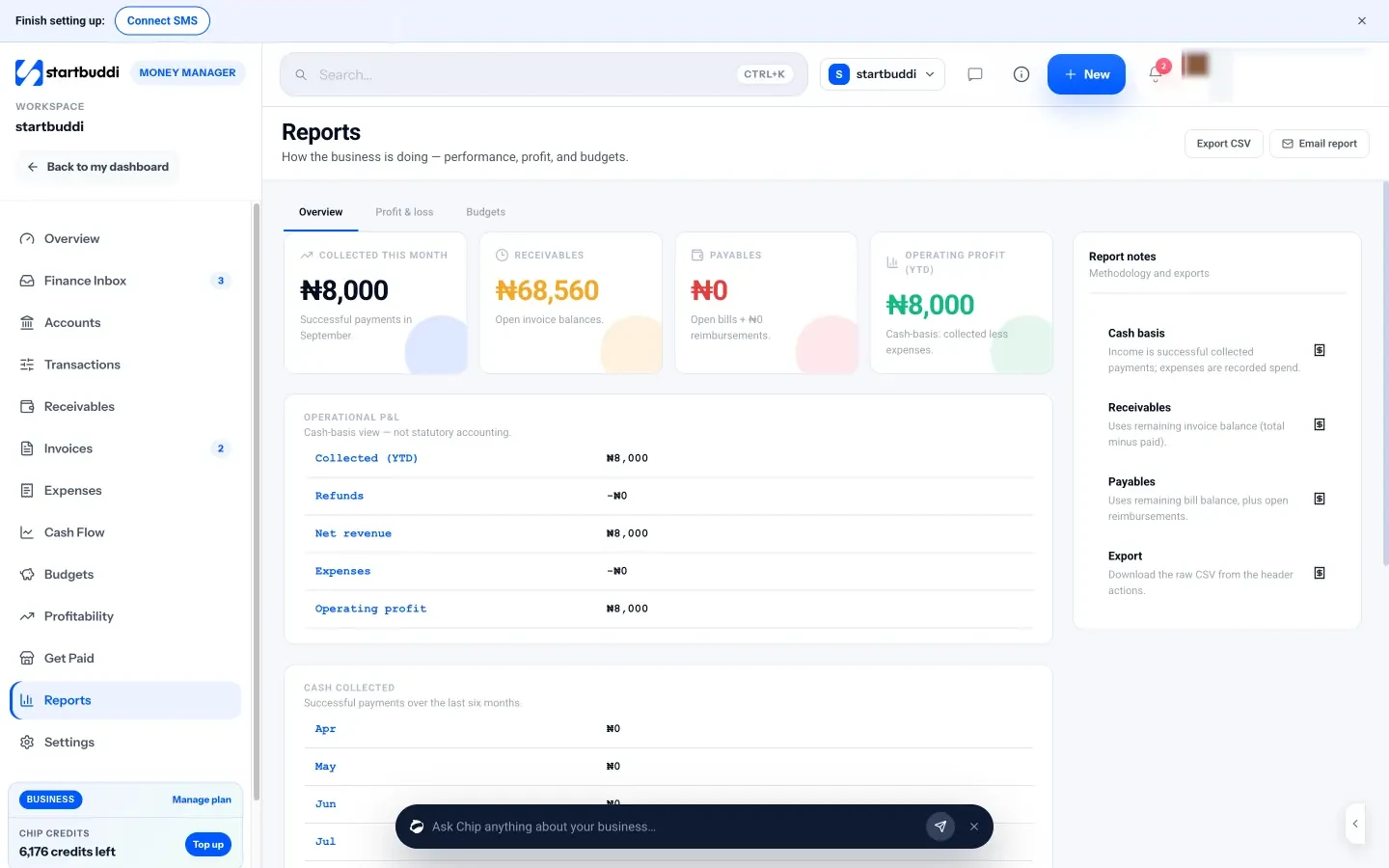
Open Money Manager, then Reports. The Overview shows money collected this month, receivables, payables and operating profit for the year so far, plus an Operational P&L. The Profit & loss tab lets you switch between this month, this quarter, this year and year to date, and shows revenue, expenses, net profit, income by source (invoices, bookings, forms, payment links, subscriptions and more), expenses by category, and a running total of tax you’ve added to invoices. You can export the data as CSV for your accountant or email yourself the report.
Expenses with categories and receipts
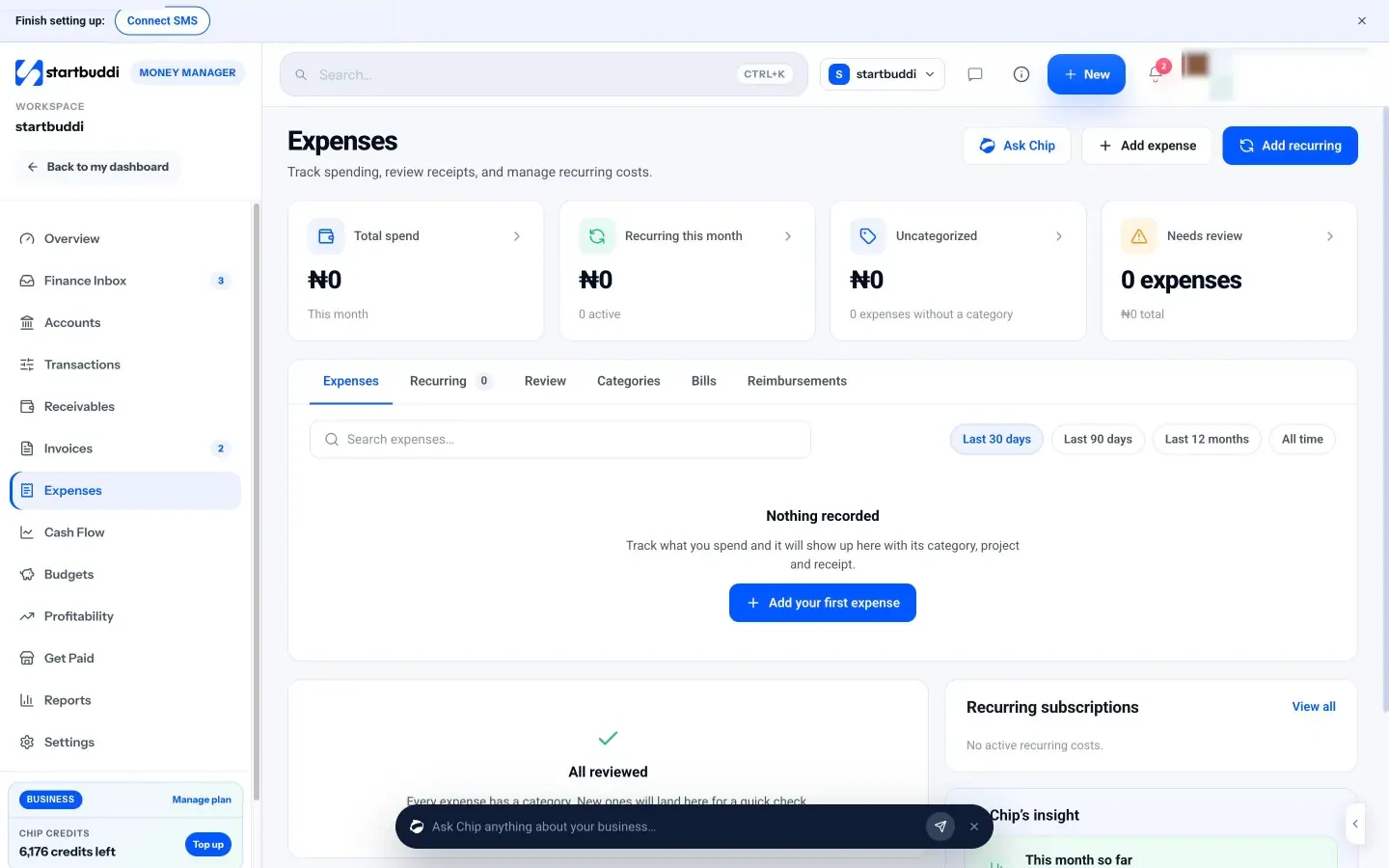
Expenses is where you log spending with a category, project and receipt, set up recurring costs like rent and software, and review anything uncategorised. Payments that come in through Paystack or Stripe on your invoices land in Transactions automatically.
Profit by client and project
Profitability ranks projects, customers, products and campaigns by revenue collected minus the expenses you’ve linked to them, which answers “who actually makes us money?”
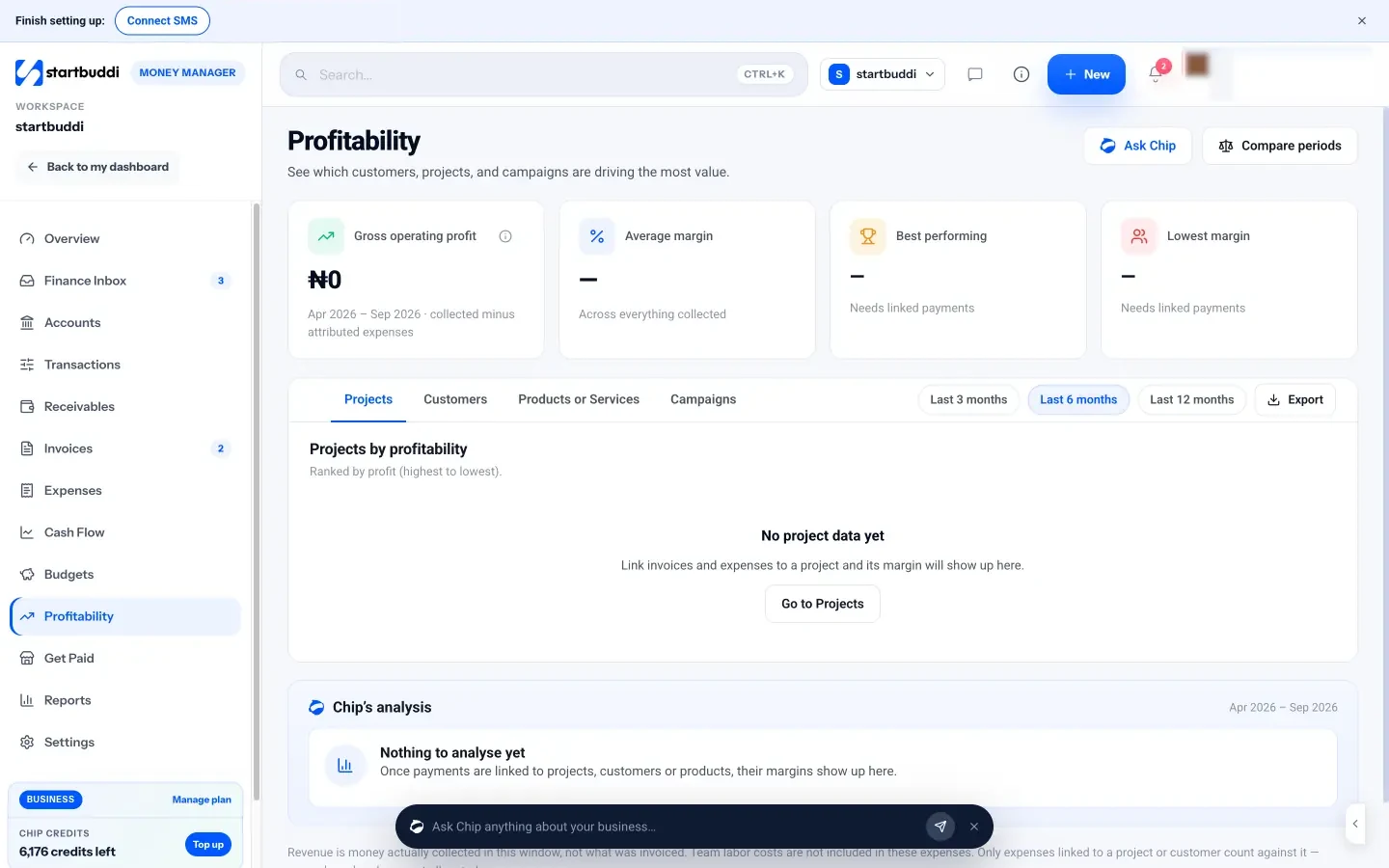
Now the limits, because they matter. The P&L is cash basis only and the app says so: it’s a view for running the business, not statutory accounts. startbuddi isn’t accounting or bookkeeping software. There are no bank feeds, so cash sales and bank-only transactions need adding by hand, there’s no QuickBooks or Xero sync, and it doesn’t file tax. Totals show in one reporting currency, with other currencies listed separately. Profitability doesn’t include the cost of your team’s time. Many small businesses use Money Manager day to day and hand the CSV export to an accountant at year end; if you need full double-entry accounting, look at our comparison with QuickBooks. The help guide on recording expenses in startbuddi shows how to get started.
Your next step
Block 30 minutes on the third working day of next month and produce last month’s P&L using the categories above, even if it’s in a notebook. Write your three sentences. If you’d rather have the totals built for you from your invoices and expenses, start with startbuddi for free and record this week’s expenses today.
Sources
- IRS Publication 583: Starting a Business and Keeping Records
- GOV.UK: Cash basis
- Canada Revenue Agency: How long to keep your records
- EY: Nigeria Tax Act, 2025 has been signed, highlights
- Nigeria Revenue Service
Frequently asked questions
Do I need accounting software to track profit and loss?
No. A notebook or simple tool works at first. What matters is recording every transaction, categorising it and reviewing the totals monthly.
What is the difference between profit and loss and a cash flow statement?
A P&L shows whether you made money over a period. Cash flow shows how money moved in and out of your account. You can be profitable and still short of cash if clients pay late.
How often should a small business prepare a P&L?
Monthly is ideal for running the business. Quarterly and yearly versions then build themselves from the monthly figures.
Should I include money I take out for myself as an expense?
Owner withdrawals are not a business expense for a sole trader. If you pay yourself a salary through a company, that salary is an expense. Ask an accountant how it works for your structure.
SEO Copywriter| Email growth Specialist| I help businesses increase revenue with strategic SEO content & high-converting email funnels.