AI lead follow-up: how AI can write your follow-up messages (and when to send them)
How AI can write and time your lead follow-up messages: what a good follow-up says, how an AI sequence works, a worked example, the rules and the risks.


- AI lead follow-up uses AI to plan and draft the messages you send after someone enquires, by email, SMS or WhatsApp, and to branch on how they respond. Start with one trigger and one goal, review every AI draft, follow consent and channel rules, and stop the moment the lead replies or books.
AI lead follow-up means letting AI write, personalise and time the messages you send to a lead after they first get in touch. It usually runs as an AI sequence: a planned series of follow-up messages, by email, SMS or WhatsApp, where AI helps write the messages, fit them to each person, and decide what happens next based on how people respond. A sequence starts when something happens, such as a form being filled in or a booking being made, then runs on its own until the person replies, buys, or reaches the end.
In short, it’s automated follow-up with a writing assistant built in. This guide explains what a good follow-up message looks like, how AI lead follow-up works, how it differs from a classic drip campaign, where it helps a small business and where it can go wrong, the rules you need to follow, and how to build your first sequence.
What a good follow-up message looks like
Before you let AI write anything, know what you want it to produce. A follow-up that gets replies usually has five parts:
- It picks up the thread: it mentions what the lead actually asked about, not “your enquiry”.
- It adds one useful thing: a typical timeline, a price range, an answer to a common question.
- It asks for one next step: book a call, reply with a date, confirm a detail.
- It is short: three to five sentences, readable on a phone.
- It sounds like you: your name, your tone, no “per my last email”.
AI is good at producing this shape quickly and adjusting it for each lead. It is not good at knowing facts you haven’t given it, which is why you check every draft.
What is AI sequencing?
A sequence is a set of messages sent in order, with waits between them. “Send a welcome email now, a helpful tip in two days, and a booking link in five” is a sequence. Businesses have used them for years under names like drip campaigns and nurture flows. If you’re new to the idea, our glossary entry on email drip sequences covers the basics.
AI sequencing adds artificial intelligence at three points:
- Planning. You describe the goal in plain words, such as “follow up everyone who asks for a quote”, and the AI proposes the steps, timings and channels.
- Writing. The AI drafts each message in your tone, using what it knows about your business and the contact.
- Adapting. The sequence branches on what people do: opened, clicked, replied, booked or paid. Some tools also read replies and route them.
The AI doesn’t replace your judgement. The best setups treat the AI as a fast first-draft writer and planner, with a person checking before anything goes live. For a short definition, see what is AI sequencing.
AI sequencing vs a classic drip campaign
| Classic drip campaign | AI sequencing | |
|---|---|---|
| Setup | You plan every step and write every message | You describe the goal; the AI drafts a plan and messages for you to edit |
| Messages | The same text for everyone, with merge fields like first name | Drafts can reflect the contact’s details and your business context |
| Path | Mostly fixed timings | Branches on opens, clicks, replies and other actions |
| Time to launch | Hours to days | Minutes for a first draft, plus your review |
| Risk | Messages feel generic | Messages can be wrong or off-tone if nobody checks |
Both approaches use the same building blocks: a trigger, steps, waits and conditions. AI mostly changes how quickly you get from idea to a working sequence, and how personal the messages can be.
How AI lead follow-up works, step by step
1. A trigger starts it
Every sequence starts with an event: a form submitted, a new contact added, a booking made or cancelled, an invoice gone overdue, a deal won, or a message received. Good triggers are specific. “Someone asked for a quote” is better than “someone joined the list”.
2. Steps do the work
Steps send messages (email, SMS, WhatsApp) or take actions, such as adding a tag, creating a task for a teammate, or updating the contact’s stage.
3. Waits set the pace
Waits space messages out: two days, a week, or “until they reply”. Too short and you’re pushy; too long and they’ve forgotten you.
4. Conditions choose the path
Conditions branch the sequence. If they clicked the pricing link, send a case study. If they booked a call, stop the sales emails. If they replied, hand over to a person.
5. Exits stop it at the right time
The most important rule of any sequence: stop when the goal is met. Nobody wants a “Still interested?” email the day after they paid.
Where AI lead follow-up helps a small business
AI is still new for most small firms. The US Census Bureau’s Business Trends and Outlook Survey found that overall AI use among US businesses hovered between 17% and 20% from December 2025 to May 2026, and less than 20% of firms with four or fewer employees reported using it. Follow-up is one of the easiest places to start, because the work is repetitive and the payoff is easy to see.
Five sequences worth building first:
- New enquiry follow-up. Reply within minutes, share one useful resource, then offer a call. Speed matters: slow replies lose leads.
- Quote or proposal chaser. A friendly check-in after three days, an answer to a common question after a week, then a final “shall I close this?” note.
- Booking reminders. A confirmation, then a reminder the day before, to cut no-shows.
- New client onboarding. Welcome, what happens next, what we need from you, and a check-in at the end of week one.
- Win-back. For customers who haven’t bought in a few months: a helpful note, then an offer, then a graceful goodbye.
Choose the channel your customers actually answer. Email suits longer messages, attachments and business buyers. SMS is short and hard to miss, which makes it good for reminders. WhatsApp works well where customers already chat with businesses there, which is common in markets such as Nigeria, Kenya, India and South Africa. Many good sequences mix channels: an email with the details, then a short WhatsApp or SMS reminder, as long as each person agreed to hear from you on that channel.
If you’d like a broader comparison of automated and manual follow-up, read marketing automation vs manual outreach.
An example AI sequence, written out
Here’s what a quote follow-up might look like for a small interior design studio in Bengaluru, after the owner asked an AI to “follow up quote requests in a warm, short tone and get them to book a site visit”. The owner edited each draft before switching it on.
Trigger: someone submits the “request a quote” form. Exit: they book a site visit or reply.
Message 1, straight away (email): “Hi Priya, thanks for telling us about your living room project. We’ve got your details and budget range. The quickest next step is a free 30-minute site visit, so we can measure up and give you a firm quote. You can pick a time here.”
Wait two days. Condition: if Priya booked, exit. If not, continue.
Message 2 (email): “Hi Priya, a quick one: most clients ask how long a living room refresh takes. For projects like yours it’s usually three to five weeks from sign-off. Happy to talk it through at a site visit, whenever suits you.”
Wait four days. Condition: if she clicked the booking link but didn’t book, create a task for the owner to call her.
Message 3 (email): “Hi Priya, I don’t want to fill your inbox, so this is my last note. If the timing isn’t right, no problem at all. Just reply whenever you’re ready and we’ll pick it up.”
Notice what the owner changed from the AI’s first draft: the typical timeline (the AI had guessed two weeks), a shorter subject line, and a task for a phone call, because a real conversation closes more jobs than a fourth email. That’s the pattern to aim for: AI for speed, you for accuracy and judgement.
How to measure whether it works
Judge a sequence by the goal, not by opens. For a quote follow-up, count how many people booked a visit and how many became paying clients, then compare with the months before you had the sequence. Look at where people drop out: if nobody acts after message two, rewrite message two. Keep an eye on unsubscribes and spam complaints too, because a rising number is an early warning that you’re sending too much.
The rules: consent, sending limits and channel policies
Automation sends messages at scale, so mistakes scale too. This is general information, not legal advice; check the rules where you and your contacts are.
- United States: the FTC’s CAN-SPAM guide requires, among other things, honest subject lines, a physical address and a clear way to opt out, with opt-outs honoured within 10 business days.
- United Kingdom: the ICO’s guidance on electronic mail marketing explains that you generally need consent, or must meet the “soft opt-in” conditions for existing customers, before sending marketing emails or texts.
- Elsewhere: many countries have similar rules. In Nigeria, for example, personal data is covered by the Nigeria Data Protection Act 2023.
Channels have their own rules too:
- Email to Gmail users. Google’s sender guidelines require all senders to set up SPF or DKIM and keep spam rates below 0.3%. Senders of 5,000 or more messages a day also need DMARC and one-click unsubscribe on marketing messages.
- WhatsApp. According to Meta’s WhatsApp Business Platform documentation, free-form messages can only be sent within a 24-hour customer service window that opens when a person messages you. Outside that window, you must use an approved message template.
Risks of AI sequencing, and how to manage them
- Wrong facts. AI can invent details, such as a price or a feature you don’t offer. Read every message before a sequence goes live.
- Off-brand tone. Give the AI your tone in plain words (“friendly, short, no jargon”) and edit the first few drafts until they sound like you.
- Too personal. Mentioning things a contact didn’t tell you directly can feel intrusive. Personalise with what they shared with you.
- Too many messages. Three to five messages over two or three weeks is plenty for most small-business sequences.
- Forgotten sequences. Review running sequences monthly. Offers expire and links break.
- No human handover. When someone replies, a person should take over. A sequence that keeps sending after a real reply damages trust fast.
How to build your first AI sequence
- Pick one trigger and one goal. For example: “When someone fills in the quote form, get them to book a call.”
- Describe it to the AI in a sentence or two. Include the goal, the tone and the number of messages.
- Edit the plan. Check timings, remove steps you don’t need, and add an exit when they book or reply.
- Edit every message. Fix facts, shorten long sentences, and make sure each one has a single clear next step.
- Test with yourself. Run the sequence with your own details and read it on your phone.
- Check consent. Make sure everyone who’ll enter the sequence agreed to hear from you.
- Switch it on, then measure. After two weeks, look at replies and bookings, not just opens, and adjust.
How startbuddi helps with AI lead follow-up
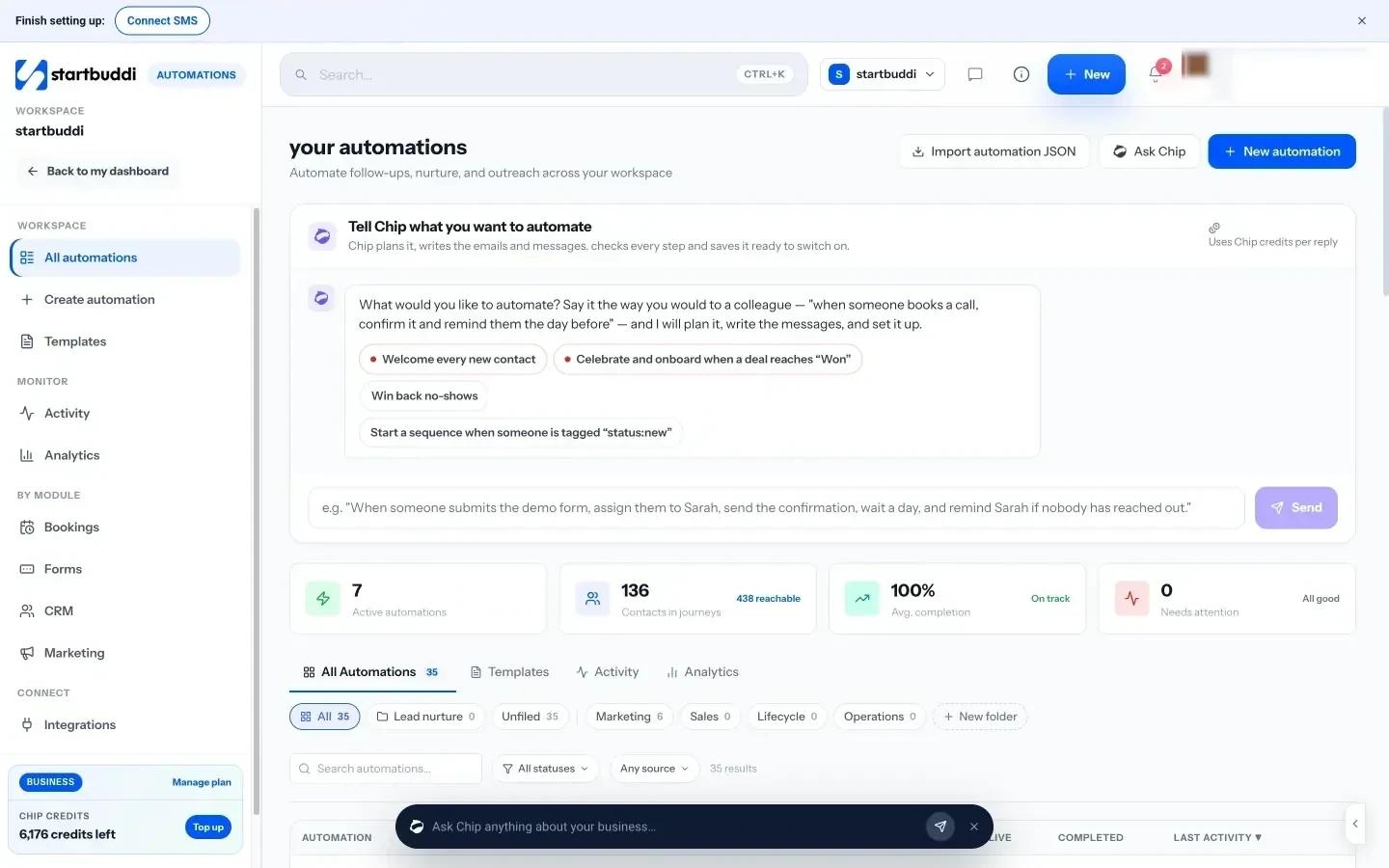
startbuddi runs sequences through Automations, one engine for follow-ups across forms, bookings, customers, invoices and marketing, with Chip, the built-in AI assistant, helping you build them.
- Tell Chip what you want to automate. Describe it in plain words, such as “When someone books a meeting, send them a confirmation and remind the owner.” Chip plans it, writes the emails and messages, checks every step and saves it as a draft for you to switch on. This uses Chip credits.
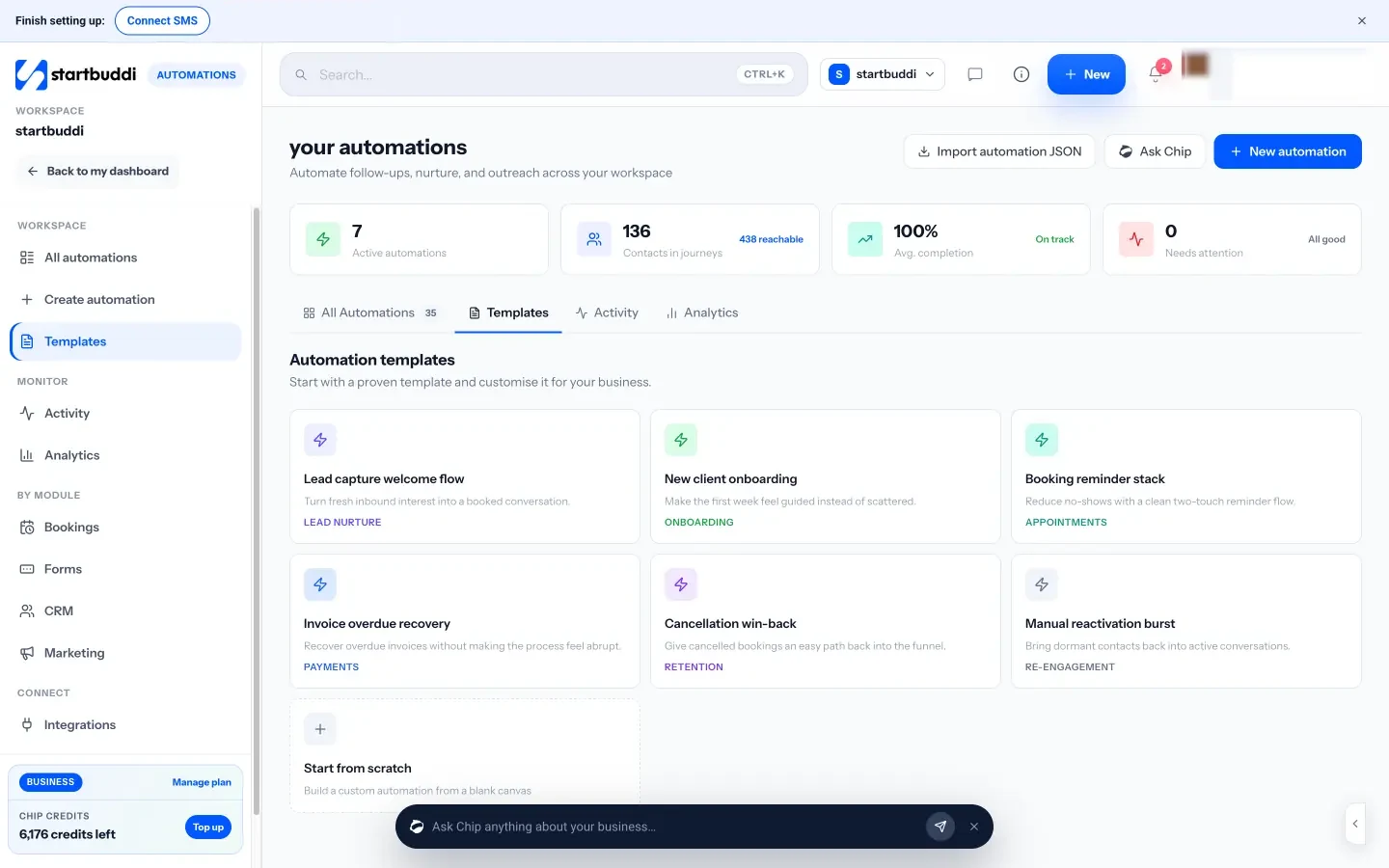
- Templates. Start from ready-made flows such as a lead capture welcome flow, new client onboarding, a booking reminder stack, invoice overdue recovery and cancellation win-back.
- Triggers and steps. Start from events such as a form submitted, a new booking, an invoice overdue, an email clicked, a deal won or a customer message received. Steps include email, SMS and WhatsApp messages, waits, conditions, “wait for their reply”, tags, tasks and exits.
- Nurture with Chip. From a single contact, Chip (in beta) can draft a short email sequence from a goal, the number of emails and a tone.
- Safety checks. Test with a contact or simulate an event before launch. Validation flags problems such as free-text WhatsApp steps that only reach people who messaged you in the last 24 hours. Before activating, a review shows how many contacts are reachable and how many are suppressed.
Honest limits: Free includes 2 active automations and Starter 10, with no limit on Growth and Scale (see pricing), and runs are capped each month (250 on Starter, 2,000 on Growth and 5,000 on Scale). WhatsApp and SMS need Starter or above, and Chip auto-replies need Growth. Some triggers, including date-based ones such as birthdays, don’t run yet. Chip’s drafts are drafts: you still review and switch them on. For step-by-step help, see how to build an automation sequence in startbuddi, and for agency setups, AI sequencing for agencies.
Your next step
Choose the one follow-up you most often forget, whether that’s quotes, new enquiries or overdue invoices, and write the goal in a single sentence. Then build it as a three-message sequence with a clear exit. If you’d like Chip to draft it for you, start a 30-day trial of a paid plan from the pricing page.
Sources
- US Census Bureau (2026): Large firms with at least 20 employees biggest AI users
- FTC: CAN-SPAM Act compliance guide for business
- ICO: Guidance on direct marketing using electronic mail
- Google: Email sender guidelines
- Meta: WhatsApp Business Platform pricing and customer service windows
Frequently asked questions
Is AI sequencing the same as a drip campaign?
It's built on the same idea. AI sequencing adds help with planning, writing and branching, so you get a working sequence faster and messages can be more personal.
How many messages should a sequence have?
For most small-business follow-ups, three to five messages over two to three weeks. Stop earlier if the person replies, books or buys.
Can AI send messages without me checking them?
Some tools allow it, but it's risky. Review AI drafts before a sequence goes live, and check running sequences regularly.
Can I use AI sequencing on WhatsApp?
Yes, within WhatsApp's rules. Outside the 24-hour window after someone messages you, you need approved message templates.
Does startbuddi's free plan include automations?
No. Free includes 2 active automations and Starter 10, and every paid plan comes with a 30-day trial.
Olabimpe Salami is the email and outreach specialist at startbuddi. Olabimpe writes about the messages that bring customers in and back: email, WhatsApp and SMS campaigns, follow-ups, and turning enquiries into paying clients.
Runs email and outreach at startbuddi