How to get clients for a service business: referrals, being found and outreach
How to get clients for a service business without a big budget: a clear offer, referrals and past clients, being easy to find, respectful outreach and fast replies.

If you want to know how to get clients for a service business, the honest answer is that there is no single trick. Clients come from a small number of routes, used every week: people who already know you, people who find you when they search, and people you reach out to first. This guide shows you how to work all three without a big budget, and how to turn the enquiries they bring into paying clients.
It is written for freelancers, consultants, coaches, agencies, trades and other service businesses, whether you are looking for your first client or trying to make the pipeline less lumpy. Each chapter starts with the business thinking, with examples, scripts and mistakes to avoid, then shows how to do it in startbuddi. By the end you will have a clear offer, a weekly client-finding routine, a page where people can book or enquire, and a simple way to track what works.
Before you look: your ideal client, offer and numbers
- Decide what makes you different
- Price it so you can afford to find clients
- Sum it up in one sentence
- Know what a client costs you
- A realistic first 90 days
- 1. Turn your offer into a bookable service
- 2. Record where every client comes from
Most people start looking for clients by asking "where can I find them?". The better first question is "who exactly am I looking for, and what am I offering them?". When you know that, finding clients becomes a list of places to go and people to talk to. When you do not, every post, message and conversation is a guess. This chapter covers the groundwork: your ideal client, your offer, your proof, and the maths of how many clients you need.
Here is the short answer to how to get clients: pick a specific type of client, make one clear offer they can say yes to, show proof that you can deliver, then spend a set amount of time every week on three routes: referrals and your network, being easy to find, and direct outreach. Track which route brings paying clients, and do more of that.
How to get clients: start with who you serve
"Anyone who needs a website" is not a client. "Independent restaurants in Accra that want online orders" is. A narrow description feels risky, because it seems to shut out work. In practice it does the opposite: it tells you where to look, what to say and what examples to show, and it makes the right people feel that you understand them.
Write a one-paragraph description of your ideal client using these prompts:
- Who are they? Type of business or person, size, location.
- What problem do they have right now? In their words, not yours.
- What have they already tried? Doing it themselves, a cheaper supplier, nothing.
- What can they afford? A realistic budget range.
- Where do they spend time? Online groups, events, associations, neighbourhoods, platforms.
Here are a few examples of good descriptions:
- A bookkeeper in Birmingham: "Owner-managed trades businesses with 2 to 10 staff who do their own books at the weekend and hate it."
- A personal trainer in Sydney: "Office workers aged 30 to 50 who want to get fit before work, near the city centre."
- An IT support company in Lagos: "Law firms and clinics with 10 to 40 staff and no in-house IT person."
You can still take work from outside that description. The description is for your marketing, not a rule about who you will help.
Make one clear offer
A service business often lists everything it can do: "branding, websites, social media, photography, consulting". Buyers find that hard to say yes to, because they cannot picture what they would get. A clear offer is a specific package with a result, a scope, a timeline and a price or price range.
| Vague | Clear offer |
|---|---|
| "Social media management" | "Twelve posts a month for Instagram and Facebook, written and designed for you, with a monthly results summary. $600 a month." |
| "Cleaning services" | "Weekly office clean for small offices up to 150 square metres, same cleaner every week, from ZAR 2,400 a month." |
| "Business coaching" | "A 90-day programme for new managers: six one-hour sessions and a written plan. £1,200." |
A clear offer makes every later step easier. Your referral ask becomes "do you know anyone who needs X?". Your page has one thing to sell. Your outreach message has one thing to propose. You can have more services, but lead with one.
Decide what makes you different
Your ideal client usually has other options: a competitor, a cheaper freelancer, a big firm, or doing it themselves. Give them a reason to choose you that is true, specific and matters to them. It rarely needs to be dramatic. Good differences for small service businesses include:
- Speed: "Quotes within 24 hours, most jobs started within a week."
- Specialism: "We only do accounts for restaurants, so we know the numbers that matter."
- Reliability: "The same cleaner every week, and we text you when we arrive."
- Convenience: "Evening and weekend appointments, online booking and card payment."
- Guarantee: "If you are not happy with the first draft, we redo it free."
Avoid differences every competitor also claims, such as "quality service" or "we care". If a rival could put the same line on their page without lying, it is not a difference.
Price it so you can afford to find clients
Your price has to cover the work, your overheads, the time you spend finding clients and a profit. Many new service businesses set a price that only covers the hours of delivery, then wonder why they are always busy and always short of money. If you are not sure where to start, the hourly rate calculator works out a rate from the income you want and the hours you can really bill.
Sum it up in one sentence
Once you know who you serve and what you offer, write a one-sentence description you can use everywhere: your bio, your page headline, your introduction at events and your outreach messages. A simple formula is "I help [who] [get what result] with [what offer]."
- "I help independent cafés in Leeds get more weekday customers with a monthly social media package."
- "We help busy families in Lekki keep their homes spotless with a weekly cleaning plan and the same cleaner every time."
- "I help first-time managers in tech companies lead their team with confidence through a 90-day coaching programme."
Say it out loud. If it sounds natural and a stranger would understand it, use it. If it needs explaining, simplify it. This sentence will do a lot of work for you over the next few months, so it is worth ten minutes of rewriting.
Gather proof before you go looking
People hire service businesses they trust, and trust comes from proof. If you are just starting, you still have options:
- Examples of work. Past projects, even from a previous job (with permission), or a small piece of work you did for a friend or a local charity.
- Testimonials. A two-sentence quote from a happy client, with their name and business if they agree.
- A before-and-after. Photos of a room, a garden, a website or a set of accounts.
- Credentials. Qualifications, memberships, insurance, registrations that matter in your field.
- A clear process. Showing how you work ("call, plan, build, review, launch") reassures people who have never hired someone like you before.
Never invent testimonials or use other people's work as your own. Apart from being dishonest, fake reviews can break consumer protection law in many countries, and they are easy to spot.
Client acquisition maths: how many clients do you need?
Client acquisition is the whole process of turning strangers into paying clients. It helps to know how many you need, and how many conversations that takes, before you start. Here is a worked example for a freelance designer. The conversion rates are assumptions to replace with your own numbers.
| Step | Assumption | Result |
|---|---|---|
| Income goal from new work | $6,000 a month | |
| Average project | $1,500 | 4 new clients a month |
| Proposals won | 1 in 3 | 12 proposals |
| Calls that lead to a proposal | 2 in 3 | 18 calls |
| Conversations that lead to a call | 1 in 4 | 72 conversations |
Seventy-two conversations a month is about 18 a week, or between three and four a working day. That is a manageable number once you know it. It also shows the levers. If you raise the average project to $2,000, you need three clients a month instead of four. If you keep 40% of clients for a second project, you need fewer new ones every month. There is more on that in our guide to customer retention strategies.
Know what a client costs you
Client acquisition cost is how much you spend, in money and time, to win one client. Add up what you spent on finding clients in a month (ads, directory fees, events, the value of your own hours) and divide by the number of new clients.
For example, a plumber in Toronto spends CAD 400 a month on a local directory listing and ads, plus about 10 hours of their own time on quotes and follow-ups, which they value at CAD 50 an hour. That is CAD 900 in total. If it brings six new customers, each one costs CAD 150 to win. If the average first job is worth CAD 350, that is fine. If the average first job is CAD 120 and customers rarely come back, it is a problem.
You do not need precise numbers. You need rough ones, per route, so you can see which route is worth more of your time.
Choose your client-finding routes
There are only three broad ways to get clients, and every tactic you read about fits into one of them. Each has a different cost, speed and ceiling.
| Route | Examples | Speed | Cost | Best when |
|---|---|---|---|---|
| Warm | Referrals, past clients, your network, partners | Fast | Low | You are starting out or have happy past clients |
| Be found | Google profile, your page, social media, directories | Slow to build, then steady | Low to medium | People already search for your kind of service |
| Outreach | Personal emails, LinkedIn messages, calls, visits | Medium | Mostly time | You sell to businesses and can name your ideal clients |
Most service businesses do best with a mix: warm routes for quick wins, being found for a steady flow, and a little outreach to fill gaps. Chapters 2, 3 and 4 cover each route in turn.
A realistic first 90 days
If you are starting from zero, here is a plan that works for many freelancers and small service businesses:
- Weeks 1 to 2: write your ideal client description and offer, gather proof, set up a simple page and a booking or enquiry link.
- Weeks 3 to 6: tell your network, ask for introductions, check in with anyone you have worked with before, and set up your Google Business Profile if you serve a local area.
- Weeks 7 to 12: add a weekly outreach block, keep posting useful content, ask every new client for a review and a referral, and start tracking where enquiries come from.
By the end of three months you will have real numbers for your own client acquisition, which are worth far more than any average you read online.
Common mistakes before you start finding clients
- Trying every channel at once. Pick two or three routes and do them properly for three months.
- No way to contact you. A phone number buried in a PDF is not enough. Make it easy to enquire or book.
- Waiting for the perfect website. A simple one-page site with your offer, proof and a booking link is enough to start.
- Not tracking where clients come from. Ask every new enquiry "how did you hear about us?" and write it down.
How to set up your offer in startbuddi
In startbuddi, your services, bookings, contacts and invoices sit in one place, so the groundwork in this chapter becomes things people can see and buy.
1. Turn your offer into a bookable service
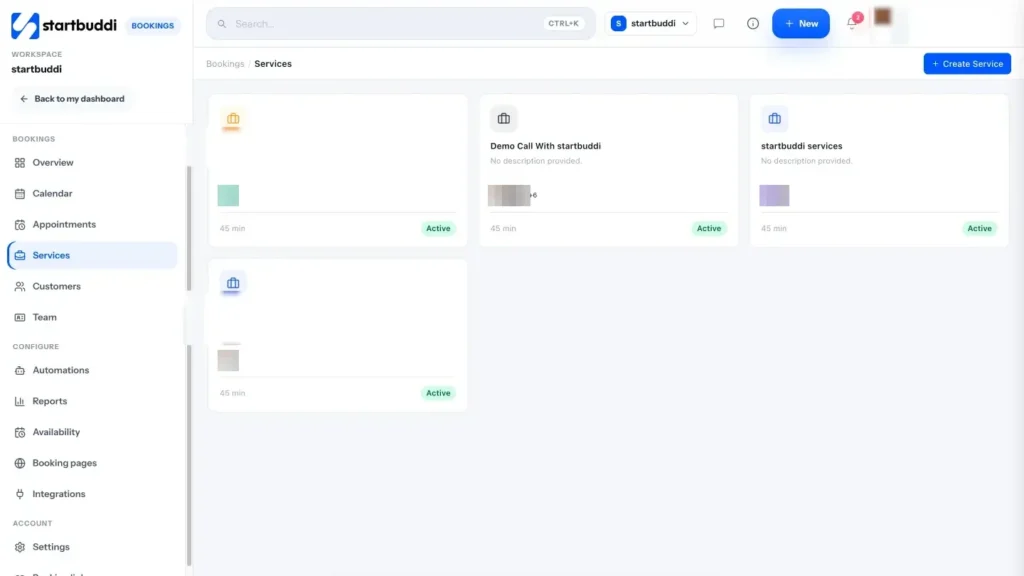
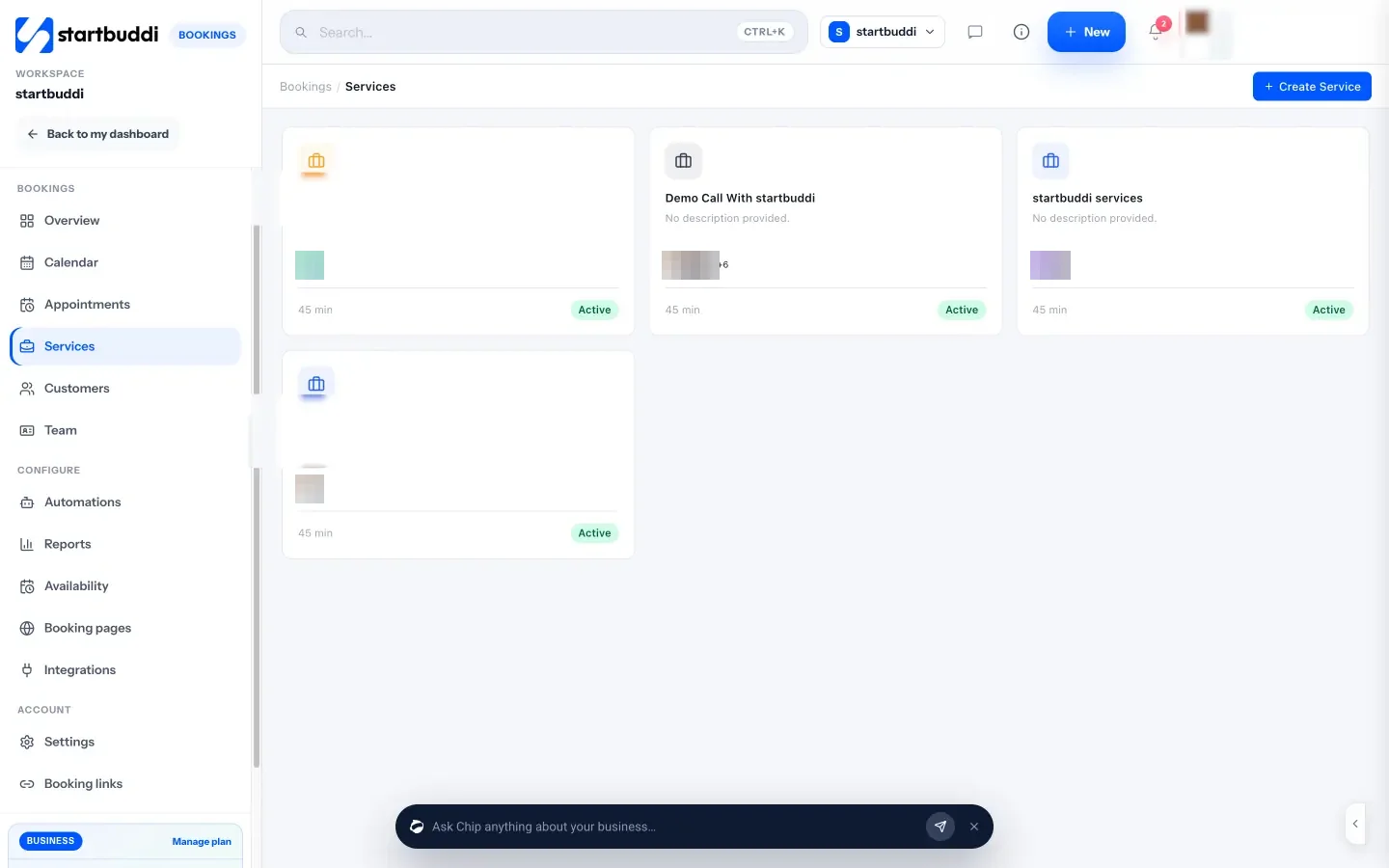
Open Bookings, then Services, and use Create Service. Give it a name, a description and a duration, then open it to set a price and currency. If you want commitment up front, turn on Require payment to book and choose the full amount or a deposit (you will need to connect Paystack or Stripe). You can also add booking questions, such as budget or type of business, and save the answers to the contact. Now "book a call" or "book a clean" is one link.
If your service is a quote-first job rather than a fixed slot, build a quote request form instead in Forms, starting from a template or letting Chip draft the fields from a sentence. Each response can create or update a contact.
2. Record where every client comes from
In Customers, every contact has a source. Contacts created from forms, bookings, website chat and marketing sign-ups arrive with it filled in, and you can set it by hand for referrals and phone calls. Later, the Customers reports show how clients found you, so your client acquisition maths uses real numbers. See contacts and companies for more.
With a clear offer and proof ready, the fastest place to find your first clients is among people who already know you. That is chapter 2.
How to find clients through referrals, past clients and partners
- When to ask
- What to say
- Should you pay for referrals?
- Turn referrals into a simple programme
- Collect testimonials as you go
- Make networking events count
- Stay visible between conversations
- 1. Build a list of past clients and quiet leads
- 2. Send personal check-ins from one inbox
- 3. Ask for reviews and referrals automatically after a job
The quickest clients to win are the ones who already trust you, or trust someone who trusts you. Referrals, past clients, your personal network and partner businesses are the warmest routes, and for most small service businesses they bring the best clients at the lowest cost. They are also the routes people neglect, because asking feels awkward. This chapter shows you how to ask without awkwardness, and how to make it a habit.
Why warm routes work so well
When someone recommends you, they lend you their trust. The buyer skips most of the doubt they would feel about a stranger, so the conversation starts further along and usually closes faster. The research backs this up.
Warm routes also bring better-fitting clients. Your happy clients tend to know people like themselves, running similar businesses with similar budgets. That is exactly the ideal client you described in chapter 1.
How to find clients through referrals
Most happy clients are willing to refer you. They just do not think of it, or do not know what kind of client you want. The fix is to ask at the right time, in the right way.
When to ask
- Right after a win. When the client says "this is brilliant" or sends a thank-you message, that is your moment.
- At the end of a project. Make it part of your wrap-up, along with the final invoice and handover.
- At a regular check-in. For ongoing clients, every three to six months.
What to say
Be specific about who you help. "If you know anyone who might need us" is easy to agree with and easy to forget. "Do you know any other clinic owners who are still taking bookings by phone?" makes the client picture a real person.
Hi Chidi, thank you again for the kind words about the new booking system. I'm glad it's already saving your team time. I'm looking to help two or three more clinics like yours this quarter. Is there anyone you know, maybe another practice owner, who is still juggling phone bookings? If so, I'd be grateful for an introduction, and happy to give them the same free review I did for you.
Notice that the message thanks them, names the result, describes a specific kind of person, and gives the client something to offer their friend. That makes the introduction feel like a favour to the friend, not a sales pitch.
Should you pay for referrals?
Some businesses offer a thank-you for referrals: a discount on the next job, a gift card or a donation to a charity of the client's choice. It can work, especially for consumer services such as cleaning, fitness or beauty. For professional services, a handwritten thank-you and returning the favour are often valued more than money. If you do offer a reward, keep it simple, tell the new client about it openly, and check whether your professional body has rules about paying for introductions.
Turn referrals into a simple programme
If referrals already bring you work, it can be worth making them official. A referral programme does not need software or complicated rules. It needs three things: a reward that feels generous, a clear way to refer, and a promise to say thank you every time.
Here is a worked example. A home cleaning business in Manchester spends about £90 in advertising to win a new regular customer. The average regular customer pays £60 a fortnight and stays for about a year, so is worth roughly £1,500 in revenue. The business offers existing customers one free clean (worth £60) for each friend who books three cleans. Each referred customer costs £60 instead of £90, and referred customers tend to arrive already trusting the business. The owner tells customers about the offer in the welcome message, on every third invoice, and in a short note after positive feedback.
Keep the rules simple enough to explain in one sentence, and honour them every time. A referral reward that is hard to claim does more harm than having none.
Collect testimonials as you go
Testimonials are proof, and they make it easier for clients to refer you, because they can point to what others have said. The best time to ask is straight after a good result. Make it easy with a couple of prompts:
Hi Ben, thanks again for the lovely message about the new kitchen. Would you mind if I shared a couple of lines about your experience on my website? If it helps, you could say what the problem was before, what it was like working with us, and how it's turned out. Two or three sentences is perfect.
Always ask permission to use their name, business and photo, and never edit their words beyond fixing a typo.
Go back to past clients and old leads
Past clients are the most overlooked source of new work. They already trust you, and their needs have probably changed since you last worked together. A short, personal check-in often turns into a new project.
Hi Aisha, it's been about a year since we launched the new website. I was looking at it today and it's holding up well. I wondered how the online orders are going, and whether there's anything you'd like to improve before the busy season? Happy to have a quick call if useful.
Do the same with leads who went quiet or said "not now". If they mentioned a date ("maybe after the summer"), write to them just before it. If they did not, a friendly "is this still on your list?" every few months is fine. Keep it personal and brief, and stop if they ask you to.
Use your network without being pushy
Your network is bigger than you think: former colleagues, old classmates, people from your religious community or sports club, other parents, suppliers and neighbours. Most of them do not know exactly what you do. Telling them is not pushy. It is information.
- Announce it once, clearly. A post or message that says what you now offer, who it is for, and how to get in touch.
- Update your profiles. Your WhatsApp Business profile, LinkedIn headline and social bios should all say what you do and link to a booking or enquiry page.
- Tell ten people personally. A direct message to ten people who know you well, asking not for work but for advice or introductions, often opens doors.
Make networking events count
Business events, trade shows and local meetups can be useful, but only if you go with a plan. Before you go, decide who you want to meet and what you will say in one sentence. At the event, ask questions and listen more than you talk; people remember those who were interested in them. Afterwards, follow up within two days with a personal note that mentions something from your conversation, and add each person to your contact list with a note on where you met. The follow-up is where the value is. Most people skip it.
Stay visible between conversations
People only refer you when you come to mind at the right moment, so it helps to stay gently visible. Three low-effort ways:
- A short, occasional email to past clients and contacts who have agreed to hear from you: a recent project, a useful tip, a seasonal reminder. Once a month is plenty. Our guide to growing an email list from zero covers how to start one properly.
- Your WhatsApp Business status or social stories, where a before-and-after photo reaches the people who saved your number.
- Showing up in your community: sponsoring a local event, volunteering your skills, answering questions in a business group. Being helpful in public is how many service businesses become "the person to ask".
None of these asks for anything. They simply remind people what you do, so that when a friend says "do you know anyone who...?", your name is the first one they think of.
Build partnerships with businesses that serve the same clients
A partner is a business that sells something different to the same people you want to reach. Partners can send you a steady flow of clients because they meet your ideal client first.
| If you are a... | Good partners might be... |
|---|---|
| Web designer | Accountants, brand photographers, printers, business coaches |
| Wedding photographer | Venues, planners, florists, make-up artists |
| Cleaning company | Estate agents, property managers, removal firms |
| Bookkeeper | Business bank managers, tax advisers, business formation services |
| Personal trainer | Physiotherapists, nutritionists, sports shops |
Start by referring clients to them. Nothing builds a partnership faster than sending work first. Then suggest a simple arrangement: you recommend each other when it fits, share each other's useful content, or run a joint event or offer.
Ask for reviews as part of the same habit
Reviews are referrals that work while you sleep. When someone searches for your service, reviews on your Google Business Profile and other sites help them decide. Google's own guidance says that the number of reviews and positive ratings can help a business's local ranking (Google Business Profile Help). Ask every happy client for a review, send them the direct link, and reply to every review you get, good or bad, politely and briefly.
Mistakes to avoid with warm routes
- Asking only once. Build the ask into your process, not your mood.
- Being vague. "Anyone who needs help" gets no referrals. A specific type of person gets introductions.
- Forgetting to say thank you. Always thank the referrer and tell them how it went (without sharing private details).
- Sending bulk marketing to your personal contacts. Personal messages to people you know are fine; adding them to a marketing list without their agreement is not.
How to work warm routes in startbuddi
1. Build a list of past clients and quiet leads
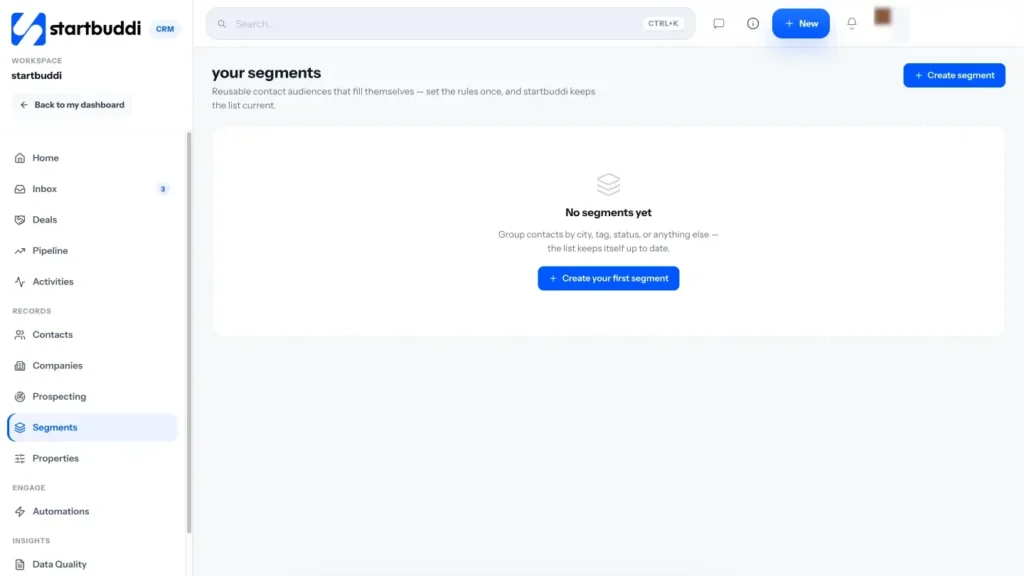
In Customers, open Segments and create a segment with rules, for example lead status "customer" and last contacted more than 90 days ago. The segment keeps itself up to date as contacts change, so you always have a fresh list of people to check in with. You can save a filtered view of your contacts list as a segment in the same way. The segments help article walks through it.
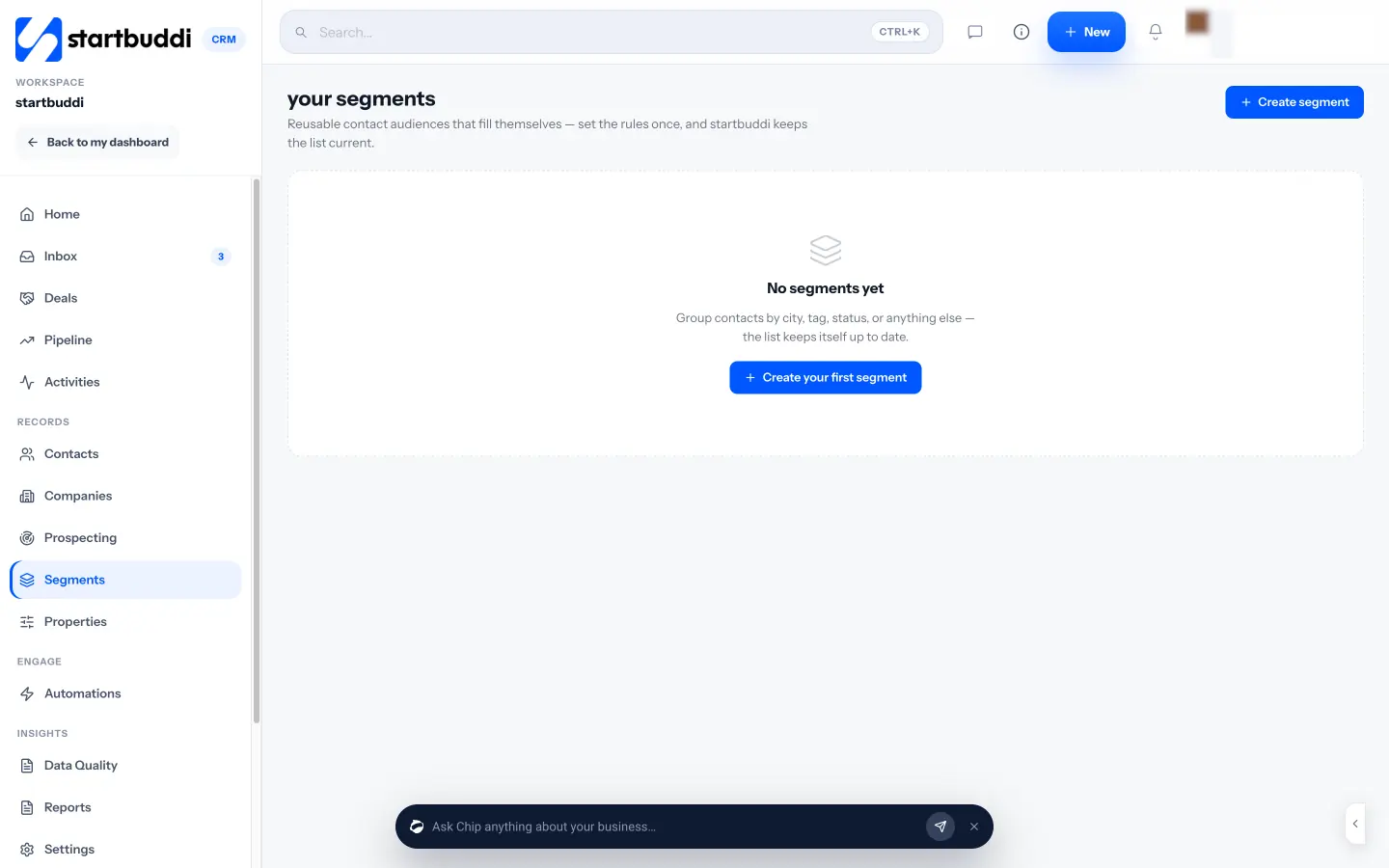
The Customers home page also has a Chip prompt, "Who haven't I contacted in 14 days?", which is a quick way to find people who are drifting.
2. Send personal check-ins from one inbox
Write to each person from the Inbox, on the channel they prefer: email, WhatsApp or SMS (WhatsApp and SMS need the Starter plan or above). Chip can draft a reply for you to edit, and every message sits on the contact's record, so you can see when you last spoke and what about.
3. Ask for reviews and referrals automatically after a job
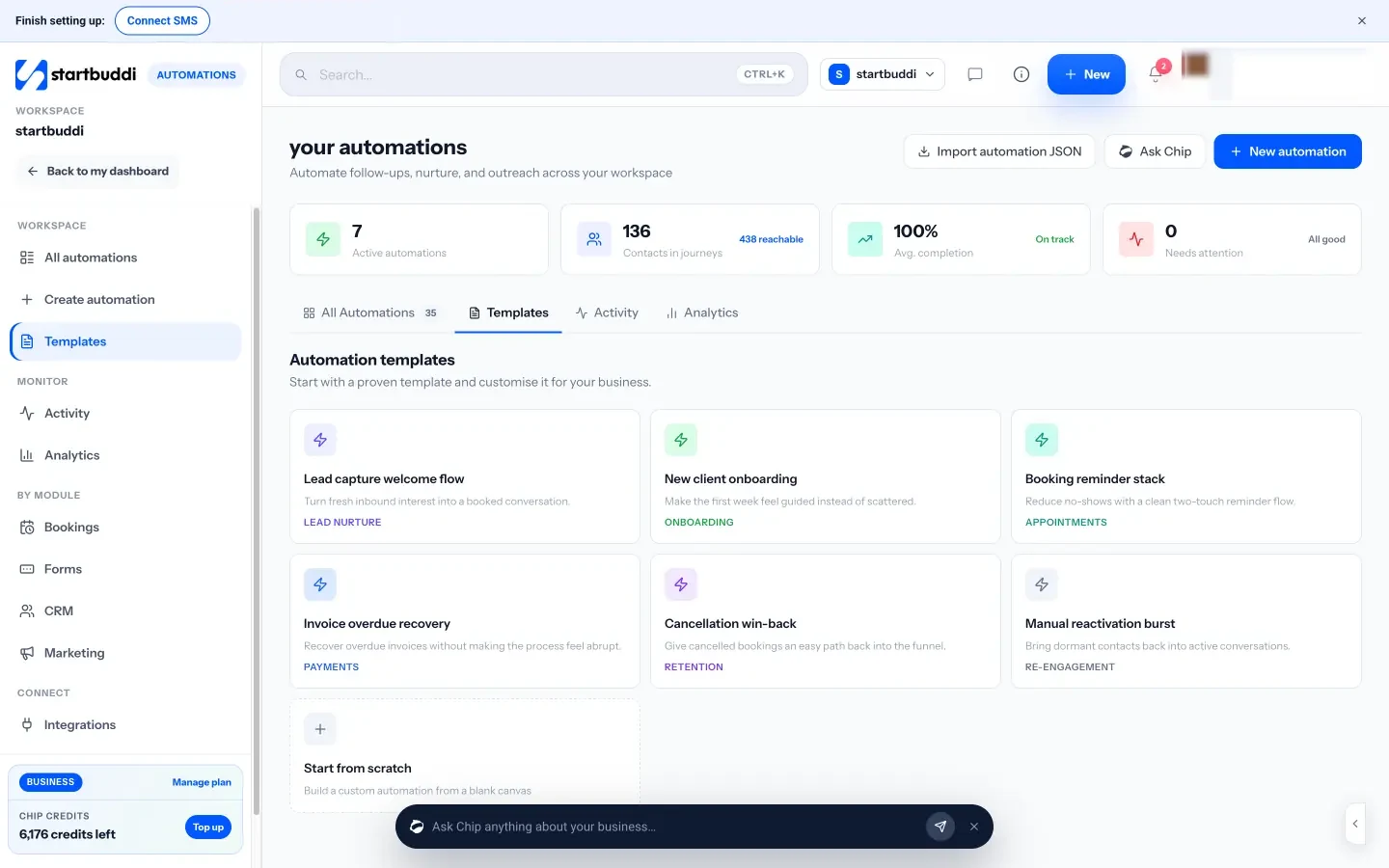
In Automations, one of Chip's suggestions is to ask for a review after every completed booking. You can start from a suggestion, a template or a sentence describing what you want, then edit the message before switching it on. A booking marked complete can trigger an email or WhatsApp message with your review link and a line about referrals. Free includes 2 active automations, and Starter allows 10. See Automations for what triggers and steps are available.
Warm routes are the fastest way to win clients, but they have a ceiling: sooner or later you run out of people who already know you. Chapter 3 covers how to be found by people who do not know you yet.
Get found: make it easy for clients to find and book you
- An example profile description
- Reply to reviews, including the bad ones
- Share what you know: talks, workshops and webinars
- A simple month of posts
- Measure whether your page works
- 1. Build a one-page site with Landing pages
- 2. Share one booking link everywhere
- 3. Put every link in your social bio
- 4. Answer visitors while they are on your page
Warm routes bring your first clients. Being easy to find brings the next ones, without you having to start every conversation. When someone searches "wedding photographer near me" or asks a friend "do you know a good bookkeeper?" and then looks you up, what they find in the next ten seconds decides whether they get in touch. This chapter covers the places that matter most for a small service business, and how to make each one lead to an enquiry or a booking.
The places clients look for a service business
You do not need to be everywhere. You need to be findable in the two or three places your ideal client actually looks, with a clear next step when they find you.
| Where they look | Best for | What to set up |
|---|---|---|
| Google search and Maps | Local services: trades, cleaning, salons, clinics, accountants | A complete Google Business Profile with reviews |
| Your own page or website | Everyone. It is where every other route sends people. | One page with your offer, proof and a booking or enquiry button |
| Social media | Visual and personal services: design, photography, fitness, beauty, coaching | A clear bio, regular posts and a link that goes somewhere useful |
| Directories and marketplaces | Trades, freelancers, specialist professionals | A full profile on one or two sites that your clients really use |
| Associations and communities | B2B and professional services | Membership listings, helpful answers in groups |
Get found on Google with a Business Profile
If your clients are local, a Google Business Profile is usually the most valuable free listing you can have. It is what appears on Maps and in the local results when someone searches for your type of business nearby.
Google says local results are based mainly on three things: relevance (how well your profile matches the search), distance (how far you are from the person searching) and prominence (how well known your business is, including reviews and links) (Google Business Profile Help, tips to improve your local ranking). You cannot change distance, but you can work on the other two:
- Complete every field: categories, services, service area, hours, phone, website and a description that uses the words your clients use.
- Add real photos: your work, your team, your premises or vehicle.
- Get reviews steadily: ask every happy client, and reply to each review.
- Keep it current: update hours for holidays and post occasional updates or offers.
For a deeper walk-through of local search, read our guide to local SEO for small business.
An example profile description
Here is the kind of description that helps both searchers and Google understand what you do. It uses the words clients search for, names the area and ends with a next step:
Family-run plumbing and heating company serving Leeds and surrounding villages since 2015. We fix leaks, install and service boilers, fit bathrooms and handle emergency call-outs seven days a week. Fixed-price quotes, clean tidy work and a 12-month guarantee on all installations. Book a visit online or call us for same-day emergencies.
Notice what is missing: slogans, long company history and vague claims. Every sentence answers something a customer wants to know.
Reply to reviews, including the bad ones
Future clients read your replies as closely as the reviews. A short, warm reply to a good review shows you care. A calm, specific reply to a bad one shows how you handle problems, which is often what a nervous buyer wants to know. For example:
Thanks for the feedback, Mrs Adeyemi, and I'm sorry the team arrived later than promised. That isn't the standard we aim for. I've spoken to our scheduler and we now text every customer if we're running more than 15 minutes late. I'd like to make it right, so I'll call you this afternoon.
Never argue in public, never share private details, and always move the conversation to a private channel to resolve it.
Have one page that does the job
Every route in this guide sends people somewhere: a referral link, a Google profile, an Instagram bio, a directory listing. If that somewhere is a confusing website, an out-of-date Facebook page or nothing at all, you lose them. You do not need a big website. You need one page that answers the questions people have before they get in touch.
- What you do and who for, in one sentence at the top.
- What they get: your main offer, with a price or "from" price.
- Proof: two or three examples and a couple of testimonials.
- How it works: three or four steps from first contact to finished job.
- One clear action: book a call, request a quote, or message on WhatsApp.
- Answers to common questions: area covered, timing, payment, cancellations.
Use social media to show, not shout
For many service businesses, social media is less about going viral and more about being the obvious choice when someone who follows you needs help. Posting what you do, regularly, keeps you in mind. Some ideas that work for almost any service:
- Before and after: a room, a garden, a logo, a set of accounts tidied up.
- Behind the scenes: how you prepare, what tools you use, a day on the job.
- Answers to questions clients ask you: "how long does a bathroom renovation take?"
- Client stories, with permission: the problem, what you did, the result.
- Simple tips that show expertise without giving away the whole job.
Two or three good posts a week on one platform beat daily posts spread across five. Make sure your bio says what you do and where, and that the link in your bio goes to a page where people can book, buy or enquire, not just your home page.
Share what you know: talks, workshops and webinars
Teaching is one of the most effective ways for a service business to be found by the right people. A free 30-minute talk at a local business group, a workshop for a partner's clients, or an online session on a topic your ideal client cares about puts you in front of a room of potential clients who already see you as the expert. Keep it genuinely useful, not a disguised sales pitch, and end with one simple offer, such as a free review call for attendees. Collect sign-ups through a form or registration page so everyone who attends ends up in your contact list, with their permission to follow up.
A simple month of posts
If you never know what to post, plan a month in one sitting. Here is an example for a small interior design studio, posting twice a week:
| Week | Post 1 | Post 2 |
|---|---|---|
| 1 | Before and after of a living room | "Three mistakes people make when choosing paint" |
| 2 | Behind the scenes: sourcing fabrics | Client story, with permission: a small flat made to feel bigger |
| 3 | Answer a question: "How much does a room redesign cost?" | Short video walk-through of a finished project |
| 4 | Tip: lighting that makes a room feel warmer | Offer: two free design consultations this month, book via the link in bio |
Only one post in eight is a direct offer. The rest build trust and show your work, so that when you do make an offer, people are ready for it. The free content calendar template is a simple way to plan yours.
Directories, marketplaces and platforms
Directories and freelance marketplaces can bring enquiries quickly, especially when you are new. Each has trade-offs. Marketplaces usually charge fees or commission, and they make it easy for buyers to compare you on price with dozens of others. Directories vary widely in quality. Before you sign up, check:
- Do your ideal clients actually use it? Ask a few.
- What does it cost, including commission, and what is a realistic number of enquiries?
- Can you keep in touch with clients directly after the first job, within the platform's rules?
- Does it let you show reviews and examples?
A sensible approach is to use one marketplace or directory to win early clients and build reviews, while you build your own page and referral network so that, over time, more clients come to you directly.
Measure whether your page works
Once your page is live, two numbers tell you whether it is doing its job: how many people visit it, and how many of them get in touch. Divide enquiries by visits to get your conversion rate. For example, if 400 people visit your page in a month and 12 book a call or send an enquiry, your page converts at 3%. If you then add a "from" price and two testimonials and the next month 400 visits bring 18 enquiries, that is 4.5%, and six extra conversations every month from the same traffic. Change one thing at a time so you know what made the difference.
Also look at where visitors come from. If most arrive from Instagram but few enquire, the page may not match what they saw in your posts. If people from Google enquire readily, your Google Business Profile deserves more attention.
Make it easy to take the next step
Being found is only half the job. The other half is making contact effortless. Every extra step loses people. Compare these two experiences:
- Hard: the visitor finds your page, sees "call us for a quote", calls during a meeting, gets voicemail and forgets.
- Easy: the visitor finds your page, taps "book a 15-minute call", picks a time that suits them, and gets a confirmation email with your number.
Offer at least two ways to get in touch: an instant option (booking link or chat) and a considered option (a short form). Reply to every enquiry quickly. Chapter 4 explains why that matters so much.
Mistakes to avoid when trying to be found
- A page with no call to action. Every page should end with one clear next step.
- Inconsistent details. Your name, address and phone number should match everywhere you are listed.
- Posting without a link that works. Check your bio link on your phone every month.
- Spreading too thin. One well-kept profile beats five abandoned ones.
How to be easy to find and book in startbuddi
1. Build a one-page site with Landing pages
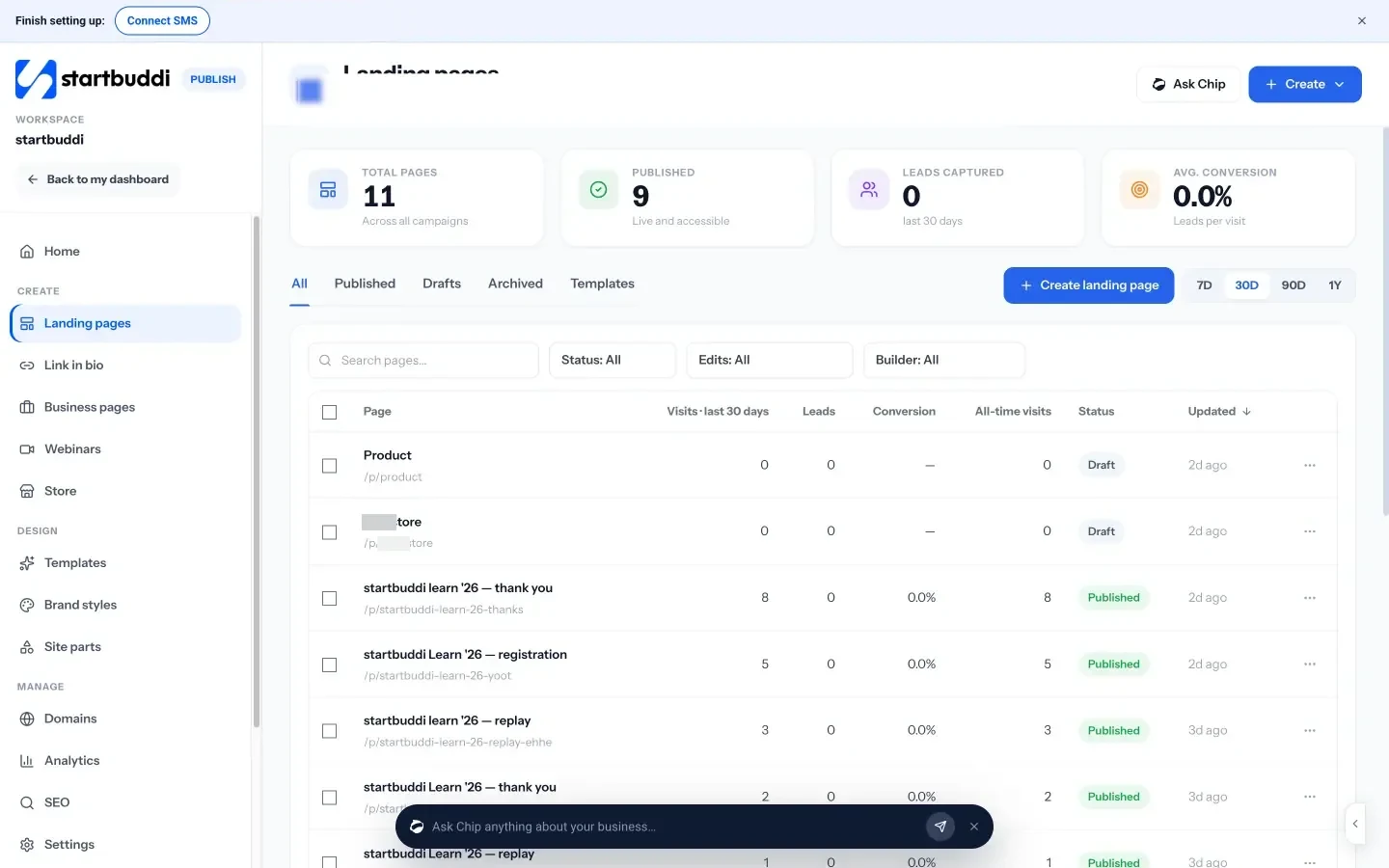
Open Publish, then Landing pages, and create a page with a goal such as "Collect leads" or "Take bookings". You can build with Chip, start from a template or start blank. Every signup lands in your contacts, and the page's Leads tab shows who came in. There is no limit on the number of pages; pages on the Free plan carry a small "Powered by startbuddi" line. See landing pages for more.
2. Share one booking link everywhere
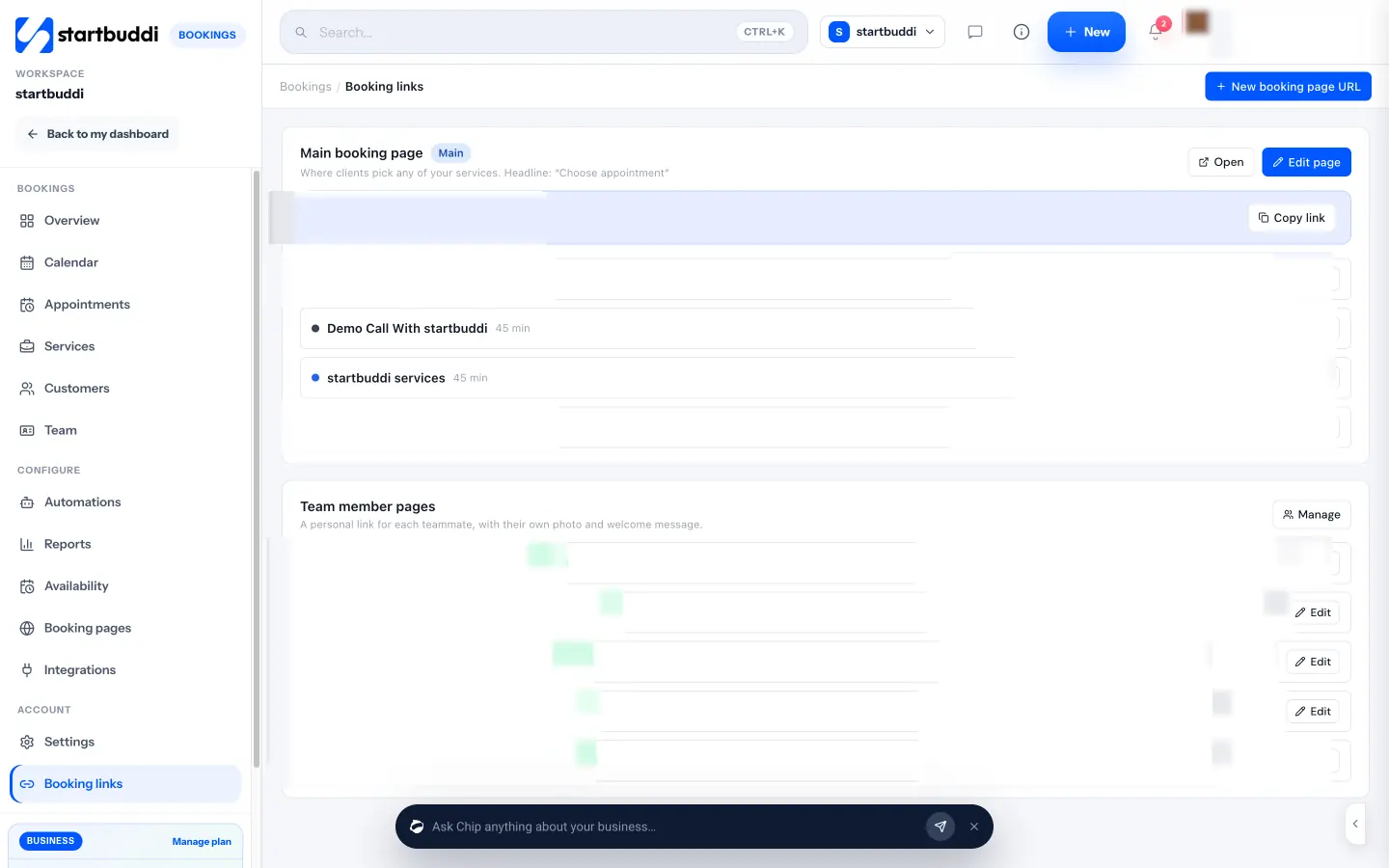
Your main booking page lists your live services, and each service has its own link. From Bookings, the Booking links tab shows every public link, and you can copy it, share it by WhatsApp or email, embed it on your site or download a QR code for your van, shop window or business card. The free booking link QR code tool does the same for any link. Clients choose a service, pick a time, enter their details and, if you require it, pay a deposit.
3. Put every link in your social bio
Link in bio in Publish gives you one mobile page for every link, product, form and booking, and people can pay you right on it. Put that link in your Instagram, TikTok or WhatsApp Business profile so followers can act without hunting for your details. Free pages show a small "made with startbuddi" line, which any paid plan can remove. More on the link in bio page.
4. Answer visitors while they are on your page
Live chat adds a chat bubble to your site. Visitors can start a chat, book a meeting or switch to WhatsApp, and conversations land in your Customers inbox. With the Growth plan or above, Chip can answer common questions from information you have approved, such as your prices, services and policies, and hand over to you when a person is needed.
Being found brings people to you. The last route, outreach, is where you go to them. Chapter 4 covers how to do it respectfully, and how to turn every enquiry into a client.
Outreach that gets replies, and turning enquiries into clients
- Follow up, but not forever
- 1. Reply fast
- 2. Qualify gently
- 3. Make the next step concrete
- 4. Ask for commitment
- When they say "not now"
- Track your outreach results
- A follow-up message you can copy
- Your first call with a prospect
- 1. Find prospects with Chip
- 2. Reply to every enquiry from one inbox
- 3. Track every enquiry to a decision
- Your next step
Outreach means contacting potential clients who have not contacted you first. Done badly, it is spam. Done well, it is a short, relevant message to the right person at the right time, and it is one of the most reliable ways for a new service business to get clients quickly. This chapter covers how to find the right people, what to say, the rules to respect, and how to turn every enquiry, from any route, into a paying client.
How to find clients for outreach
Good outreach starts with a short list, not a big one. Twenty well-chosen businesses you have researched beat 2,000 email addresses you bought. Use your ideal client description from chapter 1 to build the list.
- Look where they gather. Industry associations, local business groups, event attendee lists, chambers of commerce, online communities.
- Look for a reason to write now. A new opening, a job advert, a website that does not work on mobile, a new product launch, a funding announcement.
- Find the right person. In a small business, usually the owner or manager. In a larger one, the person who owns the problem you solve.
- Write down why they fit. One line per prospect: why you think they need you. If you cannot write it, they are probably not a good fit.
Know the rules before you send anything
Rules on unsolicited marketing messages differ by country and by channel. This is general information, not legal advice, but a few principles apply almost everywhere:
- Be honest about who you are. Use your real name and business, and a subject line that matches the message.
- Make it easy to opt out and respect it straight away.
- Personal one-to-one messages are different from bulk marketing. Do not add prospects to your newsletter unless they have agreed.
- Be careful with individuals. Rules are usually stricter for consumers and sole traders than for companies.
Some examples of where to check the rules:
- In the US, the FTC's CAN-SPAM compliance guide explains that the law covers business-to-business email as well, and sets out requirements such as accurate headers and a working opt-out.
- In the UK, the ICO's guidance on business-to-business marketing explains that you can email corporate bodies but sole traders and some partnerships are treated as individuals, who generally need to have consented.
- In Nigeria, the Nigeria Data Protection Commission oversees how personal data, including contact details, may be used.
If in doubt, write fewer, more personal messages, and get advice for your country before running any campaign at scale.
What to say: an outreach message that gets replies
A good outreach message is short enough to read on a phone, about them rather than you, and ends with an easy question. Here is a structure:
- A specific opening that shows you have looked at their business.
- One observation or idea relevant to their situation.
- A line of proof: a similar client or result.
- A small ask: a question or a short call, not a sale.
Hi Grace, congratulations on opening the new studio in Westlands. I noticed your class timetable is a PDF, which can be hard to read on a phone. We recently helped a yoga studio in Kilimani move bookings online, and their front desk stopped taking booking calls within a few weeks. Would it be useful if I sent you a two-minute video showing what that could look like for you? Best, Wanjiru
It is under 80 words. It proves you looked. It offers something useful before asking for anything. And the question is easy to say yes to.
Follow up, but not forever
Many replies come after the second or third message. A reasonable pattern is the first message, a short follow-up four or five days later with something new (an example, an idea), and a final polite note a week after that. Then stop. If someone says no or asks you not to contact them, thank them and record it so nobody writes to them again.
Turn every enquiry into a client
All three routes, warm, found and outreach, end in the same place: a person who is interested. What happens next decides whether they become a client. Four habits make the biggest difference.
1. Reply fast
People who enquire are often contacting several businesses. The first useful reply has a big advantage. In a study of US companies, firms that tried to contact a web lead within an hour were nearly seven times as likely to qualify it as firms that waited longer (Harvard Business Review). Aim to reply within a couple of hours in working time, and use an automatic reply out of hours that sets expectations and offers a booking link.
2. Qualify gently
Ask two or three questions before you invest in a long call: what they need, when, and a rough budget. Giving a price range in your first reply saves everyone time.
3. Make the next step concrete
End every conversation with a specific next step and a date: a call on Thursday, a site visit on Monday, a proposal by Friday. Vague endings ("let me know") are where most enquiries die.
4. Ask for commitment
When they are ready, send a clear quote or proposal and ask for a deposit to book the work in. A deposit confirms the decision and protects your time. Our guide to the sales process for small business covers discovery calls, proposals and follow-ups in detail.
Choose your outreach channel
Different channels suit different clients. Use the one where your ideal client is most likely to read and reply.
| Channel | Works well for | Tips |
|---|---|---|
| Personal email | Owners and managers of small and medium businesses | Short subject line, no attachments, one question at the end |
| LinkedIn message | Professional services, B2B, recruiters, consultants | Comment on their posts first; keep the first message under 60 words |
| Phone call | Local businesses, trades, clinics | Call at quiet times; ask for two minutes and respect a no |
| Visit in person | Shops, restaurants, offices in your area | Bring something useful to leave behind, and follow up the same week |
| People who have already given you their number or asked you to message | Do not message strangers cold; it feels intrusive and can break platform rules |
When they say "not now"
"Not now" is one of the most common replies to outreach, and one of the most valuable. It means you reached the right person with a relevant idea, and the timing is wrong. Thank them, ask when might be a better time, and set a reminder for that date. Something like: "Thanks, that makes sense. Would it be all right if I checked back in March, when the new branch is open?" Most people say yes, and when March comes they remember you as the polite person who waited.
Track your outreach results
Keep simple numbers for your outreach: messages sent, replies, calls booked and clients won. For example, if 40 personal messages in a month bring 8 replies, 4 calls and 1 client worth $2,000, each message was worth about $50 in revenue. That helps you decide how much time outreach deserves compared with other routes, and whether a new message template is doing better than the old one.
A follow-up message you can copy
Hi Grace, following up on my note last week about online bookings for the studio. I put together a short example of what your timetable could look like as a booking page: [link]. No pressure at all. If it's not a priority right now, just let me know and I won't follow up again. Best, Wanjiru
The follow-up adds something new, refers back to the first message, and makes it easy to say no. Giving people an easy way out often makes them more likely to reply, and a clear no is far better than weeks of wondering.
Your first call with a prospect
When an outreach message leads to a call, remember that they did not come looking for you. Spend the first part of the call on their situation, not your services. Ask what is working, what is frustrating and what they have tried. Only then share how you would approach it, with one relevant example. End by agreeing one next step, such as a short written proposal or a follow-up call with the person who decides. If it becomes clear you are not a good fit, say so. A prospect you turn away politely may still refer you to someone who is.
One more habit worth building: after every call, whether it leads anywhere or not, write two lines on the contact's record about what you learned. Over a few months those notes show you which problems come up again and again, and that is exactly what your next outreach message, post and page headline should talk about.
A weekly client-finding routine
Getting clients is a habit, not a campaign. Here is a routine that takes about three hours a week and covers all three routes. Adjust the split to what works for you.
| Day | Task | Time |
|---|---|---|
| Monday | Reply to all open enquiries; check who needs a follow-up this week | 30 minutes |
| Tuesday | Ask two happy clients for a review or referral; check in with two past clients | 30 minutes |
| Wednesday | Publish one useful post; update your Google profile if needed | 45 minutes |
| Thursday | Research five prospects and send five personal outreach messages | 60 minutes |
| Friday | Record where this week's enquiries came from; note one thing to improve | 15 minutes |
After three months, look at where your paying clients came from. Double down on the best route, and cut the one that brings nothing.
Mistakes to avoid with outreach and enquiries
- Bought lists. They are often out of date, may break data protection rules and damage your email reputation.
- A pitch in the first line. Start with them, not you.
- No follow-up at all. One polite follow-up doubles your chances of being seen.
- Treating enquiries from different routes differently. A lead from an Instagram DM deserves the same fast, organised reply as one from your website.
How to do outreach and win clients in startbuddi
1. Find prospects with Chip
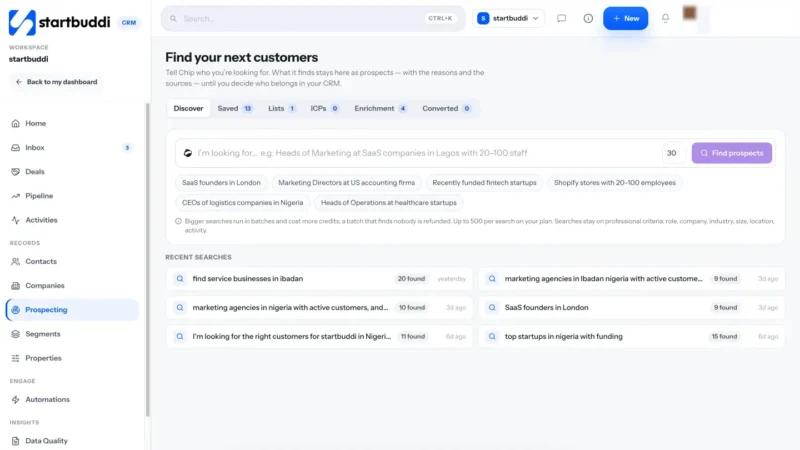
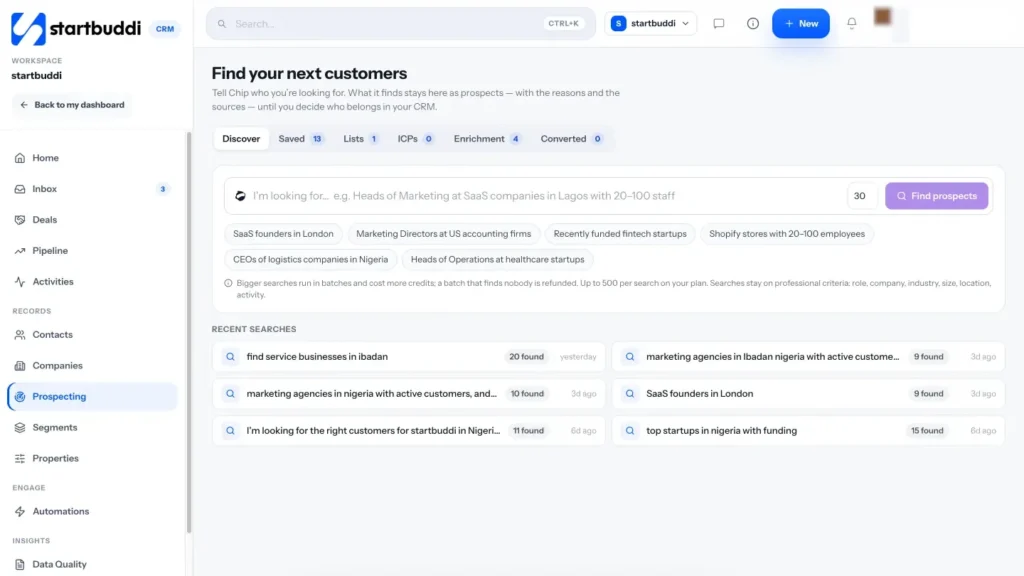
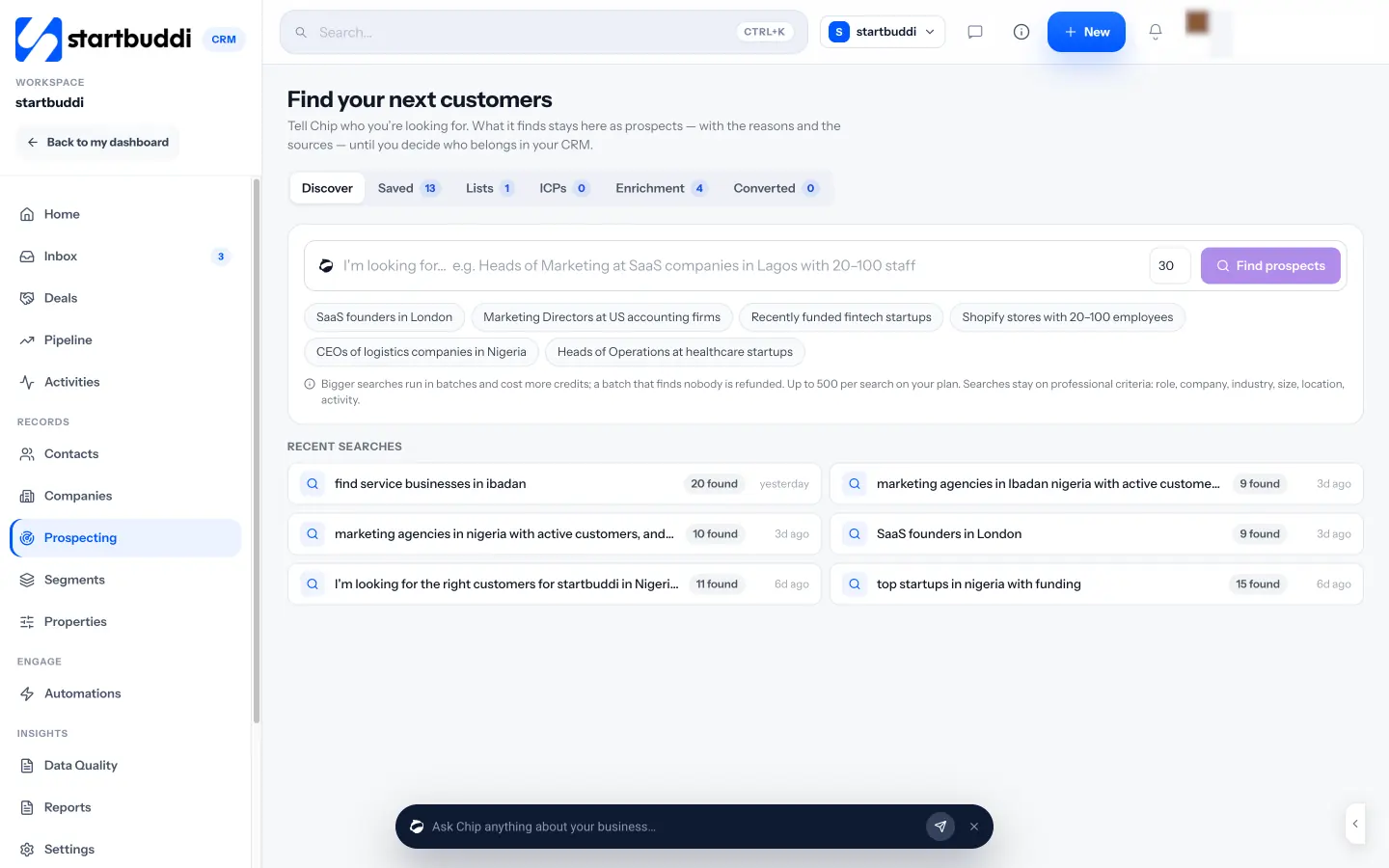
In Customers, open Prospecting and describe who you are looking for, for example "owners of yoga and pilates studios in Nairobi". Chip searches the web and business listings and returns companies and people, with the reasons it picked each one and the sources it used. You can save searches, group prospects into lists and create an ideal customer profile for repeat searches. Nothing is added to your contacts until you convert it, and work emails or phone numbers are only looked up when you ask, which uses Chip credits. Personal emails and phones are never looked up. The prospecting page and the prospecting help article explain the details.
After converting a prospect, Draft an intro with Chip writes a first message you can edit and make personal before sending.
2. Reply to every enquiry from one inbox
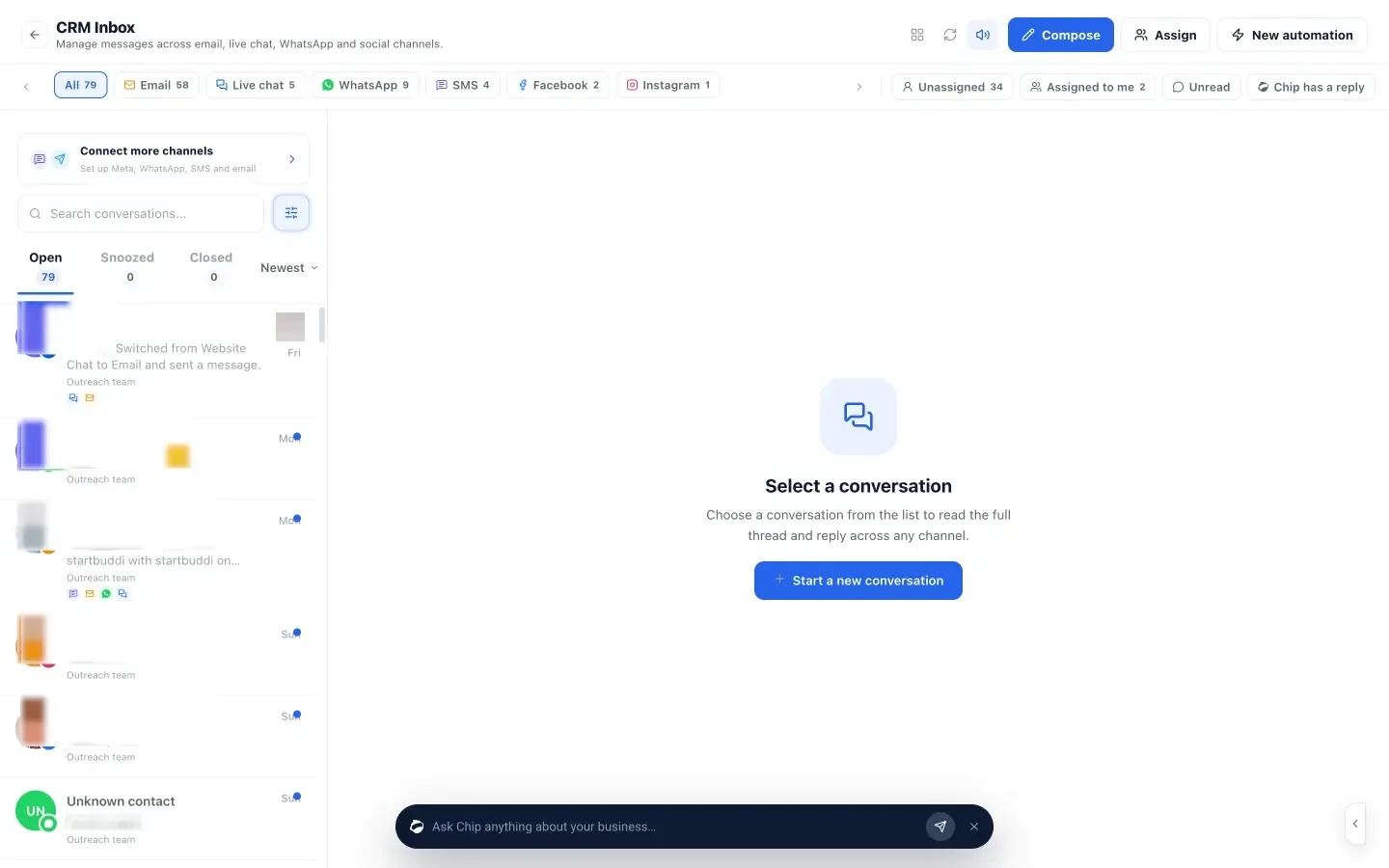
The Inbox in Customers brings email, WhatsApp, SMS, website chat, Instagram and Facebook messages together, so an enquiry is never lost in the wrong app. You can use quick replies for your standard first reply, schedule a message to send later, assign conversations to a teammate, and add internal notes. When a conversation looks like a real opportunity, Chip may suggest creating a deal. WhatsApp and SMS need Starter or above. More on the inbox page.
3. Track every enquiry to a decision
Add serious enquiries to your pipeline as deals, move them through your stages, and mark them won or lost with a reason. The Customers reports then show lead response time, win rate and where clients came from, which tells you which route in your weekly routine is paying off.
Your next step
Write your ideal client description and your one clear offer today, then set up a booking link and send three personal check-ins to past clients this week. The startbuddi Free plan covers a bookable service, a form and 250 contacts, and every paid plan starts with a 30-day trial. Compare plans and start your first week of client-finding.
Olabimpe Salami is the email and outreach specialist at startbuddi. Olabimpe writes about the messages that bring customers in and back: email, WhatsApp and SMS campaigns, follow-ups, and turning enquiries into paying clients.
Runs email and outreach at startbuddi