What is a value proposition?
Also called: Customer value proposition, CVP, value statement, core promise
A value proposition is a short, clear statement of who you help, the result they get, and why choosing you is better than their other options.
A value proposition is the promise at the heart of your business: who you help, what result they get, and why you are a better choice than the alternatives. It is usually one or two sentences, and it is the first thing a visitor should understand on your website.
A good one answers the question every customer asks within seconds of landing on your page: “Is this for me, and why should I care?”
Why a value proposition matters for a small business
- Visitors decide fast. If your homepage does not say clearly what you do and for whom, people leave before they scroll.
- It focuses your marketing. Every post, email and advert becomes a variation on one clear promise.
- It justifies your price. When people understand the result, the price makes sense.
- It separates you from the crowd. “Web design services” sounds like everyone. “Websites for dentists that fill appointment books” does not.
How to write a value proposition
A simple formula works for most small businesses:
We help [who] [get what result] by [how], unlike [the usual alternative].
You will not always print the “unlike” part, but thinking it through keeps you honest about why someone would pick you.
Examples
| Business | Vague | Clear value proposition |
|---|---|---|
| Bookkeeper, Leeds | Professional bookkeeping services | Monthly books done for small shops, so you never scramble before a VAT deadline again |
| Caterer, Lagos | Quality food for every occasion | Office lunches for 10 to 100 people, delivered hot by 12:30, with one invoice a month |
| Physio, Sydney | Expert physiotherapy | Get back to running after injury, with a plan you can follow at home between sessions |
| IT support, Nairobi | IT solutions for business | Fixed-price IT support for offices of 5 to 50 people, with help on the phone in under an hour |
The parts of a value proposition on a page
- Headline: the result, in the customer’s words.
- Subheading: who it is for and how it works, in one sentence.
- Three benefits: short bullets, each a reason to choose you.
- Proof: a review, a number you can back up, photos of real work.
- Call to action: the next step. See our call to action definition.
Value proposition vs USP vs slogan
- Value proposition: the full promise of value to a customer. It can include things competitors also offer, as long as the combination is compelling.
- Unique selling proposition: the one thing that sets you apart, which competitors do not or cannot claim.
- Slogan or tagline: a short, memorable phrase for your brand. It can hint at the value proposition but is often more about feeling than detail.
How to find your value proposition
- Start with your customer. Your buyer persona tells you what they want and what worries them.
- List the results you deliver, not the tasks you do. “Tax return filed” is a task; “no penalty letters” is a result.
- Ask customers why they chose you. Their answers often contain your best headline, word for word.
- Look at the alternatives. What do people do if they do not hire you: do it themselves, use a big firm, ignore the problem?
- Write five versions and test them. Use them as headlines on a page or subject lines in an email and see which gets more response.
Common mistakes
- Talking about yourself. “We are a passionate team with 10 years’ experience” says nothing about the customer’s result.
- Trying to appeal to everyone. A promise for everyone is convincing to no one.
- Jargon. “End-to-end digital solutions” means nothing to a café owner.
- Promises you cannot keep. “Guaranteed first page of Google” gets you customers who leave angry.
Related terms
A USP is the sharpest part of your value proposition. A landing page builder helps you put it at the top of a focused page, and your conversion rate tells you whether it is working. For writing the full offer, see how to write a business proposal.
Value propositions in startbuddi
When you set up startbuddi, you are asked “What do you do?” in one sentence, and Chip uses the answer to write your tagline, page headline, subheading and call to action label for a first landing page. You can then edit the copy on landing pages, where each page shows visits, leads and conversion so you can see which version works.
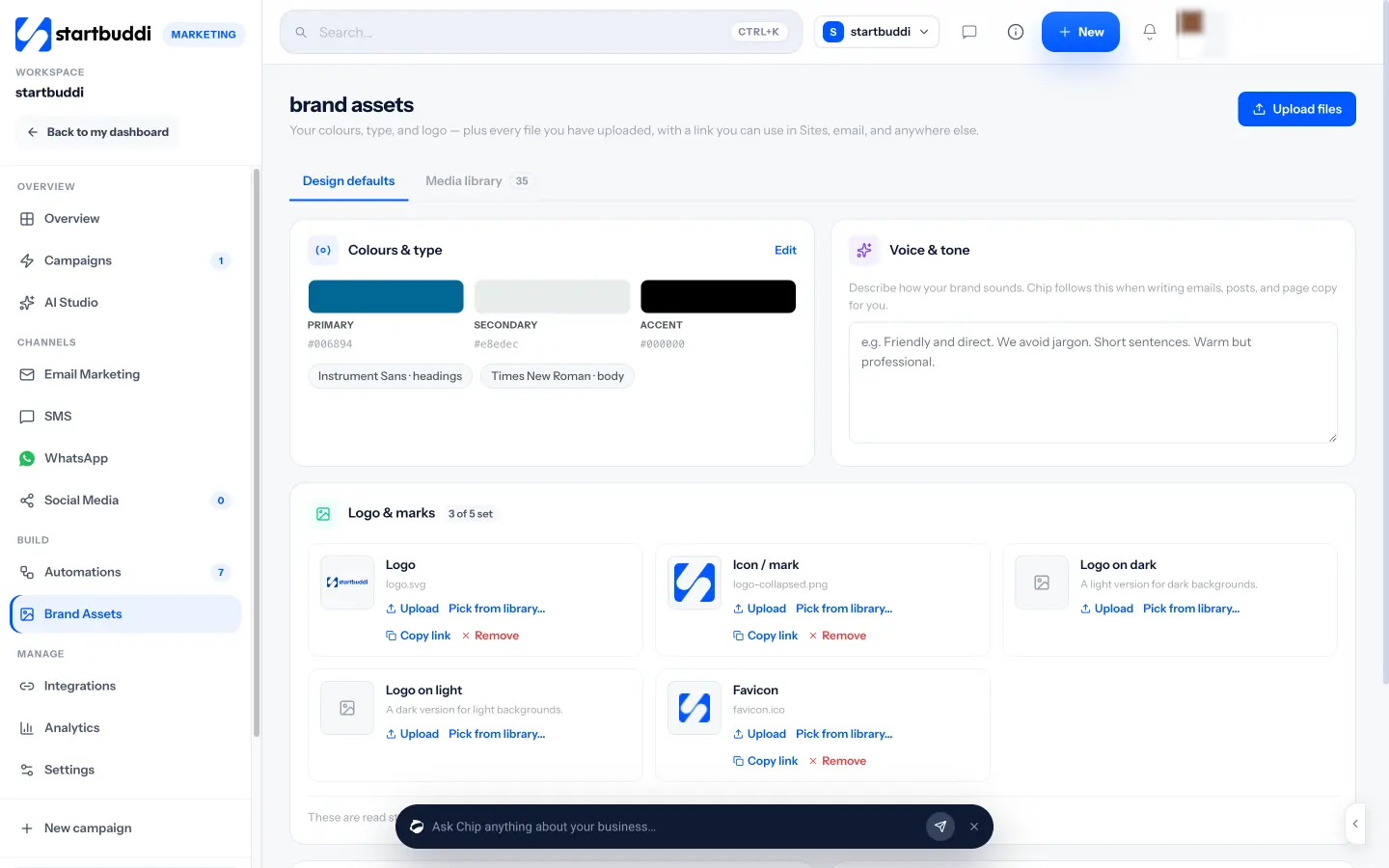
In the Marketing brand kit, a Voice and tone box describes how your brand sounds. Chip follows it when writing emails, posts and page copy, so your promise sounds the same everywhere.
Your next step: write your value proposition using the formula above, then put it as the headline on your homepage or link in bio today.
Related terms
FAQ
How long should a value proposition be?
The core should fit in one or two sentences: a headline and a subheading. Supporting benefits and proof can follow underneath.
What is the difference between a value proposition and a mission statement?
A mission statement describes why your business exists and what it aims for. A value proposition describes what a customer gets from buying from you.
Can a small business have more than one value proposition?
Yes, if you serve clearly different customers or sell very different services. Keep one main promise for your homepage and tailor the rest on separate pages.
How do I know if my value proposition works?
Ask strangers what you do after a quick look at your page, and compare response rates when you test different headlines.
Tiwalade Joanna Okedara-Kalu is the founder, CEO and CTO of startbuddi, the business system that brings clients, bookings, invoices, projects, marketing and the Chip AI assistant into one place. Tiwalade builds software around how service businesses really work day to day, and writes about client management, getting paid on time and why small businesses outgrow the tools they start with.
Founded startbuddi and leads its product and engineering