What is a call to action (CTA)?
Also called: CTA, CTA button, action button, next step
A call to action (CTA) is the words, button or link that tells someone the next step to take, such as "Book a free call", "Get the checklist" or "Pay now".
A call to action (CTA) is the part of your page, post or message that tells people what to do next. It is usually a button or a link, sometimes a single sentence: “Book your free 20-minute call”, “Download the price list”, “Reply YES to confirm”.
Every piece of marketing should have one. Without it, people read, nod, and move on.
Why a call to action matters for a small business
People are busy and distracted. Even interested visitors will not work out the next step for you.
- It turns attention into action. A post that gets likes but has no CTA rarely brings in customers.
- It removes doubt. “Book a call” answers the unspoken question “what happens if I am interested?”.
- It is measurable. Clicks on a CTA are the basis of your conversion rate, so you can test and improve it.
How a call to action works: examples by channel
| Where | Weak CTA | Stronger CTA |
|---|---|---|
| Landing page button | Submit | Get my free checklist |
| Service page | Contact us | Get a quote in 24 hours |
| Click here | See the new spring menu | |
| Instagram post | Link in bio | Tap the link in our bio to book your Saturday slot |
| WhatsApp broadcast | Let us know | Reply 1 to reserve a table for Friday |
| SMS reminder | Thanks | Reply C to confirm or R to reschedule |
| Invoice email | See attached | Pay online in two minutes |
How to write a good call to action
- Start with a verb. Book, get, download, reserve, pay, reply, start.
- Say what they get. “Get my free quote” tells people what happens next; “Submit” does not.
- Keep it short. Two to five words on a button. You can add a line of detail underneath.
- Lower the risk. “Free”, “no card needed” or “takes 2 minutes” helps people say yes.
- Make it the one obvious thing. One main CTA per page or message. A second, softer option (“See prices first”) is fine.
- Make it easy to tap. On a phone, a button needs to be big enough for a thumb and should stand out in colour.
- Repeat it on long pages. Put it near the top and again after the main sections, so nobody has to scroll back.
Types of call to action
- Lead CTAs ask for contact details: “Get the guide”, “Join the waitlist”. A lead magnet gives people a reason to click.
- Booking CTAs ask for time: “Book a free consultation”.
- Sales CTAs ask for money: “Buy now”, “Pay deposit”.
- Engagement CTAs ask for a small step: “Reply with your biggest question”, “Share with a friend”.
- Retention CTAs bring customers back: “Rebook your next appointment”.
Match the size of the ask to how warm the person is. Someone who already knows you, such as a past customer or a newsletter reader, can handle a bigger ask than a first-time visitor. A stranger from an ad is more likely to download a checklist than to buy a $2,000 package on first visit.
Common mistakes
- Too many CTAs. Follow us, subscribe, book, shop and share, all on one page, split attention until nobody does anything.
- Vague words. “Learn more” and “Click here” say nothing about the value.
- A CTA that breaks the promise. If the button says “See prices”, the next page must show prices, not a form asking for a phone number.
- Hiding it. A grey link at the bottom of a long page is easy to miss.
- Asking too early. Leading with “Buy now” before explaining the offer rarely works for services.
Related terms
Your conversion rate tells you how well a CTA works. A landing page builder helps you build pages around one CTA, and email marketing and SMS marketing each need their own short, clear CTAs. For more on building pages that convert, read how to build a landing page that converts.
Calls to action in startbuddi
The page builder in Publish includes Button, Buttons and Call to action elements, and landing page templates are each built around one goal and a form. Landing pages default to no header menu, because “a menu on a landing page is a row of exits”.
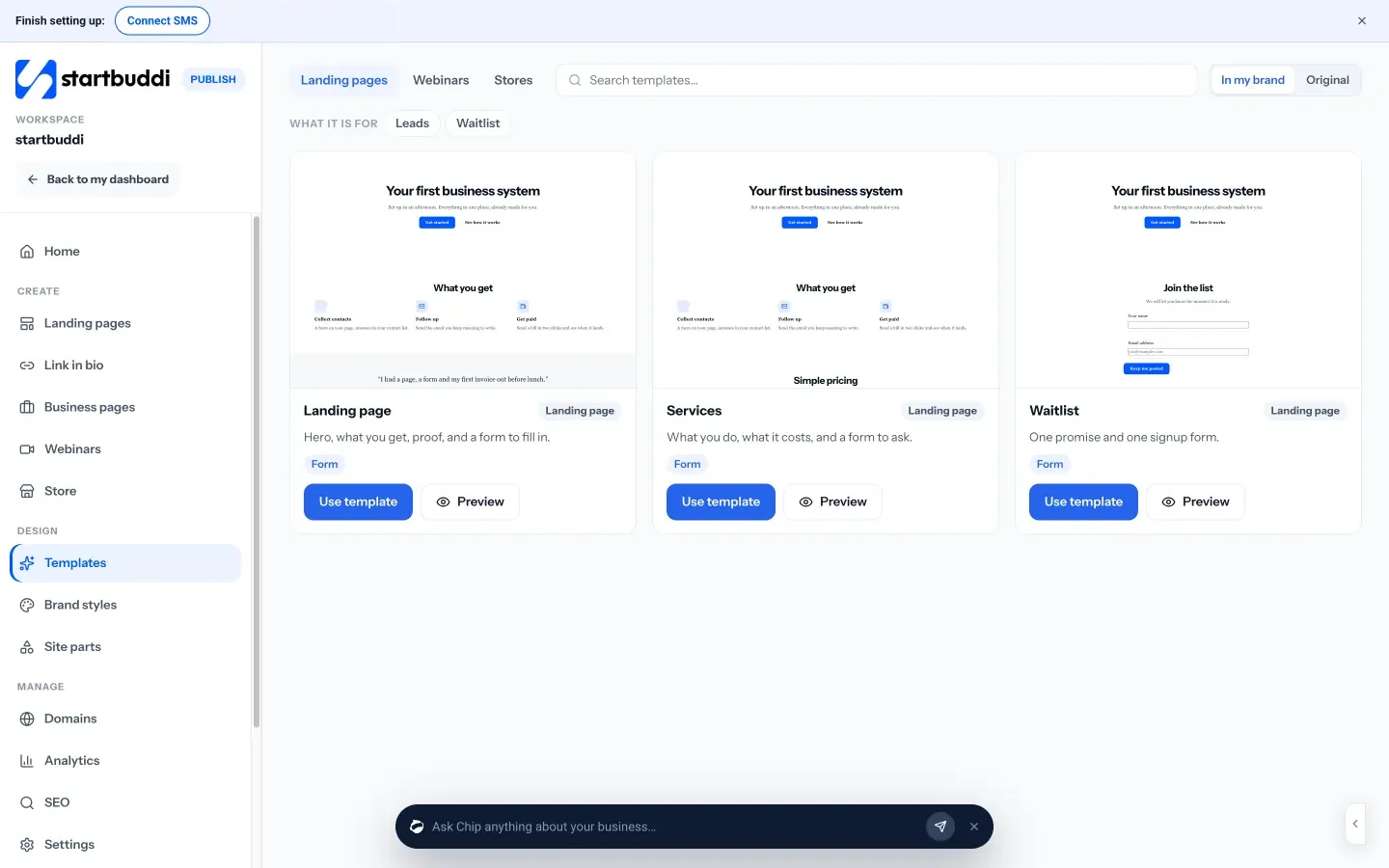
In Email marketing, the drag-and-drop editor has Button and CTA blocks, and “Create with Chip” writes the subject, preview, copy and call to action for you. When you A/B test an email, Chip can generate version B from several angles, one of which is “Different CTA”. In Forms, you can change the submit button text so it says what people get rather than “Submit”. The Marketing hub is part of every paid plan.
Your next step: open your busiest page or last email, find the call to action, and rewrite it so it starts with a verb and says what people get.
Related terms
FAQ
What does CTA stand for?
CTA stands for call to action: the prompt, button or link that tells someone what to do next.
How many calls to action should a page have?
One main one. You can repeat it several times on a long page and add one softer option, but avoid asking for several different things.
What are examples of good call to action phrases?
Book a free call, Get my quote, Download the checklist, Reserve my spot, Pay deposit, Reply YES to confirm. Each starts with a verb and says what happens next.
Does button colour matter?
What matters is contrast: the button should stand out from everything around it. There is no single best colour.
Tiwalade Joanna Okedara-Kalu is the founder, CEO and CTO of startbuddi, the business system that brings clients, bookings, invoices, projects, marketing and the Chip AI assistant into one place. Tiwalade builds software around how service businesses really work day to day, and writes about client management, getting paid on time and why small businesses outgrow the tools they start with.
Founded startbuddi and leads its product and engineering