What is SMS marketing?
Also called: Text message marketing, text marketing, SMS campaigns, mobile marketing
SMS marketing is using text messages to promote products, share updates and bring customers back, through one-off campaigns and automatic texts such as welcomes and reminders, sent only to people who agreed to receive them.
SMS marketing is using text messages to promote your business, keep customers informed and bring them back to buy again. It includes one-off campaigns sent to a whole list (a sale, a new product, an event) and automatic texts triggered by what a customer does (a welcome after sign-up, a reminder before an appointment, a thank-you after a purchase).
The idea is simple: people keep their phones close and read their texts. A short, useful message at the right moment can bring in sales faster than almost any other channel.
Why SMS marketing matters for small businesses
For many small businesses, especially in markets where not everyone has steady data, SMS reaches people other channels miss. It works on every mobile phone, from a basic handset to the newest smartphone. There is no algorithm deciding who sees it.
It is also quick to do well. You don’t need a designer or a long content plan. A local bakery, a mechanic or a tutoring centre can send its first campaign in ten minutes. The hard part is not writing the text: it is being consistent, respecting your customers’ time and measuring what works.
How SMS marketing works
- Get permission. Collect phone numbers through sign-up forms, checkout, bookings or in store, with a clear note that you will send offers and updates.
- Organise your list. Group contacts by what they bought, where they live or how they found you, so each text is relevant.
- Plan your messages. Decide which texts are campaigns (sales, launches) and which are automatic (welcome, reminders).
- Write short and clear. Who you are, what the offer is, what to do next, and how to opt out.
- Send and measure. Track delivery, clicks, replies, opt-outs and, ideally, sales.
Example: a small gym in Ibadan collects numbers at sign-up. New members get a welcome text with class times. Members who haven’t checked in for three weeks get a friendly “we saved your spot” message. Once a month, everyone gets a short note about a new class. Opt-outs stay low because each text is useful and rare.
Types of SMS marketing messages
| Type | Example | When to use it |
|---|---|---|
| Promotional | “20% off all cakes this Saturday only” | Sales, launches, events |
| Welcome | “Thanks for joining, here is your first-order code” | Right after sign-up |
| Reminder | “See you tomorrow at 10am, reply C to cancel” | Before appointments or deadlines |
| Win-back | “It has been a while. Here is something to welcome you back” | Quiet customers |
| Feedback | “How was your visit? Reply 1 to 5” | After a purchase or service |
Where SMS fits next to email and WhatsApp
Think of SMS as your short, urgent channel. Email suits longer stories, newsletters and receipts with detail. WhatsApp suits images, buttons and back-and-forth chat with people who use the app. SMS suits the moments that need a quick glance: a reminder, a last-chance offer, a delivery update. Many small businesses use all three and let each do what it is best at.
Consent and the law
SMS marketing is closely regulated in most countries. In the UK, the ICO’s PECR guidance counts text messages as electronic mail, so you generally need consent, apart from a limited soft opt-in for existing customers. In Nigeria, people can block promotional texts through the NCC’s 2442 Do-Not-Disturb service, and the Nigeria Data Protection Act 2023 lets them object to direct marketing. This is general information, not legal advice.
Best practices and common mistakes
- Lead with value. Put the offer or the useful information in the first line.
- One message, one action. A single link or a single reply option.
- Personalise lightly. A first name helps. Too many details feel intrusive.
- Keep frequency low. Texts feel personal, so too many feel pushy. Start with two to four a month.
- Handle opt-outs instantly. Never text someone who asked you to stop.
- Measure beyond delivery. Clicks and replies tell you far more than “sent”.
Related terms
Bulk SMS is the sending method behind most SMS campaigns. WhatsApp marketing is the richer, app-based alternative. Marketing automation is what sends the welcome, reminder and win-back texts without you.
SMS marketing in startbuddi
In startbuddi, SMS marketing has its own space in Marketing called SMS, with tabs for Overview, Campaigns, Contacts & Segments, Analytics and Settings. The Overview tracks messages sent, delivery rate, click rate, replies, opt-outs and attributed revenue, and replies land in your Customers inbox so you can carry on the conversation.
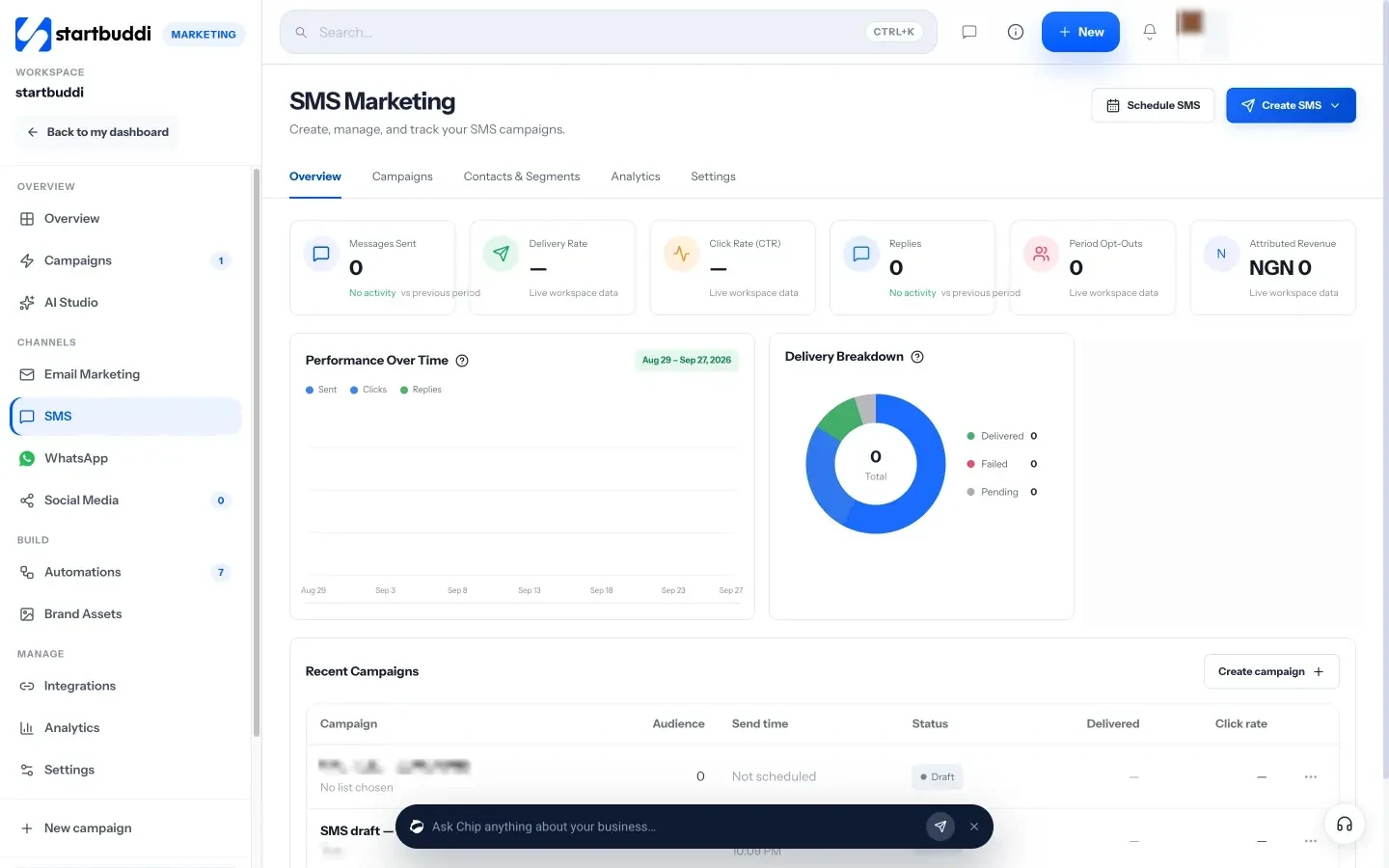
You can send campaigns through startbuddi’s built-in SMS or your own Termii, Africa’s Talking, Twilio or Brevo account. Contacts & Segments shows who opted in, pending or opted out, and the Settings tab has an SMS readiness checklist. For automatic texts, add a Send SMS step to any automation, for example a booking reminder or a welcome after a form. SMS needs the Starter plan or above. See the SMS marketing page and our walkthrough of automated SMS campaigns with triggers and flows. Not sure whether to text or WhatsApp? Read WhatsApp vs SMS marketing.
Next step
Add an SMS opt-in line to your sign-up form or checkout this week, and plan one useful text for the end of the month. When you are ready to send it to your list, see what each plan includes on the pricing page.
Related terms
FAQ
How often should I send marketing texts?
Start with two to four a month and watch opt-outs. Reminders and receipts that customers expect can be more frequent than promotions.
What is the difference between SMS marketing and bulk SMS?
Bulk SMS is the act of sending one text to many numbers. SMS marketing is the full strategy: permission, planning, automatic texts, measuring and improving.
Can customers reply to marketing texts?
Yes, if your provider supports two-way SMS. Replies are useful for feedback, bookings and opt-outs, so it helps to have them land somewhere your team checks.
Which plan do I need for SMS in startbuddi?
SMS is available on the Starter plan and above, with a monthly allowance that grows on Growth and Scale. Every paid plan starts with a 30-day trial.
Olabimpe Salami is the email and outreach specialist at startbuddi. Olabimpe writes about the messages that bring customers in and back: email, WhatsApp and SMS campaigns, follow-ups, and turning enquiries into paying clients.
Runs email and outreach at startbuddi