What is email segmentation?
Also called: List segmentation, audience segmentation, email list segments, targeted email
Email segmentation is the practice of dividing your email list into smaller groups, called segments, based on shared traits such as location, purchase history or engagement, so each group receives more relevant messages.
Email segmentation means splitting your email list into smaller groups of people who have something in common, so each group gets messages that fit them. Instead of sending one email to everyone, you might send one to customers in Lagos, another to people who booked but never paid, and a third to subscribers who haven’t opened anything in three months.
Each group is called a segment. The idea is simple: the more relevant an email is to the person reading it, the more likely they are to open it, click it and act on it.
Why email segmentation matters for a small business
A small list is precious. If you have 400 subscribers, every unsubscribe hurts. Sending a discount on children’s shoes to someone who only buys men’s shoes teaches them to ignore you. Segmenting your email list keeps each message useful, so people stay subscribed.
It also protects your sender reputation. Mailbox providers watch how people react to your mail. Google, for example, asks all senders to keep the spam complaint rate shown in Postmaster Tools below 0.3%. Emails that people want get fewer complaints, and targeted emails are the ones people want.
Finally, it saves money. Most email tools count sends. Emailing 150 interested people instead of 1,500 mixed ones costs less and usually earns more.
How email segmentation works
A segment is a rule, or a set of rules, applied to your contacts. For example:
- City is Abuja
- AND tag is “wholesale”
- AND opened a campaign in the last 30 days
Anyone who matches all three is in the segment. Good tools update segments automatically: when a new wholesale customer in Abuja opens your next email, they join without you lifting a finger. That is the main difference between a segment and a list. A list is a group you add people to by hand; a segment fills itself from rules.
Here is a worked example. A cake shop sends a Valentine’s offer. Rather than one blast, it creates three audience segments:
- Past Valentine’s buyers: “Your usual? Order before 10 February.”
- Customers who bought in the last 90 days but never at Valentine’s: “Something new for the 14th.”
- Subscribers who have never bought: a small first-order offer.
Same campaign, three versions, each one relevant.
Types of email segmentation
| Type | Based on | Example segment |
|---|---|---|
| Demographic | Who they are | Job title contains “HR” |
| Geographic | Where they are | Country is Ghana |
| Behavioural | What they did | Clicked the pricing link last month |
| Purchase or payment | Money history | Has an unpaid invoice |
| Lifecycle | Stage in their journey | New lead, active customer, lapsed customer |
| Engagement | How they react to email | No opens in 90 days |
| Source | How they found you | Filled in the “free quote” form |
Best practices and common mistakes
- Start with two or three segments. New versus existing customers is a great first split. You don’t need 30 segments on day one.
- Collect the data you will use. If you want to segment by city, ask for city on your signup form. Don’t ask for things you will never use.
- Respect consent. Segmentation doesn’t replace permission. Only people who agreed to marketing email, or who fall under a legal exception, should be in a marketing segment. Check your local rules, for example the Nigeria Data Protection Commission or the UK ICO. This is general information, not legal advice.
- Exclude as well as include. Leaving out people who already bought stops you from sending an offer to someone who paid full price yesterday.
- Don’t over-slice. A segment of eight people won’t tell you much. Keep groups big enough to learn from.
- Review quiet subscribers. A re-engagement email to people who haven’t opened in months, then removing those who still don’t respond, keeps your list healthy.
Related terms
Email marketing is the wider practice that segmentation improves. Drip sequences often start when someone enters a segment. Email automation uses segments to decide who gets which automatic email, and a CRM holds the contact data that makes good segments possible.
Email segmentation in startbuddi
In startbuddi, your email audience is the same set of contacts as your Customers records, so segments can use far more than email data. Open Email Marketing, go to Lists & Segments and choose Create list or Create segment. Segment rules can use contact details, company, location, lifecycle fields such as status, tag, owner and lead stage, email and SMS status, form submissions, bookings made, attended or missed, campaign opens and clicks, conversations, open or won deals, and paid or unpaid invoices.
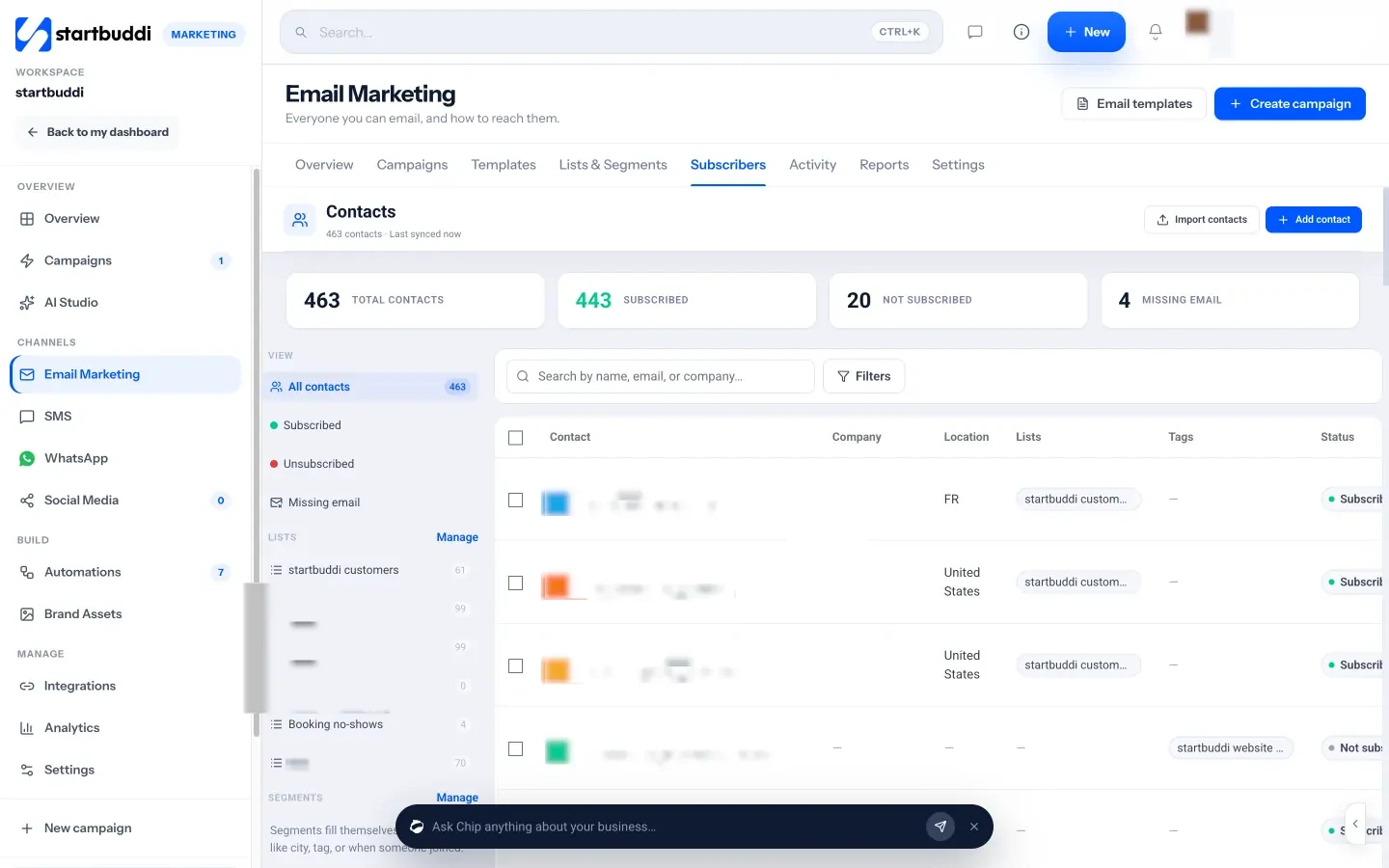
When you create a campaign, the Audience step lets you pick lists and segments, add exclusions, or use Ask Chip to build an audience: describe the people in plain words and Chip turns it into segment rules and shows how many match today. The estimated recipients count removes anyone unsubscribed, bounced or without an email automatically. Learn more on the audiences, lists and segments page.
Marketing, including email campaigns, is available on the Starter plan and above. See pricing.
Next step: pick one split that matters to your business, such as customers versus leads, and send those two groups different versions of your next email.
Related terms
FAQ
What is the difference between a list and a segment?
You add people to a list yourself. A segment is defined by rules, such as city or last purchase, and updates itself as your contacts change.
How big should my list be before I segment it?
There is no minimum. Even a list of 100 people benefits from one simple split, such as customers versus people who have never bought.
Can one contact be in more than one segment?
Yes. A person can be a Lagos customer and a recent clicker at the same time. Use exclusions when you send so they don't receive two versions of the same campaign.
Olabimpe Salami is the email and outreach specialist at startbuddi. Olabimpe writes about the messages that bring customers in and back: email, WhatsApp and SMS campaigns, follow-ups, and turning enquiries into paying clients.
Runs email and outreach at startbuddi