What is a conversion rate?
Also called: Conversion ratio, CVR, lead conversion rate, sales conversion rate, form completion rate
A conversion rate is the percentage of people who take a specific action, such as filling in a form, booking a call or buying, out of everyone who had the chance to.
How to calculate it
A conversion rate is the percentage of people who do what you hoped they would do. If 500 people visit your booking page and 25 book, your conversion rate is 5%. The “conversion” can be anything you choose: a form filled in, an email clicked, a call booked or a sale made.
It is one of the most useful numbers in marketing because it turns vague questions like “is my page any good?” into something you can measure and improve.
Why conversion rate matters for a small business
Getting attention is expensive. Conversion rate tells you how much of that attention you actually turn into business.
- It multiplies everything else. Doubling your conversion rate has the same effect as doubling your traffic, and it is usually cheaper.
- It lowers the cost of each customer. A better rate means you pay less in ads for every customer you win, which cuts your customer acquisition cost.
- It shows where people drop off. Measured at each step, it tells you exactly which page, form or email needs work.
How to calculate conversion rate
Conversion rate = number of conversions ÷ number of people who could have converted × 100
The bottom of the sum matters. For a landing page it is visitors. For a form it is people who viewed the form. For an email it is people who received or opened it. For sales it is leads or deals.
Worked example: a consultant’s landing page
A business consultant in Toronto runs a free guide page. In a month it gets 1,200 visits and 84 people download the guide. Conversion rate: 84 ÷ 1,200 = 7%. Of those 84, 6 book a paid session, so the lead-to-customer rate is 6 ÷ 84 = about 7.1%, and the visit-to-customer rate is 6 ÷ 1,200 = 0.5%.
Each of those three numbers points to a different fix: the page, the follow-up, or the offer.
Types of conversion rate
| Type | What it measures |
|---|---|
| Page conversion rate | Visitors who sign up, book or buy on a page |
| Form completion rate | People who submit a form after viewing it |
| Email click rate | Recipients who click a link in your email |
| Lead-to-customer rate | Leads who become paying customers |
| Win rate | Deals won out of deals closed (won plus lost) |
| Booking show-up rate | Booked appointments that actually happen |
What is a good conversion rate?
It depends heavily on the action, the price and where the traffic comes from. A free checklist should convert far better than a $2,000 package. Visitors from your own email list convert better than strangers from a display ad. The most useful benchmark is your own number last month.
Outside benchmarks are still handy as a sense check. If your page converts at 0.5% while similar pages sit several times higher, something basic is probably wrong: a slow page, a confusing offer, or a form that asks too much. If you are well above average, your time may be better spent getting more visitors than polishing the page.
How to improve your conversion rate
- One page, one goal. A page that asks people to book, subscribe and follow you on Instagram usually gets none of them.
- Write a clear call to action. “Book a free 20-minute call” beats “Submit”.
- Ask for less. Every extra form field is a reason to leave. Ask only what you need now.
- Match the message. If your ad promises a price list, the page it lands on should show the price list.
- Add proof. Real reviews, photos of your work and clear pricing reduce doubt.
- Check it on a phone. Many of your visitors will arrive on one.
- Follow up fast. For leads, replying within minutes rather than days lifts the lead-to-customer rate. See how to follow up with leads.
Common mistakes
- Measuring the wrong thing. A high signup rate from people who never buy is not success.
- Judging on tiny numbers. 2 conversions from 20 visits is 10%, but it could easily be 0% next week.
- Counting spam. Bot submissions inflate form conversion rates. Leave them out.
Related terms
A landing page builder helps you make single-goal pages, a form builder helps you make short forms that people finish, and a sales pipeline shows conversion from lead to won deal stage by stage.
Conversion rate in startbuddi
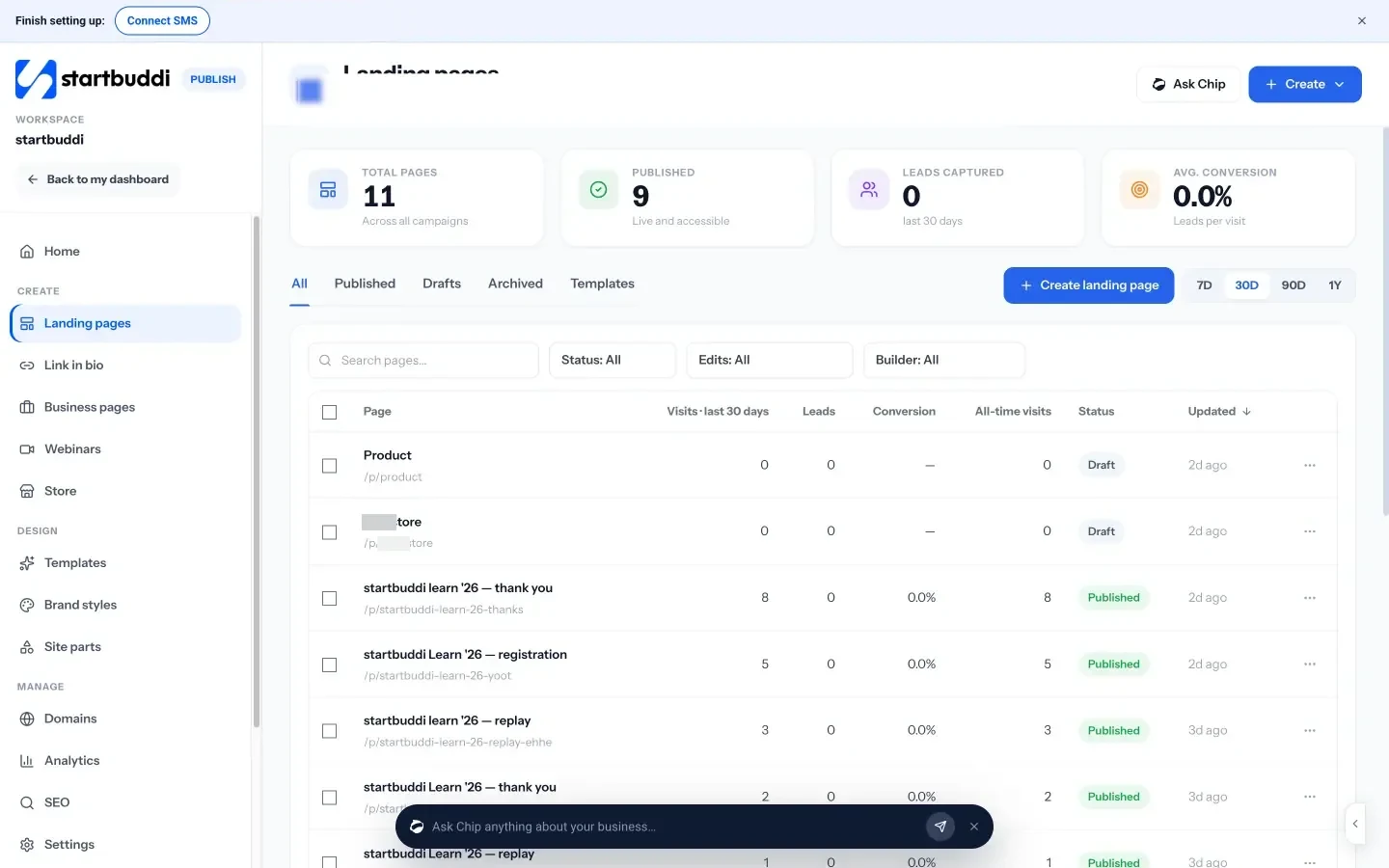
In Publish, the Landing pages list shows visits, leads and conversion for every page, plus an average conversion across all pages. Each page’s overview adds charts of visits and leads over time and where visits came from.
Forms analytics shows a completion rate from views to submissions, and which questions people answer. The Pipeline shows your win rate, and the workspace Analytics page has a Funnel tab that follows contacts from first contact to won deal, so you can see where people drop off. Spam submissions are left out of form counts.
Your next step: pick one page or form, write down its conversion rate today, and change one thing this week.
Related terms
FAQ
How do I calculate conversion rate?
Divide the number of people who took the action by the number who had the chance to, then multiply by 100. For example, 30 signups from 600 visits is 5%.
What is a good conversion rate for a landing page?
Unbounce found a median of about 6.6% across industries in late 2024, but your offer, price and traffic source matter more than any average. Compare against your own past results.
What is the difference between conversion rate and click-through rate?
Click-through rate measures how many people click a link or ad. Conversion rate measures how many complete the action you want after that, such as signing up or buying.
Does a higher conversion rate always mean more sales?
Not always. Making a signup very easy can raise the rate while bringing in people who never buy. Track the conversion that pays the bills too.
Tiwalade Joanna Okedara-Kalu is the founder, CEO and CTO of startbuddi, the business system that brings clients, bookings, invoices, projects, marketing and the Chip AI assistant into one place. Tiwalade builds software around how service businesses really work day to day, and writes about client management, getting paid on time and why small businesses outgrow the tools they start with.
Founded startbuddi and leads its product and engineering