What is customer acquisition cost (CAC)?
Also called: CAC, cost per acquisition, CPA, cost to acquire a customer, cost per customer
Customer acquisition cost (CAC) is the total you spend on marketing and sales in a period divided by the number of new customers you won in that period.
How to calculate it
Use the same period for both numbers, and count ads, tools and any paid help that went into winning customers.
Customer acquisition cost (CAC) is how much you spend, on average, to win one new customer. You work it out by adding up everything you spent on marketing and sales in a period and dividing by the number of new customers you won in that same period.
If you spent $1,200 on ads, tools and a freelance designer last quarter and won 15 new customers, your CAC is $80. That number, set against what a customer is worth, tells you whether your marketing is paying for itself.
Why customer acquisition cost matters for a small business
Most small businesses know what they spend on marketing. Far fewer know what they spend per customer, and that is the number that matters.
- It shows which channels work. $500 on Instagram ads that brings 2 customers and $500 on a local newsletter that brings 10 are very different investments.
- It protects cash. If each customer costs more to win than they pay you in the first few months, growth can drain your bank account.
- It sets a ceiling. Once you know your customer lifetime value, you know the most you can afford to spend to win a customer.
How to calculate customer acquisition cost
CAC = total sales and marketing spend in a period ÷ new customers won in that period
What to include
- Paid ads (search, social, directories)
- Marketing tools and software, or the share of them used for marketing
- Freelancers, agencies, designers and copywriters
- Printing, events, samples and sponsorships
- Sales commissions, and salaries of anyone whose job is mainly selling
If you do all the selling yourself, you can leave your own time out for a simple CAC, but it is worth knowing that your hours have a cost too.
Worked example: a cleaning company
A cleaning company in Johannesburg spends, in one quarter:
| Item | Cost |
|---|---|
| Facebook ads | R6,000 |
| Flyers | R1,500 |
| Software used for marketing | R2,500 |
| Total | R10,000 |
It wins 8 new regular clients, so CAC is R10,000 ÷ 8 = R1,250. If each client brings R900 a month in gross profit, the company earns back its acquisition cost in about six weeks. That is the payback period: CAC divided by monthly gross profit per customer.
Blended CAC vs paid CAC
- Blended CAC divides all spend by all new customers, including those who found you through word of mouth.
- Paid CAC divides ad spend by the customers those ads brought in. It is higher, and more honest about how well your ads work.
Knowing where each customer came from is what makes paid CAC possible, so record the source of every new contact.
CAC and lifetime value
CAC means little on its own. A $300 CAC is fine if a customer is worth $3,000 in profit, and a disaster if they are worth $200. The LTV:CAC ratio compares the two. A ratio well above 1 means each customer returns more than they cost to win; below 1 means you lose money on every new customer. Aim for a ratio that stays healthy and a payback period your cash can carry.
How to lower customer acquisition cost
- Improve your conversion rate. Converting 4% of visitors instead of 2% halves the cost of every customer from that traffic.
- Follow up every lead. Leads you paid for and never answered are the most expensive of all. See how to follow up with leads.
- Ask for referrals. Referred customers cost little to win.
- Build owned channels. An email list and a page that ranks in search keep bringing people in without paying per click.
- Cut what does not work. Once you track CAC by channel, drop the worst one and move the money to the best.
Common mistakes
- Leaving costs out. Counting only ads makes CAC look better than it is.
- Counting leads, not customers. Cost per lead is useful, but CAC divides by people who actually bought.
- Using tiny samples. Two customers in a month is not enough to judge a channel. Look at a quarter.
- Forgetting retention. Lowering churn often does more for profit than lowering CAC.
Related terms
Customer lifetime value is the other half of the LTV:CAC ratio. Conversion rate measures how many people take the step you want, and expense tracking is how you capture the spend that CAC is built on.
Customer acquisition cost in startbuddi
On paid plans, Marketing analytics shows cost per acquisition, return on ad spend and LTV:CAC. They are worked out from your paid invoices and the expenses you tag as Marketing or Advertising in Money Manager, so log that spend there or those figures stay empty.
The workspace-wide Analytics page compares new contacts, deals won and money received with the period before, and its Attribution tab shows where new contacts and won deals came from, in plain words such as “A form” or “Someone referred them”.
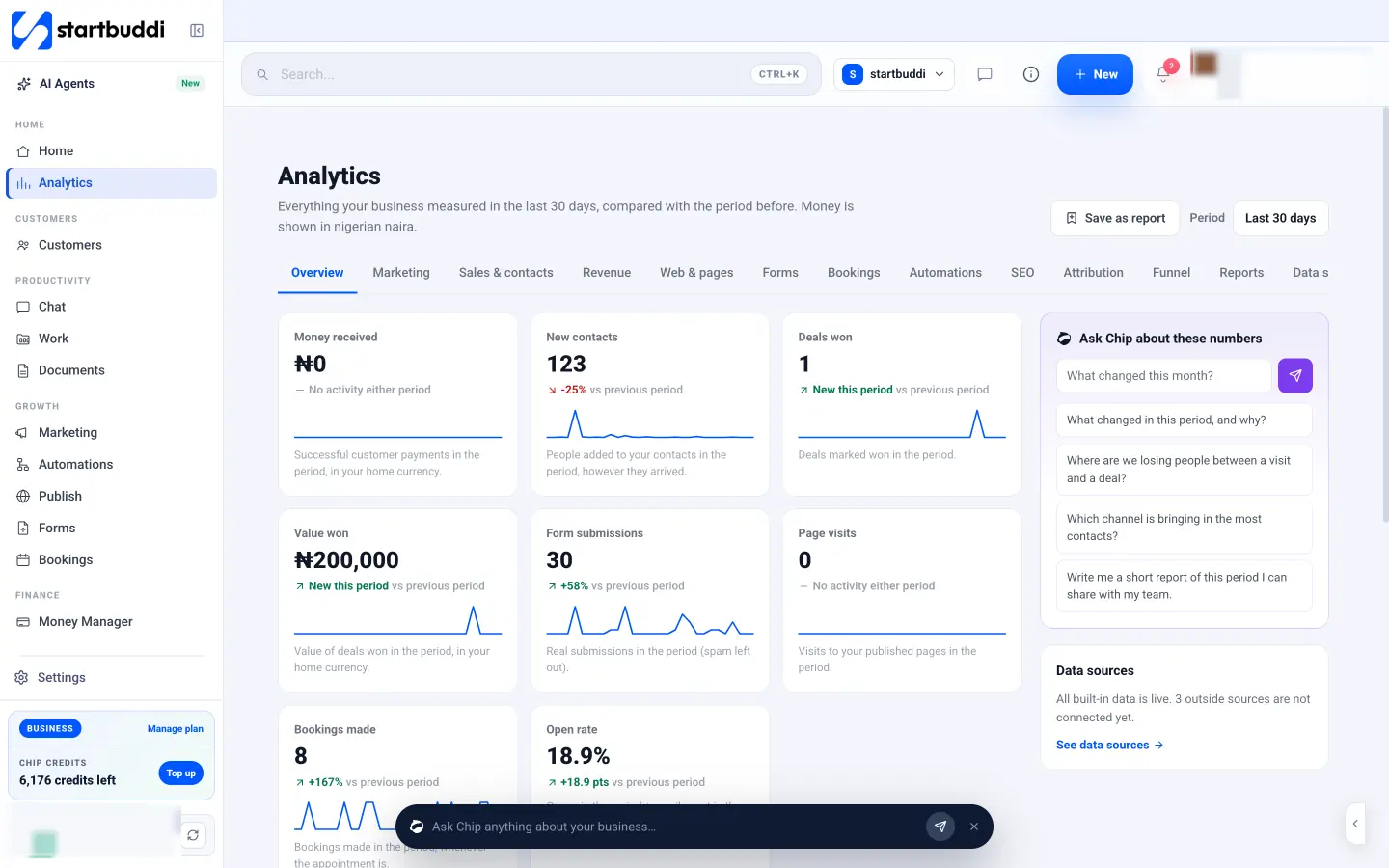
Your next step: add up last quarter’s marketing spend, count the customers you won, and work out your first CAC. Then compare plans on the pricing page if you want those numbers filled in for you.
Related terms
FAQ
What is the difference between CAC and CPA?
People often use them to mean the same thing. Strictly, cost per acquisition can mean the cost of any action, such as a signup, while CAC is always the cost of a paying customer.
Should I include my own time in CAC?
For a quick number, you can leave it out. For a true picture, put a value on the hours you spend selling, especially before you hire someone to do it.
What is a good customer acquisition cost?
One that is comfortably lower than the profit a customer brings you over their lifetime, and that you can earn back within a period your cash flow can handle.
How often should I calculate CAC?
Monthly or quarterly. Quarterly is steadier for small businesses because a few customers can swing a single month.
Tiwalade Joanna Okedara-Kalu is the founder, CEO and CTO of startbuddi, the business system that brings clients, bookings, invoices, projects, marketing and the Chip AI assistant into one place. Tiwalade builds software around how service businesses really work day to day, and writes about client management, getting paid on time and why small businesses outgrow the tools they start with.
Founded startbuddi and leads its product and engineering