What is customer lifetime value (CLV)?
Also called: CLV, LTV, lifetime value, customer lifetime value, CLTV
Customer lifetime value (CLV) is the total amount a typical customer spends with your business over the whole time they stay with you, often measured as profit rather than revenue.
How to calculate it
Compare it with what it costs to win a customer. If winning one costs more than they will spend, the numbers do not work yet.
Customer lifetime value (CLV, often shortened to LTV) is the total amount a typical customer spends with your business from their first purchase to their last. Put simply, it answers one question: what is a new customer worth to me, over the whole relationship?
If a client pays you $500 a month for 18 months, their lifetime value is $9,000 in revenue. Many businesses go one step further and count profit instead of revenue, because a sale that costs you most of its price to deliver is worth less than it looks.
Why customer lifetime value matters for a small business
Most small businesses judge a customer by the first sale. CLV makes you look at the whole relationship, and that changes decisions.
- It tells you how much you can spend to win a customer. If a customer is worth $2,000 in profit over three years, spending $150 to win one is sensible. If they are worth $80, it is not.
- It shows where growth really comes from. Repeat customers often matter more than new ones, and CLV makes that visible.
- It helps you pick your best customers. Work out CLV by customer type and you will usually find one group that is worth far more than the rest.
- It puts a number on good service. Keeping a customer six months longer has a value you can calculate.
How to calculate customer lifetime value
You do not need a spreadsheet model. The simple version has three parts:
CLV = average order value × number of purchases a year × number of years a customer stays
To use profit instead of revenue, multiply the result by your gross margin (the share of each sale left after the direct cost of delivering it).
Worked example: a hair salon
A salon in Manchester charges an average of £45 a visit. A typical client comes 8 times a year and stays for 3 years.
- Revenue CLV: £45 × 8 × 3 = £1,080
- With a 60% gross margin: £1,080 × 0.6 = £648 in profit per client
So the salon could spend up to a few hundred pounds winning a new regular client and still come out well ahead, as long as that client really does stay.
Worked example: a small agency on retainers
An agency in Nairobi bills $1,500 a month per retainer client, keeps 70% as gross margin and clients stay 14 months on average. Profit CLV is $1,500 × 14 × 0.7 = $14,700. Losing one client two months early costs about $2,100 in profit.
For subscription businesses
If you bill monthly, you can use your churn rate instead of guessing lifespan: average customer lifespan in months is roughly 1 ÷ monthly churn. With 5% monthly churn, customers stay about 20 months. Read our churn rate definition for how to measure it.
CLV and customer acquisition cost
CLV is most useful next to customer acquisition cost (CAC), the amount you spend in marketing and sales to win one customer. The ratio of the two, often written LTV:CAC, tells you whether your growth pays for itself.
- If CLV is lower than CAC, every new customer loses you money.
- If CLV is only a little above CAC, growth is fragile: one bad month and you are underwater.
- If CLV is several times CAC, you can afford to spend more on growth.
There is no single right ratio for every business, so compare your own numbers over time rather than chasing a benchmark.
Ways to raise customer lifetime value
CLV has three levers: how much people spend each time, how often they buy, and how long they stay.
- Follow up after the first sale. A thank-you, a check-in and a reminder when it is time to rebook. Our guide to how to retain clients covers the habits that help.
- Offer the next logical thing. A maintenance plan after a website build, a colour refresh after a cut.
- Make repeat buying easy. Recurring invoices, booking links and saved details remove friction.
- Win back quiet customers. Someone who has not bought for six months is cheaper to bring back than a stranger. See how to win back lost customers.
- Fix the reasons people leave. Ask departing customers why, and act on the answers.
Common mistakes
- Using revenue when margins vary a lot. A high-revenue, low-margin customer can be worth less than a smaller one.
- Averaging everyone together. One huge client can hide the fact that most customers are worth little. Split by customer type or source.
- Guessing lifespan too generously. Base it on real history, not hope.
- Treating CLV as fixed. It changes as your prices, service and retention change. Recalculate every quarter.
Related terms
Churn rate is the share of customers you lose in a period, and it is the biggest driver of how long customers stay. Lead nurturing is how you keep interested people warm before the first sale, and a CRM is where the purchase history behind CLV usually lives.
Customer lifetime value in startbuddi
startbuddi does not replace accounting software, but it keeps the numbers you need for CLV close to each customer. Every contact page in Customers has a money tile showing what that person has been invoiced, what they have paid, and what is outstanding or overdue, drawn from invoices in Money Manager.
On paid plans, Marketing analytics shows revenue, cost per acquisition and an LTV:CAC figure worked out from your paid invoices and the expenses you tag as Marketing or Advertising in Money Manager. Its funnel runs from people reached to repeat buyers over 90 days.
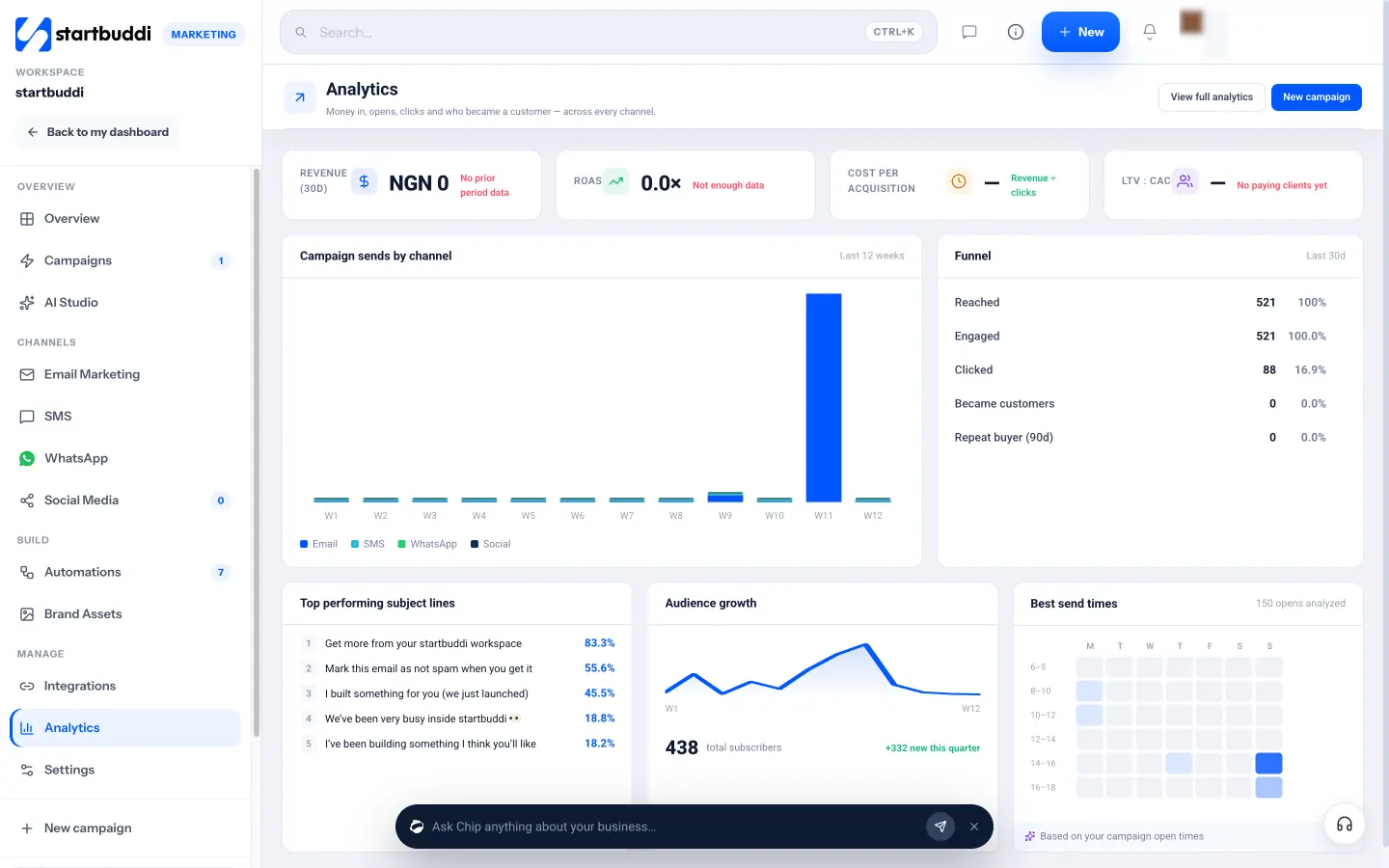
Your next step: pull last year’s invoices, work out a rough CLV for your main customer type, and compare it with what you spend to win a customer. The Marketing hub is part of every paid plan; see the pricing page.
Related terms
FAQ
What is the difference between CLV and LTV?
None in practice. Both stand for customer lifetime value. Some people write CLTV. What matters is whether you measure revenue or profit, so say which one you use.
What is a good customer lifetime value?
There is no universal number. A good CLV is one that is comfortably higher than what it costs you to win a customer, and that is growing over time.
How often should I recalculate CLV?
Every quarter is enough for most small businesses, and whenever you change prices or launch a new service.
Can I calculate CLV with only a few customers?
Yes, but treat it as a rough guide. With a small base, one unusual customer can move the average a lot, so look at the median too.
Tiwalade Joanna Okedara-Kalu is the founder, CEO and CTO of startbuddi, the business system that brings clients, bookings, invoices, projects, marketing and the Chip AI assistant into one place. Tiwalade builds software around how service businesses really work day to day, and writes about client management, getting paid on time and why small businesses outgrow the tools they start with.
Founded startbuddi and leads its product and engineering