What is churn rate?
Also called: Customer churn, attrition rate, customer attrition, cancellation rate, revenue churn
Churn rate is the percentage of customers who stop buying from you, or cancel a subscription, during a set period such as a month or a year.
How to calculate it
Leave out customers who joined during the month, so new sign-ups do not hide the ones you lost.
Churn rate is the percentage of your customers who leave during a set period. If you start the month with 200 subscribers and 10 cancel, your monthly churn rate is 5%. It is the mirror image of retention: the lower your churn, the longer customers stay and the more each one is worth.
The word comes from subscription businesses, but the idea applies to any business with repeat customers. A salon client who stops booking, or a retainer client who does not renew, has churned just as much as someone who cancels a gym membership.
Why churn rate matters for a small business
Churn is quiet. Nobody sends an email saying “I have stopped being your customer”. They simply do not come back, and unless you measure it, you only notice when revenue drops.
- It caps your growth. If you win 10 customers a month and lose 10, you are running to stand still.
- It shapes lifetime value. Lower churn means customers stay longer, which raises customer lifetime value.
- It is cheaper to fix than acquisition. Keeping a customer usually costs less than finding a new one.
- It points to problems. A spike in churn often follows a price rise, a service slip or a competitor’s launch.
How to calculate churn rate
Churn rate = customers lost during the period ÷ customers at the start of the period × 100
Count only customers who were there at the start. New customers who join and leave within the same month make the maths messy, so most small businesses track them separately.
Worked example: a monthly membership
A yoga studio in Cape Town starts March with 160 members. During March, 12 cancel. Monthly churn is 12 ÷ 160 = 7.5%.
Monthly churn adds up fast. At 7.5% a month, the studio keeps 92.5% of members each month. Over 12 months that is 0.925 to the power of 12, about 39%, so it loses roughly 61% of the members it started the year with. That is why a small monthly number deserves attention.
Customer churn vs revenue churn
Customer churn counts people. Revenue churn counts money. If your two biggest clients leave, customer churn might be 4% while revenue churn is 30%. Track both if your customers pay very different amounts.
Revenue churn = recurring revenue lost in the period ÷ recurring revenue at the start × 100
Churn without subscriptions
If customers do not cancel anything, define churn by silence. For example: “a customer has churned if they have not bought in 6 months” for a salon, or 18 months for a web designer whose clients buy once a year. Pick a window that fits your buying cycle and stick with it.
Types of churn
- Voluntary churn: the customer chooses to leave, because of price, a bad experience, a better offer or simply no longer needing you.
- Involuntary churn: the customer did not decide to leave. A card expired or a payment failed and nobody followed up.
Involuntary churn is often the easiest win: a friendly reminder when a payment fails can save a customer who never meant to go.
How to reduce churn
- Onboard well. Customers who get value in the first weeks stay longer. Our guide on how to onboard a new client walks through it.
- Stay in touch. Regular check-ins stop customers drifting. See how to retain clients.
- Watch for warning signs. Fewer bookings, slower replies or late payments often come before a cancellation.
- Ask why people leave. A two-question exit survey tells you more than guessing.
- Chase failed payments quickly. A same-day reminder with a payment link fixes most of them.
- Try to win them back. A lapsed customer already knows you. See how to win back lost customers.
Common mistakes
- Only looking at yearly numbers. By the time a yearly figure moves, the damage is done. Check monthly.
- Ignoring who churns. Churn from one customer type or one sales channel is a different problem from churn everywhere.
- Chasing zero. Some churn is healthy: customers who were a poor fit leaving is not a disaster.
- Mixing new and existing customers. Keep the base you started with separate from people who joined in the period.
Related terms
Customer lifetime value depends directly on churn: average lifespan in months is roughly 1 ÷ monthly churn. Recurring invoicing makes repeat billing automatic, and lead nurturing is the same idea as retention, applied before the first sale.
Churn in startbuddi
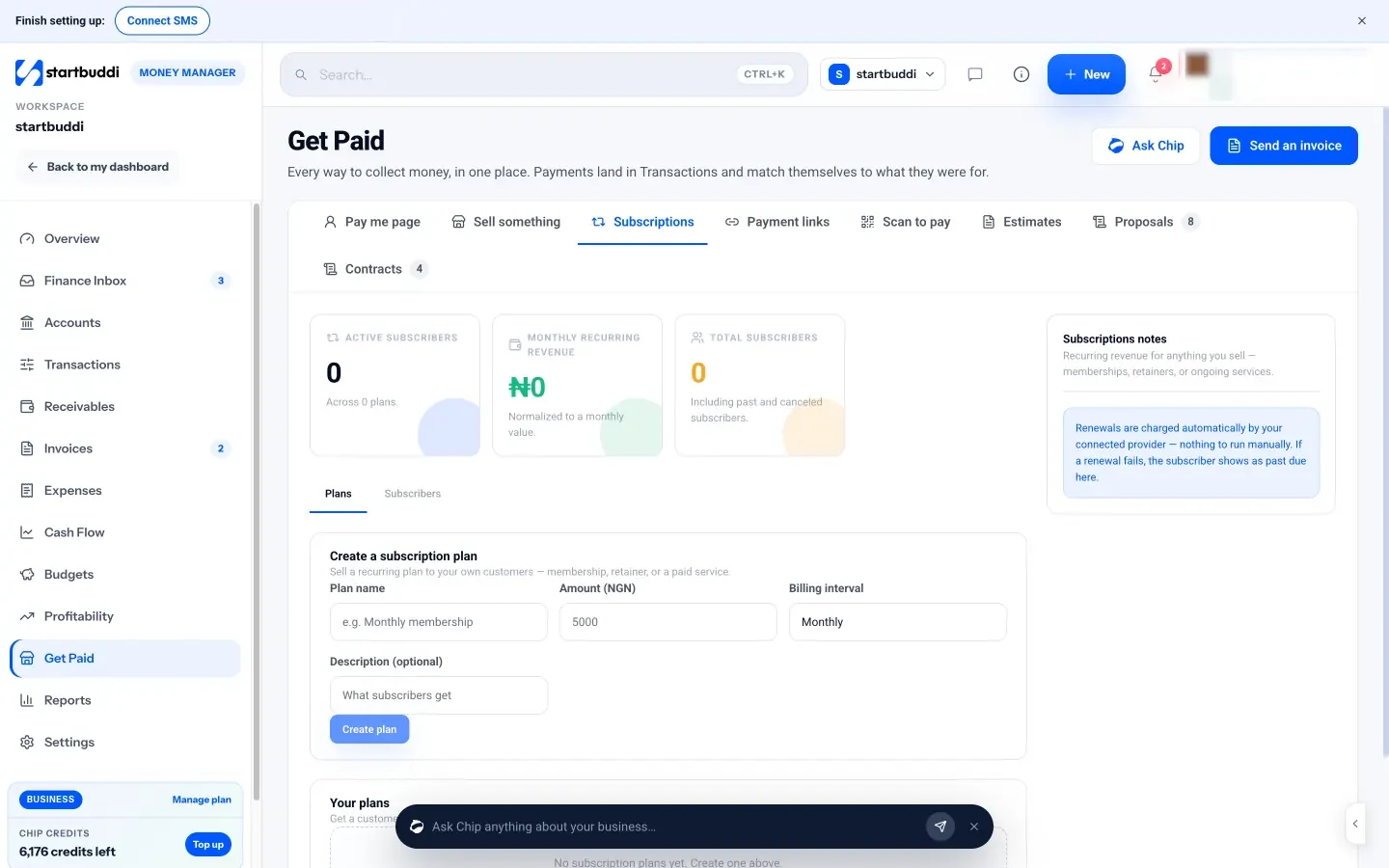
If you sell memberships, retainers or paid services on a plan, Subscriptions in Money Manager shows active subscribers, total subscribers and monthly recurring revenue, with each subscriber’s status and renewal date. Renewals are charged by your connected Paystack or Stripe account, and the Finance Inbox flags a subscription payment that failed so you can follow up.
For customers who buy without a subscription, the Contacts list in Customers filters by when you last contacted someone (for example more than 90 days, or never), and you can ask Chip “Who haven’t I contacted in 14 days?”. On paid plans, Automations include ready-made templates such as “Cancellation win-back” and “Manual reactivation burst” to bring quiet customers back.
Your next step: pick your churn rule, count last month’s churn, and set one follow-up for every customer who looks likely to leave.
Related terms
FAQ
What is a good churn rate?
It depends on your industry, price and contract length. Rather than chasing a benchmark, measure your own churn every month and aim to bring it down over time.
What is the difference between churn rate and retention rate?
They are two sides of one number. If monthly churn is 5%, monthly retention is 95%.
How do I calculate churn if my customers do not subscribe?
Choose a period of silence that means someone has stopped buying, such as six months without a purchase, and count how many customers crossed that line in the period.
Is churn always bad?
Not always. Customers who were a poor fit leaving can free up time for better ones. Worry when good customers leave, or when churn rises.
Tiwalade Joanna Okedara-Kalu is the founder, CEO and CTO of startbuddi, the business system that brings clients, bookings, invoices, projects, marketing and the Chip AI assistant into one place. Tiwalade builds software around how service businesses really work day to day, and writes about client management, getting paid on time and why small businesses outgrow the tools they start with.
Founded startbuddi and leads its product and engineering