How to start a coaching business: niche, pricing, clients and sessions
A four-part guide to starting a coaching business: choose a niche, price your packages, find your first coaching clients and run sessions people keep booking.


This guide explains how to start a coaching business from nothing: choosing who you coach, designing an offer people understand, pricing it so the business pays you, finding your first coaching clients and running sessions that keep them coming back. It is written for new life, career, business, health and executive coaches, and for experienced professionals turning years of know-how into paid coaching.
The short answer is this: pick one type of person and one problem, package your coaching into a clear programme with a fixed price, have lots of short conversations with the people you want to help, and make booking and paying for sessions so easy that nothing gets lost between “I’m interested” and the first call. Each of the four chapters starts with the business thinking, with examples, templates, worked numbers and the mistakes to avoid, and ends with how to set it up in startbuddi. By the end you will have a defined niche and offer, a price list, a simple plan for winning clients, and a booking and follow-up routine that runs without you chasing it.
Choose your niche, offer and set-up
- Choosing a coaching niche
- Decide how you will coach
- Do you need a coaching qualification?
- Set up the business side
- Test your niche before you build anything
- A one-page plan for your coaching business
- Name, brand and a simple online presence
- Common mistakes at the start
Most new coaches start with the coaching and leave the business for later. They take a course, practise on friends, then open their calendar and wait. The ones who get paying clients quickly do something different first: they decide exactly who they help and with what, and they write it down in one sentence. This chapter is about that sentence, the shape of your offer, and the few legal and admin steps you need before you take money.
How to start a coaching business: start with the client, not the qualification
Coaching is a growing field. The International Coaching Federation's 2025 Global Coaching Study counted 122,974 coach practitioners worldwide and estimated industry revenue at US$5.34 billion (ICF, 2025 Global Coaching Study). That is good news, because it means people pay for coaching. It also means a potential client has plenty of choice, and "I'm a coach, I help people reach their potential" gives them no reason to choose you.
Clients do not buy coaching. They buy a result they care about, from someone who seems to understand their situation. A new manager who has just been promoted over her former teammates wants to stop dreading Monday one-to-ones. A freelance designer in Nairobi wants to double her day rate without losing clients. A 45-year-old accountant in Manchester wants to move into a career that feels less grey. Each of those is a coaching client, and each one will pay more readily for a coach who talks about their exact problem.
Choosing a coaching niche
A niche is simply the answer to "who do you help, and with what?" It is not a trap you can never leave. It is a starting point that makes your marketing easier, because you know where your clients spend time and what words they use. You can widen it later, once referrals are coming in.
A useful way to choose is to score a few options against four questions:
- Do you understand the problem from the inside? Former HR managers make credible leadership coaches. A founder who has run a business makes a credible business coach. Lived experience shortens the trust-building part of every sale.
- Is the problem painful or valuable enough to pay for? "Getting more organised" is nice. "Getting promoted this year" or "landing the first ten clients" has a clear value.
- Can you find these people? If they gather in LinkedIn groups, professional associations, WhatsApp communities or local networking events, you can reach them.
- Will you enjoy the conversations? You will have hundreds of them. Pick people you like talking to.
Here are a few examples of vague positioning turned into something a client can say yes to:
| Vague | Clear |
|---|---|
| Life coach | I help women returning to work after a career break plan the move and negotiate the job. |
| Business coach | I help solo service businesses in Lagos and Accra get from their first few clients to a steady monthly income. |
| Career coach | I help mid-career engineers move into product management in six months. |
| Health coach | I help busy shift workers build sleep and eating routines that survive night shifts. |
| Executive coach | I coach first-time founders who have just raised money and now have to lead a team. |
Decide how you will coach
Coaching can be delivered in several formats, and the one you choose shapes your prices, your calendar and how much you can earn per hour.
- One-to-one sessions. The classic format, usually 45 to 60 minutes by video call or in person. Highest price per client, but your income is capped by your hours.
- Packages or programmes. A fixed number of sessions over a set period, for example six sessions over three months, sold as one product with one price. This is how most full-time coaches sell.
- Group coaching. Four to twelve people with a shared goal meet together. Each pays less than for one-to-one coaching, but you earn more per hour, and group members learn from each other.
- Workshops and webinars. One-off sessions that teach a single topic. They work well as a paid entry point or as a free way to meet future clients.
- Corporate coaching. A company pays for you to coach its managers. Longer sales cycles and invoices on 30-day terms, but larger contracts.
You do not need all of them. A sensible first offer for most new coaches is one clear one-to-one programme, plus a free discovery call to start conversations. Group programmes and corporate work come later, once you have results to point to.
Do you need a coaching qualification?
There is usually no single government licence for coaching, so the decision is mostly about skill and credibility. Training teaches you how to run a session, ask better questions and avoid giving advice when the client needs to find their own answer. A recognised credential also reassures corporate buyers, who often ask for one.
The best-known credentials come from the ICF. Its entry-level Associate Certified Coach (ACC) credential asks for 60 hours of coach-specific education, 100 hours of coaching experience, 10 hours of mentor coaching, a performance evaluation and an exam (ICF, ACC requirements). Other bodies, such as the EMCC, run their own schemes. You can start taking clients while you build hours, as long as you are honest about where you are.
Set up the business side
The admin is lighter than most businesses, but do it before your first paid client rather than after. This is general information, not legal or tax advice, so check the rules where you live.
- Register the business. Most coaches start as a sole trader or sole proprietor, which is quick and cheap. In the UK you set up as a sole trader with HMRC. In the US, the IRS self-employed hub explains tax obligations, and your state handles business registration. In Nigeria, business names are registered with the Corporate Affairs Commission, and our guide to registering a business in Nigeria walks through it.
- Keep money separate. Open a separate account for the business so income and expenses are easy to see at tax time.
- Get a coaching agreement. A short written agreement sets out what is included, how payment and cancellations work, confidentiality and the limits of coaching. Our coaching agreement template is a starting point to have checked locally.
- Think about insurance. Professional indemnity insurance covers you if a client claims your coaching caused them a loss. Many corporate clients require it.
- Handle client data carefully. Session notes are personal and sometimes sensitive. Keep them in one secure place, not scattered across notebooks and chat apps.
Test your niche before you build anything
Before you spend money on a website or a certificate for a specific niche, test whether the people in it want what you plan to offer. The cheapest test is ten short conversations. Find people who fit your one-sentence description, through your own network, LinkedIn or a community you belong to, and ask for 20 minutes to learn about their situation. Make clear you are not selling anything.
Useful questions for these conversations:
- What is the hardest part of [the problem] for you right now?
- What have you tried so far, and what happened?
- If this were solved, what would be different in your work or life?
- Have you ever paid for help with it: a course, a book, a coach, a therapist? What was that like?
- Where do you go for advice about this?
Listen for three signals. First, emotion: people who talk about the problem with frustration or urgency are more likely to pay to fix it. Second, past spending: someone who has already bought a course or a book on the topic values help with it. Third, the words they use. Write down their exact phrases, because those phrases become your marketing copy. If eight out of ten people shrug, the niche is too vague or the problem is not painful enough. Adjust and try again.
A one-page plan for your coaching business
You do not need a 40-page business plan. You need one page you can look at every week. Fill in these headings and keep it where you will see it:
- Who I help: your one-sentence niche.
- The result: what changes for them after working with you.
- My offer: format, length, number of sessions and price.
- Where I find clients: three channels you will use, no more.
- Income goal: how many paying clients you need each month, based on your prices.
- This quarter: three things you will do, such as "20 discovery calls" or "run one free workshop".
If you want a fuller version later, the business plan template expands each heading.
Name, brand and a simple online presence
Many coaches trade under their own name, which is sensible: clients are buying you, and your name moves with you if your niche changes. If you prefer a business name, check it is not already used by another coach in your market and that a matching web address and social handles are free. You do not need a full website on day one. A single page that says who you help, what the programme includes, what it costs and how to book is enough to send people to after a conversation. Add a clear photo of yourself, a short story of why you coach, and one or two testimonials as soon as you have them.
Common mistakes at the start
- Spending months on a logo, website and course before speaking to a single potential client.
- Choosing a niche so broad that nobody feels it is for them.
- Offering "sessions" with no defined outcome, so clients drift away after two or three.
- Coaching friends for free for too long. Practice clients are useful, but set an end date.
- Promising results you cannot control, such as "you will get promoted". Promise the process and the support, not the outcome.
Set up your coaching business in startbuddi
In startbuddi, a new coach gets one place for the pieces above: a page people can land on, a way to collect enquiries, a contact list, bookings, payments and notes. You can start on the Free plan and add more as clients arrive. Here is how to set up the foundations in your first hour.
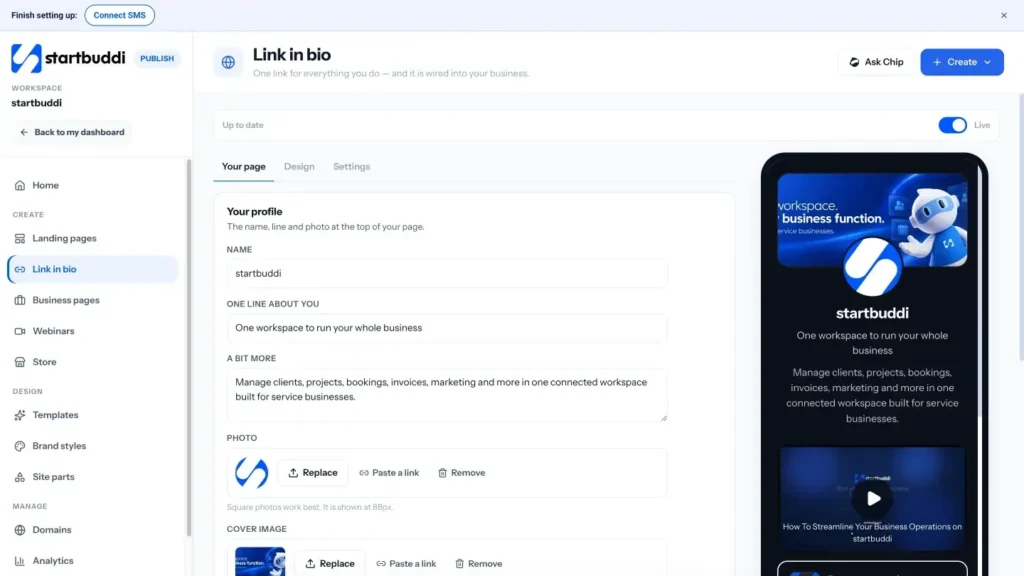
1. Give people somewhere to land. Most coaching clients will find you through a social profile, a message or a referral, then look you up. In Publish, the link in bio page is a single mobile page with your photo, one line about who you help, and blocks for links, a booking button, a form, a WhatsApp chat button and payments. It lives at its own short address you can put in your Instagram, LinkedIn or email signature. If you want something fuller, a landing page can explain your programme in more detail.
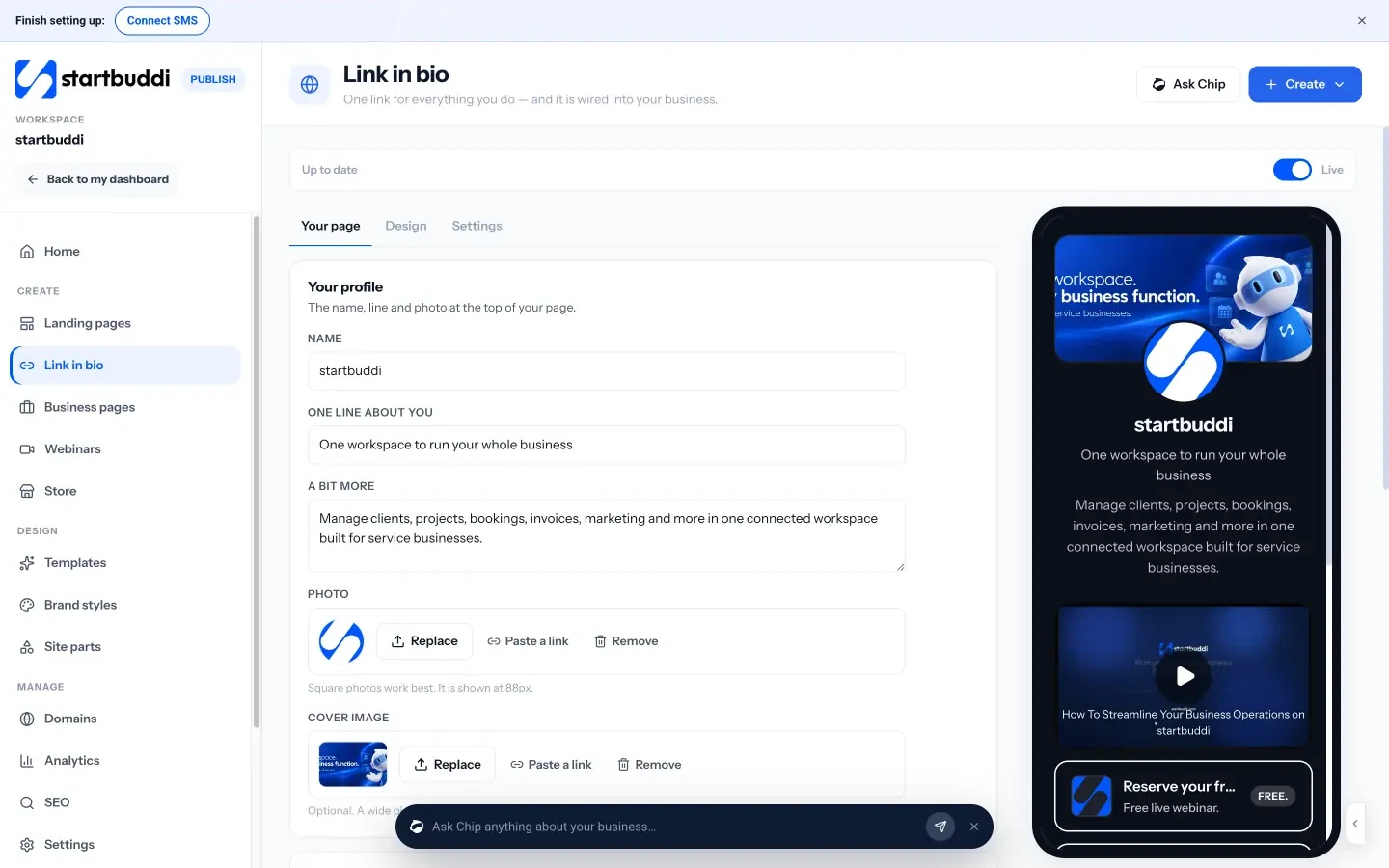
2. Create an intake or enquiry form. In Forms, you can start from a template such as Client Onboarding or Discovery Questionnaire, or describe the form you need and let Chip draft the fields for you to edit. A short enquiry form might ask for name, email, what they want to change, and what they have already tried. Every submission lands in your contacts, so no enquiry sits forgotten in an inbox. The free client intake form template has question ideas.
3. Add your first contacts. In Customers, add the people who have already shown interest, or import a CSV. A name, an email or a phone number is enough to start. Tag them by where they came from, so you know later which channel brings clients.
4. Save your agreement. Keep your coaching agreement and session templates in Documents so they are in one place. In the next chapter you will turn your offer into prices and bookable services.
Price your coaching packages and get paid
- Work out your minimum price
- Common coaching pricing models
- A simple price list you can copy
- What to put in every package
- Deposits, payment plans and refunds
- Pricing group coaching
- Corporate coaching: pricing and paperwork
- How to say your price on a call
- When and how to raise your prices
- Pricing mistakes to avoid
Pricing is where many new coaches undersell themselves. They pick an hourly rate that feels polite, then discover that after preparation, admin, marketing and tax, they are earning less than they did in a job. This chapter shows you how to work out what you need to charge, how to package coaching so clients understand the value, and how to take payment without awkward conversations.
Pricing your coaching: packages, not hours
Selling single sessions feels simple, but it causes two problems. First, it invites clients to judge you on price per hour, which makes you look expensive next to a gym membership or an online course. Second, clients book one session, feel better, and stop before any real change happens. Coaching works through repetition, so the offer should be built around a period of time and an outcome.
A package bundles a set number of sessions, plus support between them, for a fixed price. For example: "New Manager Programme: six 60-minute sessions over twelve weeks, a 360 feedback review at the start, and message support between sessions. US$1,200." The client is buying a clear result over a clear period.
Work out your minimum price
Start with what the business needs to earn, then divide by how many sessions you can realistically sell. Here is a worked example for a full-time coach.
| Item | Amount (USD a year) |
|---|---|
| Income you want to take home before tax | $50,000 |
| Business costs: software, insurance, training, supervision, marketing, accountant | $6,000 |
| Total the business must earn | $56,000 |
Now the time side. Say you work 44 weeks a year after holidays and sickness. You could deliver 20 sessions a week, but in your first years you will spend a lot of time marketing, so plan for 12 paid sessions a week on average. That is 44 × 12 = 528 sessions a year. $56,000 ÷ 528 = about $106 per session. That is your floor. Below it, the business does not pay you what you planned.
The same maths works in any currency. A coach in Nairobi aiming to earn KES 2,400,000 with KES 300,000 of costs, selling 400 sessions a year, needs about KES 6,750 a session. A coach in London aiming for £40,000 with £5,000 of costs, selling 480 sessions, needs about £94. The hourly rate calculator does this sum for you.
Common coaching pricing models
| Model | How it works | Good for | Watch out for |
|---|---|---|---|
| Single session | One price per session, paid when booked | Trial sessions, one-off problems, returning clients | Clients drifting away before results |
| Package | Fixed number of sessions over a set period for one price | Most one-to-one coaching | Unused sessions and expiry rules |
| Monthly retainer | A monthly fee for a set number of sessions and ongoing support | Long-term clients such as founders and executives | Clarity about what "support" includes |
| Group programme | A cohort pays for a fixed course of group sessions | Common problems many people share | Filling the group before the start date |
| Corporate contract | A company pays per coachee or per programme | Leadership and executive coaching | Long payment terms and procurement paperwork |
A simple price list you can copy
Three options work well because clients can compare without being overwhelmed. Here is an example for a career coach, with the logic behind each price.
- Clarity session, $150. One 75-minute session with a written action plan. A low-risk way to try you. Priced above your floor because it includes preparation and follow-up notes.
- Career change programme, $1,200. Six sessions over three months, CV and LinkedIn review, and message support between sessions. Works out at $200 a session, which covers the extra support.
- Ongoing coaching, $350 a month. Two sessions a month for clients who have finished a programme and want to keep momentum. Billed monthly, cancel with 30 days' notice.
If you coach in more than one market, set prices per currency rather than converting on the day. For example, the same programme might be $1,200, £950 or ₦650,000, chosen to suit each market rather than an exchange rate.
What to put in every package
Whatever you charge, spell out exactly what the client gets, so they can compare you fairly and you both know where the edges are:
- The number of sessions, their length and how often they happen.
- The period the package covers, and when unused sessions expire.
- What happens between sessions: messages, voice notes, reviewing documents, and how fast you reply.
- Any extras, such as assessments, workbooks or a final report.
- The price, the payment options and when each payment is due.
A clear list also protects you from scope creep, where "a quick question" by message slowly turns into unpaid coaching.
Deposits, payment plans and refunds
Take payment before the session, not after. For packages, either take the full amount up front or split it into two or three instalments, with the first one paid before the first session. A payment plan usually costs a little more in total than paying in full, which rewards commitment. Our guide to deposits and upfront payments covers how much to ask for.
Write your refund and cancellation terms down before you need them. A common approach is: sessions cancelled with at least 24 hours' notice can be moved; late cancellations and no-shows count as used; programme fees are refundable within a short window before the first session. Consumer law may give clients extra rights. In the UK, for example, people who buy a service online or by phone usually have a 14-day cancellation period under the Consumer Contracts Regulations, and if they ask you to start sooner they may have to pay for what you have already delivered. This is general information, not legal advice, so check the rules where your clients live. The cancellation policy template helps you write yours.
Pricing group coaching
Group coaching lets you help more people in the same hour, which is why many coaches add it once their one-to-one practice is steady. Price it per person, lower than one-to-one but not so low that the group has to be huge to be worth running.
A worked example: an eight-week group programme for new managers, with one 90-minute group call a week and a shared chat space. You charge $600 per person and cap the group at 10. With 8 people, that is $4,800 for 12 hours of live coaching, plus preparation and admin of perhaps 12 more hours. That is around $200 an hour of your time, compared with your one-to-one floor of $106. Even with 5 people, the programme brings in $3,000.
Set a minimum number of participants and a date by which you will confirm the group will run. If you do not reach the minimum, offer refunds or a place in the next group. In other markets the same logic applies: a programme might be £480 in the UK, ₦250,000 in Nigeria or R6,000 in South Africa, set for what your audience can pay rather than converted at the day's rate.
Corporate coaching: pricing and paperwork
When a company pays for coaching, the buyer is usually an HR or learning manager, not the person being coached. They expect a proposal, a clear price per coachee or per programme, and an invoice with their purchase order number. They will often pay on 30-day terms, so agree a deposit or staged payments for longer programmes.
Corporate prices are usually higher than private prices, because the company is paying and the work often includes reports to the sponsor, three-way meetings and more admin. Price the whole programme, not the hour. For example: "Leadership programme for three new managers: six sessions each over four months, two three-way meetings with their line manager, and a short final report. $7,500, invoiced 50% on signing and 50% at the midpoint." Our guide to writing a business proposal shows how to set this out.
How to say your price on a call
Many new coaches rush or apologise when they say the price. Practise saying it plainly, then stop talking. For example: "The programme is six sessions over twelve weeks, with support between calls. The investment is $1,200, or three payments of $420. Would you like to go ahead?" Then wait. If the client says it is more than they expected, ask what they had in mind and whether a shorter programme would suit them better. Changing the scope is better than cutting the price, because it keeps your price honest and gives them a real choice.
When and how to raise your prices
Raise prices when demand tells you to: your calendar is more than about three-quarters full, most discovery calls turn into clients, or nobody has questioned the price in months. Increase by a meaningful step, such as 10 to 20 per cent, for new clients first. Give existing clients notice, for example "From 1 March, ongoing coaching will be $390 a month. Because you've been with me since the start, your price stays at $350 until June." Clients rarely leave over a fair, well-explained increase, and the extra income lets you spend more time on each person.
For a longer look at the reasoning behind prices, our post on how to price your services covers value-based pricing for service businesses in general.
Pricing mistakes to avoid
- Pricing per hour and forgetting preparation, notes, messages and admin.
- Discounting on the discovery call because the client hesitated. Offer a smaller package instead of a lower price.
- Letting package sessions run on forever. Give them an expiry, such as "to be used within four months".
- Not raising prices for a year or more. Review them every six months, and tell existing clients in advance.
- Chasing payment after sessions have already happened. Once you are owed for three sessions, the relationship gets awkward.
Take bookings and payments for coaching in startbuddi
Once your prices are set, the goal is that a client can pick a session, pay and get a confirmation without a single back-and-forth message. There are several ways to get paid in startbuddi, and each fits a different part of a coaching business.
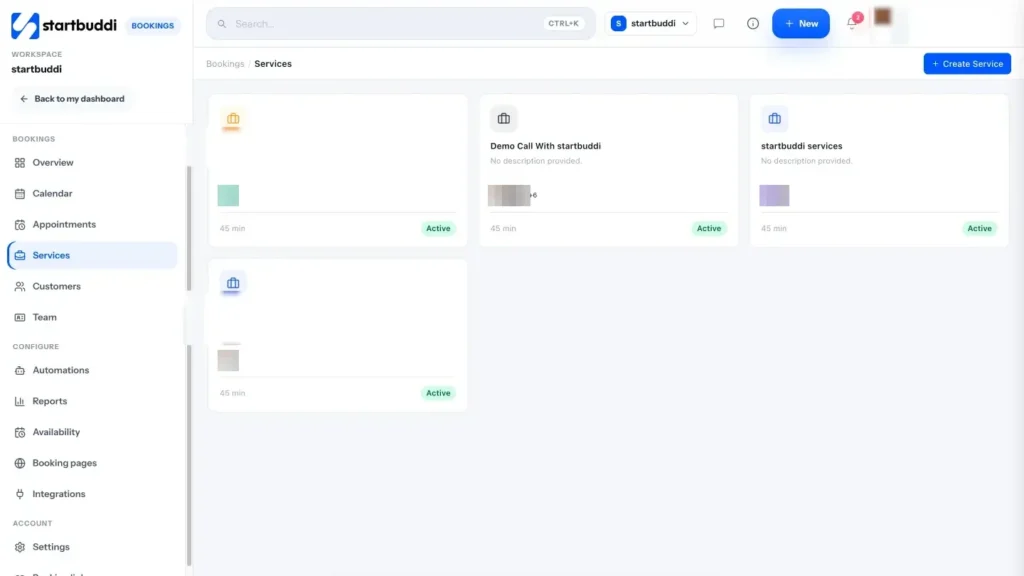
Paid sessions through Bookings. In Bookings, go to Services and click Create Service. Give it a name such as "Clarity session", a duration (15, 30, 45, 60 or 90 minutes, or 2 hours in the full editor) and a colour. Open the service to set the price and currency (NGN, USD, GBP, EUR, KES, ZAR or GHS), and turn on Require payment to book, choosing the full amount or a deposit. Clients then pay through Paystack or Stripe checkout before the booking is confirmed, and the slot is held for 30 minutes while they pay. You can also add booking questions, for example "What would you like to leave the session with?".
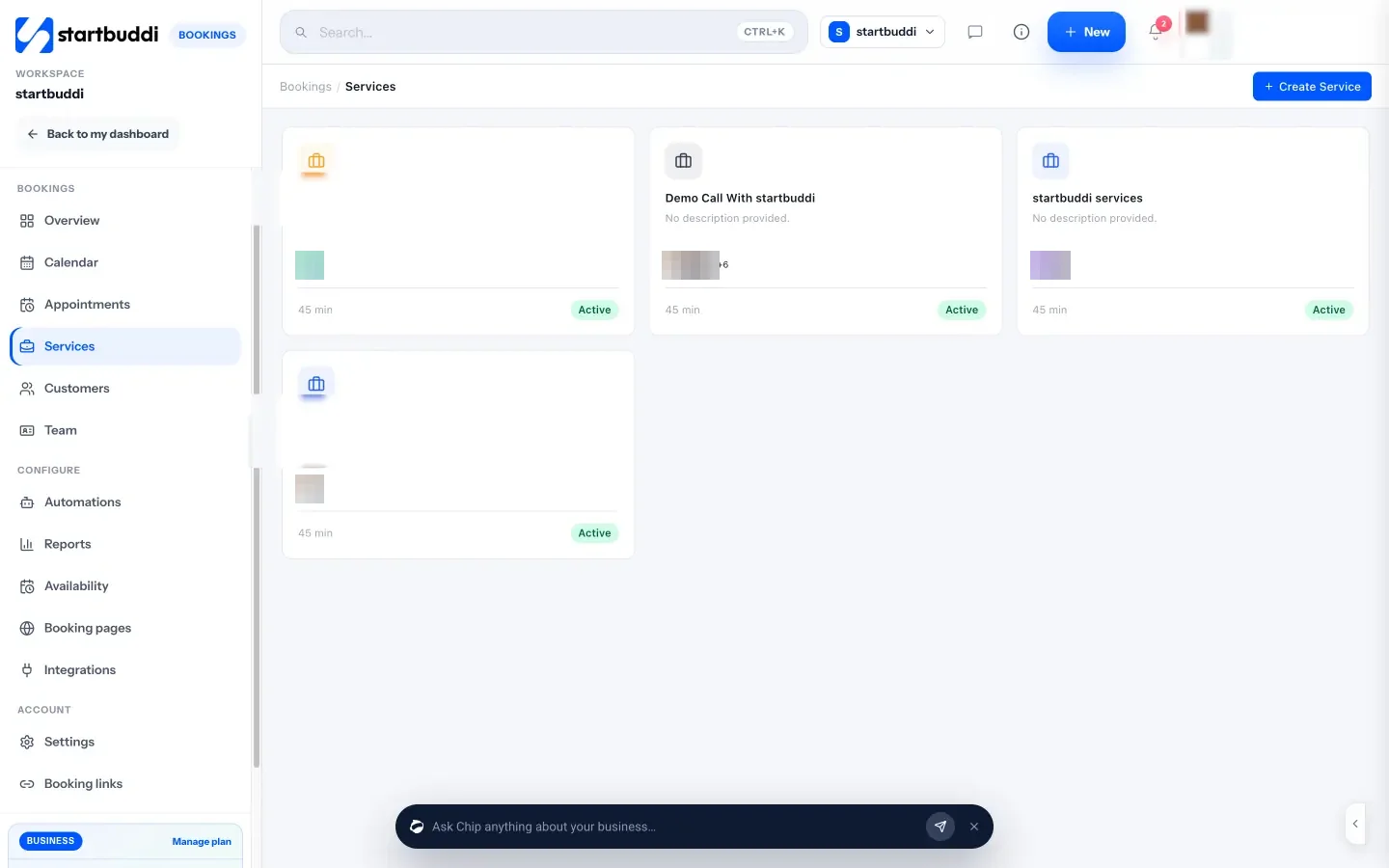
Monthly coaching through Subscriptions. For ongoing coaching, open Money Manager, then Get Paid, then Subscriptions, and create a plan with a name, amount and billing period (monthly or annually). Add a subscriber with their name and email to create a subscribe link. Renewals are charged automatically by your connected Paystack or Stripe account, and you can cancel from the same screen when a client stops. See subscriptions for details.
Packages and corporate work through invoices. For a programme paid in instalments, or a company that needs an invoice, create an invoice in Money Manager with line items, tax and your payment details, and send it with a pay link. Invoices can be paid online by card or bank transfer, and you can record a transfer that arrives outside startbuddi. The Free plan includes 5 invoices a month; Starter and above are unlimited. The guide to sending your first invoice covers terms and reminders.
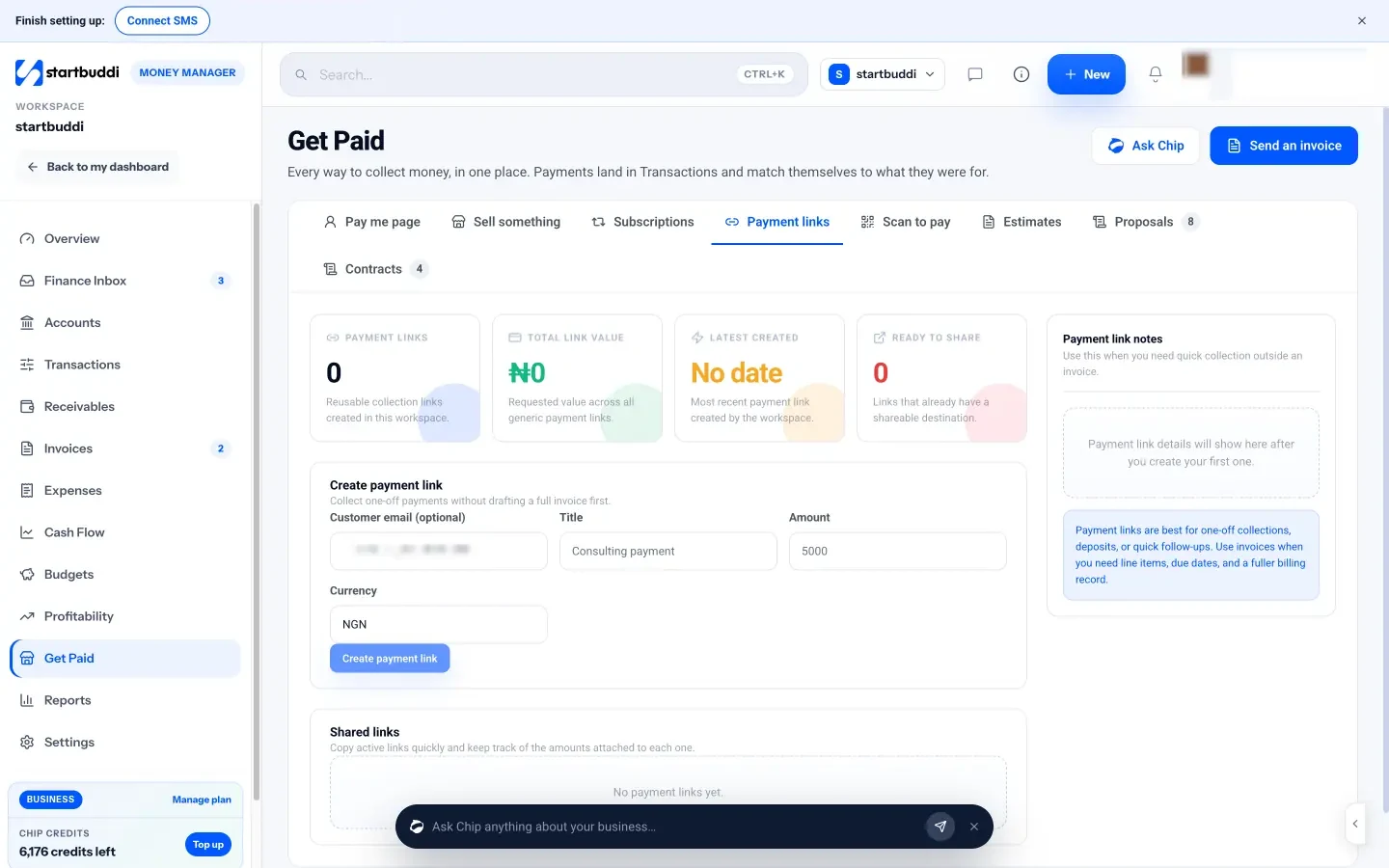
Quick one-off payments through payment links. When a client asks "how do I pay?" in a WhatsApp chat, a payment link is fastest. In Get Paid, open Payment links, enter the title and amount, create the link and paste it into the chat. See what a payment link is if you are new to them.
How to get coaching clients
- Where your first coaching clients come from
- Run a discovery call that helps, then asks
- A weekly routine for getting coaching clients
- Content ideas that attract coaching clients
- Know your numbers
- Build referral partnerships that work both ways
- Mistakes that slow down client acquisition
You have a niche, an offer and prices. Now you need people to say yes. For a new coach, the first ten clients almost never come from a website or an advert. They come from conversations: with people you already know, people they introduce you to, and people who meet you through something useful you shared. This chapter is a practical plan for getting coaching clients without a big audience or a marketing budget.
How to get coaching clients: conversations first
Coaching is a trust purchase. Someone is going to tell you things they do not tell their colleagues, and pay for the privilege. They need to feel that you understand them and that you are safe to talk to. That feeling is built fastest in a real conversation, which is why the discovery call is the centre of almost every coaching sales process.
Think of client acquisition as a simple pipeline with four stages:
- Aware. They know you exist and roughly what you do.
- Interested. They have engaged: replied to a post, downloaded something, joined a webinar or asked a question.
- Discovery call booked. They have agreed to a short call to talk about their situation.
- Client. They have paid for a programme.
Your job each week is to move people one stage forward. If you track how many people are at each stage, you will quickly see where you are stuck. Plenty of calls but few clients means your call or your offer needs work. Few calls means you need more conversations. If this is new to you, the glossary entry on a sales pipeline explains the idea.
Where your first coaching clients come from
Your existing network. Write a short, honest message to 30 to 50 people you know: former colleagues, clients from a previous job, people in communities you belong to. Do not ask them to buy. Tell them what you now do and who it is for, and ask if they know anyone who fits. For example:
Hi Sam, I hope the new role is going well. I've started a coaching practice helping first-time managers in startups, especially people who have just been promoted over their old teammates. If you know anyone going through that, I'd really appreciate an introduction. I'm offering a free 30-minute call to see if coaching would help. Thanks either way!
Communities where your niche gathers. Professional associations, alumni groups, LinkedIn groups, WhatsApp and Telegram communities, meetups and industry events. Be useful first: answer questions, share a checklist, host a short session. Selling in these spaces without giving anything back gets you ignored or removed.
Content that shows how you think. One or two posts a week on LinkedIn or Instagram, each answering a real question your ideal client asks. "What to say in your first one-to-one with a former teammate" beats "5 tips for success". End each post with a simple next step, such as a link to book a call.
Free workshops or webinars. A 45-minute online session on one specific problem, with time for questions, lets people experience your style. Everyone who registers is a warm contact you can follow up with. Our post on running a webinar that sells covers the format.
Referrals from other professionals. Therapists, recruiters, HR consultants, accountants and business advisers all meet people who need a coach. Build a small list of professionals whose clients overlap with yours, and refer work both ways.
A profile that does the selling for you. Whichever platform your clients use most, make your profile answer three questions in the first few lines: who you help, what changes for them, and how to start. On LinkedIn, that means your headline and the top of your About section. On Instagram, it means your bio and the link in it. A potential client should be able to go from reading one of your posts to booking a call in two taps.
Run a discovery call that helps, then asks
A discovery call is 20 to 30 minutes, free, and has two jobs: help the person see their situation more clearly, and find out whether your programme is the right fit. Here is a structure you can use.
- Set the scene (2 minutes). "We have 30 minutes. I'd like to understand where you are and where you want to be, and at the end, if it seems useful, I'll tell you how I work. If it isn't a fit, I'll say so. Does that sound OK?"
- Where are you now? (8 minutes). Ask open questions and listen. "What made you reach out now?" "What have you already tried?"
- Where do you want to be? (8 minutes). "If we were talking in three months and things had gone really well, what would be different?" "What would that be worth to you?"
- What is in the way? (5 minutes). Help them name the gap. Often this is the most useful part of the call for them.
- Invitation (5 minutes). If you can help, explain your programme in two or three sentences, state the price plainly and ask: "Would you like to go ahead?" If not, suggest someone who can help.
After the call, send a short follow-up the same day with a summary of what they said, the programme details and a way to pay or book. Many clients decide within a week or not at all, so a polite nudge after three or four days is helpful, not pushy. Our guide on how to follow up with leads has message templates.
A weekly routine for getting coaching clients
Client-getting works best as a small, steady habit rather than a burst of effort when the calendar looks empty. Here is a routine that fits into about five hours a week alongside coaching.
| Day | Task | Time |
|---|---|---|
| Monday | Review your pipeline: who needs a follow-up this week? | 30 minutes |
| Monday | Send 5 personal messages to people in your network or niche | 45 minutes |
| Tuesday | Write and publish one useful post answering a client question | 1 hour |
| Wednesday | Show up in one community: answer questions, comment, share a resource | 45 minutes |
| Thursday | Send 5 more personal messages and all follow-ups due | 45 minutes |
| Friday | Record the week: conversations, calls booked, clients won | 15 minutes |
| Monthly | Run a free workshop or webinar on one specific problem | 3 hours |
Content ideas that attract coaching clients
If you are not sure what to post, use the questions and phrases from your niche conversations. Each of these can become a short post, a video or an email:
- A mistake you see clients make again and again, and what to do instead.
- A question to ask yourself when facing the problem you solve.
- A short, anonymised story of a client's turning point, shared with permission.
- A simple framework or checklist, such as "three conversations to have in your first month as a manager".
- Your honest opinion on a common piece of advice in your field.
- A behind-the-scenes look at how a coaching session works, for people who have never had one.
Keep the call to action simple and the same every time: book a discovery call, join the next workshop, or reply with a question.
Know your numbers
After a month or two you will have enough data to plan. Suppose you have 40 conversations a month, 10 of them book a discovery call, and 3 become clients on a $1,200 programme. That is a 25% rate from conversation to call and a 30% rate from call to client. To reach 5 new clients a month, you need about 17 discovery calls, which means about 67 conversations. If that feels like too many, work on the step with the weakest rate. A clearer offer or a better call structure often lifts the call-to-client rate faster than finding more people to talk to.
Build referral partnerships that work both ways
A referral partner is a professional who regularly meets people who need what you offer, and who you can help in return. For a career coach that might be a recruiter or a CV writer. For a business coach, an accountant, a business lawyer or a co-working space manager. For a health coach, a personal trainer or a nutritionist.
Start with a coffee or a call, not a pitch. Learn what their clients struggle with and who they are looking to meet. Then make it easy to refer to you: give them your one-sentence niche, a short description they can forward, and a link to book a discovery call. When you refer someone to them, tell them. When they send someone to you, thank them, and let them know how it went, without sharing anything confidential. Three or four active partners can bring a steady trickle of well-matched clients with very little marketing effort.
Mistakes that slow down client acquisition
- Building a website for three months instead of having conversations.
- Posting generic motivational content that could come from any coach.
- Turning the discovery call into a free coaching session with no invitation at the end.
- Hiding the price until the end of a long email thread.
- Forgetting to follow up. Most "no" answers are really "not yet, and I forgot".
- Keeping leads in your head, a notebook and three chat apps, so people fall through the cracks.
Find and follow up with coaching clients in startbuddi
The hardest part of getting coaching clients is keeping track of dozens of half-finished conversations. In startbuddi they sit in one list, with the next step one click away.
A free discovery call link. In Bookings, create a free 30-minute service called "Discovery call" with no payment required, and add two booking questions: "What would you like help with?" and "What have you already tried?". Share the link from Overview with Share booking link: copy it, send it on WhatsApp or by email, embed it on your page, or download a QR code for event slides. Name, email, date and time are always collected, and bookings create or update contacts automatically.
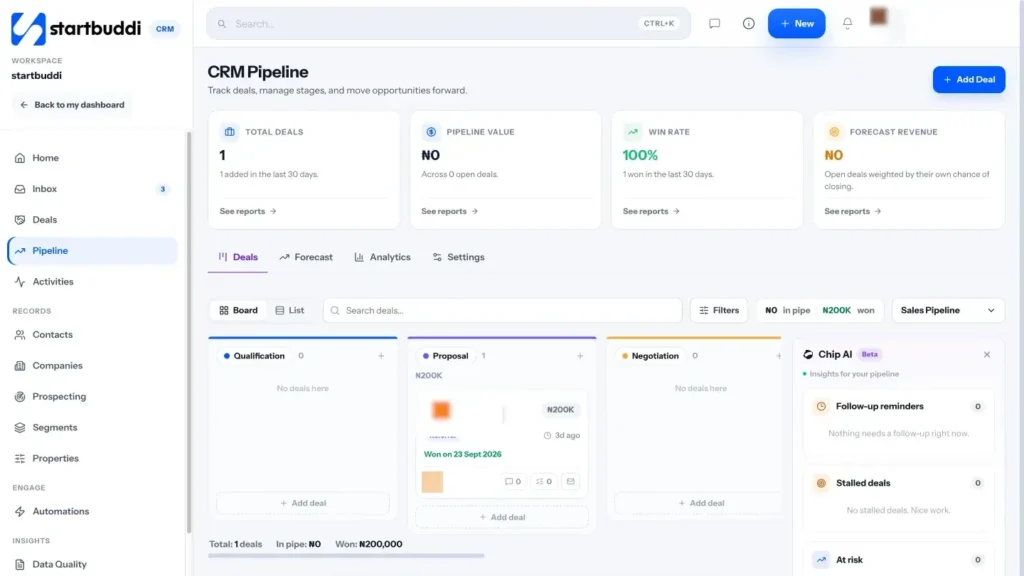
A pipeline for coaching clients. In Customers, the pipeline shows deals as cards in stages you can rename, such as Interested, Discovery call booked, Proposal sent, Client and Not now. Drag a card when someone moves on. Each contact has one page with notes, tasks, bookings and invoices, so before a call you can see everything they have said. Read more on the pipeline page.
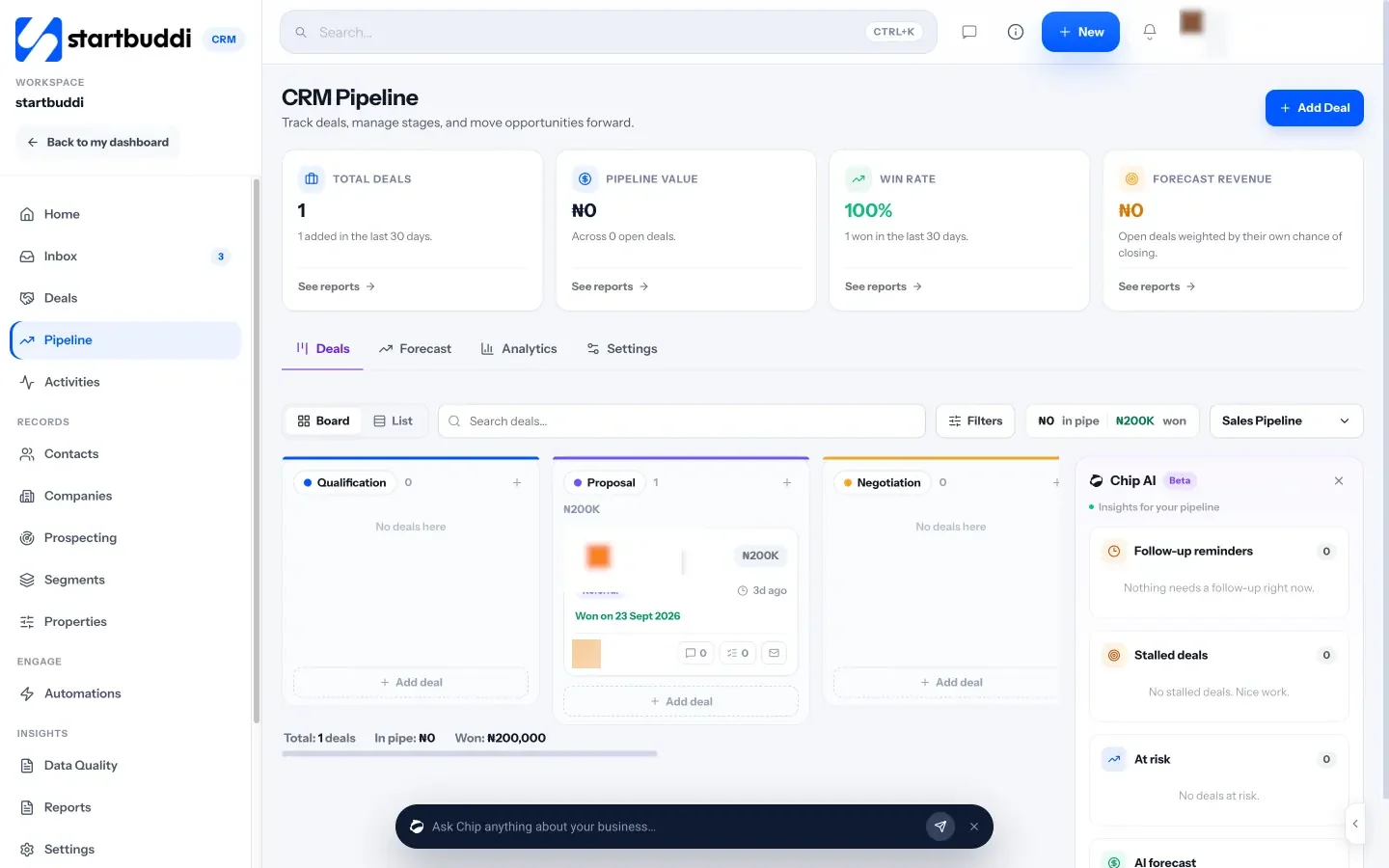
Webinars that turn into contacts. In Publish, Webinars sets up the registration, thank-you and replay pages for you, with a Coach masterclass layout among the eight options. Confirmation and reminder emails go out automatically the day before, one hour before and 15 minutes before, and everyone who registers becomes a tagged contact. On Starter and up the session itself can run in startbuddi Live; on Free you paste the join link from your own video tool, such as Google Meet. See webinars for the full list.
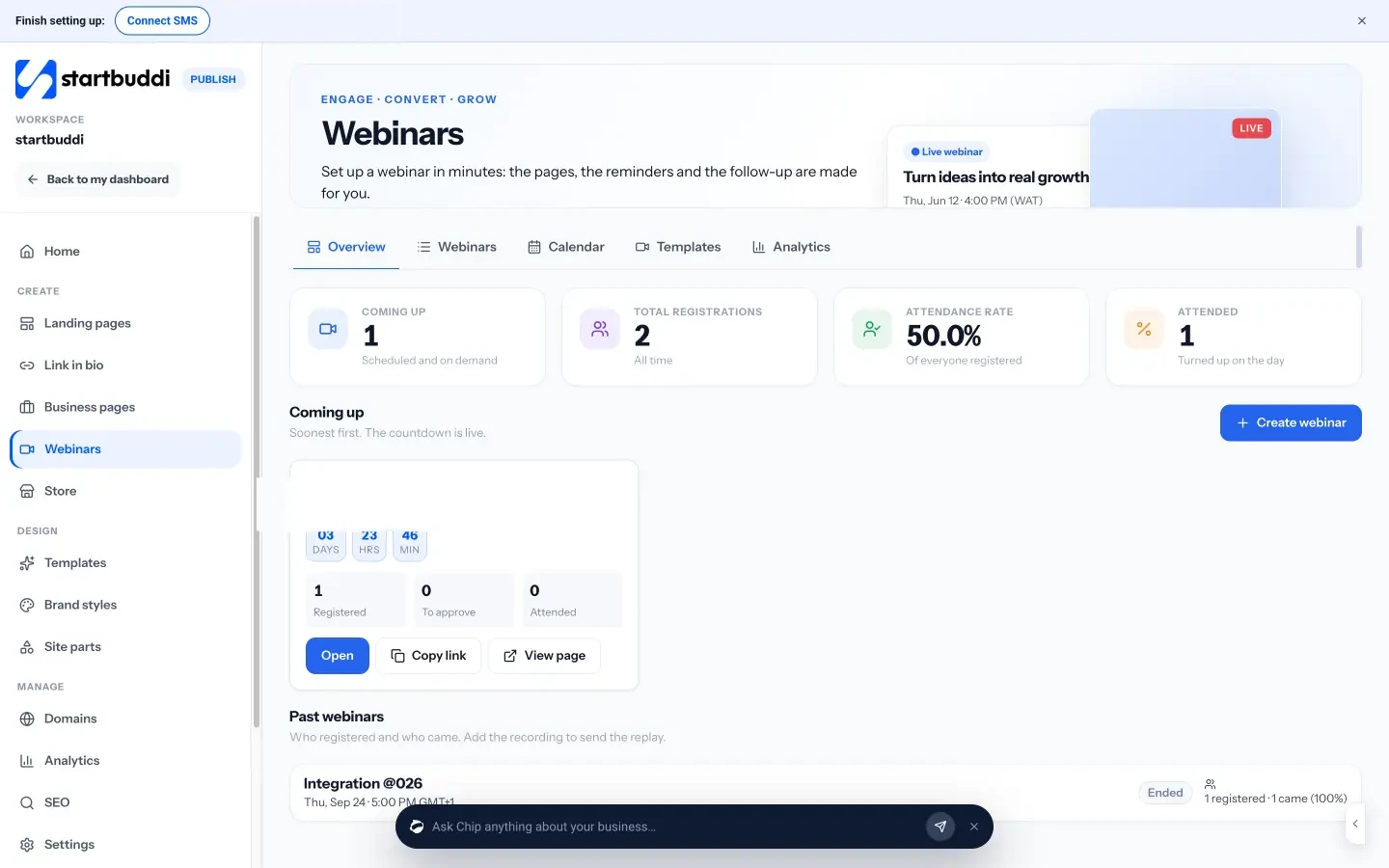
Follow-ups that happen on time. From a contact's page you can add a task such as "Follow up with Priya on Thursday", so it appears in your task list. On the Starter plan and above, you can send email campaigns to a group, for example everyone who attended a webinar, and set up automations such as a short email sequence after someone books a discovery call. The Marketing module is not included on the Free plan and Free allows 2 active automations, so start with tasks, a couple of automations and manual follow-ups, and unlock more when your list grows.
Ask Chip. Chip, the assistant built into startbuddi, can draft a follow-up message or a webinar description for you to edit. Treat everything it writes as a draft and put it in your own voice. The CRM for coaches post goes deeper on organising coaching clients.
Booking sessions and keeping clients
- Onboard new clients properly
- Set a rhythm for sessions
- Session notes that make you a better coach
- Rescheduling without chaos
- Handle no-shows and late cancellations kindly and firmly
- Show progress and plan what comes next
- Running group sessions smoothly
- The tools you need, and the ones you can skip
- Look after yourself as well as your clients
- Review the business every month
- End each programme well
- Collect testimonials the right way
- Mistakes that cost coaches repeat business
- Your next step
Winning a client is only the start. The coaching business that lasts is built on clients who turn up, do the work, get results and then either continue, come back later or send their friends. This chapter covers the operational side: onboarding, booking sessions, notes, handling no-shows, showing progress and turning a finished programme into the next one.
Booking sessions and running your coaching practice
Coaching clients are often busy people making time for themselves. Every bit of friction, such as three messages to find a slot or a reminder that never arrives, makes it easier for them to drift. The aim is a practice that feels calm and professional: they know when the next session is, they get a reminder, and they arrive knowing what you will work on.
Onboard new clients properly
The first week sets the tone for the whole programme. A good onboarding sequence looks like this:
- Welcome message the day they pay, thanking them and saying what happens next.
- Agreement covering sessions, cancellations, confidentiality and the limits of coaching, signed or accepted in writing.
- Intake questionnaire about goals, background, what they have tried and how they like to be supported. Ask them to complete it before the first session.
- First session booked with a date, a link and a calendar invite.
- How to reach you between sessions, and what response time to expect.
Our post on how to onboard a new client has a longer checklist, and the client onboarding checklist is ready to copy.
Set a rhythm for sessions
Most one-to-one programmes run every two weeks, which gives clients time to act between sessions. Some prefer weekly sessions at the start, then fortnightly. Whatever you choose, block your coaching hours in advance and protect them. A few practical rules keep things smooth:
- Offer set coaching hours, for example Tuesday to Thursday, 9am to 4pm, rather than any time.
- Leave 15 minutes between sessions for notes and a breather.
- Let clients book the next session at the end of the current one.
- Show times in the client's own time zone if you coach internationally.
- Send a reminder 24 hours before, and another an hour before for early-morning slots.
Session notes that make you a better coach
Good notes let you pick up exactly where you left off, spot patterns and show progress. Keep them short and structured. A simple template:
- Date and session number. For example "Session 3 of 6".
- Focus today. What the client wanted to work on.
- Key insights. In the client's own words where possible.
- Actions agreed. What they will do before next time, with dates.
- For next time. Anything you want to check in on.
Share the actions with the client after each session, and keep the full notes private. Treat notes as confidential personal data, and delete or anonymise them when you no longer need them, in line with your agreement and local data protection law.
Rescheduling without chaos
Life happens, and some rescheduling is normal. Make it easy for clients to move a session themselves, within your notice period, rather than by a string of messages. If a client reschedules often, raise it gently in the next session: frequent changes are often a sign that the session time does not suit them, or that they are avoiding a difficult topic. Either way, it is worth talking about. For your own cancellations, give as much notice as you can and offer two or three alternative slots straight away.
Handle no-shows and late cancellations kindly and firmly
Your policy only works if you apply it. A friendly, consistent message is enough:
Hi Daniel, I missed you at 10am today. I hope everything is OK. As in our agreement, sessions missed without 24 hours' notice count as used, so this one comes off your package. Here is the link to book your next one: [link]. Looking forward to catching up.
If a client misses twice in a row, call them. Missed sessions often mean the client is stuck or overwhelmed, and a short conversation can save the relationship.
Show progress and plan what comes next
Clients renew when they can see what has changed. At the start, agree two or three measures of success: a promotion conversation held, revenue per month, hours of sleep, confidence rated from 1 to 10. Check them at the midpoint and the end. In the final session, review progress together and ask three questions:
- What has changed since we started?
- What do you want to keep working on?
- Who else do you know who is facing what you faced at the start?
The second question leads naturally to ongoing coaching or a follow-on programme. The third is the most reliable source of referrals you will ever have. Ask for a short testimonial at the same time, with permission to use their first name and role. Our guide on how to retain clients has more ideas.
Running group sessions smoothly
Group coaching needs a little more structure than one-to-one work. Send the dates for the whole programme before it starts, so people can block their calendars. Open each session with a short check-in round, keep a clear agenda, and end with each person naming one action. Record group sessions only if everyone agrees, and say in advance how recordings will be shared and stored. A shared space for questions between sessions keeps momentum, but set expectations about when you will reply, so it does not take over your evenings.
Attendance usually drops in the middle weeks of a group programme. A reminder the day before, a short summary after each call and a personal message to anyone who misses two sessions in a row make a noticeable difference.
The tools you need, and the ones you can skip
New coaches often buy too many tools too early. In the first year you need only a few things:
- A reliable video call tool and a decent microphone.
- A booking page that shows your available times and takes payment.
- A contact list with notes, so you remember every client's story.
- A way to send invoices, payment links or subscriptions.
- A place to keep your agreement, intake form and session templates.
You can skip a course platform, a custom app and a complex website until you have a steady stream of clients. Each separate tool is another login, another bill and another place for client details to go missing. Our post on one workspace versus five separate tools runs the numbers.
Look after yourself as well as your clients
Coaching is emotionally demanding work. Many experienced coaches use supervision, where they talk through their own practice with a more experienced coach, and professional bodies often encourage it. Set boundaries early: a maximum number of sessions per day, clear hours for messages, and at least one day a week with no client work. Burnout is bad for you and for your clients.
Review the business every month
Once a month, spend 30 minutes looking at a handful of numbers: sessions delivered, new clients, clients finishing, renewals, income received, money owed and hours spent on marketing. Compare them with your one-page plan. If income is behind, look at the pipeline first. If clients are leaving early, look at onboarding and session rhythm. Small changes made each month add up to a business that is much easier to run by the end of the first year. Keep a short log of what you changed and why, so that when you review the year you can see which decisions made the biggest difference, and repeat them.
End each programme well
How a programme ends shapes what a client says about you afterwards. Plan the last session as a review rather than a normal session. Look back at the goals and measures you agreed at the start, celebrate what has changed, and write down what the client will keep doing on their own. Send a short summary afterwards with their key actions, a thank-you, and a simple way to book again if they need a check-in later.
A few weeks later, send a friendly message asking how things are going. It costs nothing, shows you care about the result and not just the fee, and is often the moment a former client says "actually, I've been meaning to get in touch".
Collect testimonials the right way
Testimonials are your strongest marketing, but only when they are real and used with permission. Ask at the end of a programme, while the results are fresh. Give the client three prompts to make it easy: what was going on before, what changed, and what they would tell someone thinking about coaching. Ask whether you can use their first name, role and city, or whether they would prefer to stay anonymous. Never edit a testimonial so that it says something the client did not mean.
Mistakes that cost coaches repeat business
- No agreed measure of success, so neither of you can see progress.
- Letting the calendar decide, with sessions squeezed around everything else.
- Forgetting what the client said last time because notes live in five places.
- Ending a programme without offering a next step.
- Never asking for referrals because it feels awkward.
Run coaching sessions in startbuddi
This is where startbuddi saves the most time for a coach: bookings, reminders, notes and client communication in one place, linked to the same contact.
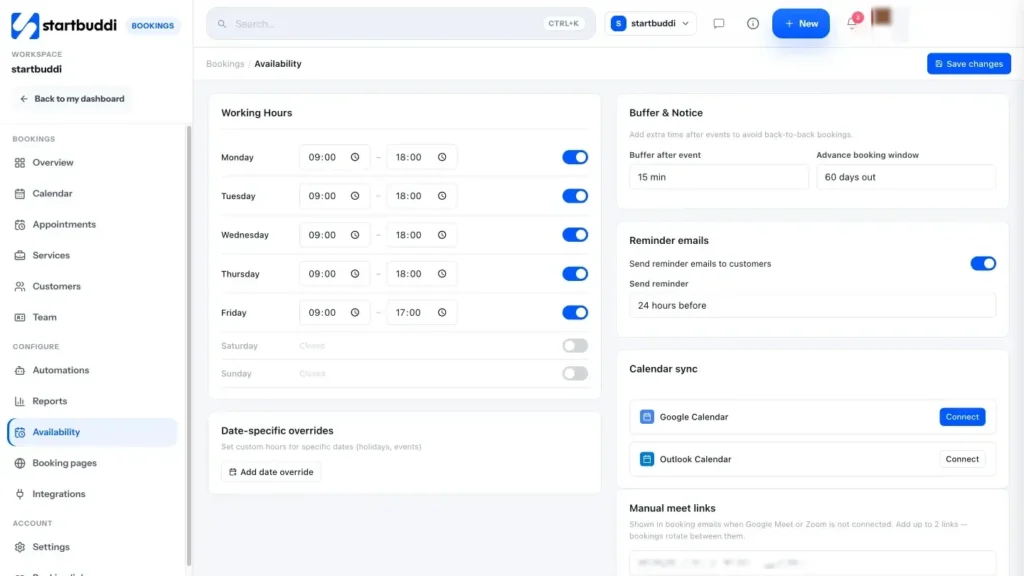
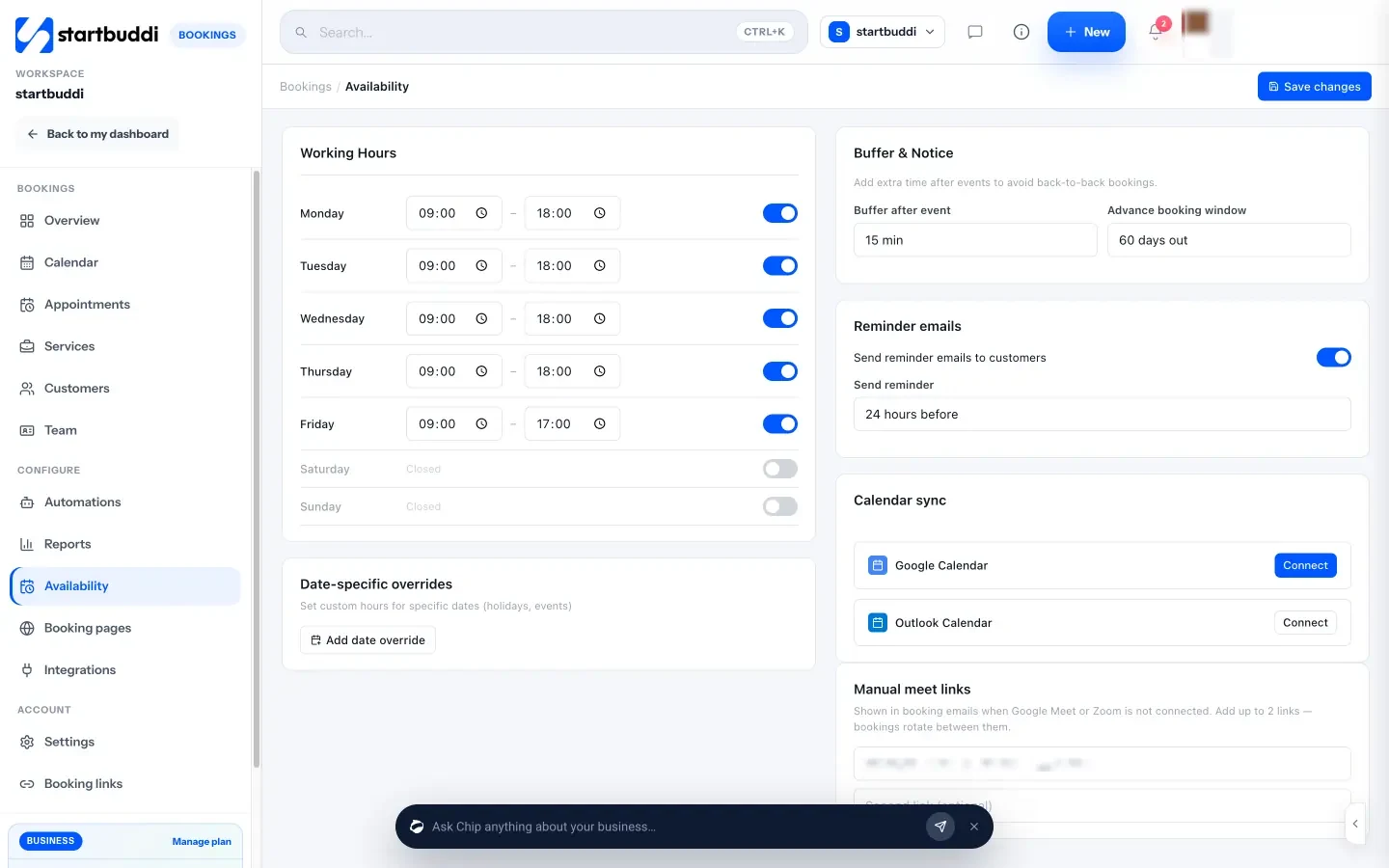
Set your coaching hours. In Bookings, open Availability and set your working hours for each weekday, a buffer after each session (up to 60 minutes) and how far ahead clients can book. Choose when reminder emails go out: 1, 2, 4, 12, 24 or 48 hours before. In Settings, set your default booking timezone; the public booking page shows clients which time zone the times are in.
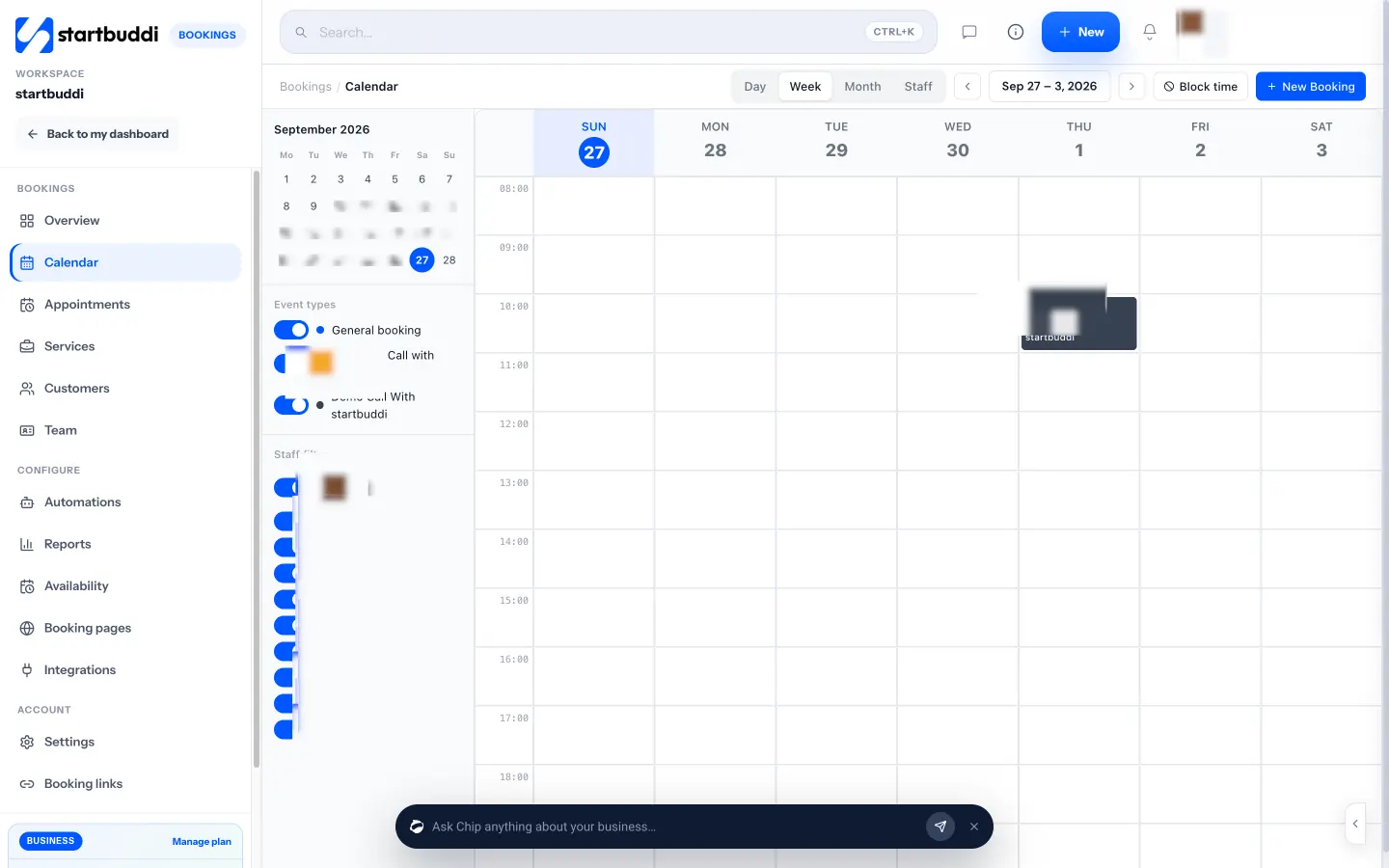
See your week. The Bookings calendar shows sessions by day, week or month, and Block time stops bookings during a lunch break, training or holiday. Bookings can be pushed to Google Calendar, which also creates Google Meet links. Calendar sync is one-way: startbuddi adds bookings to your Google Calendar but does not read your other events to block times, so block busy times in Bookings too.
Notes and follow-ups on each booking. Every booking has internal notes that save as you type, an activity timeline and buttons to mark it complete or a no-show. Marking a no-show sends your "After a no-show" follow-up email, which you can edit in Bookings settings, along with a message after a completed session. You can also generate an invoice from a booking. Because bookings create or update contacts, the client's page in Customers shows all their sessions in one place.
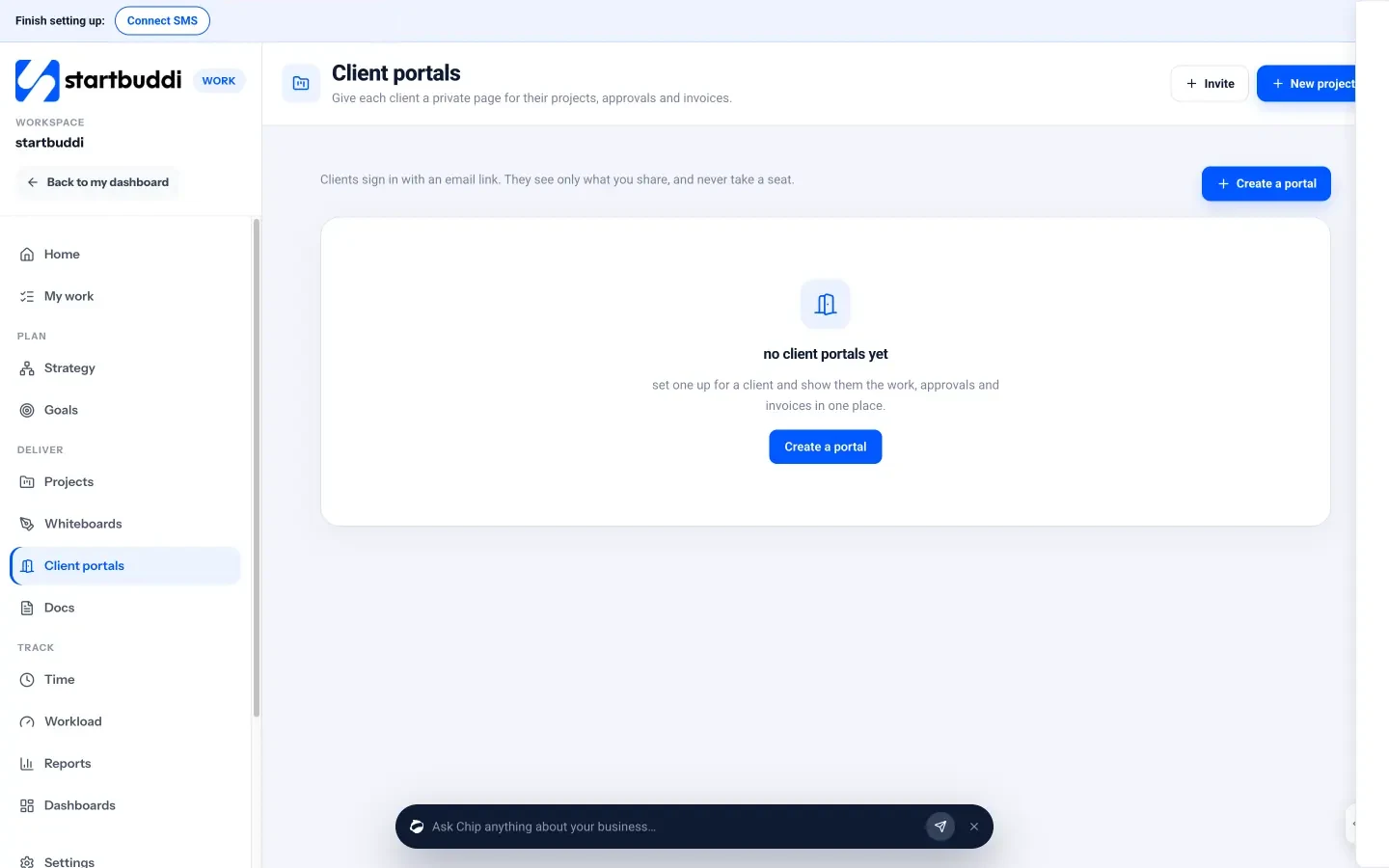
A private space for each client. For clients on longer programmes, Work has client portals: a private page where a client can see the documents, tasks, invoices and messages you share with them. They sign in with a one-time email link, with no password and no paid seat. You can build and preview a portal on Free; inviting clients needs Starter (1 live portal) or above. The glossary explains what a client portal is if you have not used one.
Automate the routine. On Starter and above, Bookings automations can send an email, WhatsApp message or SMS when a booking is created or cancelled, or add a task for you, such as "Send session summary". That is how you make sure every client gets the same good experience, even in a busy week.
Your next step
Write your one-sentence niche, set up one paid service and one free discovery call in Bookings, and send your first 20 messages this week. You can do all of it on the Free plan, then unlock Starter or Growth on the pricing page when you want email campaigns, automations and client portals. Every paid plan has a 30-day trial.
Tiwalade Joanna Okedara-Kalu is the founder, CEO and CTO of startbuddi, the business system that brings clients, bookings, invoices, projects, marketing and the Chip AI assistant into one place. Tiwalade builds software around how service businesses really work day to day, and writes about client management, getting paid on time and why small businesses outgrow the tools they start with.
Founded startbuddi and leads its product and engineering