
How to start a consulting business: niche, rates, first clients and delivery
A four-part guide to starting a consulting business: choose a niche people pay for, set consulting rates, win your first consulting clients and deliver work that brings referrals.


This guide explains how to start a consulting business from scratch: deciding what you will consult on, setting up the business properly, pricing your time, finding your first consulting clients, and delivering work good enough that clients refer you to others. It is written for people with real expertise, often built over years in a job, who want to sell that expertise independently: an HR manager becoming an HR consultant for small firms, an engineer advising on IT systems, a marketer helping founders with growth, an agronomist advising farms.
The short version: pick a specific problem for a specific kind of client, talk to at least ten of those clients before you build anything, set a day rate that covers your costs and non-billable time, win your first clients through people who already know your work, and write down a simple way of delivering every engagement so it can be repeated.
Each chapter covers the business thinking first, with examples, templates, numbers and mistakes, then shows how to run that part in startbuddi. By the end you will have a clear offer, a rate you can defend, a pipeline of conversations and a delivery process your clients can see.
Choose what you will consult on, and check people will pay
Most new consultants start too broad. "I help businesses grow" or "I do HR consulting" sounds safe because it rules nobody out, but it gives nobody a reason to call you. The consultants who get busy fastest can describe, in one sentence, who they help, with what problem, and what changes when the work is done. This chapter helps you find that sentence and test it with real people before you spend money on a logo or a website.
What a consulting business actually sells
A consultant sells expert advice and help to solve a specific problem, usually for a business or organisation, for a fee. The client could hire someone full-time instead, but they only need the expertise for a while, or they need someone from outside who has solved the same problem many times before.
That gives you three things clients pay consultants for:
- Expertise they do not have in-house: tax structuring, cybersecurity, food safety systems, pricing strategy.
- Time and focus they cannot spare: the founder knows marketing matters but has no time to plan it.
- An outside view: someone independent who can say what staff cannot, or who brings patterns from other clients.
Consulting is a real and growing field. In the US, the Bureau of Labor Statistics counts management analysts, its closest category for business consultants, at about 1.08 million jobs in 2025, with 14% self-employed, a median pay of $101,860 in May 2025, and employment projected to grow 10% from 2025 to 2035 (BLS, Occupational Outlook Handbook: management analysts). Those are US figures for one category, and pay varies enormously by country, field and experience, but they show the demand is there.
Find your niche: expertise, problem, client
A good consulting niche sits where three things overlap:
- What you know deeply. Not what you find interesting, what you have done repeatedly and could explain to a sceptical client.
- A problem that costs money or causes pain. Clients pay to fix problems that hurt: lost revenue, fines, staff leaving, systems breaking, deals stalling.
- Clients who can pay and can be reached. You need to be able to name the kind of business, find them, and know they have a budget.
Write your niche as a sentence: "I help [type of client] [solve a specific problem] so they can [result]." Some examples:
- "I help restaurants in Lagos pass food safety inspections and train kitchen staff, so they avoid fines and closures."
- "I help UK accounting firms with 5 to 30 staff move to cloud systems without losing a month to disruption."
- "I help early-stage software startups in Nairobi set up their first sales process, so founders stop being the only person who can close a deal."
- "I help family-owned manufacturers in Ontario plan for succession, so the business survives the next generation."
- "I help growing NGOs in South Africa write HR policies and fix hiring, so they can scale past 20 staff."
Notice what these have in common: a type of client, often a size or location, a specific problem, and an outcome the client cares about. You can still take work outside your niche. The niche is for marketing, so the right people recognise themselves.
Consulting niches by field: some starting points
If you are still deciding, it helps to see how broad fields break down into niches a client can recognise. These are illustrations, not a complete list.
| Field | Too broad | Specific enough to market |
|---|---|---|
| HR | HR consulting | HR policies and hiring systems for NGOs growing past 20 staff |
| Marketing | Marketing consultant | Local marketing plans for dental and physio clinics |
| IT | IT consulting | Cloud and cybersecurity set-up for law firms with under 30 staff |
| Finance | Financial consultant | Cash-flow forecasting and pricing reviews for small manufacturers |
| Operations | Business improvement | Kitchen systems and food safety for restaurant groups |
| Agriculture | Agri consulting | Irrigation and yield planning for mid-sized horticulture farms |
| Sales | Sales consulting | First sales process for founder-led software startups |
A useful test: could a potential client read your niche and immediately think "that's me" or "that's my friend Tunde"? If yes, it is specific enough.
Credibility: the proof you already have
New consultants often worry that they have no track record. You probably have more than you think. Proof can come from:
- Results from your job. "Cut hiring time from 60 to 25 days at a 200-person logistics firm" is strong proof, as long as you describe it without breaching confidentiality.
- Qualifications and certifications relevant to the niche, such as professional HR, accounting, engineering or project management credentials.
- Former managers and colleagues who will write a short recommendation or take a reference call.
- Something you have written or taught: a talk, a training session, a detailed article.
- Your first clients, once you have them. Offer a small, well-defined first engagement and ask for honest feedback you can quote, with permission.
Collect this proof in one document before you start marketing. You will use it on your website, in proposals and in conversations.
Name and a simple online presence
You do not need an elaborate brand. Many consultants trade under their own name, which builds personal reputation and avoids a rebrand if the niche shifts. If you prefer a business name, check it is free to register where you trade and that a matching web address is available.
For your first months, you need three things online: a clear profile on the network your clients use (for most business consultants, LinkedIn), a one-page website or landing page that states your niche, your offer and how to book a call, and a professional email address. That is enough to look credible when someone you contacted checks you out. You can build the rest as you learn what clients respond to.
Choose your type of consulting offer
Consultants sell in a few different shapes. Knowing which one you are offering helps with pricing and with how you describe your work.
| Offer | What the client gets | Example |
|---|---|---|
| Advice or audit | A diagnosis and a written set of recommendations | A two-week HR policy audit with a report and a one-hour walk-through |
| Done-with-you project | You design the solution and help their team put it in place | Designing a sales process and training the team to use it over six weeks |
| Done-for-you project | You do the work and hand it over | Writing a full set of HR policies and templates |
| Retainer | Ongoing access to you for a set number of hours or outcomes each month | Monthly marketing advice plus a planning session |
| Training or workshop | You teach their team a skill | A one-day workshop on handling customer complaints |
Many consultants start with an audit or diagnostic because it is easy to buy: small, fixed in scope and fixed in price. A good audit naturally leads to a bigger project to fix what it found, and then to a retainer to keep things on track.
Turn your niche into a first offer
A "productised" first offer, a named package with a fixed scope and price, is easier to sell than "I charge by the hour, let's talk". For example:
Sales process sprint (4 weeks, $4,500)
For software startups with 2 to 10 staff where the founder still closes every deal.
Week 1: review of your last 20 deals and your current tools. Week 2: a written sales process, from first contact to signed contract, with templates. Week 3: set up your pipeline and train one team member. Week 4: review two live deals together and adjust. You get: the process document, email templates, a working pipeline and two coaching calls.
The price and scope are yours to set. The point is that a client can say yes to it without a long negotiation.
Check that people will pay before you build anything
You do not need a website to test a consulting idea. You need conversations. Aim for ten to fifteen short calls with people who fit your niche, before you spend money on anything else.
These are not sales calls. They are research. Ask:
- "What are the biggest problems you are dealing with in [area] right now?"
- "What have you tried so far? What happened?"
- "How much time or money does this problem cost you?"
- "Have you ever paid anyone to help with it? What did that look like?"
- "If someone could fix this, what would that be worth to you?"
Listen for three signals: the same problem comes up again and again, people have already tried to solve it (so it matters to them), and some have paid for help before (so there is a budget). If two or three people ask "can you help us with that?" by the end of the call, you have your first leads.
How much money you need before you start
Consulting is cheap to start, but income is uneven at first. Clients take time to decide, projects take time to deliver, and invoices take time to be paid. Plan for a slow first few months.
A worked example: a consultant in London needs £2,800 a month to cover personal bills and £300 a month for business costs (insurance, software, phone, travel). If it takes four months to reach a steady income, and they expect to earn half of their target in those months, the gap is roughly 4 × £3,100 × 50% = £6,200. That is the minimum runway to have saved, or covered by part-time work, before leaving a job. In Nairobi, Lagos or Toronto the figures change, but the method is the same: monthly needs, times the months to ramp up, times the share you will not yet be earning.
Many consultants start on the side: a first client or two while still employed (checking their employment contract allows it), and leave once they have enough work booked for the next few months.
A four-week launch plan
If you like structure, here is one way to go from idea to first conversations in a month, alongside a job or other work:
- Week 1: write your niche sentence and first offer. List 50 people who fit or know people who fit. Collect your proof in one document.
- Week 2: book and run five research calls. Refine your niche and offer based on what you hear. Update your LinkedIn headline and about section.
- Week 3: run five more research calls. Draft your agreement, estimate and proposal templates. Work out your day rate (chapter 2).
- Week 4: announce your practice to your network in small, personal batches. Publish a one-page site with a booking link. Follow up with everyone who showed interest in the research calls.
By the end of the month you will have a tested offer, a price, templates and a handful of warm conversations, which is more than most consultants have after six months of polishing a website.
Mistakes to avoid at the start
- Being a generalist. "Business consultant" gives clients nothing to remember.
- Building before talking. A logo and website do not win clients. Conversations do.
- Choosing a niche with no money. A problem people complain about but never pay to fix is not a business.
- Underestimating the ramp-up. Assume the first clients take longer than you hope.
- Forgetting what you enjoy. You will do this work every day. Pick problems you like solving.
How to start in startbuddi
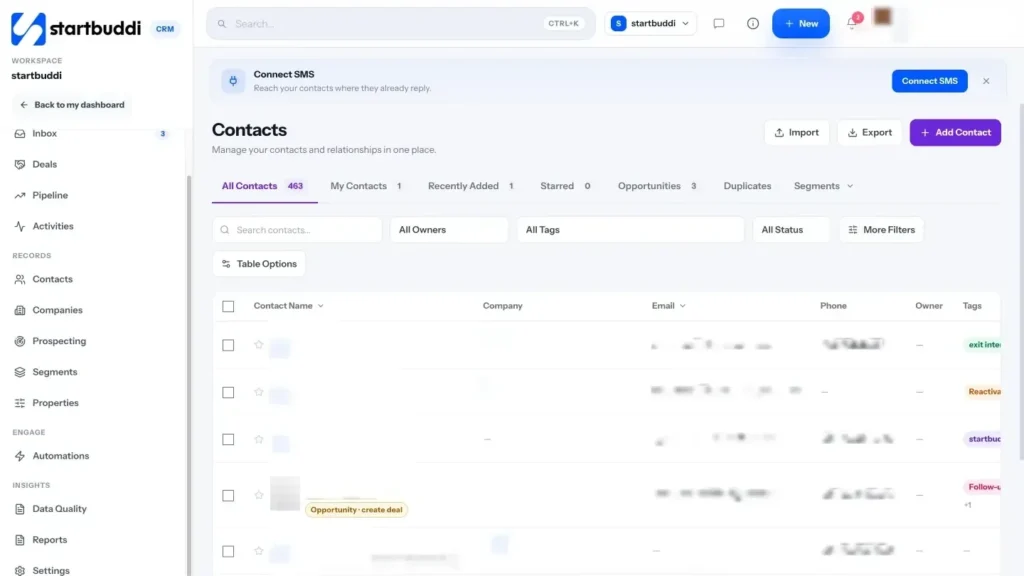
Your first asset is not a website; it is your list of people. In startbuddi, open Customers, then Contacts, and add the people you plan to speak to: former colleagues, former clients, people in your industry, anyone who fits your niche. A name and an email or phone number is enough to start. If you have them in a spreadsheet or exported from your phone or LinkedIn, use Import to upload a CSV, map the columns and tag everyone at once.
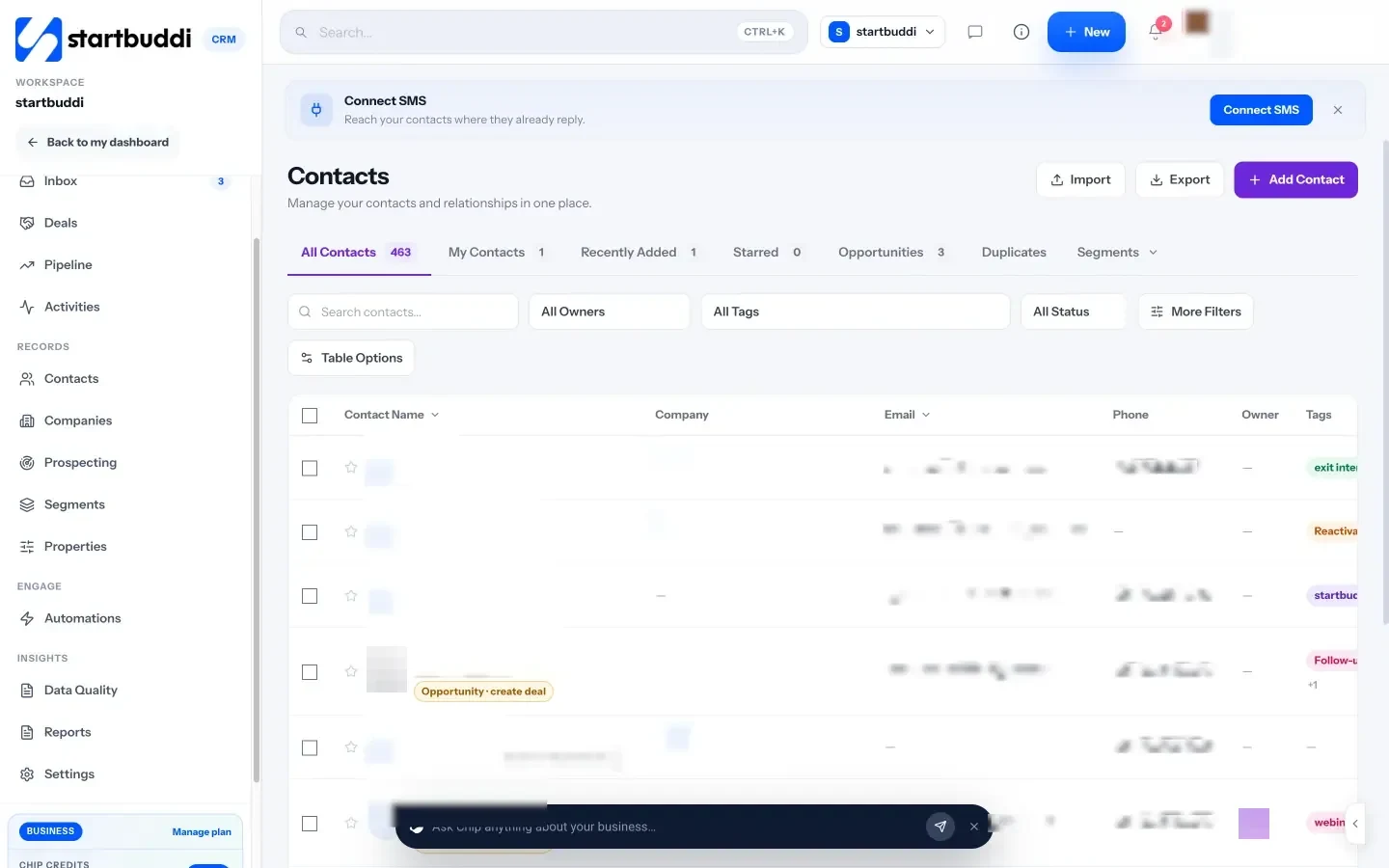
Use tags to keep your research organised, for example "research call", "warm", "former colleague" or the niche itself. After each research call, add a note on the contact with what they said. Notes are shared with the inbox, so the context is there when they reply to a follow-up later. When you add a company, you can start with its website and startbuddi fills in the logo and details for you.
This is where your future pipeline starts. Chapter 3 turns these contacts into deals. For more on how consultants organise clients, see our post on CRM for consultants and the startbuddi for consultants page. The Free plan includes up to 250 contacts, which is plenty for your first research calls.
Set up the business and set your consulting rates
Once you know what you are selling and that people want it, you need a business that can take money properly, a contract that protects you, and prices that make the numbers work. This chapter covers legal structure, bank accounts, insurance and contracts in plain terms, then goes deep on consulting rates: the main pricing models, how to calculate a day rate from scratch, worked examples in several currencies, and how to talk about price with confidence.
Choose a legal structure
This is general information, not legal or tax advice. Rules differ by country and change over time, so check with the official body where you will trade, or with an accountant or lawyer.
Most new consultants choose one of two structures:
- Sole trader or sole proprietor: you and the business are the same legal person. It is simple and cheap to set up, but you are personally responsible for business debts.
- Limited company or LLC: the business is a separate legal entity. It costs more to set up and run, with more paperwork, but can limit your personal liability and may be expected by some larger clients.
Where to check the rules in a few countries:
- United Kingdom: GOV.UK explains how to set up as a sole trader, including registering for Self Assessment if you earn more than £1,000 from self-employment in a tax year.
- United States: the SBA explains how to choose a structure and which licenses and permits you may need, which vary by state and city.
- Nigeria: business names and companies are registered with the Corporate Affairs Commission. Our post on registering a business name in Nigeria walks through it.
- Canada: the government's starting a business pages cover registering or incorporating and getting a business number.
Bank account, records and tax
Open a separate bank account for the business from day one, even as a sole trader. It keeps your records clean, makes tax time far easier, and looks more professional on invoices. Keep every receipt for business costs, and record every payment you receive.
Set aside money for tax from every payment. The right percentage depends on where you live and how much you earn, so ask an accountant early. A common habit is to move a fixed share of every client payment into a separate savings account the day it arrives, so tax bills are never a surprise.
Insurance
Consultants give advice, and advice can go wrong. Professional indemnity insurance (called professional liability or errors and omissions insurance in some countries) covers claims that your advice caused a client a loss. Some clients will ask for it before signing. Depending on your work you may also need public liability cover, and cover for equipment. The SBA's guide to getting business insurance suggests speaking to agents, comparing terms and prices, and reassessing every year as you grow, which is good advice anywhere.
Contracts: never start without one
A consulting agreement protects both sides by writing down what you will do, what you will not do, what it costs, when payment is due and what happens if things change. At minimum it should cover:
- The scope: deliverables, timeline, and what is out of scope.
- Fees, payment schedule, deposit and late payment terms.
- How changes to scope are agreed and priced.
- Confidentiality, and who owns the work you produce.
- How either side can end the agreement.
- Limits on your liability.
Our free consulting agreement template covers these points, and our post on writing a client service agreement explains each clause in plain words. Have a lawyer review your standard agreement once, then reuse it.
Consulting rates: the four main pricing models
| Model | How it works | Good when | Risk |
|---|---|---|---|
| Hourly | Client pays for each hour worked | Scope is unclear, or work is small and ad hoc | You earn less as you get faster; clients watch the clock |
| Day rate | Client pays per day of work | On-site work, workshops, clearly bounded advisory days | Same as hourly, but less admin |
| Fixed project fee | One price for a defined outcome | Scope is clear and you have done it before | Scope creep eats your margin if the contract is loose |
| Retainer | Monthly fee for ongoing access or outcomes | Clients need regular help after a project | Unused hours cause friction if the terms are vague |
Many consultants use a mix: a fixed fee for audits and projects, a retainer afterwards, and a day rate for workshops. Value-based pricing, setting the fee based on what the outcome is worth to the client rather than your time, is a version of the fixed fee. It works best once you can show results from previous clients.
Calculate your day rate from scratch
Start from what you need, not what you think clients will pay. Five steps:
- Target income: what you want to earn in a year before tax, as if it were a salary.
- Business costs: insurance, software, equipment, travel, accountant, training, marketing.
- Working days: 52 weeks × 5 days = 260, minus holidays, public holidays and some sick days.
- Billable share: the share of working days you will actually bill. Early on, much of your time goes on finding clients, admin and learning. Many consultants plan for around half.
- Day rate = (target income + costs) ÷ billable days.
The same method in other currencies:
| Where | Target income + costs | Billable days | Day rate |
|---|---|---|---|
| London | £60,000 + £8,000 | 110 | about £620 |
| Lagos | ₦24,000,000 + ₦3,000,000 | 110 | about ₦245,000 |
| Nairobi | KSh 3,600,000 + KSh 400,000 | 110 | about KSh 36,400 |
| Johannesburg | R720,000 + R80,000 | 110 | about R7,300 |
These are worked examples using made-up targets, not market rates. Your market may pay more or less, and specialist fields pay more. Use the calculation as your floor: the lowest rate at which the business works. Our free hourly rate calculator does the maths for you.
Check your rate against the market
Once you know your floor, find out what clients are used to paying. Ask peers in your field, look at published rate cards from consultancies in your niche, and ask in research calls what clients have paid before. If the market rate is well above your floor, charge closer to the market. If it is below your floor, you need a narrower niche where your expertise is worth more, a different client type with bigger budgets, or a lower-cost way of delivering the work.
Turn day rates into project prices
Most clients prefer a fixed price for a defined project. To price one, estimate the days, multiply by your day rate, and add a buffer for the unknown, often 15 to 25%.
Worked example: the four-week sales process sprint from chapter 1. Estimated effort: 2 days of review, 1.5 days writing the process, 1 day of setup, 1 day of training and coaching, plus 0.5 days of calls and admin = 6 days. At $950 a day, that is $5,700. A 15% buffer takes it to about $6,550. You might publish it at $6,500, or start at a lower launch price for your first two clients in exchange for a testimonial, and say so openly.
Build a simple rate card
A rate card is a short list of your standard offers and prices. You may not publish it, but having it written down stops you inventing prices on the spot and undercharging under pressure. An example for the sales consultant above:
| Offer | Scope | Price |
|---|---|---|
| Sales audit | Review of last 20 deals, tools and process; findings call; short report | $2,400 fixed |
| Sales process sprint | 4 weeks: process, templates, pipeline set-up, training, two coaching calls | $6,500 fixed |
| Advisory retainer | 1 day a month plus quarterly review, 3-month minimum | $1,200 a month |
| Team workshop | Half day, up to 10 people, with materials | $1,500 |
| Ad hoc advice | By the hour, minimum 2 hours | $130 an hour |
Notice the minimum on ad hoc work. Short, one-off calls cost more in admin and context-switching than they appear to, so a minimum protects your day. Notice, too, that the ad hoc hourly rate is a little higher than the day rate divided by eight: clients who want the flexibility of hourly work pay slightly more for it, which nudges them towards the packages.
Deposits and payment terms
Ask for a deposit before you start. For projects, 30 to 50% upfront is common, with the rest on completion or split across milestones. For retainers, bill at the start of each month, not the end. Explain it simply: the deposit reserves your time in the calendar and covers the first phase.
Clients in other countries and currencies
Consulting travels well, and many consultants work for clients abroad. A few practical points:
- Agree the currency in the contract. If you quote in dollars but live in naira, rand or shillings, say so clearly, and decide who bears the cost of conversion and transfer fees.
- Offer a way to pay that suits the client, such as card payment through a payment provider, or a bank transfer with full details on the invoice.
- Check tax rules for foreign clients with your accountant. VAT, sales tax and withholding tax can apply differently to cross-border services.
- Mind time zones when promising response times and scheduling calls.
The tools you actually need at the start
New consultants often spend weeks choosing software. You need very little to begin, and it helps if it is connected so you are not copying details between apps:
- A contact list and pipeline to track who you have spoken to and what happens next.
- A booking link so people can book a call without email back-and-forth.
- Estimates, contracts and invoices with a way for clients to pay online.
- A project and task list for delivery, ideally one the client can see.
- A place for documents and templates you reuse.
- Time tracking, even for fixed-fee work, to check your estimates.
You can do all of this with separate apps or with one system. The important thing is to decide early and use it consistently, because your client history is one of the most valuable things your business will own.
Talking about price with confidence
- Say the number and stop. "The sprint is $6,500, with half upfront." Then wait.
- Anchor on the problem, not your time. "You said deals are stalling and you're closing everything yourself. This fixes that in four weeks."
- Offer options, not discounts. If the budget is tight, reduce the scope (a two-week audit only) rather than the rate.
- Put it in writing the same day, in a proposal or estimate.
Mistakes to avoid
- Pricing from your old salary divided by hours. It ignores costs, holidays and the time you cannot bill.
- Discounting to win the first client. It sets an anchor that is hard to move later.
- Starting without a signed agreement and deposit.
- Mixing business and personal money.
How to set this up in startbuddi
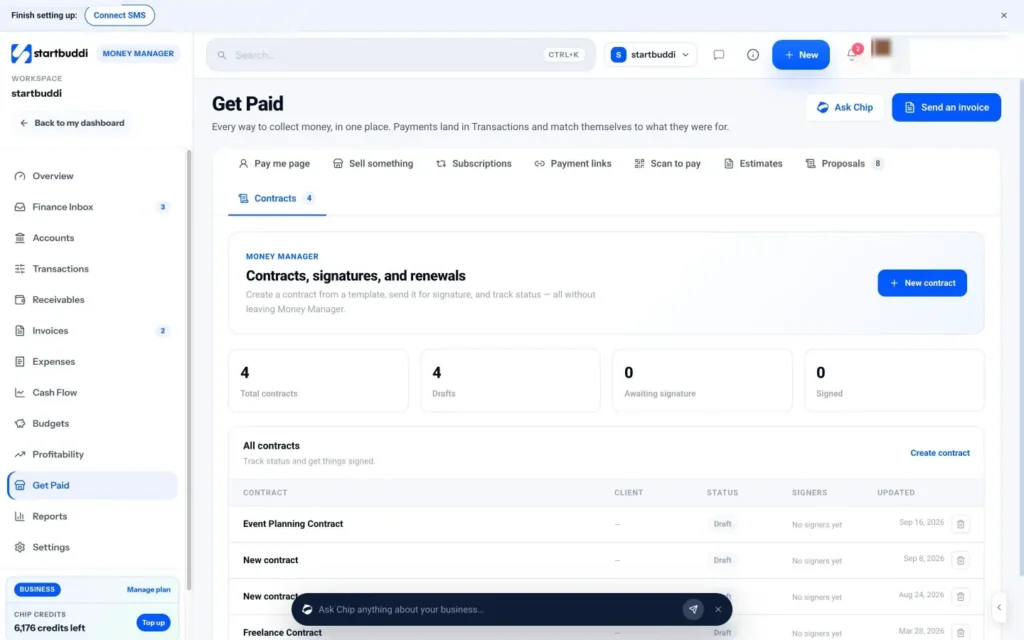
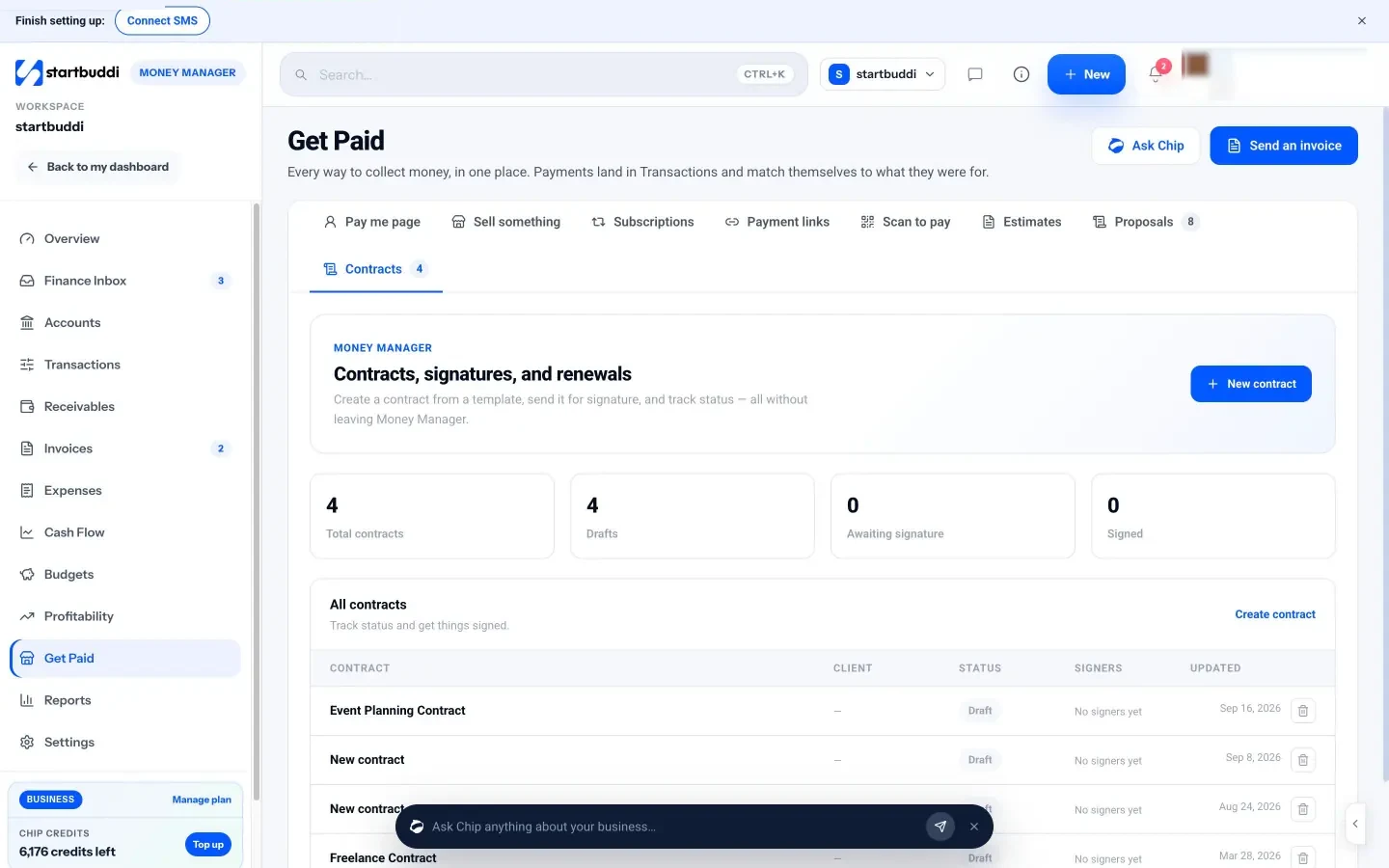
In startbuddi, quotes, proposals and contracts live in Money Manager, under Get Paid, on the Estimates, Proposals and Contracts tabs. An estimate has line items, tax, discount, notes and terms, so you can price your sprint line by line and note "50% deposit to begin". Send it by email; when the client agrees (they reply to the email), click Mark accepted, then Convert to invoice, and the accepted estimate becomes an invoice with the same line items.
For the agreement itself, New contract lets you start from a template or a blank page, edit the wording in the document editor, add signers and send it for signature. Signers sign on a startbuddi page, and the status moves to Signed when everyone has signed. The built-in contract templates are aimed at freelance and project work (such as the Freelance Contract), so start from the closest one or from blank, and paste in the clauses from our consulting agreement template. The template picker itself notes that templates are a starting point, not legal advice.
Estimates can be in the client's currency, set per document, which helps with clients abroad. Each estimate keeps an activity timeline (created, sent, accepted or declined, converted), and the Estimates tab shows totals for accepted, waiting and pipeline value, so you can see at a glance how much work is out for decision. One honest limit: there is no online "accept" button for estimates yet. The client accepts by replying to the email, and you record it with Mark accepted.
There is also a Proposals tab with a Project Proposal template for when you want a longer document before the estimate. Our post on how to write a business proposal covers what to put in it.
How to find consulting clients and win the work
Finding consulting clients is the part most new consultants dread, and the part they most often get wrong by jumping straight to cold emails and ads. Your first consulting clients will almost certainly come from people who already know and trust you. This chapter shows you how to work your network without feeling pushy, how to build steady sources of new leads, how to run a discovery call that turns into a proposal, how to follow up, and how to track it all so nothing slips.
Start with the people who already know you
Trust is the hardest part of selling consulting. Clients are buying advice they cannot see in advance, from someone they are unsure about. People who have worked with you already have that trust, so start there.
Make a list of 50 to 100 people: former managers and colleagues, former clients and suppliers, people from professional groups, alumni networks, friends who run businesses. You already started this list in chapter 1. Then contact them in small batches with a short, personal message. Not a sales pitch, an announcement and a question.
Hi Funmi, hope you're well. I wanted to let you know I've left Acme and started my own consulting practice, helping restaurants pass food safety inspections and train kitchen staff. You've seen more kitchens than anyone I know, so I'd value your view: who do you know who's struggling with inspections right now? No pressure at all, and I'd love to catch up either way.
Asking for introductions or advice gets a warmer response than asking for work, and often leads to work anyway.
Build steady sources of leads
Your network gets you started. To keep a pipeline full, build two or three of these, and do them consistently rather than trying all at once:
- Referrals from clients. Ask every happy client, at the end of the work: "Who else do you know who has this problem?" Make it easy by offering to send a short note they can forward.
- Partners. Find people who serve the same clients but do not compete with you. An accountant, a lawyer, a software reseller or a recruiter can all send you work, and you can send them work back.
- Useful content. Write short posts on LinkedIn or a newsletter about the problems your niche faces, with practical advice. Over months, it makes you the name people remember.
- Speaking and workshops. Talks at industry events, chambers of commerce, trade associations or online communities put you in front of a room of potential clients at once.
- Direct outreach. Carefully researched, personal messages to a small list of ideal clients, about a specific problem you have noticed. Quality over quantity.
Set up a referral partnership
Partnerships work when both sides benefit and both know exactly who to send. A simple way to start one:
- List five businesses that serve your ideal clients without competing with you. For an HR consultant: an accountant, an employment lawyer, a recruitment agency, a payroll bureau, an office-space provider.
- Ask for a 20-minute coffee or call to learn about their clients, not to pitch.
- Explain in one sentence who is a good fit for you, and ask who is a good fit for them.
- Send them a referral first if you can. Nothing builds a partnership faster.
- Stay in touch every couple of months with something useful.
Two or three active partners can supply a steady share of your work within a year.
A weekly sales routine
Consultants often sell in bursts: busy with delivery, the pipeline empties, panic, frantic outreach, a new project, repeat. A small, fixed weekly routine smooths the peaks and troughs. For example, every Monday and Thursday morning, one hour:
- Review the pipeline: who needs a reply, who needs a follow-up, what is stuck.
- Send five personal messages to people in your network or target list.
- Follow up on every open proposal.
- Write or share one useful post.
- Book at least two conversations for the coming week.
Two hours a week, every week, even when you are busy with delivery, is what keeps the next project coming.
The discovery call
A discovery call is a 30 to 45-minute conversation to understand the client's problem and decide together whether you can help. It is not a presentation. Aim to listen for 70% of the time. A simple structure:
- Set the agenda (2 minutes). "I'd like to understand what's going on, share how I usually help, and agree whether it makes sense to go further. Sound OK?"
- The situation (10 minutes). "Tell me about the business and what's prompted this conversation."
- The problem (10 minutes). "What's not working? How long has it been like this? What have you tried?"
- The cost (5 minutes). "What is this costing you, in money, time or stress? What happens if nothing changes in six months?"
- The outcome (5 minutes). "If we fixed this, what would be different? How would you measure it?"
- Decision and budget (5 minutes). "Who else is involved in deciding? Have you set aside a budget for this?"
- Next step (3 minutes). "Based on what you've said, I think [offer] fits. I'll send a short proposal by Thursday. Can we book 20 minutes on Friday to go through it?"
Always leave with a booked next step. "I'll send something over" with no date is where most deals quietly die.
Write a proposal they can say yes to
A consulting proposal should be short: two to four pages. It repeats the client's problem in their words, describes the outcome, sets out the approach and timeline, gives the price and terms, and ends with how to start. Send it within two working days of the call, while the conversation is fresh. Keep a template so each new proposal takes an hour, not a day.
Offer two or three options where it makes sense, for example an audit only, the full project, or the project plus three months of support. Options turn the question from "yes or no?" into "which one?".
Follow up without being annoying
Most decisions take longer than you expect. Clients get busy, budgets need approval, other priorities jump in. A calm follow-up routine keeps you in their mind without pressure:
| When | What |
|---|---|
| Same day as the call | A thank-you with a summary of what you heard |
| Within 2 days | The proposal, with the booked review call |
| 3 days after the review call | A short check: "Any questions I can answer?" |
| 1 week later | Something useful: an article, an idea, a relevant example |
| 2 weeks later | A direct question: "Is this still a priority, or should we pick it up later in the year?" |
| Then monthly | Stay in touch lightly until they say yes or no |
A clear "not now" is useful. Move them to a "later" stage and set a reminder for the month they mentioned.
Make your LinkedIn profile work for you
For most business consultants, LinkedIn is where potential clients check you out after a message or an introduction. Treat your profile as a one-page sales document:
- Headline: your niche sentence, not your old job title. "Helping restaurants in Lagos pass food safety inspections" beats "Consultant".
- About section: the problem you solve, who for, how you work, one or two results, and how to book a call.
- Featured: your booking link, a useful article, or a short case study.
- Recommendations: ask three former colleagues or clients to write one about a specific piece of work.
Handling common objections
Objections are usually questions in disguise. Prepare calm answers to the ones you will hear most:
- "It's more than we expected." "That's fair. Can I ask what you were expecting? If budget is the issue, we could start with the audit on its own, and you decide on the rest once you've seen the findings."
- "We need to think about it." "Of course. What would help you decide? Is there anything you're unsure about, or someone else who needs to see it?"
- "Can you send some examples?" "Yes. I'll send a short case study from a similar business, and I can introduce you to the owner if you'd like a reference."
- "We might do it ourselves." "That can work. The main risk is time: your team has done this once, I've done it many times. Happy to share the checklist either way."
- "Now isn't a good time." "Understood. When would be better? I'll note it and check in then."
Say no to the wrong clients
Early on, every enquiry feels precious. But some clients cost more than they pay: they want work far outside your niche, push hard on price before hearing the scope, or show signs of not respecting agreements. A polite no, with a referral to someone better suited if you know one, protects your time and your reputation. The right clients come faster when your calendar is not full of the wrong ones.
Do the pipeline maths
Knowing your numbers turns "I hope work comes in" into a plan. Track how many conversations turn into proposals, and how many proposals turn into clients. A worked example with illustrative numbers:
- You want 2 new projects a month at $6,500 each.
- If 1 in 3 proposals is accepted, you need 6 proposals a month.
- If 1 in 2 discovery calls leads to a proposal, you need 12 discovery calls a month, or about 3 a week.
- If 1 in 5 outreach messages or introductions leads to a call, you need about 60 a month, or 3 a working day.
Your real ratios will be different, and early on you will not know them. Track them from the first month, and within a quarter you will know exactly how much outreach your income target needs.
Mistakes to avoid
- Pitching on the discovery call. Listen first. The client should do most of the talking.
- Free consulting. A 30-minute call is fine; a two-hour working session with a full plan is the work itself.
- No next step. End every call with a date in both calendars.
- Chasing everyone. Some leads are not a fit. Saying no politely leaves time for the ones who are.
- Keeping it all in your head. By month three, you will forget who you promised to call back.
How to run your pipeline in startbuddi
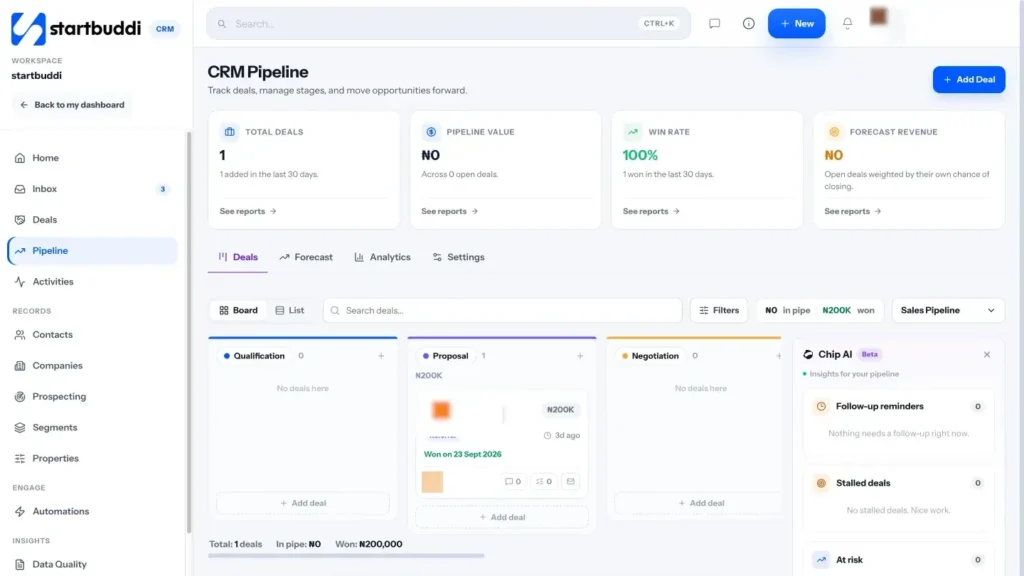
In startbuddi, deals live in Customers, under Pipeline and Deals. Each deal has a name, a contact, a value, a stage and an expected close date. The board shows your stages as columns, and you drag a deal forward as it moves, from first conversation to proposal to negotiation, then mark it won or lost with a reason. You can rename stages to match your process, for example "Research call", "Discovery call", "Proposal sent", "Deciding", "Later".
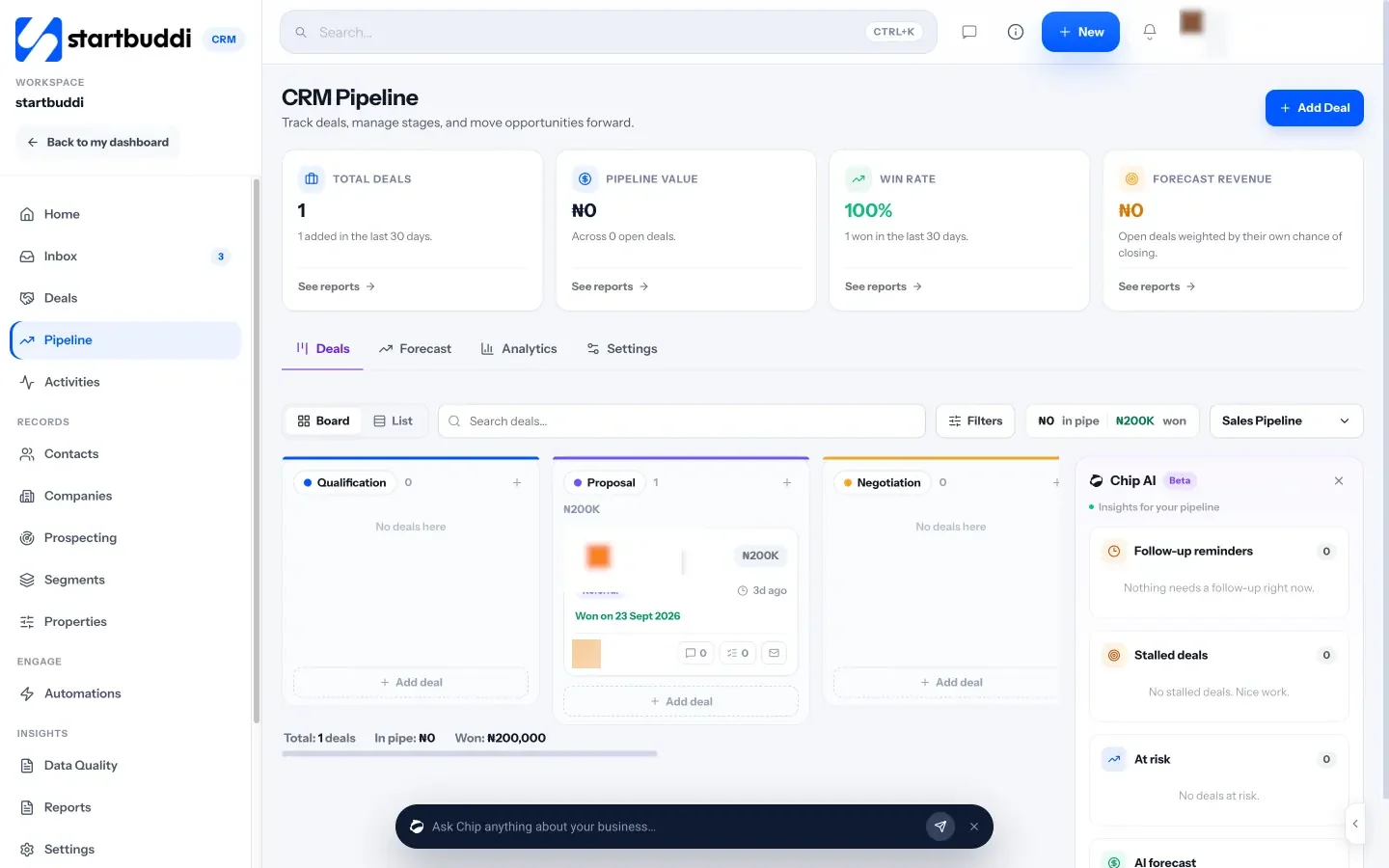
The pipeline also keeps itself partly up to date: when a contact replies, their deal moves out of the first stage, and when an invoice on a deal is paid, the deal is marked won. Chip's insights panel flags follow-up reminders, stalled deals and deals at risk, and the Customers home page has prompts such as "Who needs a reply?" and "Plan my follow-ups". On any contact, Nurture with Chip can draft a short follow-up email sequence for you to edit before anything is sent. Free includes 2 active automations, including sequences, and Starter allows 10.
Your weekly sales routine fits here too. The Customers home page opens with a short Chip briefing of unread messages, open deal value and money still owed, and a ranked list of next best actions, so Monday's pipeline review can start from that list rather than from memory. Filters such as "Last contacted" (for example, more than 90 days ago) help you find past clients and warm contacts it is time to get back in touch with.
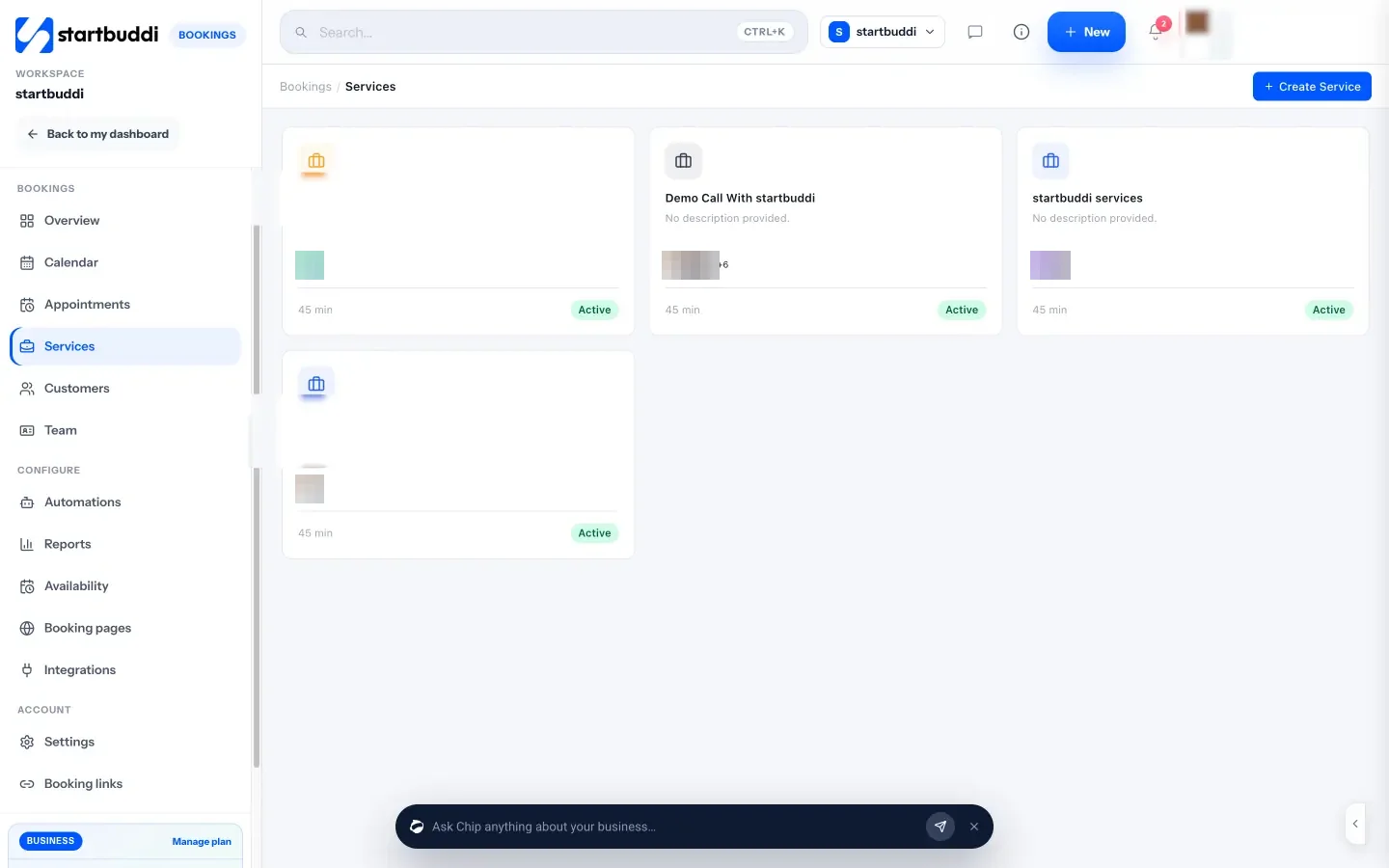
For discovery calls, use Bookings. Create a service such as "Discovery call, 30 minutes", set your working hours and a buffer between calls, add booking questions ("What's the main challenge you want to discuss?"), and share the link in your emails and on LinkedIn. Bookings create or update the contact in Customers, so every call is linked to the right person. Our booking system for consultants page shows how it fits together, and the sales pipeline page covers deals in more detail.
Deliver consulting work that earns referrals and repeat clients
Winning the client is the start. How you deliver decides whether they come back, refer you, and let you raise your rates. The consultants who grow fastest are rarely the cleverest; they are the most reliable. They start on time, communicate clearly, deliver what they promised, and make the client look good. This chapter covers onboarding a new client, a repeatable engagement structure, managing scope, tracking time and money, getting paid, turning projects into retainers, collecting testimonials and deciding when to grow.
Onboard every client the same way
The first week sets the tone. A consistent onboarding routine shows you are organised and gets the work moving fast:
- Signed agreement and deposit received. Do not start before both.
- Welcome message with what happens next, who to contact, and the first meeting date.
- Kickoff meeting: confirm goals, scope, timeline, who does what on their side, how you will communicate and how often you will report.
- Information request: a short list of documents, data and access you need, with a deadline.
- Shared space where the client can see progress, documents and next steps.
Our post on how to onboard a new client covers this in detail.
A repeatable engagement structure
Most consulting work follows the same broad phases, whatever the field. Writing yours down makes every project easier to plan, price and explain.
| Phase | What happens | What the client gets |
|---|---|---|
| 1. Discovery | Interviews, data, site visits, reviewing what exists | A short summary of what you found so far |
| 2. Diagnosis | Working out the root causes and options | A findings document or presentation |
| 3. Recommendations | Choosing the approach with the client | A plan with priorities, owners and dates |
| 4. Implementation | Helping the team put it in place (if in scope) | New processes, documents, training, tools set up |
| 5. Review and handover | Checking results, documenting, training the owner | A handover pack and a review meeting |
For each phase, keep a checklist of tasks and templates you reuse. By your fifth client, a new engagement should take minutes to set up, not hours.
Communicate more than you think you need to
Silence worries clients. Even when the work is going well, a client who has not heard from you for two weeks starts to wonder. A short weekly update, sent on the same day each week, prevents that:
Weekly update, week 3
Done this week: finished interviews with all five kitchen leads; drafted the new cleaning schedule.
Next week: review the draft with Chef Ada on Tuesday; start staff training plan.
Needed from you: the last two inspection reports by Monday.
Risks: none right now.
It takes ten minutes to write and saves hours of "just checking in" messages.
Manage scope before it creeps
Scope creep, small extra requests that add up to a lot of unpaid work, is the most common reason consulting projects lose money. It usually starts with a reasonable ask: "While you're here, could you also look at...?" Handle it the same way every time:
- Acknowledge it: "Good idea, and I can see why it matters."
- Name it: "It's outside what we agreed for this project."
- Offer a choice: "I can add it for $X and it adds a week, or we can note it for phase two."
- Confirm in writing before doing the work.
The best defence is a tight scope in the agreement: list the deliverables, the number of revision rounds and what is explicitly out of scope.
Track your time, even on fixed fees
If you bill hourly, you have to track time. If you charge fixed fees, you should still track it, because it tells you whether your estimates were right. After three projects, compare the days you estimated with the days you spent. If you always go over, raise your prices or tighten the scope. If you finish early, you may be underpricing the value.
Get paid on time
Invoice promptly and make it easy to pay. Send the deposit invoice when the agreement is signed, milestone invoices as each phase is approved, and the final invoice on the day you hand over. Include clear payment terms, a pay link where possible, and a polite, regular follow-up routine for late payments. Our guide on how to send an invoice and get paid on time covers all of this with templates.
Turn projects into retainers
Retainers give you predictable income and give clients continued access to your help. The best time to offer one is at the end of a successful project, when the client has seen results and knows what could slip without support.
A good retainer is specific about what the client gets each month: for example, one planning session, up to eight hours of advice by email or call, a monthly review of key numbers, and priority response within one working day. Bill at the start of the month. Review the scope every three to six months so it stays fair to both sides. Our post on how to sell and bill retainers covers pricing and terms.
Worked example: a consultant on a $950 day rate offers a retainer of one day a month of advice and one half-day review each quarter. Monthly equivalent: about 1.2 days, or $1,140. Priced at $1,200 a month with a three-month minimum, four retainer clients bring in $4,800 a month before any project work.
Hand over properly
The end of a project is when the client decides whether to recommend you. A clear handover makes the value visible and helps the work last after you leave. A good handover pack includes:
- A one-page summary: what the problem was, what you did, what changed.
- All final documents, templates and process guides, in one place.
- Who on the client's side now owns each part, and what they need to do weekly or monthly.
- The "phase two" list of ideas and risks for the future.
- A date for a short follow-up call, 30 to 60 days later, to check things are holding.
That follow-up call is also the natural moment to ask for a referral or discuss a retainer.
Ask how it went
At the end of each engagement, send a short feedback request: how satisfied they are overall on a 1 to 10 scale, what was most valuable, and what you could do better. Read every answer. Patterns across clients show you what to keep, what to change in your process, and sometimes which parts of your work are worth more than you charge.
Common delivery mistakes
- Starting before the deposit and agreement are in place.
- Going quiet during the long middle of a project.
- Saying yes to extras without pricing them.
- Delivering a report nobody uses. Recommendations need owners, dates and help to put them in place.
- Doing everything yourself instead of teaching the client's team, which leaves them dependent and less satisfied.
- Overbooking yourself. Keep time each week for admin, marketing and learning, or quality and pipeline both suffer.
Collect results and testimonials
At the end of every project, ask the client three questions: what has changed since we started, what was most valuable, and would they be happy to be quoted or to take a reference call. Write the answers down as a short case study, with numbers where the client agrees to share them, and ask their permission before using any of it publicly. Never invent or exaggerate results. Real, specific stories from named clients (with permission) are the most persuasive marketing a consultant can have.
A weekly operating rhythm
Running a consulting business means juggling delivery, sales and admin. A simple weekly rhythm keeps all three moving:
| Day | Focus |
|---|---|
| Monday | Plan the week, review the pipeline, send client updates |
| Tuesday to Thursday | Deep client work and meetings |
| Thursday morning | Sales routine: follow-ups, outreach, proposals |
| Friday | Invoices, time review, admin, learning, and a look at next week |
Protect at least one half-day a week with no meetings for thinking and writing. Clients pay consultants for good judgement, and good judgement needs quiet time.
Keep client records tidy
After each project, spend fifteen minutes updating your records: final notes on the client, what worked, what did not, the value of the work, and a reminder to check in a few months later. Past clients are your best source of repeat work and referrals, but only if you remember to stay in touch. A contact who hears from you every quarter with something useful is far more likely to call when the next problem appears.
Raise your rates
Review your rates at least once a year, and whenever you are consistently fully booked. Raise them for new clients first. For existing clients, give plenty of notice, usually 60 to 90 days, explain briefly, and thank them for working with you. A short, confident message works best:
Hi Kemi, a note that from 1 April my day rate will move from $950 to $1,050. Your current retainer stays at its present price until the end of June. Thank you for working with me this past year; I'm looking forward to the next.
When to grow beyond yourself
Once you are fully booked and turning work away, you have three options: raise prices, work with associates (other independent consultants you bring in for specific projects), or hire. Associates are the lowest-risk step. Agree rates and responsibilities in writing, keep the client relationship with you, and use the same delivery process so quality stays consistent.
How to deliver in startbuddi
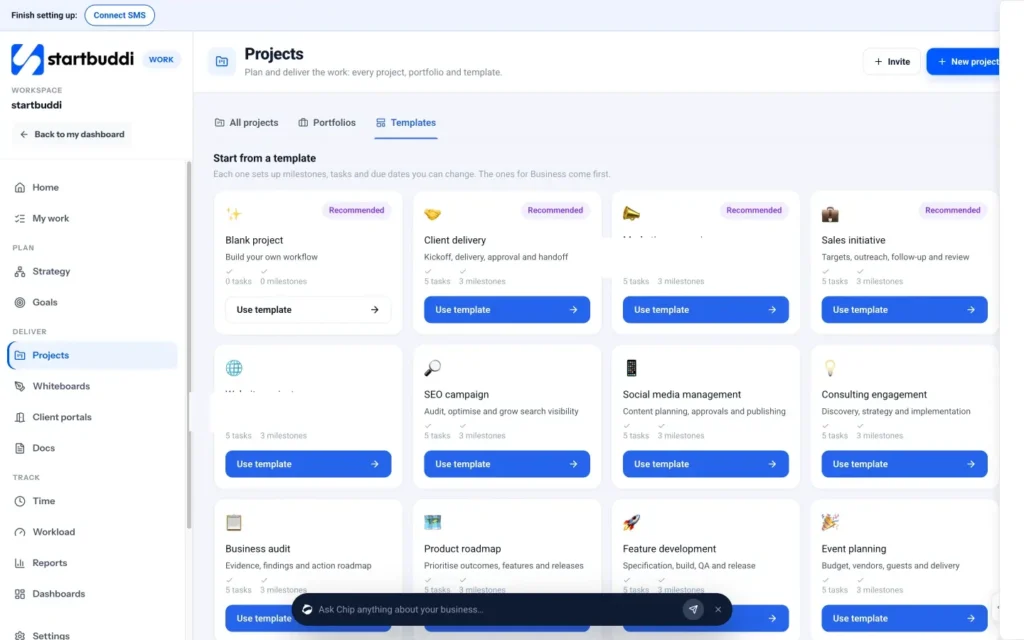
In startbuddi, delivery runs in Work. Under Projects, then Templates, there is a Consulting engagement template (discovery, strategy and implementation) and a Business audit template, each of which sets up milestones, tasks and due dates you can change. There is also a Complete consulting system bundle covering discovery, evidence, strategy delivery, implementation and reporting. Start a project from the template, link the client, then assign dates.
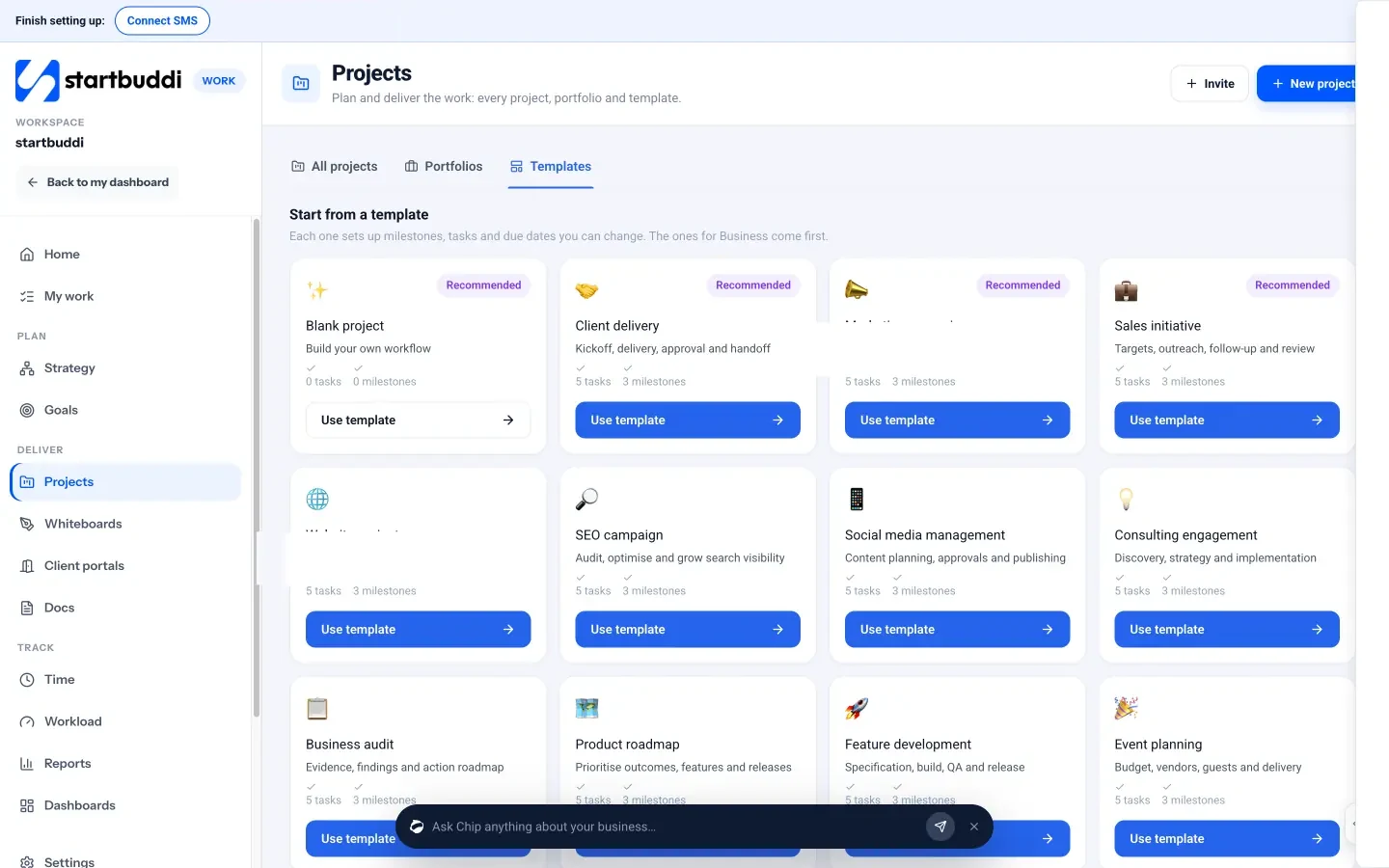
To give the client a place to follow the work, create a client portal under Work. You choose what the client sees (projects, milestones, deliverables, documents, invoices, messages and more), share deliverables for approval, and chat with the client in the portal. Clients sign in with an email link, with no password and no paid seat. When you mark a deal won in the pipeline, Chip also offers to create a portal for that client. Live portals depend on your plan: Free lets you build and preview one, Starter includes 1 live portal, Growth 10 and Scale 50. See client portals.
For time, Time in Work lets you start a timer on a task or log time manually, tick whether it is billable, and see weekly totals of total hours, billable hours and billable value. That is your data for checking estimates against reality. For invoices, open Money Manager, then Invoices, or convert an accepted estimate straight into an invoice. Invoices can include a Stripe or Paystack pay button once connected, and there is a Subscriptions tab in Get Paid where you can create a monthly plan for a retainer and send the client a subscribe link, with renewals handled by the payment provider.
Because contacts, deals, projects, portals, time and invoices sit in the same workspace, each client's record builds up as you work: a company page in Customers shows its contacts, open deals, active projects, invoices, bookings and documents together. That is the tidy client record described above, kept up to date without extra admin, and it makes the quarterly check-in with past clients much easier to do. If you want help, ask Chip from any screen, for example to summarise where a client stands before a call. For more on running consulting projects, see project management for consultants.
A good next step: write your one-sentence niche today, add your first twenty contacts to startbuddi, and book three research calls this week. See how it all connects on the consultants page or compare plans on pricing.
Tiwalade Joanna Okedara-Kalu is the founder, CEO and CTO of startbuddi, the business system that brings clients, bookings, invoices, projects, marketing and the Chip AI assistant into one place. Tiwalade builds software around how service businesses really work day to day, and writes about client management, getting paid on time and why small businesses outgrow the tools they start with.
Founded startbuddi and leads its product and engineering