Lead generation for small business: how to get a steady flow of new customers
A four-part guide to lead generation for small business: plan your numbers, capture inbound leads, find prospects respectfully and follow up until they buy.


This guide explains lead generation for small business owners: how to attract people who might buy from you, capture their details, find new prospects yourself, and follow up until they become customers. It is for service businesses, consultants, agencies, trades and small B2B companies that want a steadier flow of enquiries than word of mouth alone can give. If you already get plenty of enquiries but too few become customers, skip ahead to chapter 4, which covers qualifying, following up and closing.
The short answer: work out how many leads you need, then combine inbound methods (a clear page, a useful offer and a short form that capture people who are already looking) with outbound methods (referrals, partnerships and respectful outreach to people who fit your ideal customer). Reply fast, qualify honestly and follow up on a schedule. The four chapters follow that order, each ending with how to do it in startbuddi, and chapter 4 covers the lead generation tools for small businesses that are worth using.
Plan your lead generation: how many leads, from whom, and how
- An example ICP
- Where to find your ideal customers
- One list that fills itself
- Companies as well as people
- A daily view of who needs you
Most small businesses run on word of mouth. It is a wonderful source of customers until it goes quiet, usually in the month you most need it. Lead generation is how you stop depending on luck: a planned, repeatable way to bring in people who might buy, so you always have conversations in progress. This chapter explains what lead generation means for a small business, how to work out how many leads you need, who to target and which methods suit you. Then it shows where your leads live in startbuddi.
What lead generation for small business means
A lead is a person or business that has shown some interest in what you sell, or that fits your ideal customer and could be approached. Lead generation is the work of finding those people and getting their permission to continue the conversation: an enquiry, a booked call, a download, a reply.
It helps to separate three stages that people often mix up:
| Stage | What it means | Example |
|---|---|---|
| Lead | Someone who might be interested | A café owner who downloaded your menu design checklist |
| Qualified lead | Someone who fits, has the need, and could buy soon | The same owner, who tells you they are opening a second site in March and has a budget |
| Customer | Someone who has paid | They sign the proposal and pay the deposit |
Lead generation fills the top of that list. Chapter 4 covers how to move people down it. Both matter: lots of leads you never follow up is as useless as great follow-up with nobody to follow up.
Inbound and outbound: the two ways to generate leads
There are two broad approaches, and most healthy small businesses use both.
- Inbound: people come to you. They search, see a post, read your guide or hear a recommendation, then get in touch. Examples: your website, Google Business Profile, social media, a free guide in exchange for an email, webinars, referrals.
- Outbound: you go to them. You identify people who fit and start the conversation. Examples: introductions through your network, partnerships, events, personal emails or LinkedIn messages, calls to existing contacts.
Inbound leads are usually warmer and cheaper to convert, but slow to build. Outbound gives you control over timing and who you talk to, but takes more effort per lead and must be done respectfully and legally. A new consultancy might rely on outbound and referrals in its first months while inbound pages and content build up.
Work out how many leads you need
Lead generation becomes much less stressful when you know your number. Work backwards from your goal:
- Customers needed: how many new customers do you need each month to hit your revenue goal?
- Close rate: of the qualified leads you talk to, what share become customers? If you do not know yet, assume 20 to 30 per cent for warm, qualified service leads and adjust as you learn.
- Qualification rate: of all the leads that come in, what share are a real fit?
Here is how the maths works for three different businesses:
| Business | Goal | Customers needed | Close rate | Qualified leads | Share that qualify | Total leads needed |
|---|---|---|---|---|---|---|
| Web design studio (US) | $15,000 a month from $3,000 projects | 5 | 25% | 20 | 50% | 40 |
| Bookkeeping firm (UK) | 6 new £250 monthly clients | 6 | 30% | 20 | 60% | about 34 |
| Solar installer (Nigeria) | 4 installs a month | 4 | 20% | 20 | 40% | 50 |
Forty leads a month sounds very different from "more clients, please". It tells you how much activity you need, and when you track real numbers it shows you which step to improve: more leads, better-qualified leads, or better follow-up.
Define your ideal customer
Lead generation fails most often not because there are too few leads, but because they are the wrong leads. An ideal customer profile (ICP) describes the customers you most want: the ones who buy, pay on time, are good to work with and refer others.
For businesses selling to other businesses, include:
- Type of organisation: industry, size (staff or revenue), location.
- Who decides: the role of the person who buys, and who else influences them.
- The trigger: what usually happens just before they need you (opening a new site, hiring, a new regulation, a bad experience with a supplier).
- Budget: what they typically spend on this kind of service.
- Red flags: signs that someone is not a fit.
For businesses selling to individuals, describe life stage, location, the problem, what they have tried and what makes them act. Chapter 1 of our small business marketing guide has a worked example.
Write your ICP on one page and use it to decide everything else: which channels to use, what to say, who to approach and who to politely turn away.
An example ICP
Here is an ICP for an illustrative IT support company in Johannesburg:
Professional offices (accountants, lawyers, medical practices) in Johannesburg with 10 to 50 staff and no in-house IT person. The buyer is the practice manager or a partner. The trigger is usually a security scare, a new office move or the person who "did IT on the side" leaving. They currently spend R5,000 to R20,000 a month on ad hoc fixes. Red flags: fewer than five staff, or wanting help only in emergencies with no ongoing plan.
From that paragraph, the company knows who to approach (practice managers), where to find them (professional associations, office landlords, accountants' networks), what to say (a free security check) and when (after office moves or staff changes).
Where to find your ideal customers
Once you know who you want, list the places they gather or leave traces:
- Online communities: industry Facebook and LinkedIn groups, forums, WhatsApp communities (always follow the group's rules on promotion).
- Associations and directories: trade bodies, chambers of commerce and professional registers often list members publicly.
- Events: trade shows, meet-ups, local business breakfasts, webinars in your field.
- Complementary businesses: the suppliers, advisers and service providers who serve the same customers before or after you.
- Search and maps: for local B2B, a map search for a business type in your area is a ready-made list of potential customers.
- News and signals: new openings, expansions, funding announcements and job adverts often signal a need.
Choose your lead generation methods
With so many options, choose methods that fit your customer, your budget and your time. Here are the most common, with honest notes.
| Method | Best for | Speed | Cost |
|---|---|---|---|
| Referrals and introductions | Every business | Fast | Low |
| Website or landing page with a form | Everyone, especially services | Medium | Low |
| Lead magnet (free guide, checklist, template) | Services and B2B | Medium | Low |
| Google Business Profile and local SEO | Local businesses | Slow to medium | Low |
| Social media and content | Visual, consumer and expert businesses | Slow | Time |
| Webinars and events | Coaches, consultants, B2B | Medium | Low to medium |
| Partnerships | Businesses with complementary partners | Medium | Low |
| Personal outreach (email, LinkedIn, calls) | B2B, high-value services | Fast | Time |
| Paid ads | Businesses that know their numbers | Fast | Money |
Pick one inbound and one outbound method to start, plus referrals, which every business should run. Give each method at least two months and a clear target before judging it.
Start with referrals: the lead source you already have
Before any new channel, set up a simple referral system, because referred leads tend to trust you already and close faster. Most businesses get referrals by accident. You can get them on purpose:
- Make a list of every happy customer, past colleague, supplier and friend who understands what you do.
- Tell them precisely who you help. "Anyone who needs a website" is hard to act on. "Restaurants opening a second site in Lagos" makes someone think of a name.
- Ask at the right moments: when a project ends well, when a customer thanks you, when they renew.
- Make it easy: give them a short message or link they can forward.
- Close the loop: thank everyone who refers, whether or not the lead buys, and tell them what happened.
A short message works well:
Hi Funmi, thank you again for the kind words about the menu redesign. I am taking on two more restaurant projects next month. If you know another owner who is opening a new site or refreshing their brand, I would really appreciate an introduction. Here is a short link you can forward: [link].
Put your lead plan on one page
Bring it together in a simple plan you can check every month:
- Monthly goal: new customers and revenue.
- Lead target: total leads and qualified leads needed (from the maths above).
- Ideal customer: your one-paragraph ICP.
- Inbound method: for example, a free checklist on a landing page promoted on LinkedIn twice a week.
- Outbound method: for example, ten personal messages a week to businesses that match your ICP.
- Referrals: who you will ask this month.
- Follow-up rule: reply to every new lead within one working hour; follow up three times over two weeks.
- Tracking: the source of every lead, and which ones became customers.
Continuing the web design example: 40 leads a month might come from 10 referrals and introductions, 15 enquiries through the website and a free "website checklist for restaurants", and 15 replies from 60 personal outreach messages. After two months, real numbers replace the guesses and show which source to grow.
Common lead generation mistakes
- Chasing volume over fit. Fifty unqualified leads waste more time than they are worth.
- No single place for leads. Leads scattered across WhatsApp, email, a notebook and a form tool get forgotten.
- Slow replies. Interest fades by the hour (chapter 2 has the research).
- No follow-up after the first contact. Many sales happen only after several touches.
- Buying lists. It often breaks data protection rules and produces cold, unresponsive contacts.
- Giving up on a lead too early. "Not now" often means "not this month". Keep in touch with good-fit leads who are not ready yet.
- Not tracking the source. Without knowing where good leads came from, you cannot do more of what works.
Where your leads live in startbuddi
The single most useful thing you can do for lead generation is to keep every lead in one place, whatever channel it came from. In startbuddi that place is Customers.
One list that fills itself
Contacts fill in from forms, bookings, website chat, landing pages, imports and manual entry, and each contact keeps its source. You can add someone in seconds (a name, an email or a phone number is enough), import a CSV of up to 10,000 contacts at a time with duplicate handling, and filter by source, lead status (New, Qualified, Disqualified), last contacted and more. A saved filter such as "Lagos agencies, not yet contacted" becomes a segment you can return to. The Free plan includes up to 250 contacts, and Starter raises that to 2,500.
Companies as well as people
If you sell to businesses, Companies keeps each organisation on its own record with its contacts, deals, invoices, bookings and conversations. Adding a company can start with its website: startbuddi looks up the logo and details for you, and you edit anything that is wrong. Each contact and company record then becomes the full history of the relationship, so anyone on your team can pick up a lead where someone else left off.
A daily view of who needs you
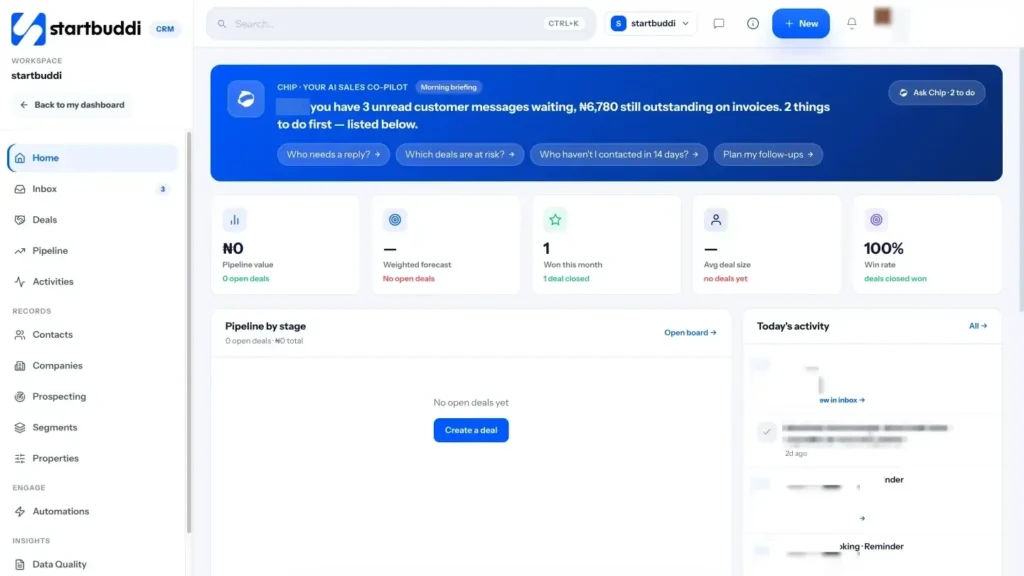
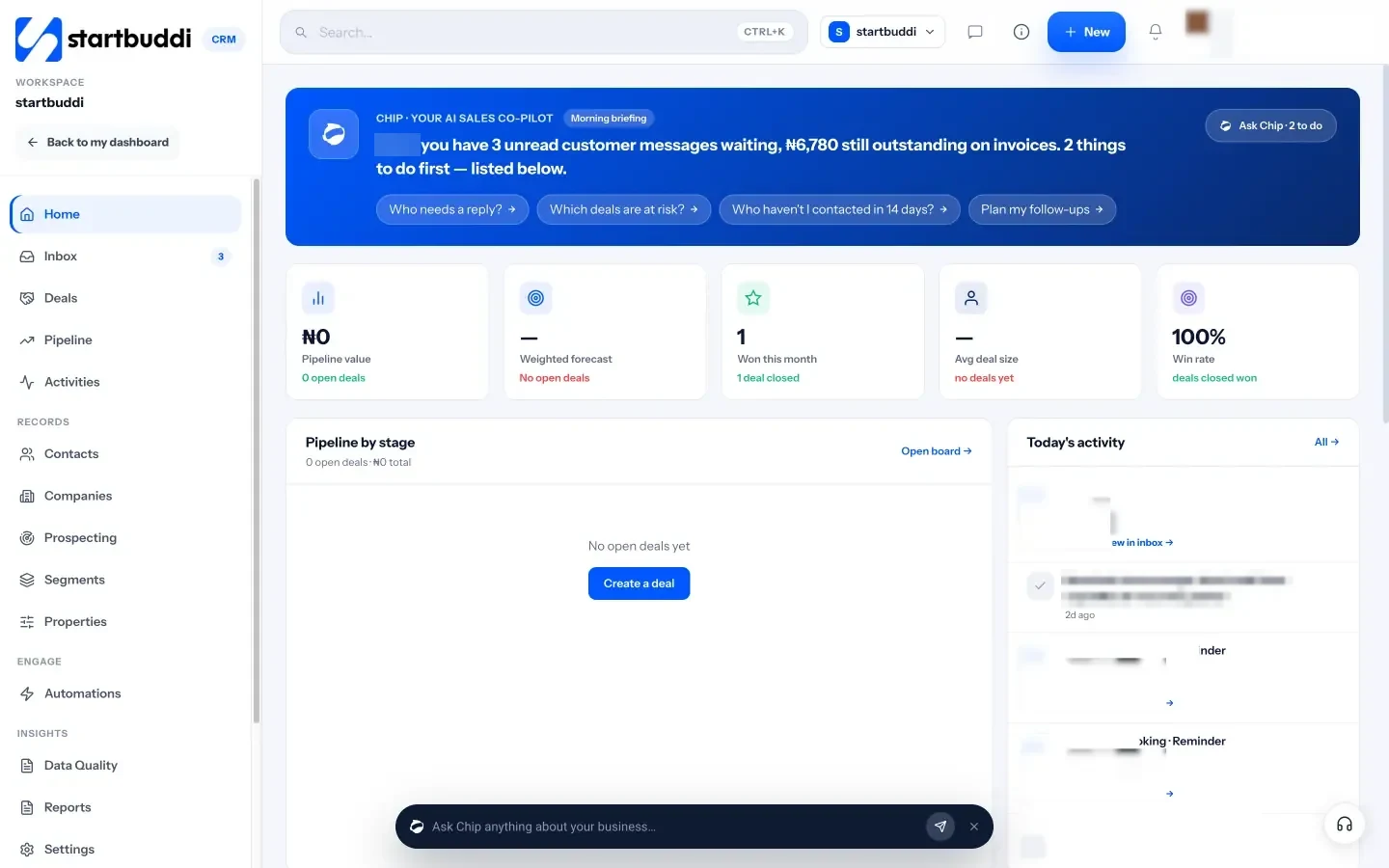
The Customers home opens with a briefing from Chip that sums up unread messages, open deal value and money owed, followed by pipeline value, win rate, today's activity, an inbox preview and a ranked list of next best actions, such as who to reply to and which deals have stalled. Quick prompts include "Who needs a reply?" and "Who haven't I contacted in 14 days?". Learn more on the Customers page.
Chapter 2 covers inbound lead generation: how to turn your website, content and conversations into a steady flow of enquiries, and why speed of reply matters so much.
Inbound: capture leads from your website, content and chat
- What to send after someone downloads
- What to ask
- Form habits that help
- A first reply you can adapt
- Make booking a call effortless
- Build a lead capture form in minutes
- Put your lead magnet on its own page
- Let leads book a call themselves
- Answer website visitors with live chat
Inbound lead generation means making it easy for interested people to raise their hand. Plenty of small businesses already get visitors, followers and calls; they simply lose most of them because there is no clear next step, the form asks too much, or nobody replies until tomorrow. This chapter covers the pieces of an inbound system: a clear offer, a lead magnet, a short form, fast replies and a first follow-up that runs on its own. Then it shows how to build each piece in startbuddi.
Give people a reason and a way to get in touch
Every page, post and profile should answer the question "what do I do next?". For most small businesses, there are four good answers, and you should offer at least two:
- A direct enquiry: a short form or quote request for people ready to talk.
- A booked call: a link to book a free 15 or 30-minute call at a time that suits them.
- A quick message: a WhatsApp button or live chat for people who prefer to ask a question first.
- A lead magnet: something useful in exchange for an email or phone number, for people not ready yet.
The first three catch people who are ready now. The lead magnet catches the much larger group who will be ready later, so you can stay in touch until they are.
Lead magnets that work for small businesses
A lead magnet is a free, genuinely useful thing you offer in exchange for contact details. It works when it solves a small, specific problem for your ideal customer and naturally leads towards what you sell.
| Business | Lead magnet idea | Why it works |
|---|---|---|
| Accountant | "Tax deadline calendar for sole traders" (PDF) | Useful every year; shows expertise; leads to bookkeeping services |
| Wedding planner | "12-month wedding planning checklist" | Captures couples early in planning |
| Web designer | "Website checklist for restaurants" | Shows the gaps they have; your service fills them |
| Personal trainer | "7-day beginner meal plan" | Low effort for the reader; builds trust |
| Solar installer | "How much solar do I need? Calculator and guide" | Attracts people actively researching |
| Consultant | "Free 20-minute strategy review" (a call) | Direct conversation with qualified people |
Keep it short and practical. A two-page checklist that solves one problem beats a 40-page ebook nobody finishes.
A good lead magnet page is short. Use a headline that names the result ("The 12-month wedding planning checklist"), a sentence on who it is for, three bullet points on what is inside, a picture of the actual guide, the form, and one line on privacy ("We will email you the checklist and occasional tips. Unsubscribe any time."). Leave out menus and links that lead elsewhere; the page has one job.
What to send after someone downloads
A lead magnet is the start of a conversation, not the end. A short follow-up sequence turns a download into a relationship. Three emails over a week is plenty:
- Straight away: the download, a one-line tip on how to use it, and who you are.
- Two or three days later: one common mistake related to the topic and how to avoid it, with a real example from your work.
- A week later: a short invitation: "If you would like help with this, here is how we work and how to book a free 15-minute call."
After that, add them to your regular newsletter so they hear from you once or twice a month until they are ready. Always include a simple way to unsubscribe.
Build forms that people finish
Every extra field on a form is a reason for someone to give up. Ask only what you need to take the next step, and nothing else.
What to ask
- For a lead magnet: first name and email (or phone, if you follow up on WhatsApp). That is usually enough.
- For an enquiry: name, email or phone, what they need, and one qualifying question such as "When would you like to start?" or "Roughly what is your budget?"
- For a quote: the details you genuinely need to price the job (size, location, dates), and nothing you could ask on the call.
Form habits that help
- Use a clear button label that says what happens ("Send me the checklist", "Get my quote") rather than "Submit".
- Tell people what happens next and how quickly ("We reply within one working hour").
- Add a "How did you hear about us?" question to learn where leads come from.
- Include a consent tick box if you want to send marketing, and link your privacy notice.
- Test the form on your phone. Many people will fill it in there.
Our post on building a lead capture form that converts has more examples, and what a form builder is explains the basics.
Reply fast: speed wins leads
How quickly you respond to a new lead may matter more than anything else in this guide. Interest fades quickly, and people often contact several businesses at once. The first to reply helpfully often wins.
You do not need to be glued to your phone to reply fast. Three habits make it manageable:
- An instant automatic reply that thanks them, says what happens next and, if possible, offers a booking link.
- A notification for every new lead to your phone or email, so you see it in minutes.
- Saved replies for your most common questions, so a personal answer takes one minute.
A first reply you can adapt
Hi Tolu, thanks for getting in touch about a new website for your restaurant. I have had a quick look at your current site and I have a couple of ideas already. Could we have a 15-minute call this week? You can pick a time here: [booking link]. If you prefer, just reply with a good time and I will call you.
It is personal, shows you paid attention and makes the next step easy. If you cannot reply properly within the hour, send a short holding message ("Thanks, I am on a job until 3pm and will call you then") so the lead knows a real person has seen it.
Make booking a call effortless
For service businesses, a booked call is often the most valuable inbound lead: the person has chosen to give you their time. Remove every obstacle:
- Offer a short, clearly named call ("Free 20-minute project chat"), not a vague "consultation".
- Show real available times, so nobody has to email back and forth.
- Ask two or three questions when they book, so you can prepare.
- Send a confirmation straight away and a reminder the day before.
- Put the booking link everywhere: your page, email signature, social bios and first replies.
A reminder alone can cut the number of people who forget to turn up, which matters when each call might be worth a new client. Our post on following up with leads covers what to do after the call.
Turn content and social media into leads
Posts, articles and videos build trust, but they only generate leads when they point somewhere. Every piece of content should have a natural next step:
- An article about "how to choose a caterer" ends with a link to your menu and a quote form.
- An Instagram post showing a finished kitchen ends with "Book a free design visit, link in bio".
- A LinkedIn post on tax deadlines offers your free deadline calendar.
- A short video answering a common question ends with "Message us on WhatsApp for a quote".
Webinars and workshops are a strong inbound method for coaches, consultants and B2B services: people register with their details, spend time learning from you, and many will want a follow-up conversation.
Live chat and WhatsApp on your website
Some people will not fill in a form but will ask a quick question. A chat box or WhatsApp button catches them. The risk is that chats come in when you are busy and go unanswered, which is worse than no chat at all. If you add chat, decide who answers, during which hours, and what happens outside them, such as an automatic answer to common questions and a promise of a human reply by a set time.
Inbound mistakes to avoid
- A contact page with only an email address. Give people a form, a booking link and a message option.
- Long forms for a first contact. Get the conversation started, then ask for details.
- No automatic reply. A silent form feels like a black hole.
- Lead magnets unrelated to what you sell. A free phone case competition brings the wrong people.
- Too many choices. A page with six buttons and three forms confuses people. Offer one main action and one lighter alternative.
- Leads stuck in the form tool. If they do not reach your customer list, they get forgotten.
How to capture leads in startbuddi
Forms, landing pages, bookings and live chat in startbuddi all feed the same contact list, so inbound leads never sit in a separate tool.
Build a lead capture form in minutes
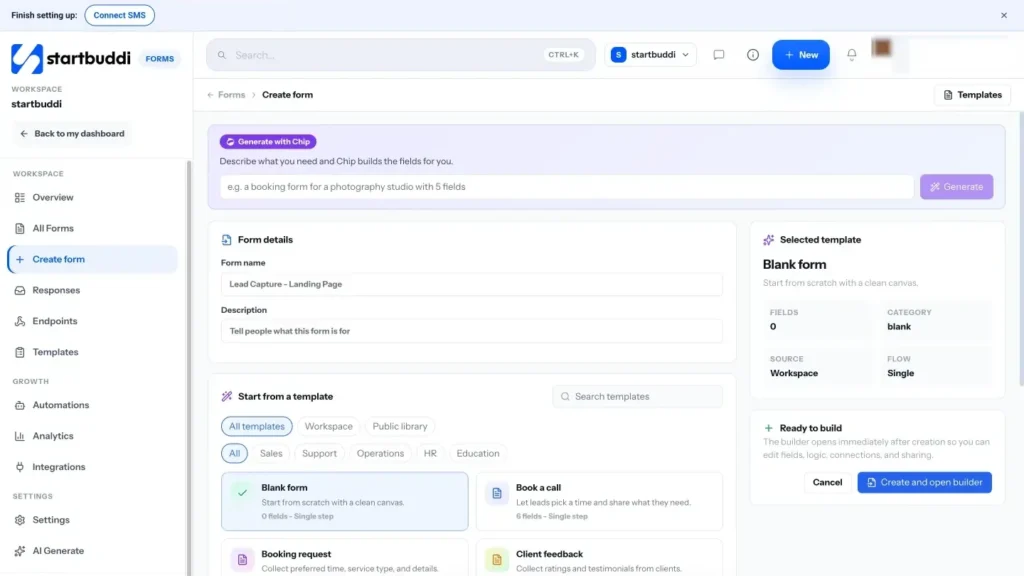
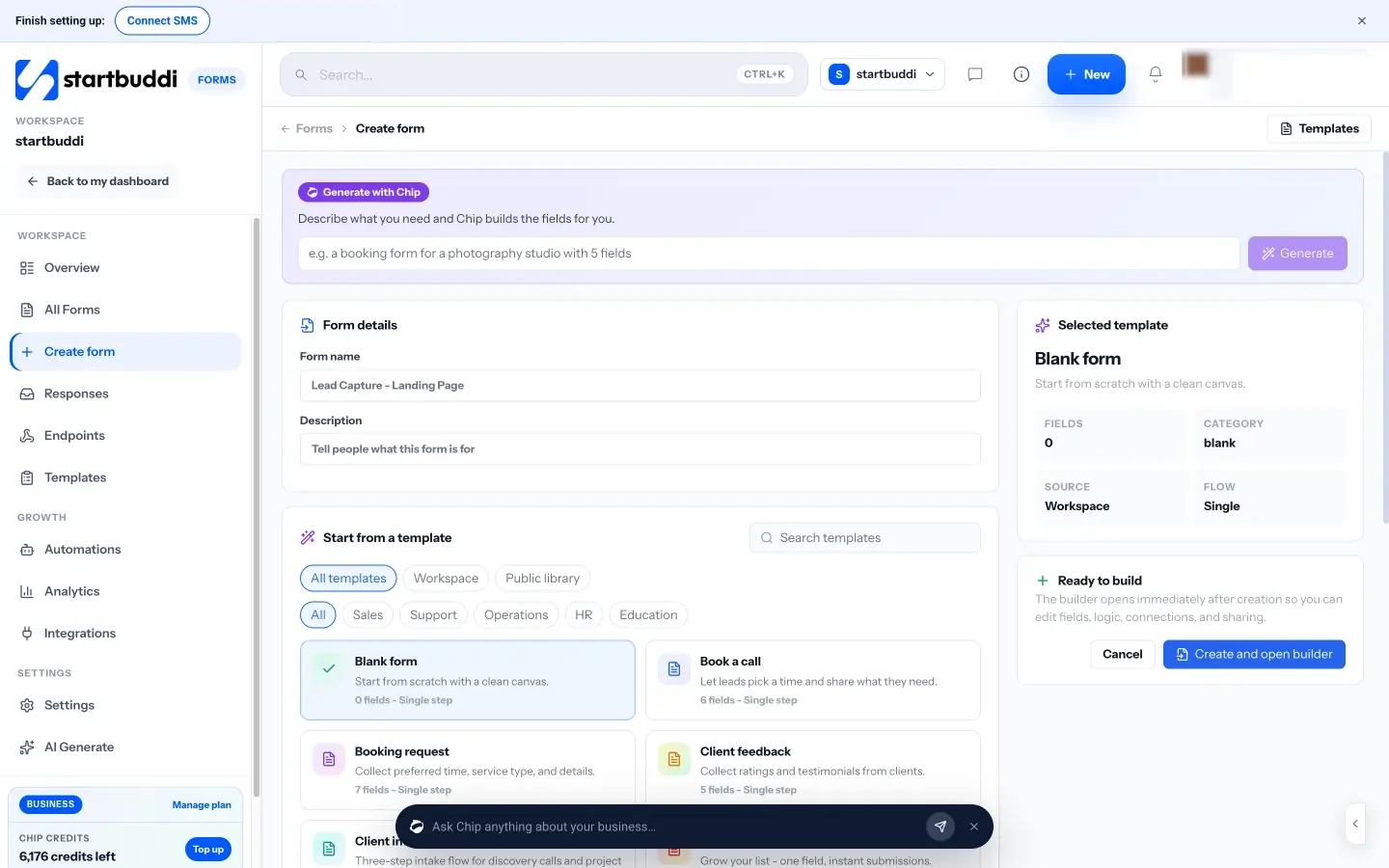
In Forms, start from one of the templates (such as Lead Capture or a Discovery Questionnaire), build from scratch, or use Generate with AI and describe what you need so Chip builds the fields for you. Every field can save its answer to a contact property, and you can mark a field as counting for marketing consent. Each form's settings let you add or update the person in your contacts automatically, handle duplicates, and email you on every new submission. You can share a form as a link, embed it on your own website or show it as a popup button. The Free plan includes one form; Starter includes 20.
Put your lead magnet on its own page
In Publish, a landing page can be set up as a lead magnet page, to give away a guide, checklist or template in exchange for an email, or as a booking page for free calls. Every submission creates or updates a contact with the source page and campaign saved on the record, and it can start an automation the moment it lands. A single "thank you" automation that sends the download straight away is the one most lead magnet pages need; the Lead capture welcome flow template does this and more. Free includes 2 active automations, and Starter allows 10.
Let leads book a call themselves
Bookings gives you a booking page where people choose a service, such as a free 20-minute call, and pick from the times you are available. Each booking lands in your calendar and on the person's contact record, so a booked call is also a captured lead. Use the booking link in your first replies, email signature and social bios, and pair it with the Booking reminder stack automation template to send reminders before the call.
Answer website visitors with live chat
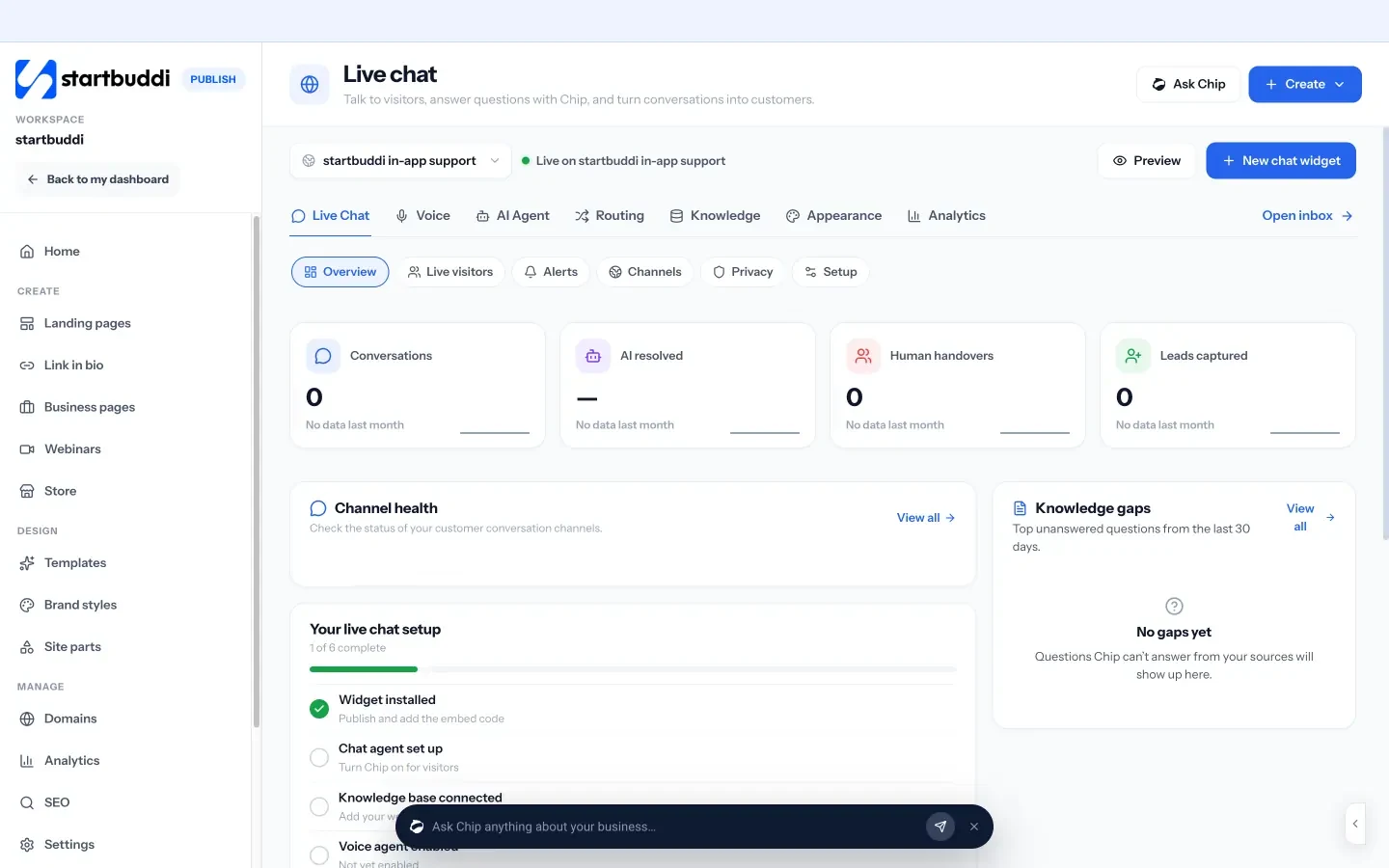
Live chat adds a chat widget to your website with one line of code. Visitors can chat, book a meeting or switch to WhatsApp, and you choose when to ask for their details. Chip can answer first from the knowledge you approve and hand over to a person with the full conversation, so the visitor never repeats themselves. Conversations arrive in your Customers inbox. Chip auto-replies need the Growth plan or above and use Chip credits. More on the website chat page.
Inbound brings people who are already looking. Chapter 3 covers outbound: how to find and approach the right people yourself, respectfully and within the rules.
Outbound: find and approach the right prospects
- Partnerships with complementary businesses
- Events, in person and online
- The three rules of good outreach
- Build a prospect list by hand
- Look for triggers
- Templates you can adapt
- When someone replies
- Channels for outreach
- A weekly outbound routine
- Tell Chip who you are looking for
- Save your ideal customer profiles
- Convert only the ones you choose
Inbound leads arrive when people are ready. Outbound lead generation lets you choose who you talk to and when, which is especially useful when you are new, when inbound is slow, or when you sell a high-value service to a small group of businesses. Done badly, outbound is spam. Done well, it is simply a professional introduction to someone who has a problem you solve. This chapter covers partnerships, events and personal outreach, gives you templates, explains the rules in several countries, and shows how Chip can find prospects for you in startbuddi.
Warm outbound first: partnerships and introductions
The warmest outbound leads come through people who already trust you. Beyond customer referrals (chapter 1), two sources are underused by most small businesses.
Partnerships with complementary businesses
A complementary business serves the same customers as you, before or after you, without competing. Examples:
- A wedding photographer and a venue, florist or planner.
- A bookkeeper and a business bank's relationship managers or a local business association.
- A web designer and a copywriter, photographer or marketing consultant.
- A solar installer and an electrician, architect or estate agent.
- A personal trainer and a physiotherapist or nutritionist.
Approach one partner at a time with a specific idea: a joint workshop, a shared guide, a referral arrangement or a bundle. Make it clearly good for their customers first. One strong partner can send more qualified leads than months of social media.
Keep partnerships simple and fair. Agree in writing how referrals are passed on, whether any referral fee applies, and how you will both look after the customer. Check in every couple of months, share results, and thank your partner publicly when it helps them too, for example by recommending them in your own newsletter.
Events, in person and online
Go where your ideal customers gather: trade shows, industry meet-ups, business breakfasts, association events, webinars. Better still, speak or run a short workshop, which positions you as the expert in the room. Follow up everyone you meet within two days with a short, personal message that mentions your conversation.
Personal outreach that people welcome
Personal outreach means contacting someone who fits your ideal customer and has not contacted you. It works for business-to-business services when it is researched, relevant and respectful. It does not work as a numbers game with a template blasted to a bought list.
The three rules of good outreach
- Research first. Spend five minutes learning about the person and their business. What have they posted, launched or announced? What might they need?
- Lead with them, not you. Open with something specific about their situation, then offer something useful, such as an observation, an idea or a resource.
- Ask for something small. A reply, a 15-minute call, permission to send an idea. Not a sale.
Build a prospect list by hand
Before you write a single message, build a short list of people worth contacting. Twenty to fifty well-chosen names beat a thousand random ones. For each prospect, note:
- The business name, website and location.
- The person who decides, and their role.
- Why they fit your ideal customer.
- A trigger or reason to contact them now.
- Where you found them, so you can explain it if asked.
- Status: not contacted, contacted, replied, call booked, not a fit.
Good sources include business directories, association member lists, map searches for a business type in your area, company websites and professional profiles. Stick to business information that is publicly available and relevant to your offer.
Look for triggers
The best time to contact a business is just after something changes. Triggers make your message relevant and your timing feel natural rather than random:
- Opening a new location or moving office.
- Hiring for a role related to what you do (a business hiring its first marketer may need a website).
- Winning funding, a big contract or an award.
- A new regulation affecting their industry.
- Launching a new product, menu or service.
- A leadership change.
Mention the trigger in your first line. "Congratulations on the new branch" is a far better opening than "I hope this email finds you well".
Templates you can adapt
A first email to a business
Subject: Your new Victoria Island branch
Hi Ngozi, congratulations on opening the second branch of Mama's Kitchen, the photos from the launch looked great. I design menu pages and ordering links for restaurants in Lagos, and I noticed your new branch is not yet on your website or Google listing, so some customers may be struggling to find it. I put together three quick ideas for how the two branches could share one menu page. Would it be useful if I sent them over? No pressure either way.
Best, Ade, Ade Designs (ade@example.com)
A LinkedIn connection note
Hi David, I enjoyed your post on hiring your first operations manager. I help growing accounting practices in Manchester automate client onboarding. Would be good to connect.
A follow-up after no reply (five to seven days later)
Hi Ngozi, just floating this back up in case it got buried. Happy to send those menu page ideas if they would help; if not, no problem at all and I will not keep emailing.
Notice what these share: specific, short, useful, one small ask and an easy way to say no. Send one follow-up, perhaps two, then stop.
When someone replies
A reply is the moment outbound becomes a real lead. Respond quickly, thank them, answer any question directly and suggest one clear next step, usually a short call with a booking link. If they say "not now", ask when would be a better time and make a note to follow up then. If they say "no", thank them, remove them from your list and move on. A polite exit leaves the door open; a pushy one closes it for good.
Channels for outreach
- Email: the standard for B2B. Use your business address, a clear name and a real signature.
- LinkedIn: good for professional services. Connect with a short personal note, then build the relationship before pitching.
- Phone: still effective for local B2B services, especially after an email or introduction. Check the do-not-call rules where you are.
- WhatsApp: not for cold outreach. The WhatsApp Business Messaging Policy says businesses may only contact people who have given their number and opted in to receive messages. Use WhatsApp once a lead has asked you to.
The rules on outreach in brief
Marketing and outreach are regulated differently from country to country, and the rules for contacting businesses often differ from those for contacting individuals. A few examples:
- United Kingdom: the ICO's business-to-business marketing guidance explains that the email marketing consent rule does not apply to corporate subscribers such as limited companies, but you must still identify yourself and offer an opt-out, sole traders and some partnerships are treated like individuals, and UK GDPR still applies to the personal data of business contacts.
- United States: commercial email must follow the CAN-SPAM Act, including honest subject lines, a physical address and a working way to opt out.
- Nigeria: the Nigeria Data Protection Act, overseen by the NDPC, governs how you collect and use personal data, including business contacts' names and emails.
- European Union: the GDPR and national e-privacy laws apply, and rules on unsolicited business email vary by country.
In every case: be honest about who you are, contact people for a relevant reason, keep records of where you got their details, stop immediately when asked, and never buy or scrape lists of personal contact details. This is general information, not legal advice.
How much outreach to do
Outreach is a steady habit, not a campaign. Work out the volume from your lead plan in chapter 1. Suppose, as a starting assumption only, that personal, researched messages to well-chosen businesses get replies from one in four or five people (your real rate will differ, so track it), and that half of those replies become qualified conversations, then 60 messages a month produce about 12 to 15 replies and 6 to 8 qualified leads. That is 15 messages a week: about three a day, or one focused hour twice a week.
Track four numbers: messages sent, replies, qualified conversations and customers. After a month you will know your real rates and whether to change who you contact, what you say or how often.
A weekly outbound routine
- Monday (30 minutes): add ten new prospects to your list, each with a trigger or reason.
- Tuesday and Thursday (45 minutes each): research and send seven or eight personal messages.
- Wednesday (15 minutes): send follow-ups to last week's messages with no reply.
- Friday (15 minutes): update statuses, book calls with everyone who replied, and note what worked.
Under three hours a week, done every week, produces a steady flow of conversations. Consistency beats bursts: fifteen messages every week for three months will do more than a hundred in one frantic week followed by silence.
Outbound mistakes to avoid
- Mass templates. If your message could be sent to anyone, it will be ignored by everyone.
- Pitching in the first line. Start with them, not your services.
- Endless follow-ups. Two follow-ups at most, then stop.
- Contacting people who are clearly not a fit. It wastes their time and yours.
- Not recording anything. Without notes, you will contact the same person twice or forget a promising reply.
- Giving up after two weeks. Outbound results build as you refine your list and message.
How to find and approach prospects in startbuddi
Prospecting in Customers is designed for the research step of outbound: finding real people and companies that fit, with the reasons and sources, so you spend your time on messages instead of spreadsheets.
Tell Chip who you are looking for
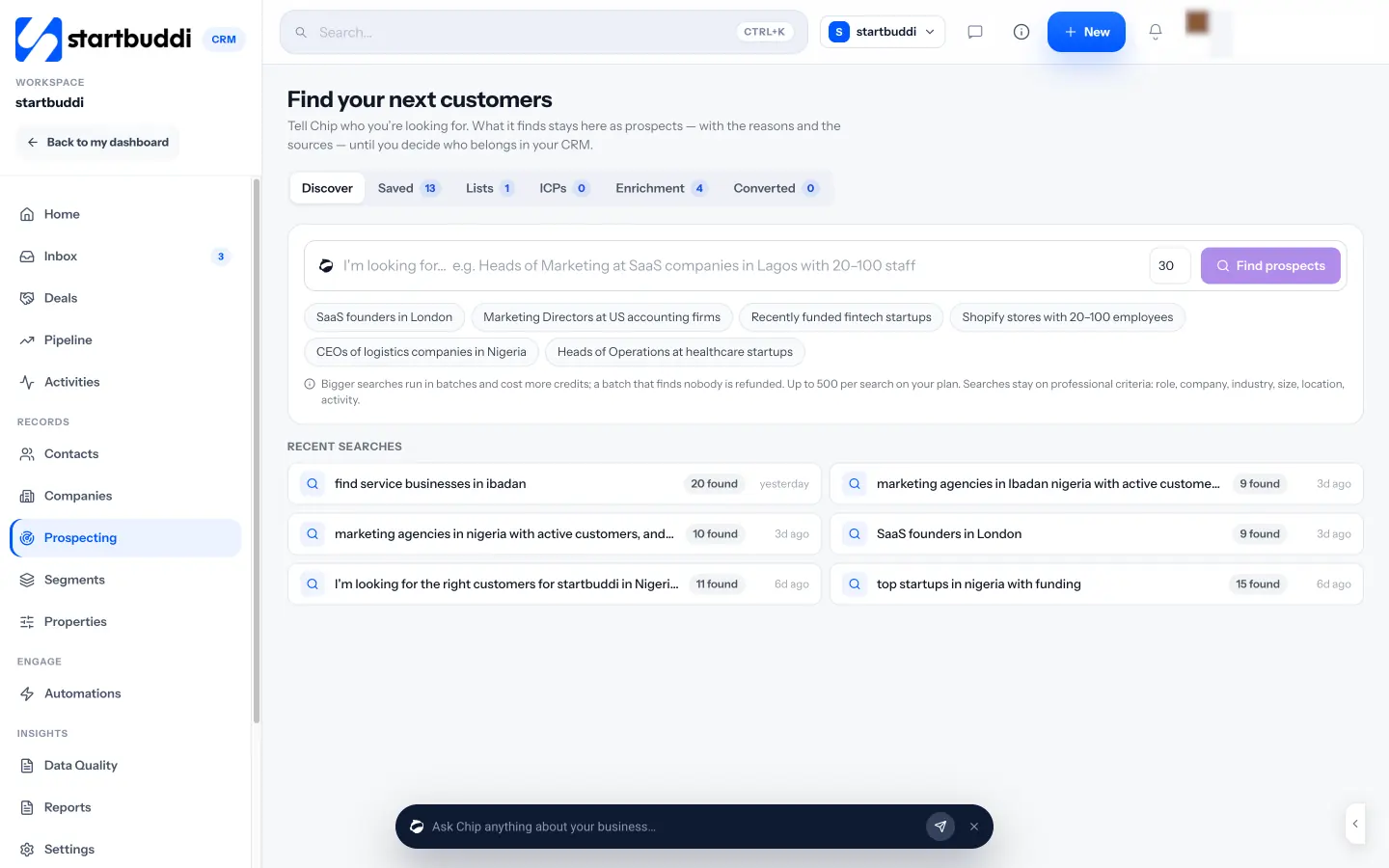
Type who you want, for example "Heads of Marketing at SaaS companies in Lagos with 20 to 100 staff", and choose how many prospects to find. Chip searches business listings and the web and picks out the people and companies the sources support, usually within a minute or two. Each prospect shows why Chip picked them, the signals and the sources, and a match strength. Searches stay on professional criteria such as role, company, industry, size and location, and personal emails and personal phone numbers are never looked up. Work emails and business phone numbers are not revealed until you ask, which uses credits and records the source on the prospect.
Save your ideal customer profiles
Save an ICP with roles, industries, countries, cities, company size and other criteria, and run it again whenever you need more prospects. Chip can also suggest an ICP based on the customers you have already converted. Group prospects into lists by market, role or campaign, and ask Chip for more like the ones that worked.
Convert only the ones you choose
Nothing enters your contact list until you decide. When you convert a prospect, startbuddi checks for duplicates, links or creates the contact and company, and records "Chip Prospecting" as the lead source. You can then ask Chip to draft an introduction, which you edit and send yourself. Prospecting uses Chip credits, and a search that finds nobody usable is not charged. The maximum prospects per search depends on your plan: 50 on Free, 250 on Starter and 500 on Growth and Scale. More on the Prospecting page.
Whether leads come in or you go out and find them, the money is made in what happens next. Chapter 4 covers qualifying leads, following up and the lead generation tools for small businesses that keep it all moving.
Qualify, follow up and close (and the tools that help)
- Give every lead a status
- Score leads to prioritise
- A follow-up message for a quiet lead
- Send a proposal that is easy to say yes to
- Handle the common objections
- A weekly pipeline review in 20 minutes
- A pipeline that keeps itself up to date
- Every conversation in one inbox
- From proposal to payment
- Scores, statuses and automatic follow-ups
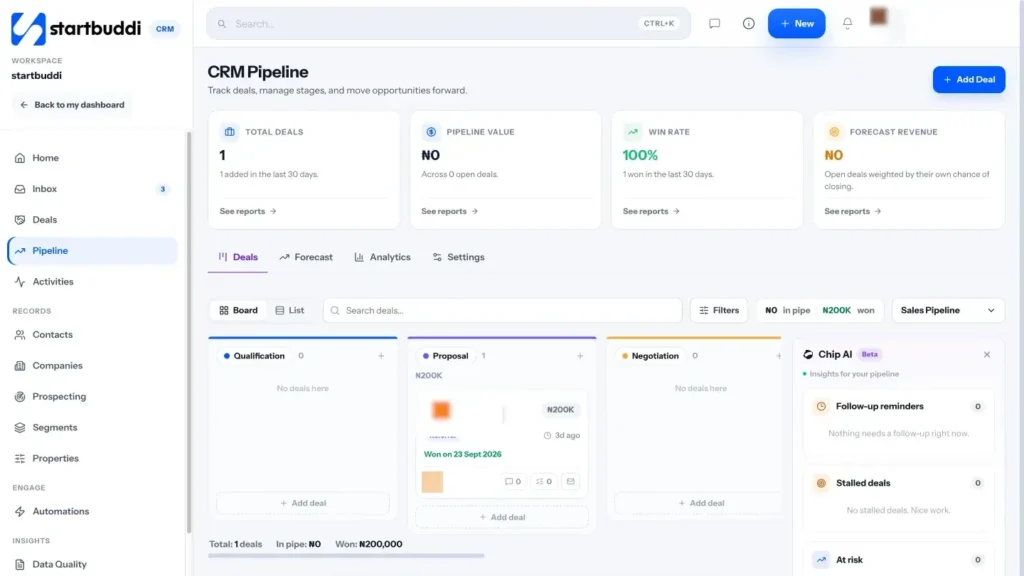
Generating leads is only half the job. The money is made in what happens next: working out which leads are worth your time, following up until they decide, and keeping track so nobody falls through the cracks. Many small businesses generate enough leads already and simply lose most of them after the first conversation. This chapter covers qualifying leads, a follow-up schedule, a simple pipeline, the numbers to track, and the lead generation tools for small businesses that make it manageable. Then it shows how to run it all in startbuddi.
Qualify leads before you invest time
Not every lead deserves a proposal. Qualifying means finding out, politely and early, whether someone is a real fit. A simple version of a well-known sales framework asks four things:
| Question | What you want to know | How to ask it |
|---|---|---|
| Need | Do they have a problem you solve? | "What made you look for help with this now?" |
| Timing | When do they want it done? | "When would you ideally like this finished?" |
| Budget | Can they afford your service? | "Projects like this usually cost between X and Y. Does that fit what you had in mind?" |
| Decision | Who decides, and how? | "Who else will be involved in choosing?" |
Mentioning a price range early feels uncomfortable, but it saves both sides time. People who cannot afford you are grateful to know quickly, and people who can will relax because there is no surprise coming.
Give every lead a status
A status tells you, at a glance, what to do next. Keep it simple:
- New: not yet contacted.
- Contacted: you have replied and are waiting.
- Qualified: a real fit with a need, timing and budget.
- Not a fit: politely closed, with the reason noted.
- Nurture: a good fit, but not ready yet. Stay in touch.
Score leads to prioritise
If you have more leads than time, a simple score helps you decide who to call first. Give points for things that predict a sale in your business: fits your ideal customer, has a clear timeline, has engaged recently (replied, opened, booked), has a budget in range, came through a referral. You do not need anything sophisticated; a few points for each signal and a quick sort is enough to focus your day.
Follow up until they decide
Many leads are lost not because they chose a competitor, but because nobody followed up. People are busy, messages get buried and decisions wait for the right moment. A steady, polite follow-up schedule wins deals that silence would lose.
| When | What | Channel |
|---|---|---|
| Within an hour | Personal reply and a clear next step (a call or a question) | Their channel of choice |
| Day 1 after a call | Summary of what you discussed, the proposal or quote, and the next step | |
| Day 3 | Check they received it; offer to answer questions | Email or message |
| Day 7 | Something useful: an example, a case, an answer to a likely worry | |
| Day 14 | A direct question: "Is this still a priority, or should I check back later?" | Phone or message |
| Day 30 onwards | Move to nurture: a monthly newsletter or occasional useful note |
The Day 14 message works well because it gives people an easy way to say "not now" or "yes, let's go". Either answer is progress. Our post on building a client follow-up system has more templates.
A follow-up message for a quiet lead
Hi Sam, I know things get busy, so I wanted to check in on the proposal for the office move IT set-up. Is this still something you are planning for next month, or would it be better if I checked back in the new year? Either is completely fine.
Turn qualified leads into customers
Send a proposal that is easy to say yes to
Once a lead is qualified, the proposal or quote is often the last step before a decision. Keep it short and specific:
- Their situation in their words: show you listened.
- What you will do: clear scope, what is included and what is not.
- The result: what changes for them when it is done.
- Price and payment terms: one clear price, or two or three options, and when payment is due.
- Timeline: key dates.
- Next step: exactly how to say yes (sign, reply or pay a deposit), with a date the price is valid until.
Send it within a day of the call, while the conversation is fresh, and book the follow-up call before you hang up. Our post on writing a business proposal that wins the job has a full template.
Handle the common objections
Most hesitation falls into a few patterns. Prepare a calm, honest answer for each:
- "It is too expensive." Ask what they are comparing it with. Explain what is included, offer a smaller scope or a phased start, but avoid simply cutting your price.
- "We need to think about it." Ask what they are unsure about. There is usually one specific worry you can answer.
- "Now is not a good time." Agree a date to check back, and add them to nurture.
- "We are talking to others." Welcome it. Ask what matters most in their decision, and make sure your proposal answers that clearly.
- "I need to ask my partner or boss." Offer to join a short call with them, or send a one-page summary they can forward.
Listening properly to an objection often reveals the real question, and answering that question honestly closes more deals than any clever technique.
Use a simple pipeline
A sales pipeline is a visual list of your open opportunities, grouped by stage. It shows how much business is in progress, where deals get stuck and what to do today. A small business pipeline needs only a few stages:
- New lead
- Qualified
- Proposal sent
- Negotiation
- Won or Lost
Review it once a week. Anything that has not moved in two weeks needs a follow-up or a decision. Record why deals are lost; after a few months the reasons tell you whether to change your price, your offer or who you target. If pipelines are new to you, read what a sales pipeline is, and for leads who are not ready yet, see lead nurturing.
A weekly pipeline review in 20 minutes
Once a week, go through every open deal, oldest first. For each one, ask three questions: what is the next step, who owns it, and by when? If a deal has no next step, send a follow-up or move it to nurture. If it has been stuck in the same stage for more than two weeks, call the person. If it is clearly dead, mark it lost with a reason. Twenty minutes a week keeps the pipeline honest, and an honest pipeline gives you a far better idea of next month's income than hope does.
Track the numbers that matter
- Leads by source: where each lead came from.
- Lead to customer rate: by source, so you know which sources bring buyers, not just enquiries.
- Response time: how long it takes you to reply to a new lead.
- Cost per lead and per customer: for any paid activity, and your time for the rest.
- Time to close: how long from first contact to payment.
- Pipeline value: the total value of open, qualified opportunities.
Look at them monthly. If leads are low, work on chapters 2 and 3. If leads are fine but few become customers, work on qualification and follow-up. If deals close but take months, look at your offer and the Day 14 message.
Lead generation tools for small businesses
You do not need a large sales stack. These are the categories that matter, roughly in the order a small business needs them:
| Job | Tool category | Why it matters |
|---|---|---|
| Keep every lead in one place | CRM or contact list | The foundation; everything else feeds it |
| Capture inbound leads | Forms, landing pages, booking pages | Turns visitors into named leads |
| Reply and follow up | Shared inbox, email and messaging | Speed and consistency win deals |
| Automate the routine | Automations or sequences | Instant replies and reminders without you |
| Track deals | Pipeline | See what is in progress and what is stuck |
| Find new prospects | Prospecting and research tools | Speeds up outbound research |
| Measure | Reports and analytics | Shows which sources bring customers |
These also double as the core sales tools for small businesses: the same contact list, inbox and pipeline carry a lead from first enquiry to paid invoice. You can buy each separately or use one system that covers several. What matters most is that leads flow automatically from capture to your contact list and pipeline without copying and pasting. Our guide on choosing CRM tools for small business explains what to look for.
Mistakes to avoid after the lead arrives
- Sending a proposal without qualifying. You spend hours writing for someone with no budget.
- Following up once, then giving up. Plan several touches over a few weeks.
- Letting "not now" leads disappear. Put them in nurture and check back when they said.
- Keeping the pipeline in your head. It works until you are busy, which is exactly when it matters.
- Discounting to close. A quick discount can win one deal and set the price expectation for every referral that follows. Offer a smaller scope or a payment plan first.
- Never asking why you lost. A short, polite question after a "no" teaches you more than any report.
How to qualify, follow up and close in startbuddi
In startbuddi, leads, conversations, deals and invoices sit on the same contact record, so following up and closing happen in one place.
A pipeline that keeps itself up to date
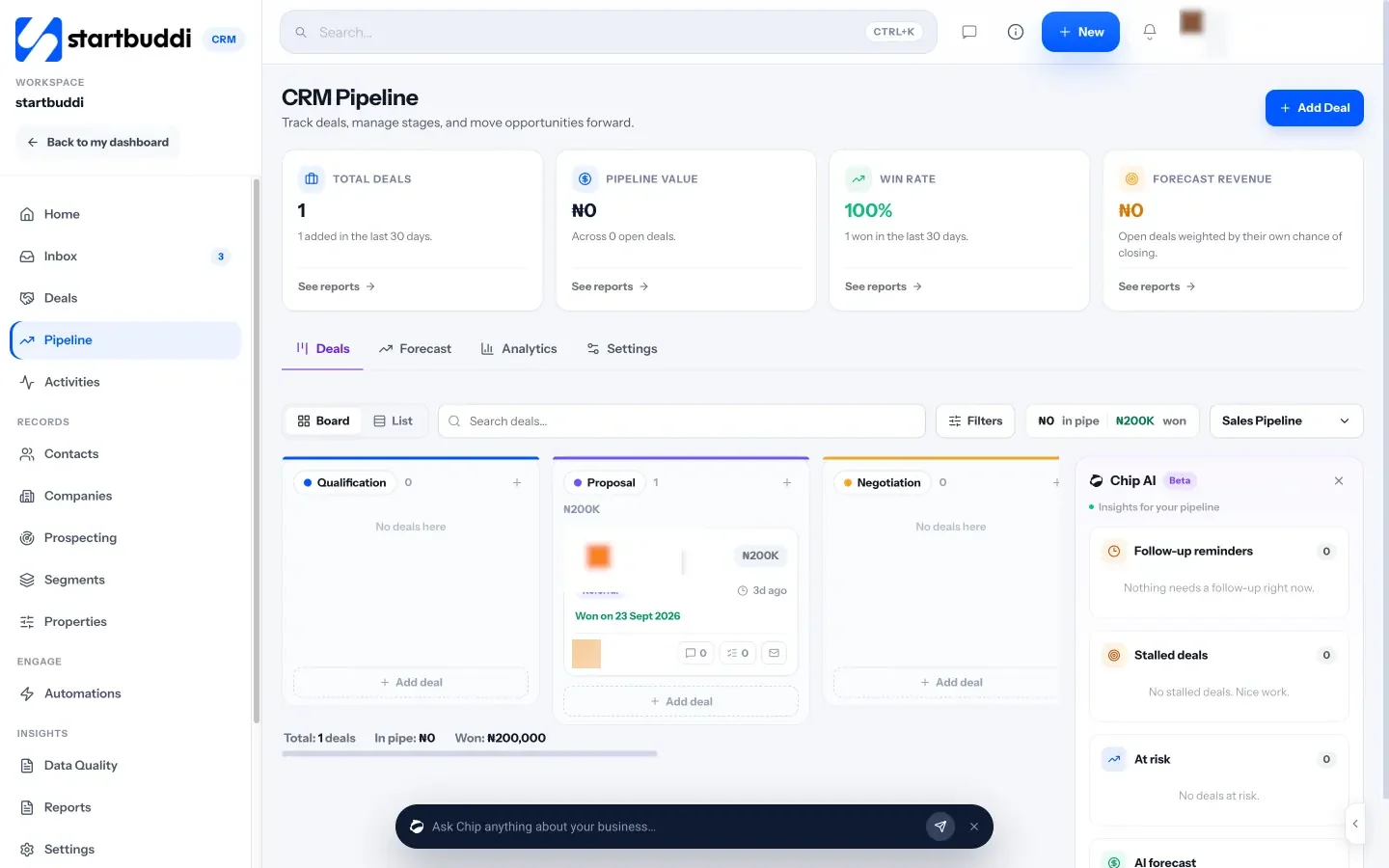
The Pipeline in Customers shows deals as cards you drag between stages. The default stages are New Leads, Qualified, Proposal Sent, Negotiation, Won and Lost, and you can rename them or build more pipelines. When a contact replies, their deal moves out of the first stage; when an invoice on a deal is paid, the deal is marked won, and every move is written to the deal's history. Chip flags stalled and at-risk deals and suggests moving deals forward. You can require a reason when marking a deal lost, so your loss reasons build up over time. More on the sales pipeline page.
Every conversation in one inbox
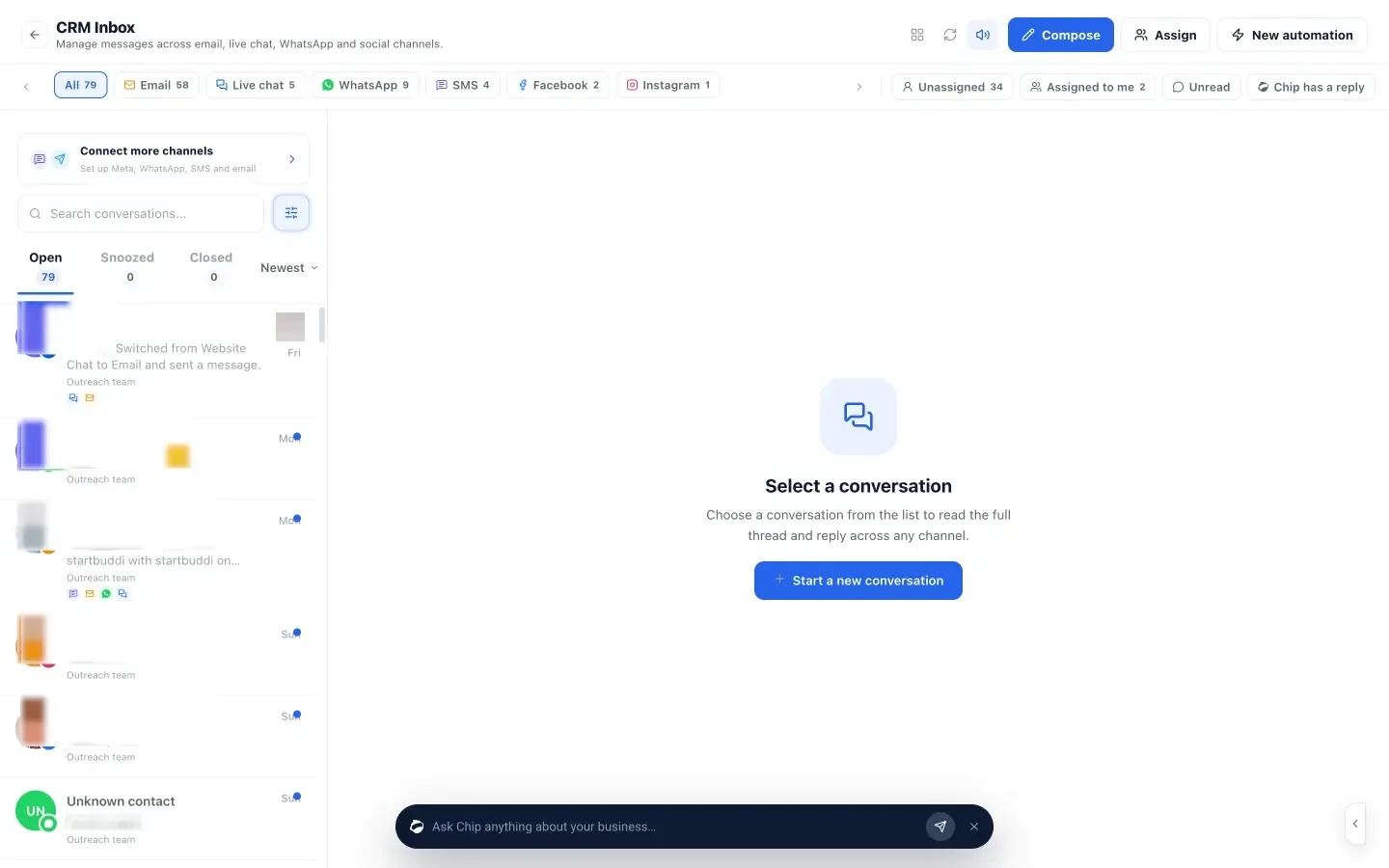
The Customers inbox brings email, SMS, WhatsApp and website chat conversations into one place, next to the contact's details and deals, so you can reply fast without switching apps. From a conversation, Chip can suggest creating a deal when a contact looks ready. SMS and WhatsApp need the Starter plan or above.
From proposal to payment
When a lead is ready, Money Manager's Get Paid area has Estimates, Proposals and Contracts. You can create a proposal from a template, add pricing, send it for approval and continue into a contract and an invoice for the same client, with e-signatures for contracts. Because the invoice is linked to the deal, paying it marks the deal as won, and the revenue shows up against the customer.
Scores, statuses and automatic follow-ups
Each contact has a lead status (New, Qualified or Disqualified) and a lead score from 0 to 100 worked out from their activity, spend, how recently you were in touch and whether they have a deal. It is a fixed formula rather than a prediction, which makes it easy to understand. Filter contacts by score to decide who to call first. For follow-ups, the Lead capture welcome flow template replies to every new form submission straight away, and Nurture with Chip drafts a short email sequence for a specific contact that you edit before anyone receives it. Free includes 2 active automations and Starter 10, with a 30-day trial on every paid plan (see pricing). See pricing for the full plan comparison.
Your next step: write down how many leads you need this month (chapter 1), then set up one inbound capture and one outbound habit this week. If you want your forms, inbox, pipeline and prospecting in one place, see how Customers works.
Tiwalade Joanna Okedara-Kalu is the founder, CEO and CTO of startbuddi, the business system that brings clients, bookings, invoices, projects, marketing and the Chip AI assistant into one place. Tiwalade builds software around how service businesses really work day to day, and writes about client management, getting paid on time and why small businesses outgrow the tools they start with.
Founded startbuddi and leads its product and engineering